Love in this place.

It’s okay to be heartbroken for more than one group of people at the same time. When it comes to showing compassion, we don’t have to pick sides. Sometimes, often really, maybe even always, there is hurt and anguish everywhere, and we can mourn the lot of it. 

Beware people who tell you not to be concerned for this group or that group and the hurt they feel. 

Beware those who try to dehumanize others. 

Beware those who lump you in as the ‘enemy’ for working to assure people are treated humanely.

Beware people who draw lines between us and them. 

Beware those who try to limit you to a label or single identity. 

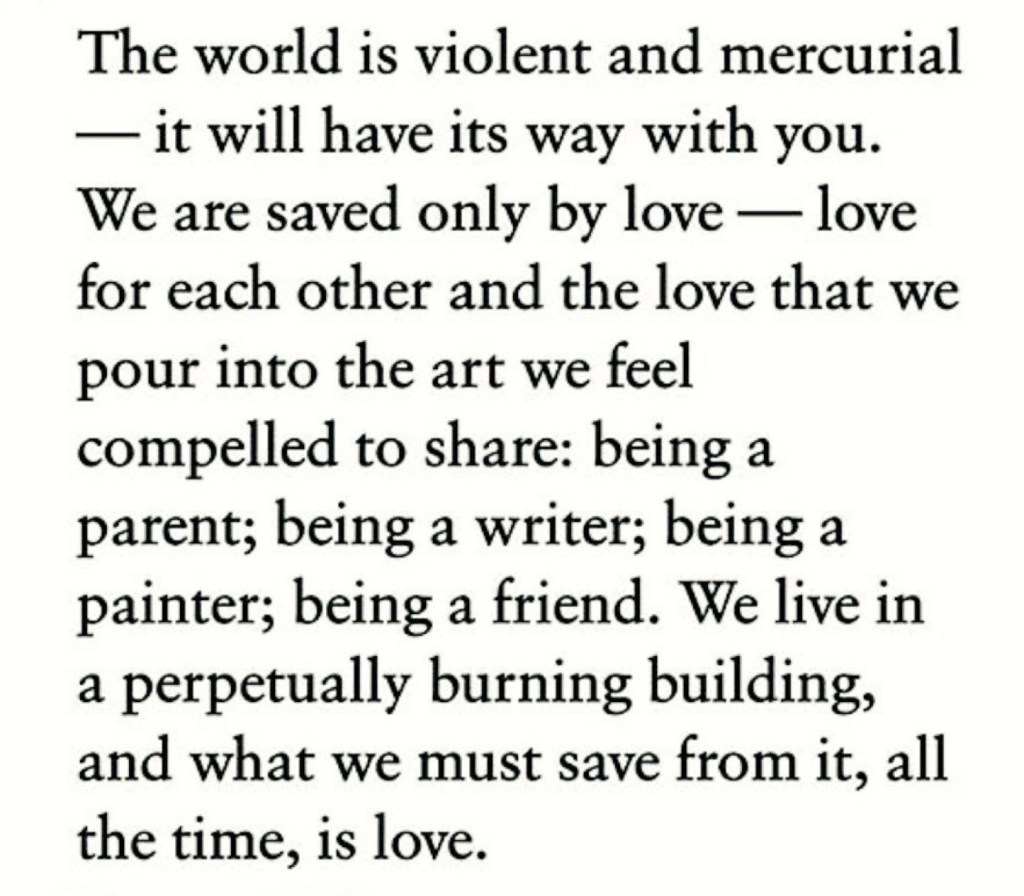
Our hearts are big enough to embrace it all. What we must save is love.

A work-out routine for character.

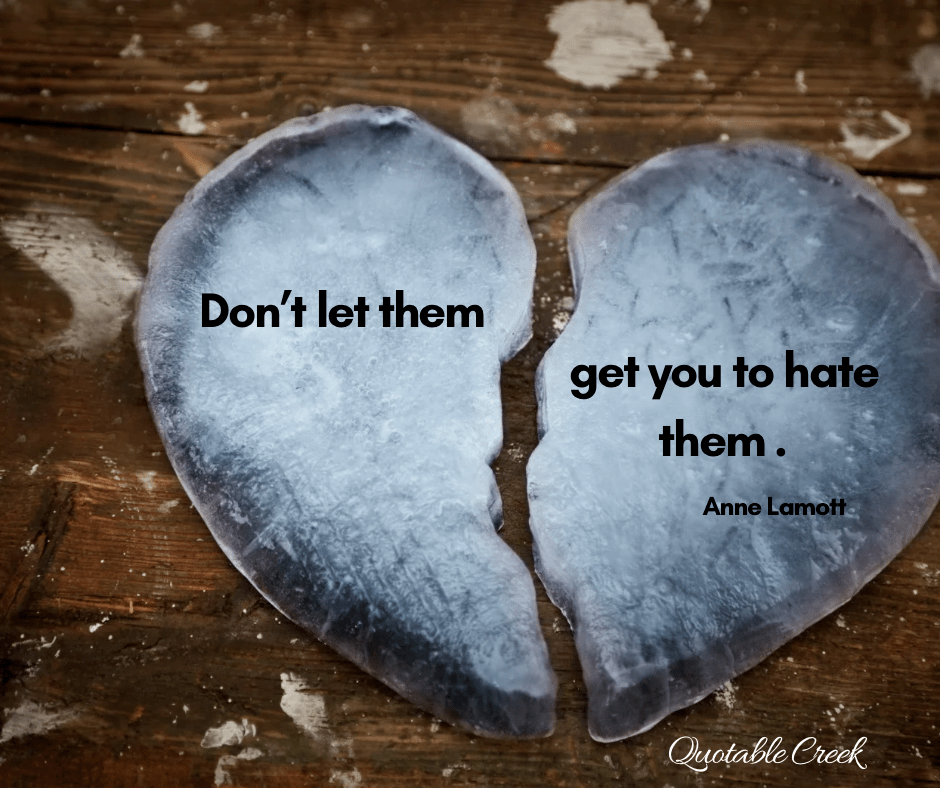
In her book Almost Everything, Anne Lamott describes her struggle with hate:

Hate weighed me down and muddled my thinking.  It isolated me and caused my shoulders to hunch, the opposite of sticking together and lifting our hands and eyes to the sky.  The hunch changes our posture, because our shoulders slump, and it changes our vision, as we scowl and paw the ground.  So as a radical act we give up the hate and the hunch the best we can.  We square our shoulders and lift our gaze….

Hating the way I was feeling helped me give up Camel cigarettes thirty-two years ago, and then alcohol.  It is good to surrender things that poison us and our world.  Am I free of such toxicity now?  Well about forty percent, and that is a pretty good deal.  I’ll take it.”

She now considers the circumstances and people pushing her to hate as helpful weight-training equipment to build muscles in her soul, ‘Nautilus equipment for your character.’

That’s a helpful perspective shift, isn’t it?

Hang on to you hat. Hang on to your hope.

Enjoy these profound words from E.B. White:

30 March 1973


Dear Mr. Nadeau:

As long as there is one upright man, as long as there is one compassionate woman, the contagion may spread and the scene is not desolate. Hope is the thing that is left to us, in a bad time. I shall get up Sunday morning and wind the clock, as a contribution to order and steadfastness.

Sailors have an expression about the weather: they say, the weather is a great bluffer. I guess the same is true of our human society–things can look dark, then a break shows in the clouds, and all is changed, sometimes rather suddenly.

It is quite obvious that the human race has made a queer mess of life on this planet. But as a people we probably harbor seeds of goodness that have lain for a long time waiting to sprout when the conditions are right. Man’s curiosity, his relentlessness, his inventiveness, his ingenuity have led him into deep trouble. We can only hope that these same traits will enable him to claw his way out.

Hang on to your hat. Hang on to your hope. And wind the clock, for tomorrow is another day.

Sincerely,
E. B. White

Finding your power.

In a captivating interview, Jane Goodall offers some final thoughts, filmed to be aired only after her death, with the last bit spoken directly to the camera with no one overhearing. Apparently, this is part of a series on Netflix called Famous Last Words.

It’s a sobering thought, thinking about what is the final thing you want to say to the world, to loved ones, to friends. Because they’re your last chance, these types of words hold special import.

As is unsurprising, Goodall’s final words focused, not on herself, but on others, inspiring everyone to make a difference and not give up in what she called these ‘dark’ times’.

Here are Jane’s final words:

In the place where I am now, I look back over my life. I look back at the world I’ve left behind. What message do I want to leave? I want to make sure that you all understand that each and every one of you has a role to play. You may not know it, you may not find it, but your life matters, and you are here for a reason.

And I just hope that reason will become apparent as you live through your life. I want you to know that, whether or not you find that role that you’re supposed to play, your life does matter, and that every single day you live, you make a difference in the world. And you get to choose the difference that you make.

I want you to understand that we are part of the natural world. And even today, when the planet is dark, there still is hope. Don’t lose hope. If you lose hope, you become apathetic and do nothing. And if you want to save what is still beautiful in this world – if you want to save the planet for the future generations, your grandchildren, their grandchildren – then think about the actions you take each day.

Because, multiplied a million, a billion times, even small actions will make for great change. I want to – I just hope that you understand that this life on Planet Earth isn’t the end. I believe, and now I know, that there is life beyond death. That consciousness survives.

I can’t tell you, from where I am, secrets that are not mine to share. I can’t tell you what you will find when you leave Planet Earth. But I want you to know that your life on Planet Earth will make some difference in the kind of life you find after you die.

Above all, I want you to think about the fact that we are part – when we’re on Planet Earth – we are part of Mother Nature. We depend on Mother Nature for clean air, for water, for food, for clothing, for everything. And as we destroy one ecosystem after another, as we create worse climate change, worse loss of diversity, we have to do everything in our power to make the world a better place for the children alive today, and for those that will follow.

You have it in your power to make a difference. Don’t give up. There is a future for you. Do your best while you’re still on this beautiful Planet Earth that I look down upon from where I am now.

God bless you all.

As they did while she was alive, her words inspire us to do as much as we can with what we have, to look out for others, and to cherish and care for creation. let her words be a blessing and beacon to all of us now.

An apology to heal the hurt.

“I’m sorry, but…” Some apologies make things better, and some just don’t. In fact, they might make things worse by blaming the person you hurt or showing that there is just no true awareness of what went wrong. 

Generally, the apologies that have an excuse fall in the latter category. A good apology makes you feel seen and heard, that someone has looked at things from your point of view and understood the negative impact they have made. A good apology requires us to stand in the shoes of the person we’ve wronged and feel what they are feeling. Not what we would feel if we were in their shoes, but what they’re feeling. 

Then, when we feel the harm we’ve caused, it should change us, make us not want to cause that harm again to that person or others, and make us want to make amends. It shouldn’t leave us where we were. If it does, if we repeat the same hurtful words or behavior, perhaps we haven’t yet done the work that goes into reconciliation. 

Back into the other person’s shoes we go until we understand and grow. This is how progress is made, how relationships heal and grow stronger, how trust is restored. And, because we humans are very fallible creatures, it’s not a one and done thing, but a continuing process. Evaluating the effect we are having on people, making sure we are treading softly, taking responsibility and making amends when we don’t. Perhaps two steps forward, one step back, but staying in relationship, rebuilding trust, and moving forward together.

Are you keeping up with the Joneses?

Do you find yourself comparing your life with that of your friends or co-workers? Science says that Facebook and other social media can actually make people feel sad rather than connected because it seems like your friends are having a better time than you are. Often that comparison is misleading.

But always that comparison is beside the point. There will always be someone smarter, richer, more accomplished, happier, etc. than you; just like you will be all those things for someone else.

The challenge is to be happy with what you are and have. At times like these, it is comforting to read Saint Teresa of Calcutta’s words:

People are often unreasonable, irrational, and self-centered.  Forgive them anyway.

            If you are kind, people may accuse you of selfish, ulterior motives.  Be kind anyway.

            If you are successful, you will win some unfaithful friends and some genuine enemies. Succeed anyway.

           If you are honest and sincere people may deceive you.  Be honest and sincere anyway.

            What you spend years creating, others could destroy overnight.  Create anyway.

            If you find serenity and happiness, some may be jealous.  Be happy anyway.

  The good you do today, will often be forgotten.  Do good anyway.

 Give the best you have, and it will never be enough.  Give your best anyway.

         In the final analysis, it is between you and God.  It was never between you and them anyway.

Don’t worry about the Joneses. Instead, keep your heart grateful and your actions focussed on making a positive difference in this world.

Peace sprouts.

What can we do to help? The problems seem great, and we seem so small.

Consider these words from Pope Leo XIV:

“Do not be afraid. Be sprouts of peace where the seed of hatred and resentment is growing; be weavers of unity where polarization and enmity prevail; be the voice of those who have no voice to ask for justice and dignity; be light and salt where the flame of faith and the taste for life are fading.” — Pope Leo XIV

Every giant tree starts as a tiny sprout. Be sprouts of peace.

We have more control and are stronger than we think. What we do makes a difference. Let’s make it a good difference!

The breath of a relationship’s life

There is a Museum of Medieval Torture in Hollywood. Imagine that. All the creative and horrendous ways people came up with to hurt other people. And even in this ‘modern’ era, some people spend time thinking of creative ways to hurt others, including in our penal system where solitary confinement is perhaps one of the harshest. Or in our churches, where shunning, cutting someone off from the community with no further interaction, is still practiced in many faiths.

This cruelty can extend into our most intimate relationships and friendships when one person practices the silent treatment, shutting down communication completely over some perceived transgression. Or even when they ‘ghost’ someone, disappearing completely from another’s life and leaving no trace, with no warning or explanation. And these acts like the bed of nails or drawing and quartering or yore are torture, too, because they are intended to inflict pain and misery.

In What You’re Saying When You Give Someone the Silent Treatment, Daryl Austin notes:

The silent treatment goes by many names: shunning, social isolation, stonewalling, ghosting. Although psychologists have nuanced definitions for each term, they are all essentially forms of ostracism. And the tactic is nothing new. Ancient Greeks expelled for 10 years citizens who were thought to be a threat to democracy, and early American settlers banished people accused of practicing witchcraft. Religions have frozen out individuals for centuries: Catholics call it excommunication, herem is the highest form of punishment in Judaism, and the Amish practice Meidung. The Church of Scientology recommends total “disconnection” from anyone deemed antagonistic toward the religion.

“My research suggests that two in three individuals have used the silent treatment against someone else; even more have had it done to them,” Williams said. Experts told me that although they need more data to know for certain, instances of the silent treatment have likely increased over the years as new forms of communication have been invented. “Every new method of connection can be used as a form of disconnection,” Williams said.

Ostracism can also manifest in lesser ways: someone walking out of the room in the middle of a conversation, a friend at school looking the other way when you wave at them, or a person addressing comments from everyone in a message thread except you. “Partial ostracism,” Williams told me, might mean monosyllabic replies—a terse period at the end of a one-word text message. But in serious cases, ostracism can take a heavy toll whereby victims become anxious, withdrawn, depressed, or even suicidal.

“Because we humans require social contact for our mental health, the ramifications of isolation can be severe,” Joel Cooper, a psychology professor at Princeton, told me. “In the short term, the silent treatment causes stress. In the long term, the stress can be considered abuse.”

And silent treatment hurts, not just the victim, but the perpetrator as well.

But the silent treatment ultimately harms the person causing it, too. Humans are predisposed to reciprocate social cues, so ignoring someone goes against our nature, Williams said. The perpetrator is therefore forced to justify the behavior in order to keep doing it; they keep in mind all the reasons they’re choosing to ignore someone. “You end up living in a constant state of anger and negativity,” Williams said.

One study found that social rejection provoked a response in its victims similar to that of victims of physical abuse; the anterior cingulate cortex area of the brain—the area thought to interpret emotion and pain—was active in both instances. “Exclusion and rejection literally hurt,” John Bargh, a psychology professor at Yale, told me.

So, in this modern era, what should we do when tempted to give someone the silent treatment? What can we do when we’re on the receiving end?

Perhaps the beginning of an answer is realizing just how damaging that type of behavior can be to ourselves, each other, and the relationship. Realizing that communication, no matter how fraught, is the way back into community. Appreciating that we were put here on this earth to do good, not harm.

And then going from there.

Out loud.

Entering into wild wonder.

Author Amy Tan shares this remarkable insight: 

“In one of John Muir Laws’s books, I read something profound that changed the way my brain thinks. “As you draw the bird,” he writes, “try to feel the life within it.” So now I look at the bird before me and imagine how it senses the world, how it feels breathing cold air, how it feels to have its feathers ruffling in the wind, how it feels to always have an eye out for possible food and possible predators. The bird sees me and is a nanosecond from flying off, but it stays. Why? By imagining the life within, the bird I am drawing is alive, no longer a shape and its parts, but a thinking, sentient being, always on the brink of doing something. By feeling the life within, I am always conscious that all creatures have personalities, and so do trees and clouds and streams. To feel the life within, I now imagine myself as the bird that is looking at me. I imagine its wariness, the many ways it has almost died in its short life. I worry over its comfort and safety, and whether I will see my little companion the next day, the next year. To feel the life within is to also feel grief in the goneness of a single creature or an entire species. Imagination is where compassion grows. Let us join with children to imagine and wonder, to use curiosity as the guide to miracles in plain sight. Let us enter with them into wild wonder so that we become guardians together of all that is living and all that must be saved.”From Orion Magazine, “The Life Within”.

I wonder if we can look at each other that way, as something vaster, as thinking sentient beings with worlds of experience, some harsh. Would that help us to treat each other better? In her book, Dead Man Walking, Sister Helen Prejean describes just this sort of thing as she works with a death row inmate, a man who admittedly committed a heinous act, seeing not just the man but also, though covered with tattoos and bathed in bravado, the little wounded child within. That empathy allowed her to see past the crimes to the human and to feel compassion for him.

Perhaps today we can look with new eyes to see each other as a composite of good and bad, but each fully human and fully deserving of respect and compassion. To paraphrase Amy Tan above, when we consider the person, can we try to picture the life within, the challenges and struggles, hopes and triumphs? Can we become, together, ‘guardians of all that is living and must be saved’ in a place where ‘compassion grows’?

Gramnesia and momeries.

I discovered a new word the other day that has me soul-searching. Gramnesia, a portmanteau combining ‘grandparent’ and ‘amnesia’. A grandparent experiencing gramnesia trots out recollections of the good, easy times they had raising their children, and brings those up in a way which can be a tacit criticism of the way those children are now raising their grandkids. In other words, someone experiencing gramnesia has forgotten the complete picture of parenthood.

While it’s natural to look fondly back on the years when your children were little, it may be problematic if you make those now grown children feel it is unnatural to struggle.

As Allie McQuaid says:

In a follow-up Instagram Reel, McQuaid explained that the main reason these comments are unhelpful is that they don’t change the things parents of young kids are struggling with and they minimize the very real stress they’re facing. 

“Our boomer parents telling us that we didn’t cry ever (whether that’s true or not is up for debate apparently..) doesn’t change the fact that OUR baby now is crying and needs our care,” McQuaid wrote.

Instead of judging or comparing, perhaps it would be more helpful for grandparents to be curious. What might they learn and discover from how their children are showing up now as parents?

Parenting techniques change. Smacking someone with a paddle may have been acceptable once, but now it’s illegal, for instance. Priorities change. Keeping up with the Joneses or maintaining appearances may not be as important to your kids as quality time with their kids. Perhaps the gramnesiac will have something to learn. and perhaps, too, they’ll discover a way to help, something they may have greatly appreciated when they were going through the challenges of raising children.

And also, as hard as it is to be vulnerable and discuss the hard times, those stories, call them ‘momeries’, (portmanteau of mom and memories) may make your child feel hopeful and encouraged as they shoulder parenting duties, that times will be both tough and rewarding beyond their wildest expectation.

And that’s normal.