When we are being welcoming, the focus is outward not inward. We look to what would make the other person comfortable, not what would make us comfortable. We don’t invite vegetarians, and then serve meat. Or teetotalers and serve alcohol. We get out of our own perspective and walk in the guest’s shoes to consider what would make them comfortable.
Aesop illustrated this premise with the Tale of the Fox and the Stork:
A fox invites a stork to eat with him and provides soup in a bowl, which the fox can lap up easily; however, the stork cannot drink it with its beak. The stork then invites the fox to a meal, which is served in a narrow-necked vessel. It is easy for the stork to access but impossible for the fox. The moral drawn is that the trickster must expect trickery in return and that the golden rule of conduct is for one to do to others what one would wish for oneself.
The same is true, presumably, when welcoming people to the Lord’s table. What would make others comfortable? How can you reach more people? What about the way you do things might be off putting? How can you step out of your own perspective to consider what would make others in the community feel welcomed and comfortable? Our job isn’t to be a bar to spreading the word but a conduit.
Desmond Tutu talks about the importance of a broad welcome:
We are made for goodness. We are made for love. We are made for friendliness. We are made for togetherness. We are made for all of the beautiful things that you and I know. We are made to tell the world that there are no outsiders. All are welcome: black, white, red, yellow, rich, poor, educated, not educated, male, female, gay, straight, all, all, all. We all belong to this family, this human family, God’s family.
In this world of constant scrutiny and omnipresent recordings, mistakes seem to have moved from a necessary part of learning to an instant cause for condemnation.
We can all think back to learning to walk and talk or play a sport where the mistakes were a part of learning. Fear of falling down would keep everyone from walking. In order to learn how to make a basket, lots of shots will bounce off the rim and backboard.
When we moved on to raising children, focusing on the mistakes could cripple a child emotionally. Instead, we celebrated the steps forward, the successes. Noted the progress. We don’t expect a toddler to write a dissertation. We celebrate the milestones as they come.
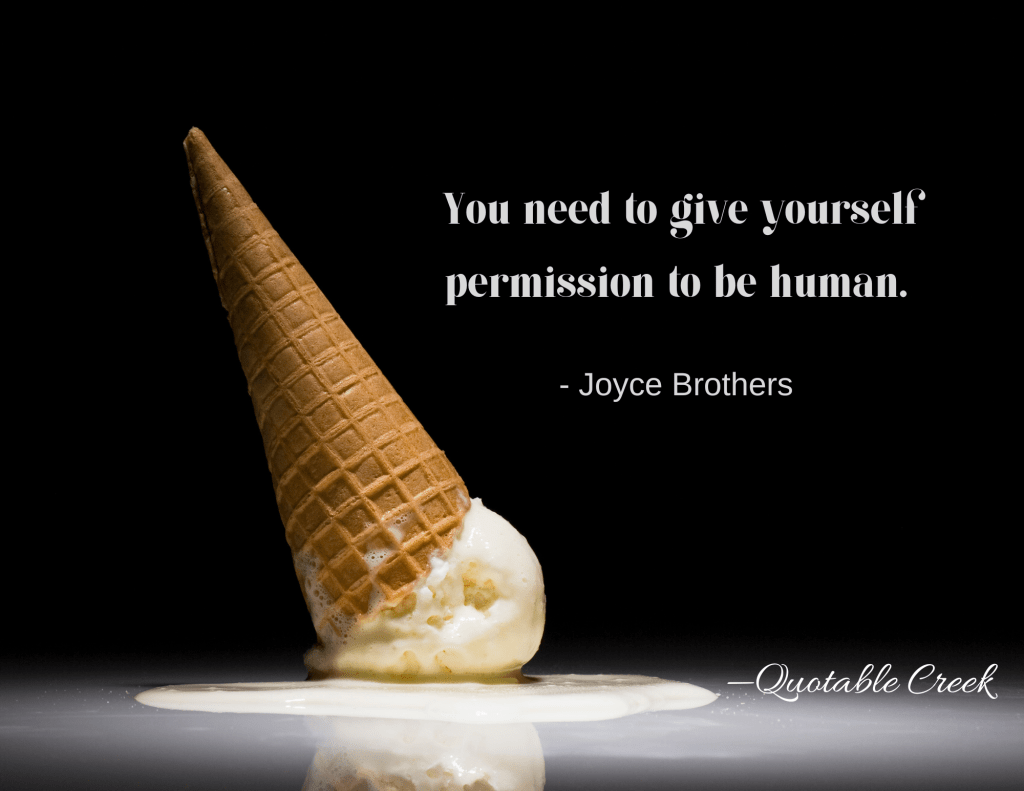
I wonder if that approach would help move our troubled world forward. Celebrating the progress. Looking for the successes. Embracing the common ground. Letting everyone feel that they can continue to learn from their mistakes, that that is part of being human. A world with a little bit of breathing room. We all will mess up. We can show each other grace when we do.
Not long ago, the world shut down, and most people were asked to sequester and stay home while essential workers reported, still, for duty. It was a strange time, involving so many swiftly moving facts to assimilate and assess forward progress.
But that question of ‘essential’ is an interesting one. Some of the jobs labeled ‘essential’ or not were surprising choices.
How does one determine what is ‘essential’? What of the artist? With so many schools cutting art and music programs as non-essential, I wonder what the world would look like filled just with grammarians and mathematicians. Surely, art, though it puts no food on the table and sets no broken bones, is essential to the human spirit.
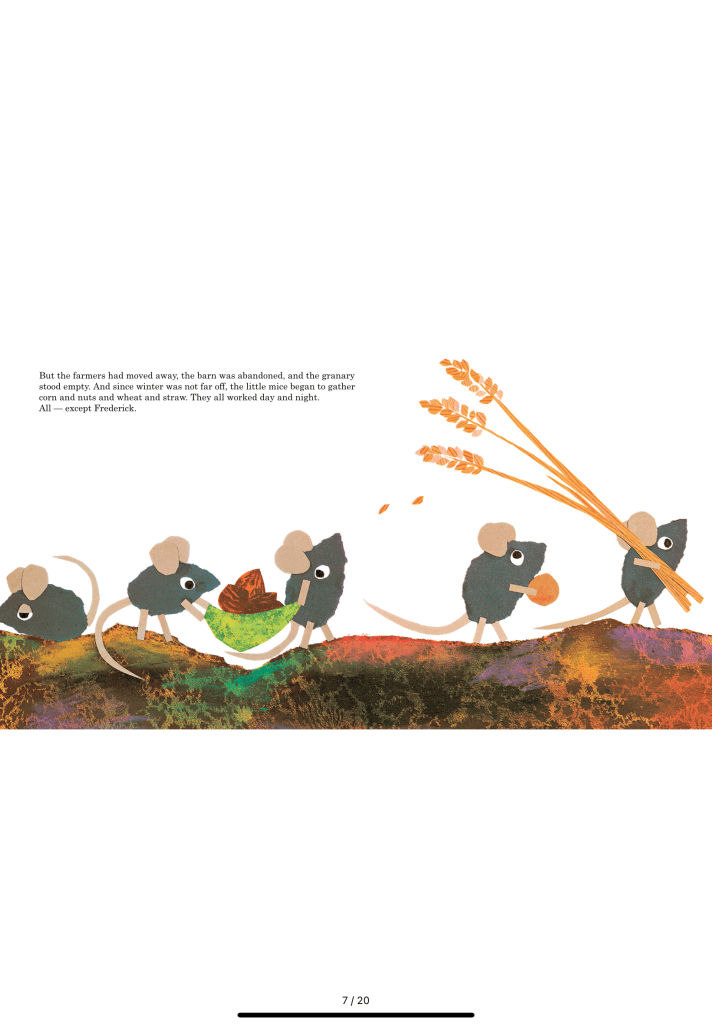
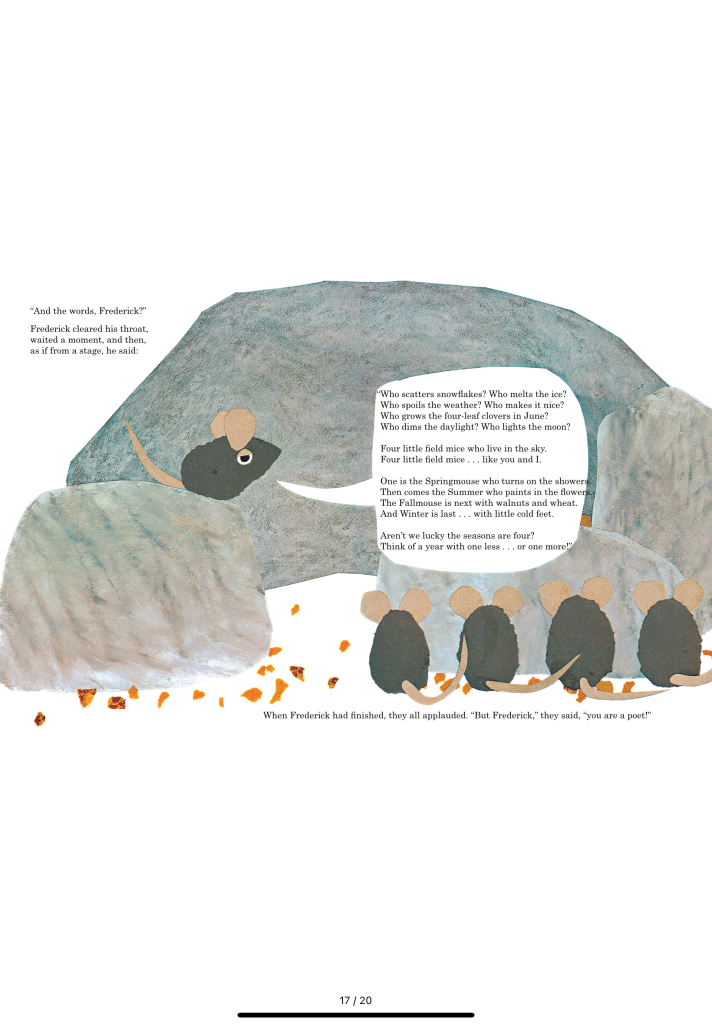
Such is the theme of Frederick by Leo Lionni. While four mice toil to set up stores of grain for winter, one mouse collects color, and sounds, and words.
And when winter came, and the mice were cold and hungry, Frederick’s words sustained them.
So lift a glass in praise to the artists, the writers, the musicians. Those who lift us up and sustain us and offer us beauty for our souls.
What an amazing world this is, every bit of it connected to something else, and all together. Under every footstep we take are millions of organisms working out their life journeys. As is true in every breath we take, bite we eat, even into our own interior microscopic landscapes. The whole world is simply thrumming with life force, of which we are a part. We can spend a lifetime studying how it all fits together, and would still probably fall short of understanding the full complexity.
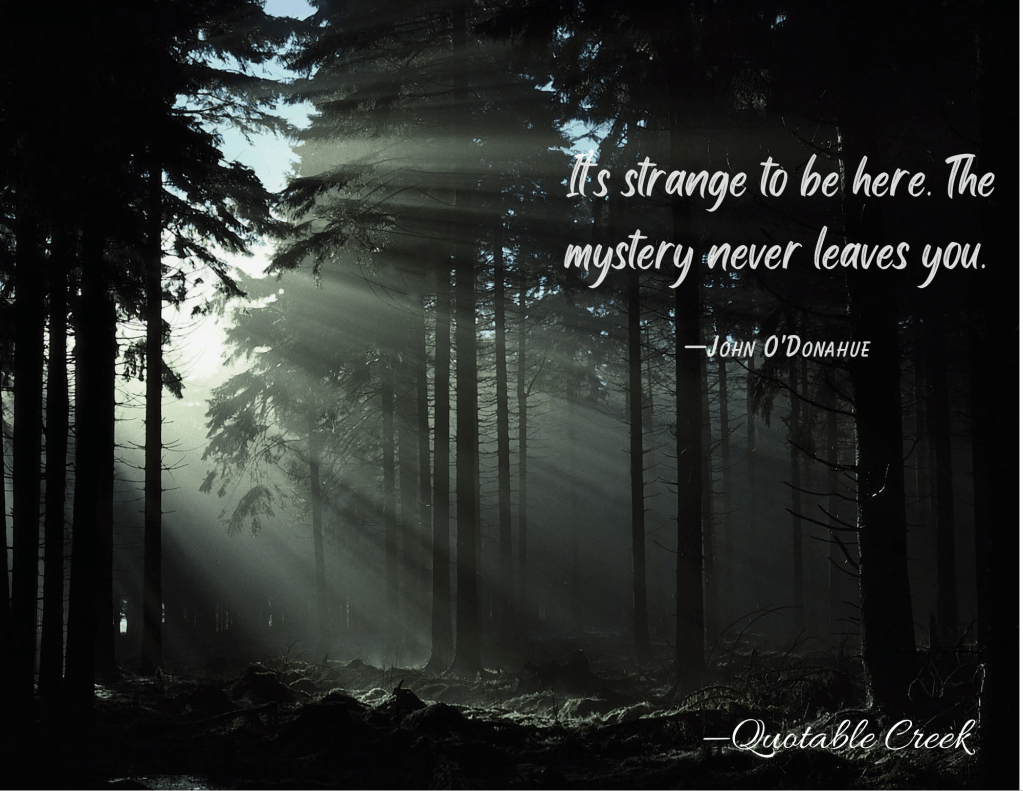
Irish philosopher and poet, John O’Donohue puts it this way
Well, I think it makes a huge difference, when you wake in the morning and come out of your house, whether you believe you’re walking into dead geographical location, which is used to get to a destination, or whether you’re emerging out into a landscape that is just as much if not more alive as you, but in a totally different form, and if you go towards it with an open heart and a real, watchful reverence, that you will be absolutely amazed at what it will reveal to you.
Perhaps if we realized the enormity of life force we are wandering amongst, we would walk more softly, breathe more deeply, and open our eyes wide in surprise and delight at the beauty of it all.
There are many seasons in life. Fall, winter, spring, summer. Childhood, middle age, old age. Caterpillar, pupa, butterfly. And so on. One of my favorite ‘seasons’ is graduation season. I love liminal, threshold spaces, moving from one stage to another. But most of all, I love graduation speeches. What do you say to this group of young adults ready to embark on that magical mystery tour of life? What will resonate as both inspiring and yet true? What will help them in the time travel way an older version of ourselves might come back with a warning or suggestion?
So I thought it might help if I just went ahead and told you what I think is the truth of your spiritual identity …
Actually, I don’t have a clue.
I do know you are not what you look like, or how much you weigh, or how you did in school, and whether you get to start a job next Monday or not. Spirit isn’t what you do, it’s … well, again, I don’t actually know.
And thus she begins from this deep place of not knowing and urges the graduates to not confuse their spiritual lives with their lived lives, to find a way to plug into that which awakens them, and to keep the faith:
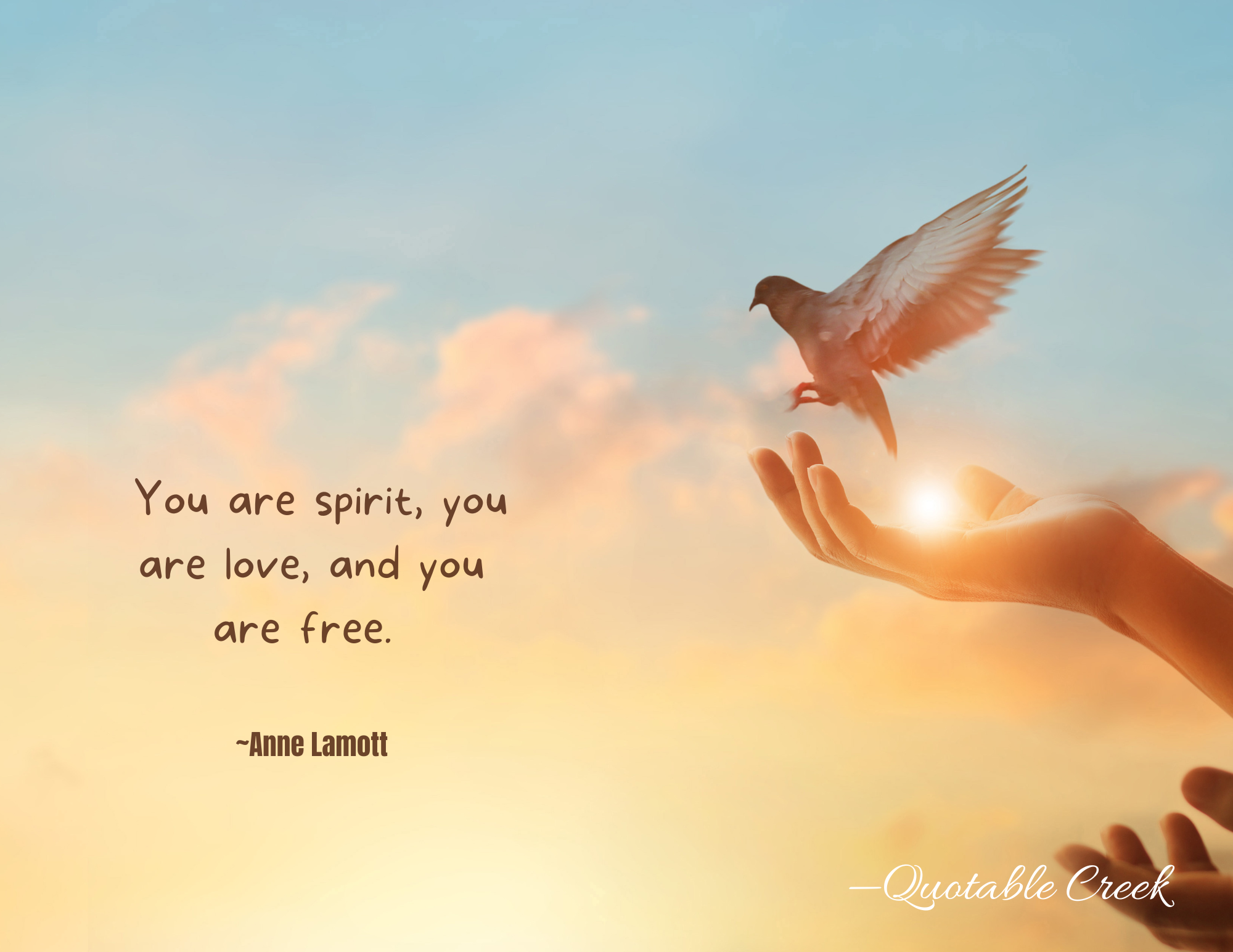
It’s magic to see spirit largely because it’s so rare. Mostly you see the masks and the holograms that the culture presents as real. You see how you’re doing in the world’s eyes, or your family’s, or — worst of all — yours, or in the eyes of people who are doing better than you — much better than you — or worse. But you are not your bank account, or your ambitiousness. You’re not the cold clay lump with a big belly you leave behind when you die. You’re not your collection of walking personality disorders. You are spirit, you are love, and you are free. You’re here to love, and be loved, freely. If you find out next week that you are terminally ill — and we’re all terminally ill on this bus — all that will matter is memories of beauty, that people loved you, and you loved them, and that you tried to help the poor and innocent.
So how do we feed and nourish our spirit, and the spirit of others?
First, find a path, and a little light to see by. Every single spiritual tradition says the same three things: 1) Live in the now, as often as you can, a breath here, a moment there. 2) You reap exactly what you sow. 3) You must take care of the poor, or you are so doomed that we can’t help you.
Her whole speech is well-worth a read, but if you want one thing to hold onto right now, remember this: “You are spirit, you are love, and you are free.”
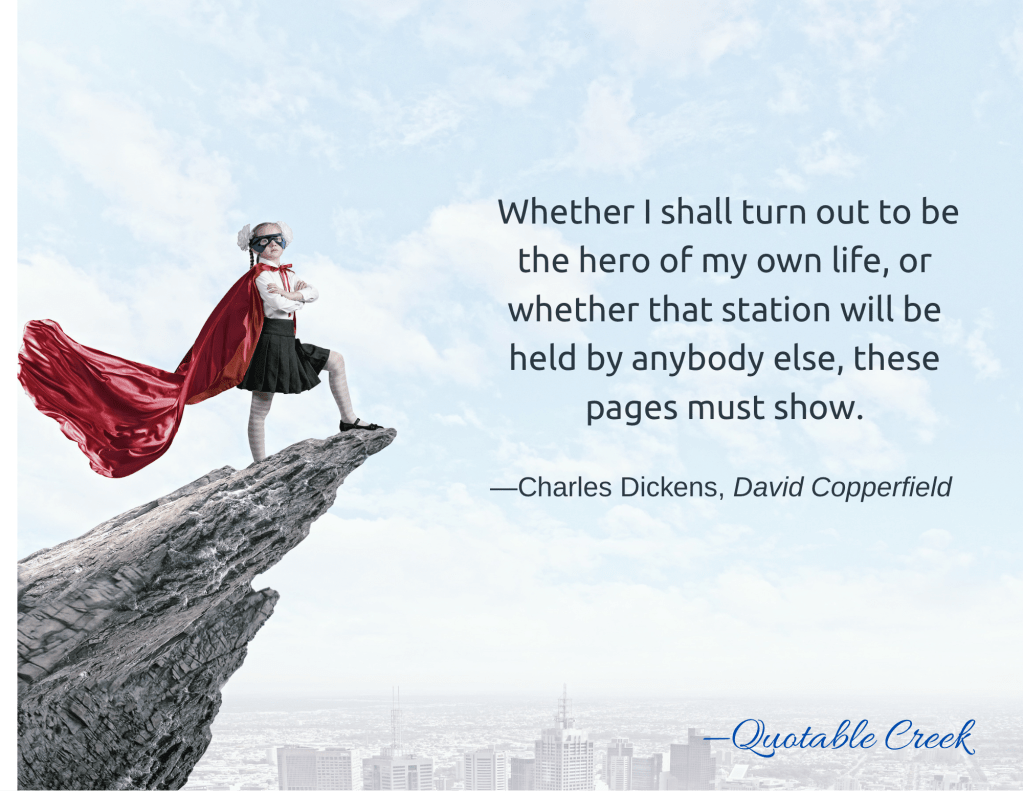
When we think about our own personal heroes, can we see a pattern? How did they rise to the challenges presented in their day?
How are we rising to the occasions and the challenges presented in our time? Right now. Are there injustices we can speak up against? Are there places where our voices will make a difference? What are the rights and wrongs happening right now today?
I am about one-fourth of the way through Charles Dickens’s, David Copperfield. It’s astonishingly good, as are most of his books. And, like others, it calls out some of the injustices of his day—child labor, poorhouses, domestic violence, emotional cruelty, sexism, bullying and so on. With his wide audience and engaging stories, he had tremendous power and is credited for being the impetus for many social justice reforms.
However, he had his own blind spots.
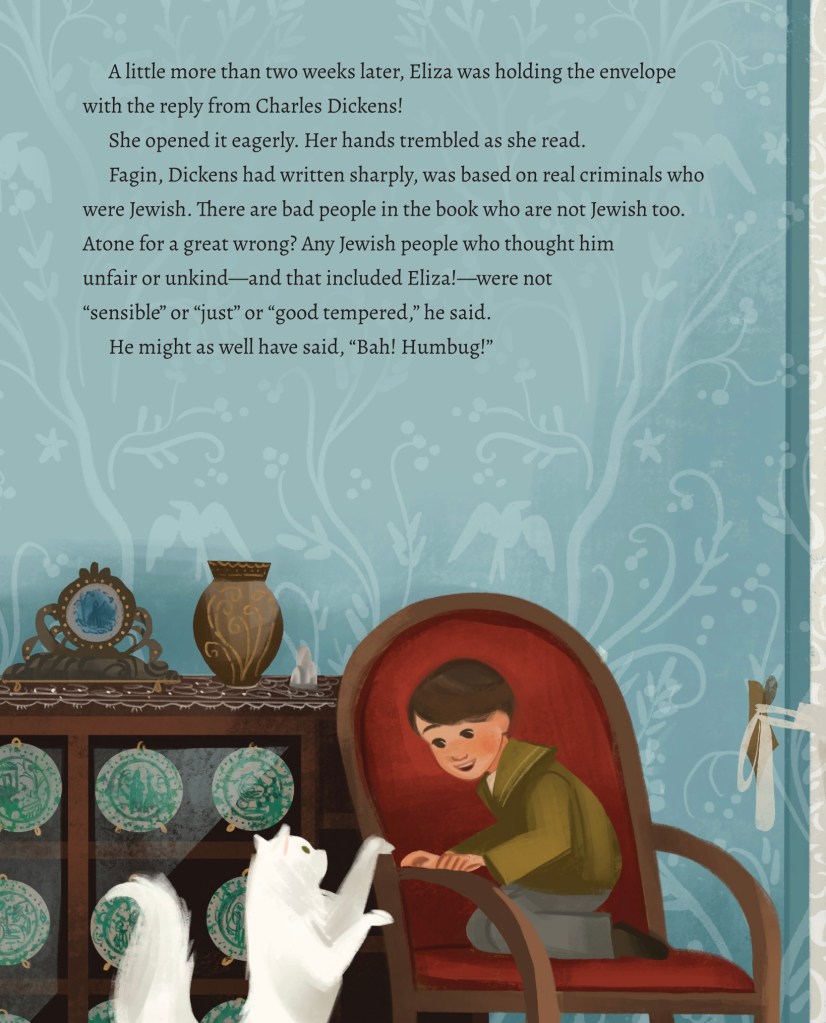
One reader, Eliza Davis, wrote to him, accusing him of portraying her people, those of Jewish ancestry, in stereotypical and negative ways. She cited Fagin, from Oliver Twist, a cruel and selfish man teaching young street urchins to steal. Eliza begged him to show more complexity in his Jewish characters.
Dickens was unimpressed.
Dear Mr. Dickens, By Nancy Churnin
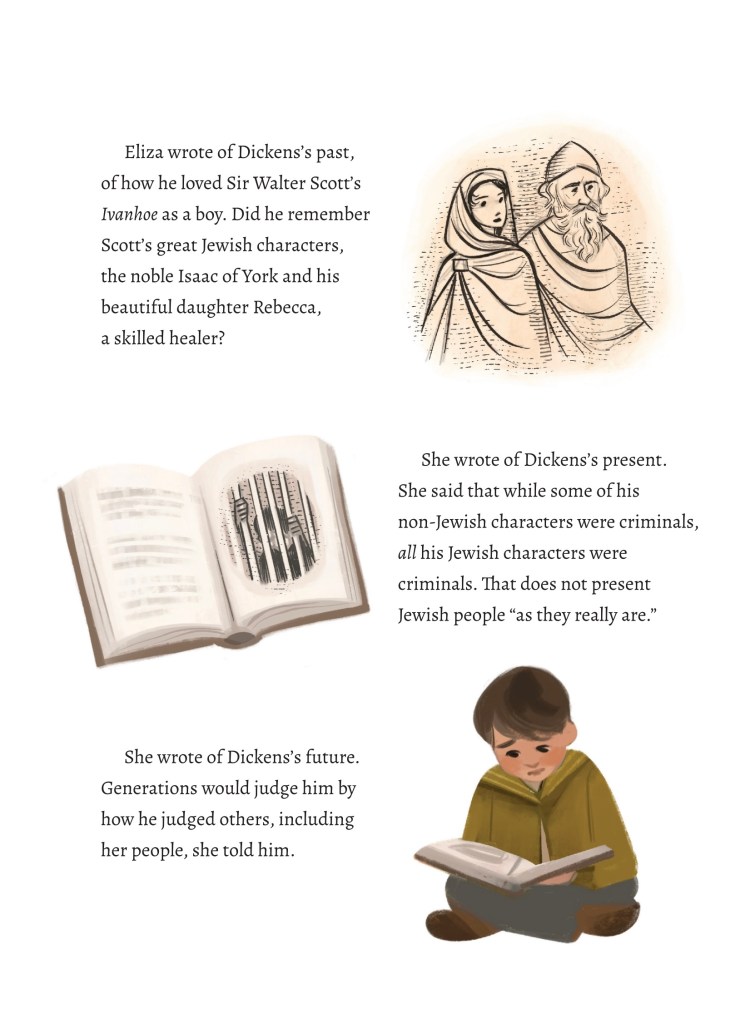
However, taking a page from Dickens’ own, Christmas Carol and the transformation of Ebenezer Scrooge, Eliza wrote him again:
Dear Mr. Dickens, by Nancy Churnin
And this time, Dickens was moved. And changed. From then on, his Jewish characters were complex and kind, and the exchange between Eliza and Dickens is credited for having a part in reducing anti-Semitic views and laws of the day.
Eliza had the same tools at hand as Dickens himself: pen, paper, and a keen sense of justice. While she lacked his fame, she made up for it by essentially teaming with him to bring about change.
What are the injustices of our day? It can be challenging to see them, sometimes, because we’ve been so steeped in things the way they are, that they seem normal. But if we pretend we are explaining our world to an alien, for instance, we might be hard-pressed to answer some of their questions. It is in those places, those places we know to be wrong, that we can strive to be the heroes of our own lives.
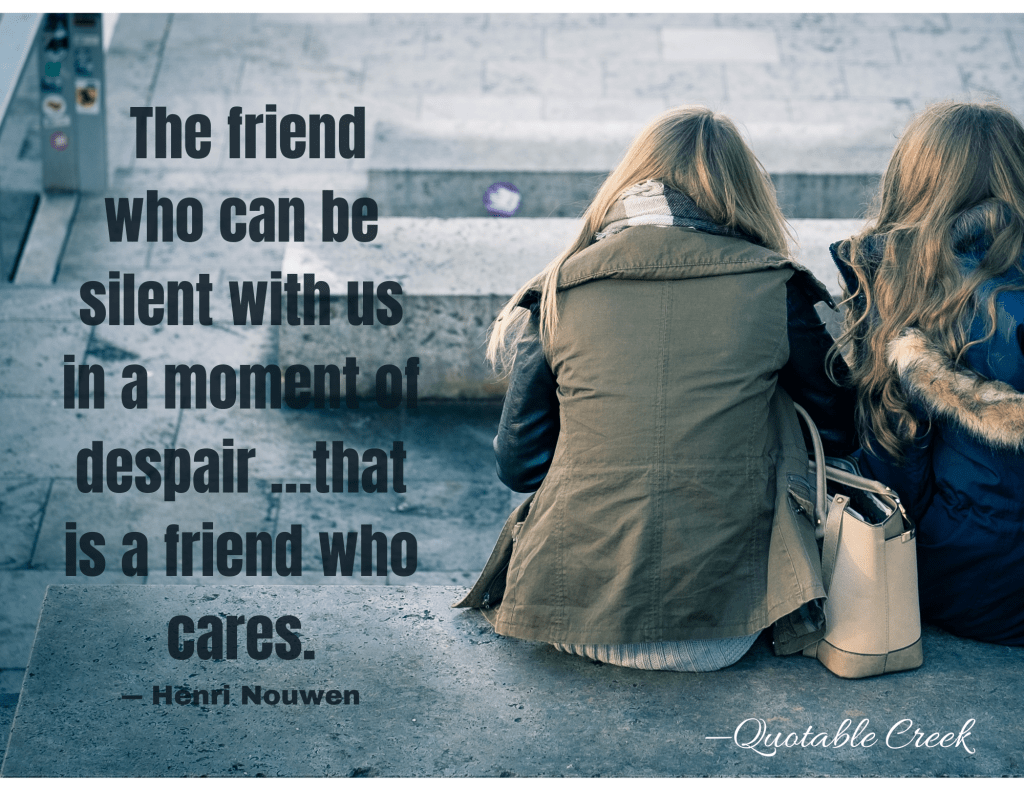
Not every problem can be solved. Not every complaint wants a ‘solution’. Sometimes the heart just craves company, someone to walk beside in trying times.
As Henri Nouwen says,
When we honestly ask ourselves which person in our lives means the most to us, we often find that it is those who, instead of giving advice, solutions, or cures, have chosen rather to share our pain and touch our wounds with a warm and tender hand. The friend who can be silent with us in a moment of despair or confusion, who can stay with us in an hour of grief and bereavement, who can tolerate not knowing, not curing, not healing and face with us the reality of our powerlessness, that is a friend who cares.”
― Henri Nouwen, Out of Solitude: Three Meditations on the Christian Life
Consider jobs. Today’s jobs may not be tomorrow’s jobs, just like yesterday’s jobs aren’t today’s.
Lamplighters
and knocker uppers
went the way of electric street lamps and alarm clocks. (Go here for a fascinating list of 51 jobs that don’t exist anymore.)
And yet the people who had these now obsolete jobs led as full and vibrant of lives as we do. We are not our jobs. Our worth has little to do with the job we have. Our jobs are external to our essence.
For proof, consider this paragraph written by AI:
Sure, I’d be happy to help with that! While our jobs can be an important part of our identity and sense of purpose, it’s important to remember that we are not defined solely by our careers. Our individual identities are made up of a wide range of experiences, values, and beliefs, many of which extend far beyond the workplace. It’s important to recognize and honor the many facets of our identities, including our personal passions, relationships, and hobbies, as well as our professional aspirations. While our jobs may provide structure and direction in our lives, they are just one piece of a larger puzzle that makes up who we are. By embracing the totality of our identities, we can find greater meaning, fulfillment, and happiness in all aspects of our lives.
We are at an inflection point when a bot can write copy like this in seconds. We’ve seen self check out lines in grocery stores and libraries. Automation in every aspect of manufacturing. We’ve seen artificial intelligence pass the bar exam and win photography contests. What are the arenas for only human hands and heart? What are the jobs of our future? What does artificial intelligence lack that only humans can provide?
First among these must be soul. And then heart. Compassion. Human to human contact. Empathy. If and when AI enters into these realms, the world will be a very complicated place.
Sometimes I feel everything in life comes down to the question, ‘Who is my neighbor?’
We are always asking, ‘This one, too?’ And the answer is always, ‘Yes’.
The felon, the refugee, the homeless person, the enemy, the one who hurt you, the one you disagree with, the one who makes your life hard? Yes, always yes.
I’m not a fan of clutter. I’m also quite challenged to part with stuff. It’s a problem. Like some people avoid carbs or sugar, I avoid ‘collecting’ because I know, given my propensities, it will lead to clutter. But there are many things that are clutter-free that I love to collect. Among these are words. Words are just so delightful— the sound and smack of them, their history, their aptness for a particular purpose.
One of my favorite bits of writing advice is to collect words that might fit for the time and place of your story.
In The Writer’s Portable Mentor, Priscilla Long writes:
The writers of deep and beautiful works spend real time gathering words. They learn the names of weeds, and tools, and types of roof. They make lists of color words (ruby, scarlet, cranberry, brick). They savor not only the meanings, but also the musicality of words. They are hunting neither big words nor pompous words nor Latinate words but mainly words they like. They are not “improving their vocabulary” or studying for the SAT or the GRE. They are not trying to be fancy or decorative. This is a different kind of thing.
She suggests keeping a journal of these words and going on quests to capture more:
HANDS ON: MAKE YOUR OWN LEXICON Buy a small bound and sewn blank book, with fine paper. This is your Lexicon. Put in words you like, words that strike your fancy, words you want to own. I suggest giving each word half a page. Put in the word _ lickspittle – and draw a horizontal line dividing the page in half. This way you can put in a word and look it up later. (Under lickspittle write: a contemptible, fawning person; a flatterer or toady.) You will end up with two words per page. This is not a typical vocabulary list full of horrible Latinate words you don’t know and don’t want to know. The rule is, put in only the good words, the juicy words, the hot words. From time to time, savor this book. Look up words you’ve put in (something from your reading) and haven’t looked up yet. Be sure to investigate the root. Put in familiar words along with new words. Play with sounds right in your Lexicon: kitchen matches; cord/weird/word/ fired/turd. From time to time read a big dictionary hunting for a new good word, any word that strikes your fancy: galoot. On some pages make word lists. Fiddle parts – peg box, button, side rib, bridge. Words for blue – cobalt, woad, sapphire, smalt. Words from an art exhibition you especially loved – bone, tin plate; cotton, cord, silk ribbon, silver, galloon; coconuts, shells, ostrich eggs (from Moscow Treasures). Put down things you don’t know the names of. Do you know the parts of a window? (Muntin? Sash?) Do you know the parts of a rocking chair? Draw or describe the thing in your Lexicon and then set about looking (in a book on house repairs or on furniture) for splat or spindle or stile. Do not order your list in any way.
She goes on to discuss making a word trap to fit the piece you are working on, the musicality and derivation of words, the vowel scale, and all sorts of other intriguing ways to add nuance, accuracy, and lilt to your piece. Hers is one of my favorite craft books, of which I have dozens. (See above about my hoarding propensities.)
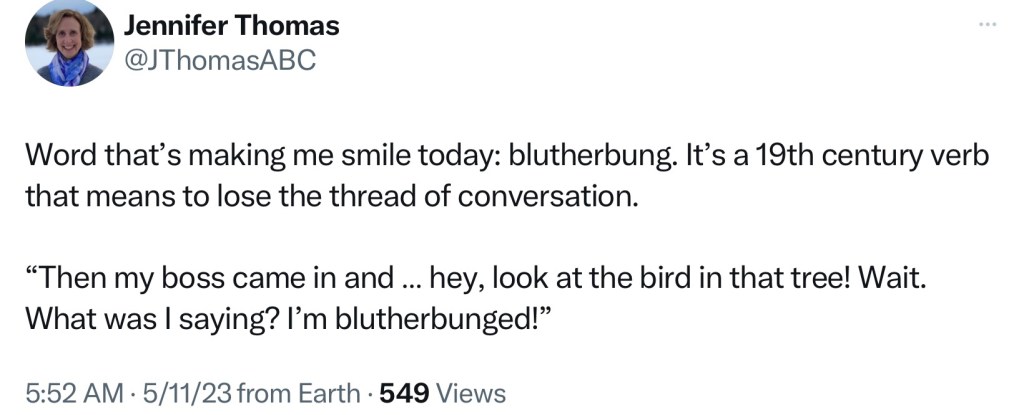
But this intro brings me to my joy for the day. I discovered someone on Twitter who shares this love of words, who posted a word for the day. It’s blutherbung, an appropriate word for me these days as it turns out.
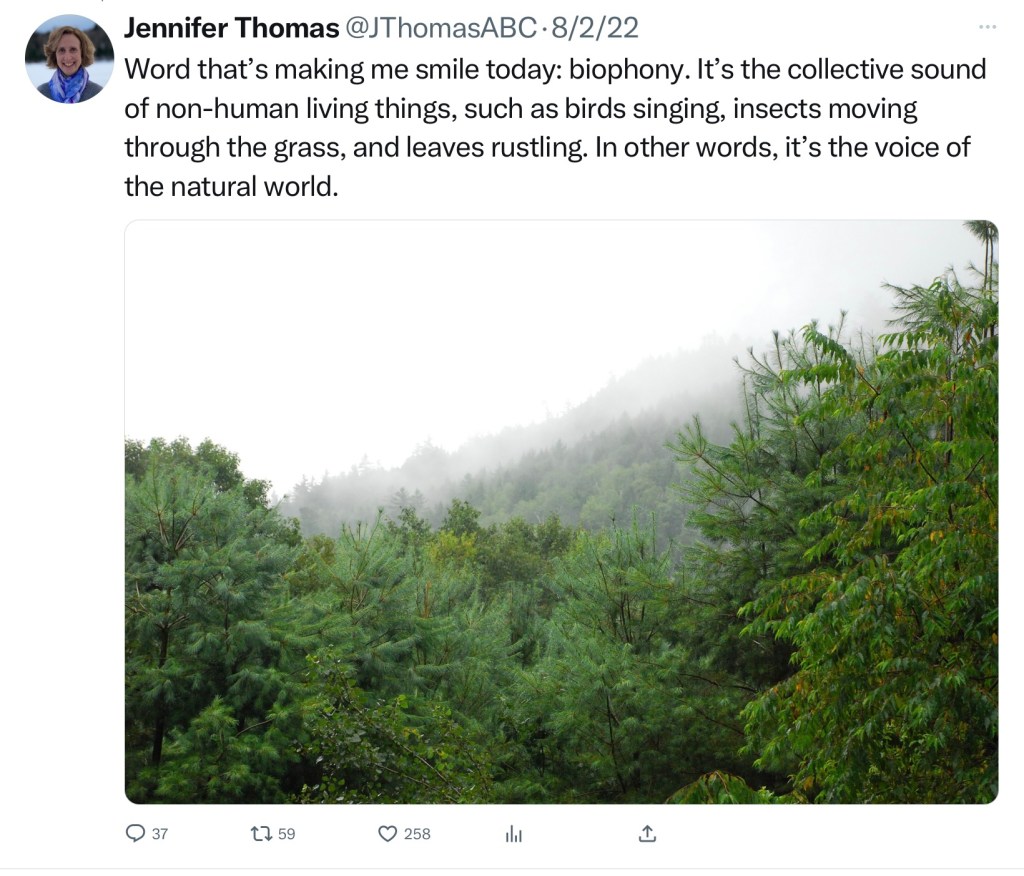
And then I looked at her feed and found another
Lickspittle, blutherbung, biophony. Aren’t these just wonderful? who do you suppose thought these up, studying human nature or the natural world and coming up with just the word to describe that particular confluence of traits? And now I’ve subscribed to her feed to get these delightful tidbits each day.
As you can probably guess, another thing I collect is quotations. I have a little book to jot them as I’m reading an article or book. I periodically look through this little book and write my thoughts about them. Which is what brought me here to writing Quotable Creek.
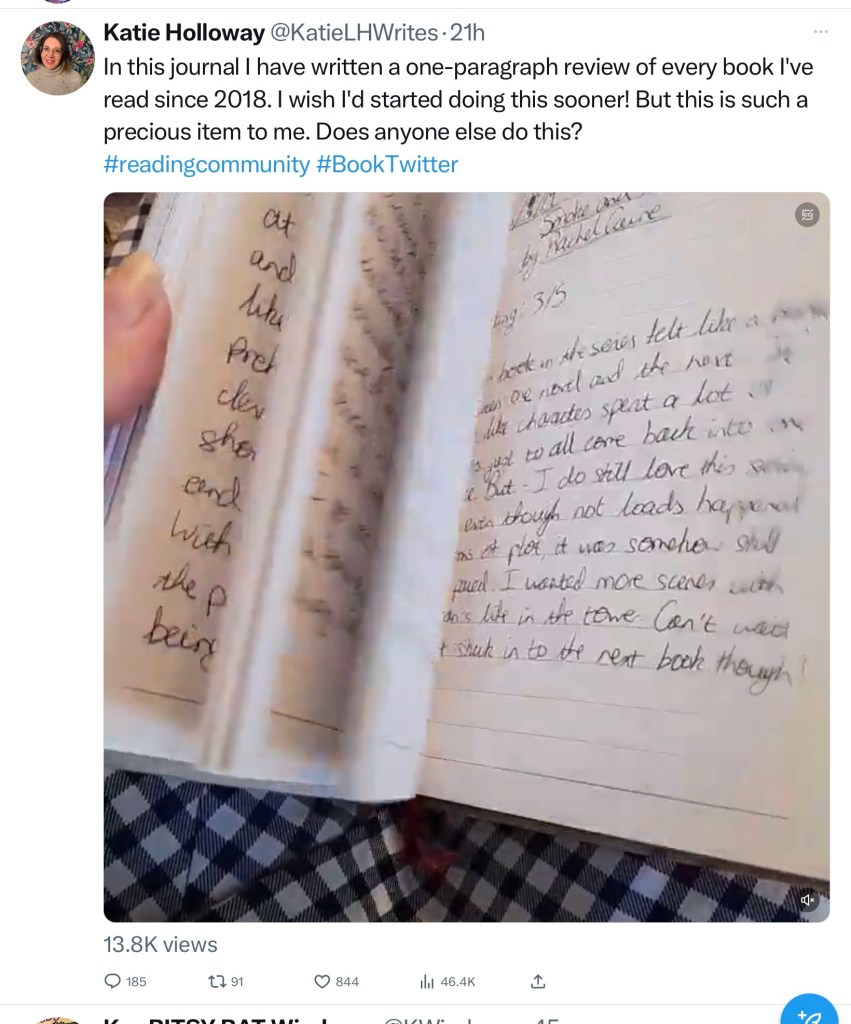
Another thing I ‘collect’ is gratitudes. I write the things I’m thankful for in a gratitude journal, to keep them and remember those moments. My next thing I’m thinking of to collect is book impressions. I read quite a bit, but get blutherbunged and forget about them. Perhaps keeping a little thought about each will bring them back to me. It’s another thing I found on Twitter. Probably when I was reading from the word lady’s thread.





 QuotableCreek.com