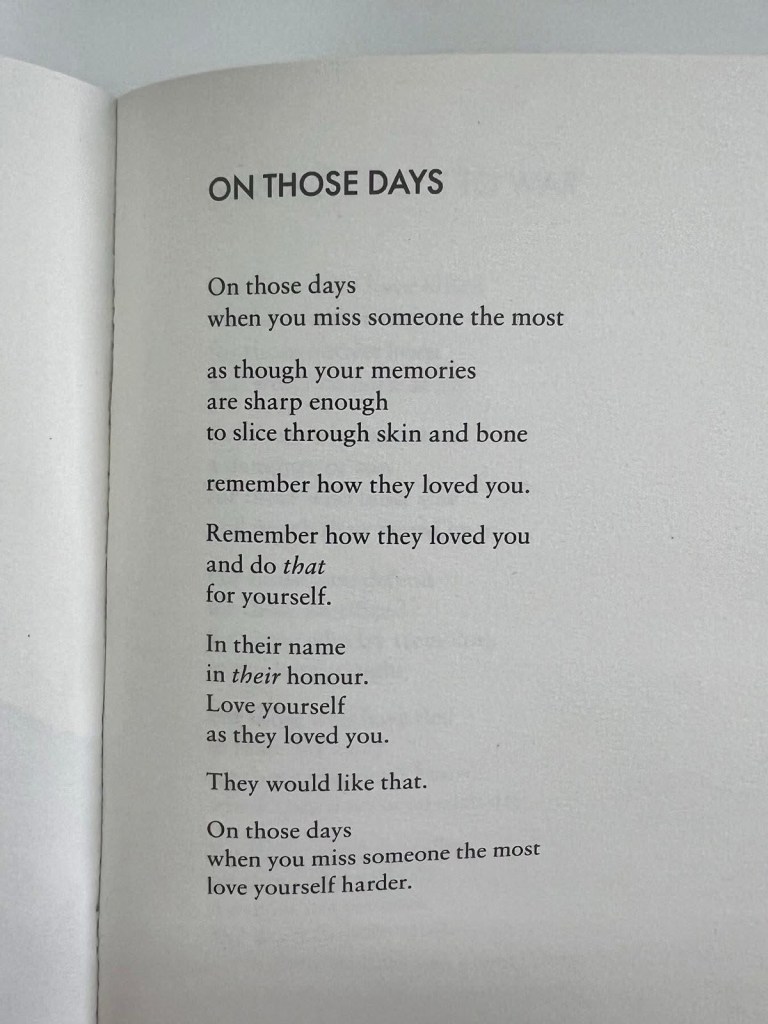
Christmas is a joyful time, but joyful times often bring complex emotions, particularly of loss for the people and loved ones who aren’t with you at the table. We remember times past when we were all together, when things seemed less complicated, when relationships seemed more solid, and we mourn that loss even as we celebrate.
Love makes us vulnerable as there is the possibility of loss. And loss hurts. That’s the human condition. And to try to avoid the pain of loss by never loving would be a far greater loss really. For to miss loving is to miss the whole joy of living.
Grief happens. When we think of grief as the flip side of love, though, we can offer ourselves some solace.
Consider these words by Donna Ashcroft today, and every day. You are loved.
There is something about an anonymous gift that brings special joy to both the giver and the receiver. For the person getting the gift, it makes you feel like the whole world cares, that around any corner is the person who cared enough to make your life special. And to the giver, it strips off all the status and pride and self-satisfaction you may get from a public gift and, with the lusciousness of a secret, fills you with love and gratitude that you are in a position to make a difference.
Consider this delightful story about a somewhat anonymous giver, call him George Walker, and his gift to a young boy in the Philippines.
“Dear Timothy,
I want to be your new pen pal.
I am an old man, 77 years old, but I love kids; and though we have not met I love you already.
I live in Texas – I will write you from time to time – Good Luck. G. Walker”
Now, after President Bush’s death, we have learned that George Walker was President George Herbert Walker Bush, but look at how much joy is in his writing when it is semi-anonymous. He is embracing the true spirit of giving.
For more on anonymous giving, take a look at this feature I wrote on anonymous giving filled with inspiring stories.
What are some things you might do anonymously to spread your love?
So much of our suffering is invisible. Loneliness, sorrow, depression, not fitting in. We can bind up our own cuts and scrapes, but how do we bind up those kind of wounds?
There is an old parable about heaven and hell. In both, people are forced to eat with spoons that are too long to feed themselves. In hell, they are starving. In heaven, they feed each other.
When it comes to these invisible hurts, we are healed by kindness, one to another. We don’t know when we are being kind that it may help someone, but it certainly can’t hurt. And it may be just the long-spooned nourishment that someone else needs.
To inspire acts of kindness today, watch this video of a poor baby elephant stuck in a muddy hole. The gratitude its mother shows its rescuers will melt your heart.
Sometimes we help; sometimes we need help. Sometimes we teach; sometimes we are the student. Sometimes we follow; sometimes we lead. But the truly profound thing in each of these examples is that we are always on both sides of the continuum at the same time. The teacher learns as much from her students as she teaches. The leader who best leads remembers what it is like to be led. And when we help others, it makes us more empathic, more generous, more loving and expands our own humanity. We realize we are one. We are a community that best thrives when all work to help each other.
What is worth fighting for? Sometimes a battle is won in a courageous show of strength and derring do. A fireman runs into a burning building to save a child. A passerby stops to help victims of an accident. A pilot steers a damaged plane to safety.
But sometimes the battle requires showing up time after time with love, kindness, and patience. Not giving up on someone. Having faith that love will win. Believing that relationships can be salvaged.
Dick Van Dyke is a national treasure, still singing and dancing his way through life at nearly 100. He reminds us that there are dark times, but behind the clouds the sun still shines. We show up. We do our best. And we realize that not everything is within our control.
He says,
We should never judge a day by its weather. It means you never know what’s going to happen,’ I said. ‘You do your best, then take your chances. Everything else is beyond our control.
Enjoy this lovely interaction between Van Dyke and Chris Martin, a balm for any troubled soul.
‘If you look the right way, you can see that the whole world is a garden,’ muse the characters in Frances Hodgson Burnett’s The Secret Garden. And, perhaps, on a more intimate level, so our mind is too a garden.
We cultivate our thoughts, enrich them with information, learn, grow, stretch. But weeds can overrun any garden, and we can find our minds overcome with anxiety, negative thinking, and endless catastrophic thinking.
But Burnett notes:
Much more surprising things can happen to any one who, when a disagreeable or discouraged thought comes into his mind, just has the sense to remember in time and push it out by putting in an agreeable determinedly courageous one. Two things cannot be in one place.
When we find ourselves overcome with negative thoughts, we can imagine our mind a garden. Something we can lovingly tend, plucking weeds, nourishing blooms, replacing gloom with gratitude, planting seeds of possibility and promise.
While there are many things in this world we cannot control, we still can control our thoughts and find a way to focus on ones that keep our mental garden thriving.
Isn’t that the bottom line of Christmas? Strip away all the decorations and gifts and songs and celebrations, and what remains is: love wins. It’s about love. God loves us, and we are to love each other. And even in a world divided by hate, blind to oneness, driven by greed, love will win. Because that’s the point of Christmas.
Just when we think we get what life is all about, something comes along to knock us upside the head and show us we have it wrong. It forces us to reevaluate our foundational assumptions about the purpose of life and look at things in a whole new way. It’s a paradigm shift.
Stephen Covey tells of a paradigm shift he experienced:
“I remember a mini-Paradigm Shift I experienced one Sunday morning on a subway in New York. People were sitting quietly — some reading newspapers, some lost in thought, some resting with their eyes closed. It was a calm, peaceful scene. Then suddenly, a man and his children entered the subway car. The children were so loud and rambunctious that instantly the whole climate changed.
“The man sat down next to me and closed his eyes, apparently oblivious to the situation. The children were yelling back and forth, throwing things, even grabbing people’s papers. It was very disturbing. And yet, the man sitting next to me did nothing.
“It was difficult not to feel irritated. I could not believe that he could be so insensitive to let his children run wild like that and do nothing about it, taking no responsibility at all. It was easy to see that everyone else on the subway felt irritated, too. So finally, with what I felt was unusual patience and restraint, I turned to him and said, “Sir, your children are really disturbing a lot of people. I wonder if you couldn’t control them a little more?”
“The man lifted his gaze as if to come to a consciousness of the situation for the first time and said softly, ‘Oh, you’re right. I guess I should do something about it. We just came from the hospital where their mother died about an hour ago. I don’t know what to think, and I guess they don’t know how to handle it either.’
“Can you imagine what I felt at that moment? My paradigm shifted. Suddenly I saw things differently, I felt differently, I behaved differently. My irritation vanished. I didn’t have to worry about controlling my attitude or my behavior; my heart was filled with the man’s pain. Feelings of sympathy and compassion flowed freely. “Your wife just died? Oh, I’m so sorry. Can you tell me about it? What can I do to help?” Everything changed in an instant.
“Many people experience a similar fundamental shift in thinking when they face a life-threatening crisis and suddenly see their priorities in a different light, or when they suddenly step into a new role, such as that of husband or wife, parent or grandparent, manager or leader.
“It becomes obvious that if we want to make relatively minor changes in our lives, we can perhaps appropriately focus on our attitudes and behaviors. But if we want to make significant, quantum change, we need to work on our basic paradigms.
“In the words of Thoreau, ‘For every thousand hacking at the leaves of evil, there is one striking at the root.’ We can only achieve quantum improvements in our lives as we quit hacking at the leaves of attitude and behavior and get to work on the root, the paradigms from which our attitudes and behaviors flow.”
(from Stephen Covey’s book, The Seven Habits of Highly Effective People)
Or consider the paradigm shift that Ebenezer Scrooge’s partner, now a ghost, Jacob Marley, recounts to him before the visit of the three Christmas ghosts in Christmas Carol. Both Scrooge and Marley thought they had life figured out–it was all about business and making money, the more the better. But Marley has had a paradigm shift since dying:
“‘But you were always a good man of business, Jacob,’ faltered Scrooge, who now began to apply this to himself.
“‘Business!’ cried the Ghost, wringing its hands again. ‘Mankind was my business; charity, mercy, forbearance, and benevolence, were, all, my business. The deals of my trade were but a drop of water in the comprehensive ocean of my business.’ “
Get ready to get hit upside the head, metaphorically speaking. It may be time for a paradigm shift.