Choose joy.

These days it feels a bit like we are bombarded by news, so overwhelming in scope as to cloud out the sun. Overwhelm is on the menu. And joy can feel like an exotic indulgence. And yet, choosing joy can be an act of resistance.

As Maria Popova notes, drawing on her experience in writing The Marginalian:

14. Choose joy. Choose it like a child chooses the shoe to put on the right foot, the crayon to paint a sky. Choose it at first consciously, effortfully, pressing against the weight of a world heavy with reasons for sorrow, restless with need for action. Feel the sorrow, take the action, but keep pressing the weight of joy against it all, until it becomes mindless, automated, like gravity pulling the stream down its course; until it becomes an inner law of nature. If Viktor Frankl can exclaim “yes to life, in spite of everything!” — and what an everything he lived through — then so can any one of us amid the rubble of our plans, so trifling by comparison. Joy is not a function of a life free of friction and frustration, but a function of focus — an inner elevation by the fulcrum of choice. So often, it is a matter of attending to what Hermann Hesse called, as the world was about to come unworlded by its first global war, “the little joys”; so often, those are the slender threads of which we weave the lifeline that saves us.

Delight in the age-salted man on the street corner waiting for the light to change, his age-salted dog beside him, each inclined toward the other with the angular subtlety of absolute devotion.

Delight in the little girl zooming past you on her little bicycle, this fierce emissary of the future, rainbow tassels waving from her handlebars and a hundred beaded braids spilling from her golden helmet.

Delight in the snail taking an afternoon to traverse the abyssal crack in the sidewalk for the sake of pasturing on a single blade of grass.

Delight in the tiny new leaf, so shy and so shamelessly lush, unfurling from the crooked stem of the parched geranium.

I think often of this verse from Jane Hirshfield’s splendid poem “The Weighing”:

So few grains of happiness

measured against all the dark

and still the scales balance.

Yes, except we furnish both the grains and the scales. I alone can weigh the blue of my sky, you of yours.

Pausing to notice and delight in these little moments can counterbalance the great and pressing weight of darkness. It is from each of these moments, we draw value and solace, hope and strength.

And we persevere, weaving the ‘slender threads’ of the lifelines that save us.

Welcome the wind.

It’s too easy to forget that we are of this earth. Our agendas and business suits disguise us. Our tasks distract us.

But we are sensuous beings, of the earth and for the earth. We, like the tree frog, are part of creation. How lovely it is to remember that, to appreciate our moment of life in the grand scheme of things, to feel the wind in our hair and the grass under our feet. To drink deep of this moment when we are here.

We are here.

Enjoy the journey.

Sometimes our eyes and hearts are focussed so far in the distance, that we fail to see what is right in front of us. The people we spend our days with, the beauty surrounding us, the opportunities we have to make a difference. When we zoom in to the detail, the richness of the particular moment can be astounding and surprising. What a beautiful, remarkable world we live in. So full of complexity. Each person we see is as full of contradictions and surprises as we are ourselves. Each living or created thing we see is so full of detail.

Long-term goals are great, but what a shame if we don’t appreciate each step along the way. We may work side by side with someone but barely know their name let alone what their hopes and dreams are. We may be so busy moving forward that we are blind to the heartache of even the people we live with. It is easy to speed through life with eyes averted like people descending in an elevator focussed only on the floor numbers.

Today take time today to enjoy the journey, the mysteries unfolding all around you, the people who share your path, and all the beautiful and startling things right here, right now.

Like, for example, who can not stop and be amazed at this little beagle shaking its jowls, its great ears flopping to the beat, its sturdy paws holding on in front but shifting with its wagging tail in back, the gorgeous landscape behind it? What a fascinating little miracle, right here. Just this.

Little miracle of the day.

Staying alive with joy.

How do we make sure we aren’t just staying alive but staying vibrant? Making our moments count? Making an impact and difference in the lives of those we care about? Making our lives matter?

Consider Virginia Woolf’s words:

Whatever happens, stay alive. Don’t die before you’re dead. Don’t lose yourself, don’t lose hope, don’t lose direction.

Stay alive, with yourself, with every cell of your body, with every fiber of your skin.

Stay alive, learn, study, think, read, build, invent, create, speak, write, dream, design.

Stay alive, stay alive inside you, stay alive also, outside, fill yourself with colors of the world, fill yourself with hope, with Wow Scenery.

Stay alive with joy.

There is only one thing you should not waste in life, and that’s life itself.

How do we become hard-hearted as we age, focused so much on ourselves and our own needs? How do we deaden ourselves to community and lives being lived around us, turning inward and reclusive, dying really to the fabric of life?

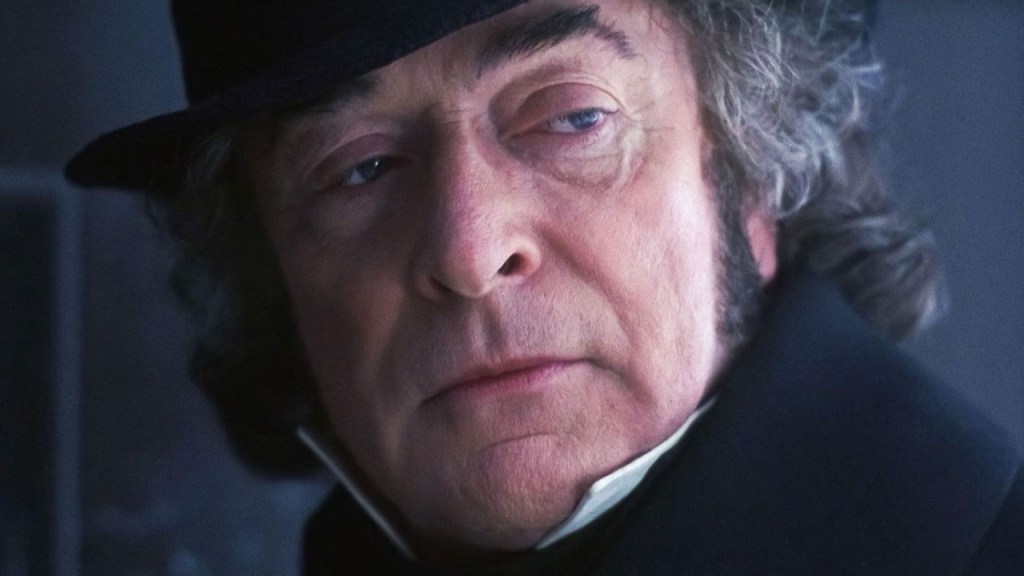
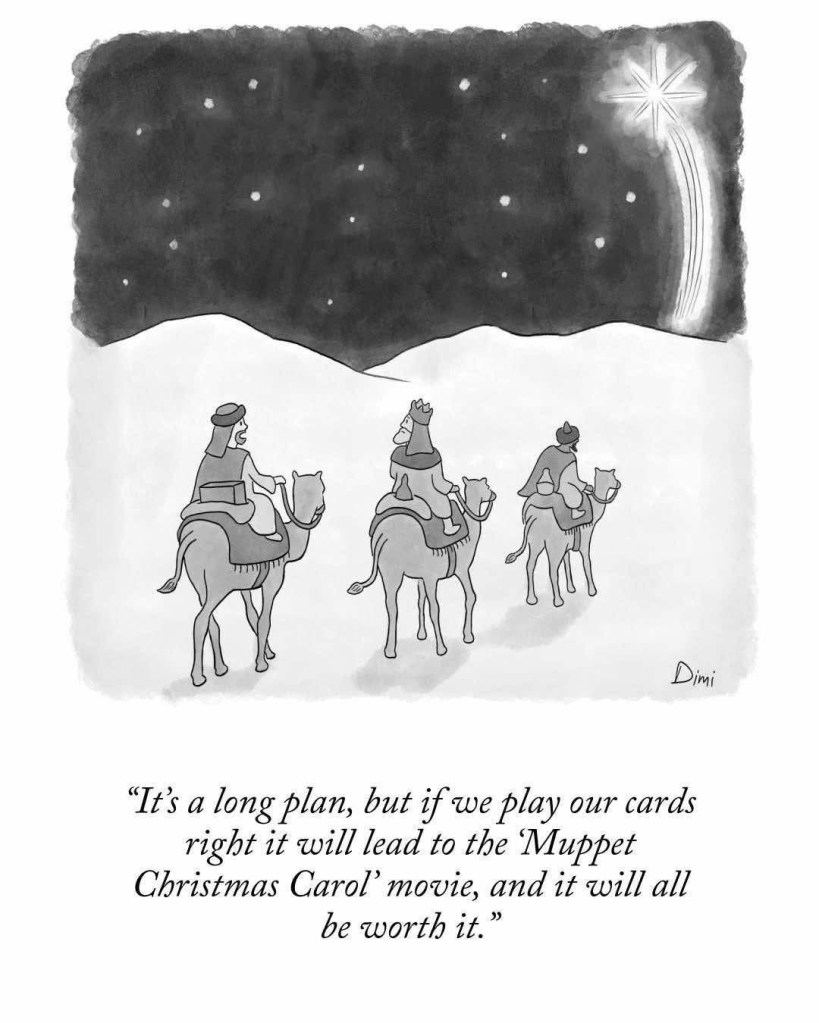
I just watched the muppet version of Christmas Carol which did a great job of capturing Charles Dickens’s classic story about the transformation of Ebenezer Scrooge, first his turning in, the selfishness, the greed, the callousness to those around him, his miserliness in spirit and deed.

But then, with the spirits’ intervention, Scrooge has an epiphany and realization that life is a looking out, a contributing, a generosity and an overflowing of joy. His life becomes filled with vibrancy and exuberance and a realization of the difference he can make in the here and now. At that moment, he becomes part of something larger than himself, alive with possibility and connection.

Each of us faces Scrooge’s dilemma. We may not be miserable misers, but perhaps we have turned in to focus on ourselves. Perhaps we’ve become callous to the suffering around us and blind to the good we can do. Perhaps we’ve lost the joy.

Scrooge’s story reminds us all that it isn’t too late to turn over a new leaf, to reach out to those around us, to wear our love and concern on our sleeves, to care. And by spreading joy, we find ourselves drenched in it as well.

Leaving the world a bit better.

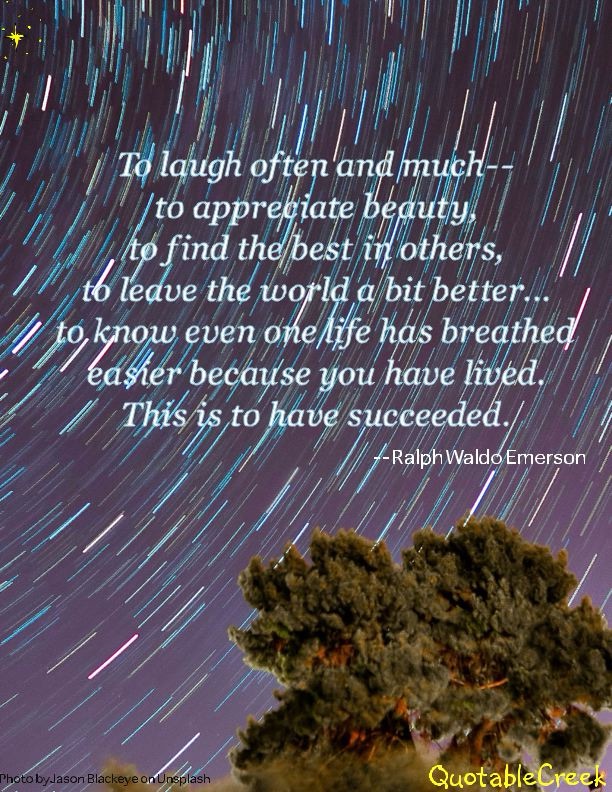
We all want to succeed, but what is the metric for measuring whether we’ve been successful? There are so many. Money, status, power, bucket lists, fame, travel… but what of the little things? Are you successful if you have enough money to buy a small country but no one to love or trust? Is it success if you are famous but lonely? If you have power but wield it to cause pain and misfortune to others, how can that be considered success? If you’ve traveled the world but not been truly present anywhere, does that count?

Perhaps true success at this thing called life is as simple as Emerson’s thoughts above. To leave the world a bit better, to ease the burdens of others, to look for and bring out the best in others, to do no harm. These all matter, maybe not in measurable concrete ways, but in ways we can all feel and appreciate if not count. More important, these are all things we each can do. We have the ability to be successful beyond our wildest imaginings.

And don’t forget to laugh often and much. Finding the joy and not letting it slip right past you undetected is important, too.

Like to the lark at break of day.

I am a huge fan of birdsong. It is so joyful. Listening to a little bird, so unassuming, singing with all it has to welcome the day reminds us of what it is like to be alive—vibrant and grateful, blessed with a day ahead to sing our song however that might manifest itself in each individual life. Open. Ready. Eager even.

And yet life can bring us low. Consider Shakespeare’s 29th Sonnet below. He certainly gets what it is like to feel outcast and alone, bemoaning our fate, jealous of others’ future and friends, their talents and possibilities, when we feel we have none.

And yet,

There is, or maybe was, someone who brightened our spirits. Someone who loved us and, like the simple lark singing its joyful song, that love can change an outlook in a blink. And next to that love, all the treasure of kings is paltry.

For a perfect, tear-jerking read of this Sonnet, take a listen to Judi Dench in the clip below. and take a minute, sometime today, to listen to a bird singing its heart out and remember those you love and those who love you.

When, in disgrace with fortune and men’s eyes,

I all alone beweep my outcast state,

And trouble deaf heaven with my bootless cries,

And look upon myself and curse my fate,

Wishing me like to one more rich in hope,

Featured like him, like him with friends possessed,

Desiring this man’s art and that man’s scope,

With what I most enjoy contented least;

Yet in these thoughts myself almost despising,

Haply I think on thee, and then my state,

(Like to the lark at break of day arising

From sullen earth) sings hymns at heaven’s gate;

       For thy sweet love remembered such wealth brings

       That then I scorn to change my state with kings.

The singing leaf and your busy heart.

Let heaven and nature sing.

There is a thrum, a life force, a joy at the core of it all, and sometimes we need to tune in to it and listen.

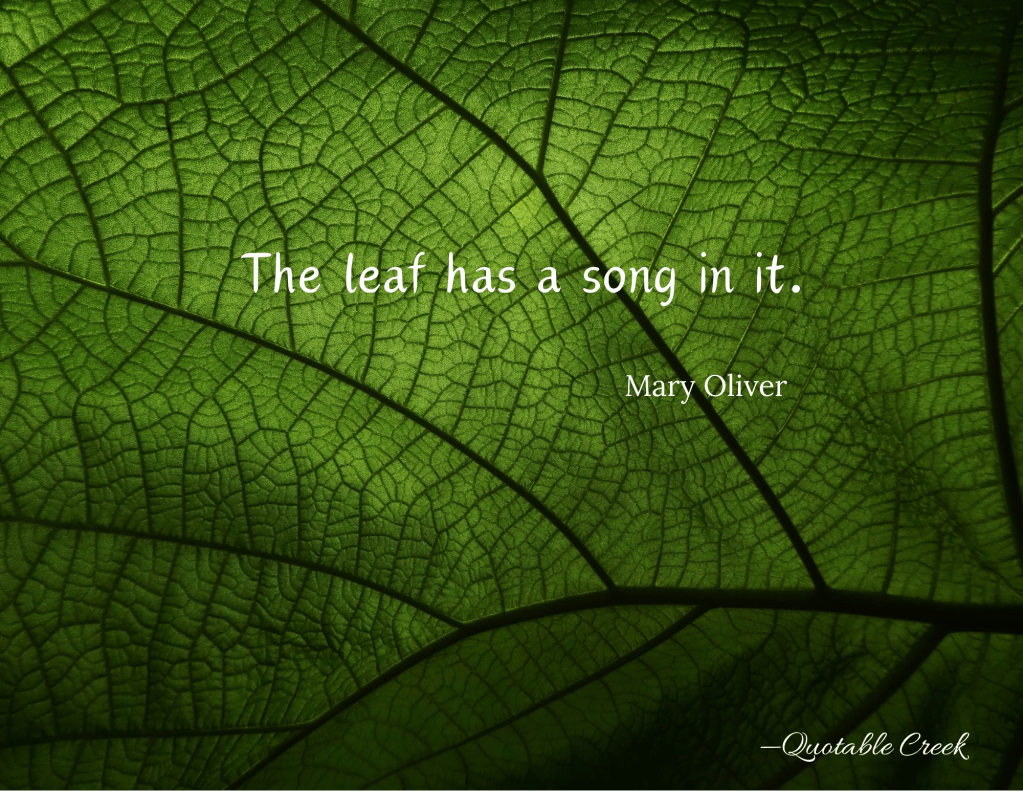
As Mary Oliver wrote:

What can I say that I have not said before?

So I’ll say it again.

The leaf has a song in it.

Stone is the face of patience.

Inside the river there is an unfinishable story and you are somewhere in it

And it will never end until all ends.

Take your busy heart to the art museum and the chamber of commerce

But take it also to the forest.

The song you heard singing in the leaf when you were a child

Is singing still.

I am of years lived, so far, seventy-four,

And the leaf is singing still.

Where will you take your busy heart today? Can you hear the leaf singing?

Joy shadow.

How wonderful it would be to count all joy– to recognize the gift in the difficulty, to see the growth in the hardship, to see joy as a reflection of sorrow. Grief, despair, hopelessness, loss can hit so hard, it may feel like we will never feel joy again. And yet joy follows us like a shadow if we can pause to be grateful.

Then a woman said, “Speak to us of Joy and Sorrow.” 

And he answered: 

Your joy is your sorrow unmasked. 

And the selfsame well from which your laughter rises was oftentimes filled with your tears. 

And how else can it be? 

The deeper that sorrow carves into your being, the more joy you can contain. 

Is not the cup that hold your wine the very cup that was burned in the potter’s oven? 

And is not the lute that soothes your spirit, the very wood that was hollowed with knives? 

When you are joyous, look deep into your heart and you shall find it is only that which has given you sorrow that is giving you joy. 

When you are sorrowful look again in your heart, and you shall see that in truth you are weeping for that which has been your delight. 

Some of you say, “Joy is greater than sorrow,” and others say, “Nay, sorrow is the greater.” 

But I say unto you, they are inseparable. 

Together they come, and when one sits alone with you at your board, remember that the other is asleep upon your bed. 

Verily you are suspended like scales between your sorrow and your joy. 

Only when you are empty are you at standstill and balanced. 

When the treasure-keeper lifts you to weigh his gold and his silver, needs must your joy or your sorrow rise or fall. Khalil Gibran, Joy and Sorrow, Chapter Viii

Unique you.

What are the things you love, the things you hate, the things that keep you up at night? What are your favorite smells, sounds, tastes, sights, things to touch? How are you inhabiting that body you’ve been given and finding joy?

Whatever your combination of answers to these questions is, it is uniquely your own. It is what makes you, you.

For each of us, that answer will be different, but all part of the same global struggle for individualism. Here is George Bernard Shaw’s answer to some of these questions:

So long as I remain alive and well, I shall continue to feel strongly about prose style, to love the surface of the earth, and to take a pleasure in solid objects and scraps of useless information.

I love his list. What’s yours?

Bringing the sun.

How broad is your focus? On your own needs and wants, or broader? It seems that a broad focus, on others as much or more than ourselves increases empathy and happiness.

As Daniel Goleman said:

Self-absorption in all its forms kills empathy, let alone compassion. When we focus on ourselves, our world contracts as our problems and preoccupations loom large. But when we focus on others, our world expands. Our own problems drift to the periphery of the mind and so seem smaller, and we increase our capacity for connection – or compassionate action.


― Daniel Goleman, Social Intelligence: The New Science of Human Relationships

Does this seem true as you think about the people in your life?

The other thing that happens when you turn your concern to others is the whole world opens up. There is so much to learn, to do, to care about. So many places to put your time and efforts. So many people to love and help.