Savor the joy.

Joy is a fascinating emotion. It often springs up in us at surprising times. There is something of a wellspring vibe to it, as if it bubbles up in us with little bearing to our circumstance in life or particular experience. As C. S. Lewis notes,

“I call it Joy. ‘Animal-Land’ was not imaginative. But certain other experiences were… The first is itself the memory of a memory. As I stood beside a flowering currant bush on a summer day there suddenly arose in me without warning, and as if from a depth not of years but of centuries, the memory of that earlier morning at the Old House when my brother had brought his toy garden into the nursery. It is difficult to find words strong enough for the sensation which came over me; Milton’s ‘enormous bliss’ of Eden (giving the full, ancient meaning to ‘enormous’) comes somewhere near it. It was a sensation, of course, of desire; but desire for what?…Before I knew what I desired, the desire itself was gone, the whole glimpse… withdrawn, the world turned commonplace again, or only stirred by a longing for the longing that had just ceased… In a sense the central story of my life is about nothing else… The quality common to the three experiences… is that of an unsatisfied desire which is itself more desirable than any other satisfaction. I call it Joy, which is here a technical term and must be sharply distinguished both from Happiness and Pleasure. Joy (in my sense) has indeed one characteristic, and one only, in common with them; the fact that anyone who has experienced it will want it again… I doubt whether anyone who has tasted it would ever, if both were in his power, exchange it for all the pleasures in the world. But then Joy is never in our power and Pleasure often is.” The Shape of My Early Life

Joy is distinct from pleasure and happiness. It is an abundance, a bliss, an immeasurable gratitude for the privilege of being. It isn’t meant to be ignored, but embraced, relished, cherished. Not as a byproduct of some other experience, but in itself.

As Mary Oliver says, 

“If you suddenly and unexpectedly feel joy,

don’t hesitate.

Give in to it.

There are plenty of lives and whole towns destroyed or about to be.

We are not wise, and not very often kind.

And much can never be redeemed.

Still life has some possibility left.

Perhaps this is its way of fighting back,

that sometimes something happened better than all the riches or power in the world.

It could be anything, but very likely you notice it in the instant when love begins.

Anyway, that’s often the case.

Anyway, whatever it is,

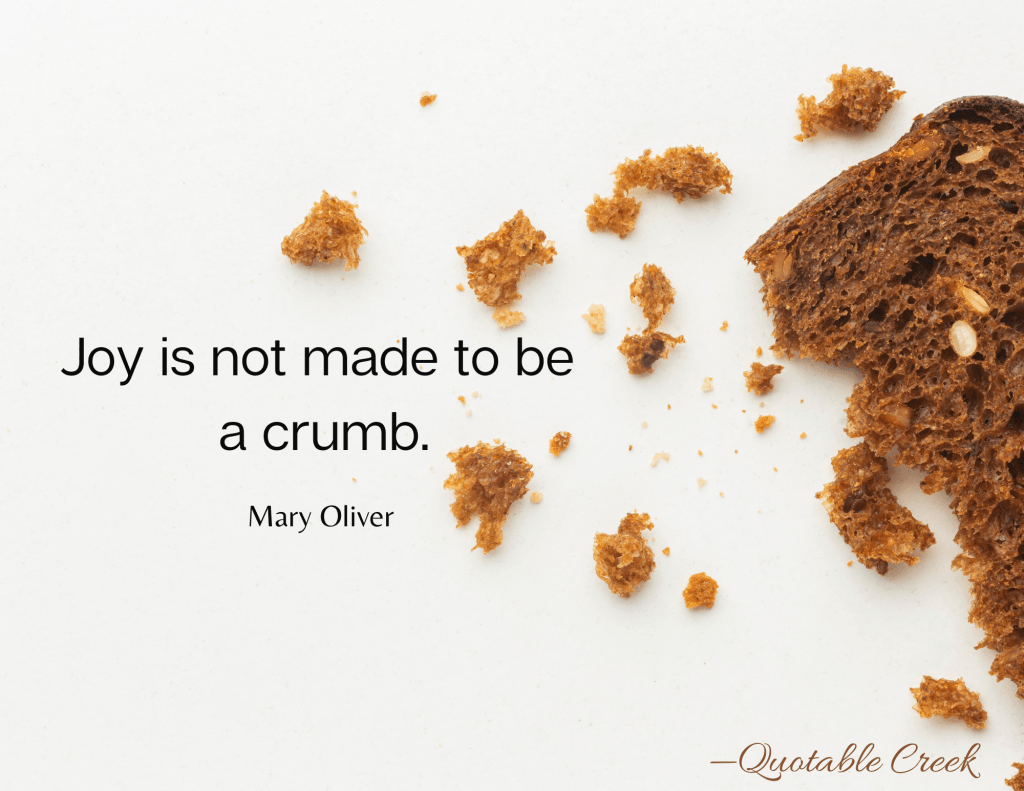
don’t be afraid of its plenty. Joy is not made to be a crumb.

Swan, Poems and Prose Poems

If you should be lucky enough to feel joy bubbling up, savor it. Don’t hesitate.

Surprise!

How much do our expectations get in the way of our gratefulness? If we were expecting nothing, would our eyes open more to all the gifts we receive each day. Brother David Steindhal-Rast explores just this link between surprise and gratitude:

Have you ever noticed how your eyes open a bit wider when you are surprised? It is as if you had been asleep, merely day-dreaming or sleepwalking through some routine activity, and you hear your favorite tune on the radio, or look up from the puddles on the parking lot and see a rainbow, or the telephone rings and it’s the voice of an old friend, and all of a sudden you’re awake. Even an unwelcome surprise shakes us out of complacency and makes us come alive. We may not like it at first, but looking back, we can always recognize it as a gift. Humdrum equals deadness; surprise equals life. In fact, my favorite name for the One I worship in wonder – the only name that does not limit God – is Surprise.

Right this moment, as I remember spiritual giants I have been privileged to meet – Mother Teresa, Thomas Merton, Dorothy Day, His Holiness the Dalai Lama – I can still feel the life energy they radiated. But how did they come by this vitality? There is no lack of surprises in this world, but such radiant aliveness is rare. What I observed was that these people were all profoundly grateful, and then I understood the secret.

Surprise is a seed. Gratefulness sprouts when we rise to the challenge of surprise

A surprise does not make us automatically alive. Aliveness is a matter of give-and-take, of response. If we allow surprise to merely baffle us, it will stun us and stunt our growth. Instead, every surprise is a challenge to trust in life and so to grow. Surprise is a seed. Gratefulness sprouts when we rise to the challenge of surprise. The great ones in the realm of Spirit are so intensely alive because they are so deeply grateful.

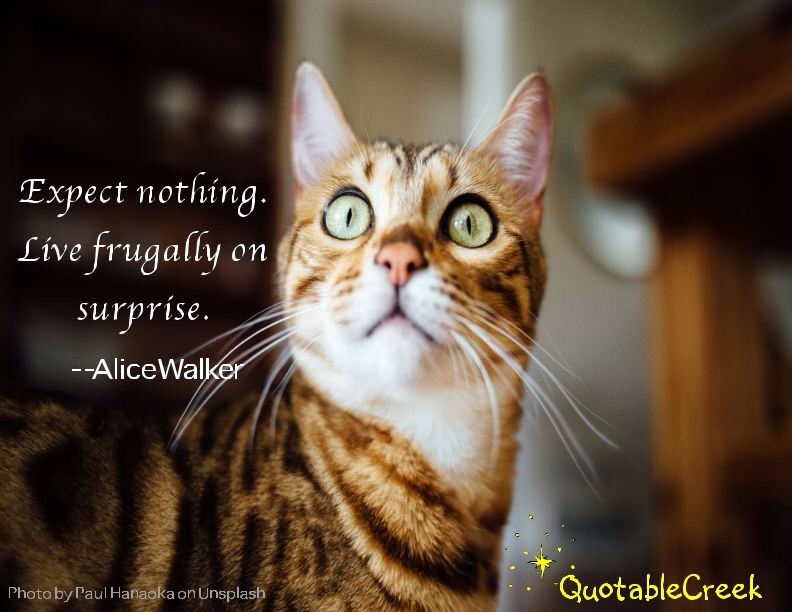
Gratefulness can be improved by practice. But where shall beginners begin? The obvious starting point is surprise. You will find that you can grow the seeds of gratefulness just by making room. If surprise happens when something unexpected shows up, let’s not expect anything at all. Let’s follow Alice Walker’s advice. “Expect nothing. Live frugally on surprise.”

To expect nothing may mean not taking for granted that your car will start when you turn the key. Try this and you will be surprised by a marvel of technology worthy of sincere gratitude. Or you may not be thrilled by your job, but if for a moment you can stop taking it for granted, you will taste the surprise of having a job at all, while millions are unemployed. If this makes you feel a flicker of gratefulness, you’ll be a little more joyful all day, a little more alive.

Once we stop taking things for granted our own bodies become some of the most surprising things of all.

Once we stop taking things for granted our own bodies become some of the most surprising things of all. It never ceases to amaze me that my body both produces and destroys 15 million red blood cells every second. Fifteen million! That’s nearly twice the census figure for New York City. I am told that the blood vessels in my body, if lined up end to end, would reach around the world. Yet my heart needs only one minute to pump my blood through this filigree network and back again. It has been doing so minute by minute, day by day, for the past 75 years and still keeps pumping away at 100,000 heartbeats every 24 hours. Obviously this is a matter of life and death for me, yet I have no idea how it works and it seems to work amazingly well in spite of my ignorance.

I do not know how my eyes adapt, yet when I chant by candlelight they are 100,000 times more sensitive to light than when I read outdoors on the porch at noon. I wouldn’t know how to give instructions to the 35 million digestive glands in my stomach for digesting one single strawberry; fortunately, they know how to do their job without my advice. When I think of this as I sit down to eat, my heart brims with gratefulness.

From the humble starting point of daily surprises, the practice of gratefulness leads to these transcendent heights.

In those moments, I can identify with the Psalmist who cried out in amazement, “I am fearfully and wonderfully made.” (Ps.139:14) From there it is only a small step to seeing the whole universe and every smallest part of it as surprising. From the humble starting point of daily surprises, the practice of gratefulness leads to these transcendent heights. Thomas Carlyle pointed to these peaks of spiritual awareness when he wrote, “Worship is transcendent wonder” – transcendent surprise.

Surprise is a seed; let it sprout and blossom today to color your life with gratitude.

Choosing joy.

Sometimes joy is a matter of perspective. It’s reaching down and being grateful for it all, the mess, the euphoria, the triumphs, and the tragedies. Grateful to be here, to have a voice, to have people to care about, to have a chance to make a difference. Joy in it all is a choice.

In Bread for the Journey, Henri Nouwen unpacks this further:

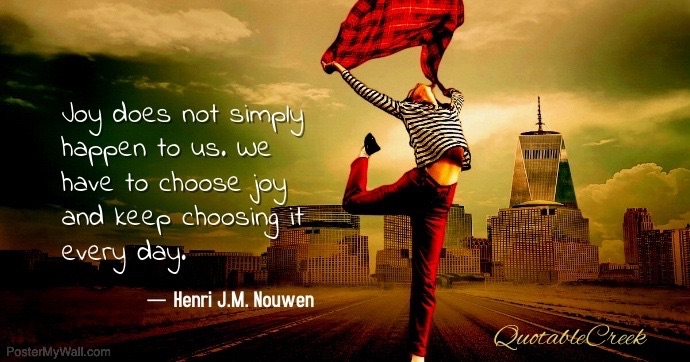
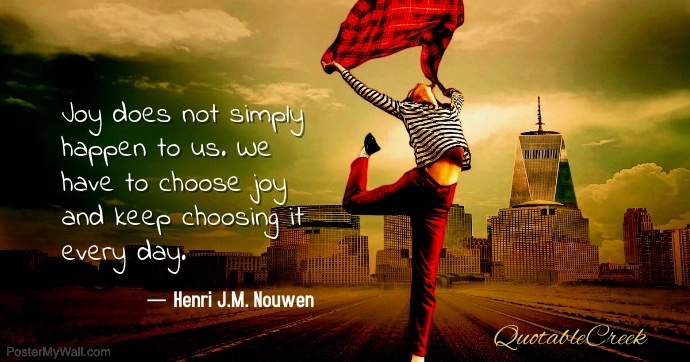
Joy is what makes life worth living, but for many joy seems hard to find. They complain that their lives are sorrowful and depressing. What then brings the joy we so much desire? Are some people just lucky, while others have run out of luck? Strange as it may sound, we can choose joy. Two people can be part of the same event, but one may choose to live it quite differently from the other. One may choose to trust that what happened, painful as it may be, holds a promise. The other may choose despair and be destroyed by it.  What makes us human is precisely this freedom of choice.

What is the promise behind the circumstances that threaten to steal your joy? Is there something hopeful there? Seeing that promise may just be the key you are looking for.

Wishing you joy.

Today, may you find joy in all the little moments. In the solitude and in the bustle. In the labor and in the rest. May that joy bring you peace and connection on this imperfect day in your imperfect life. May joy choose you.

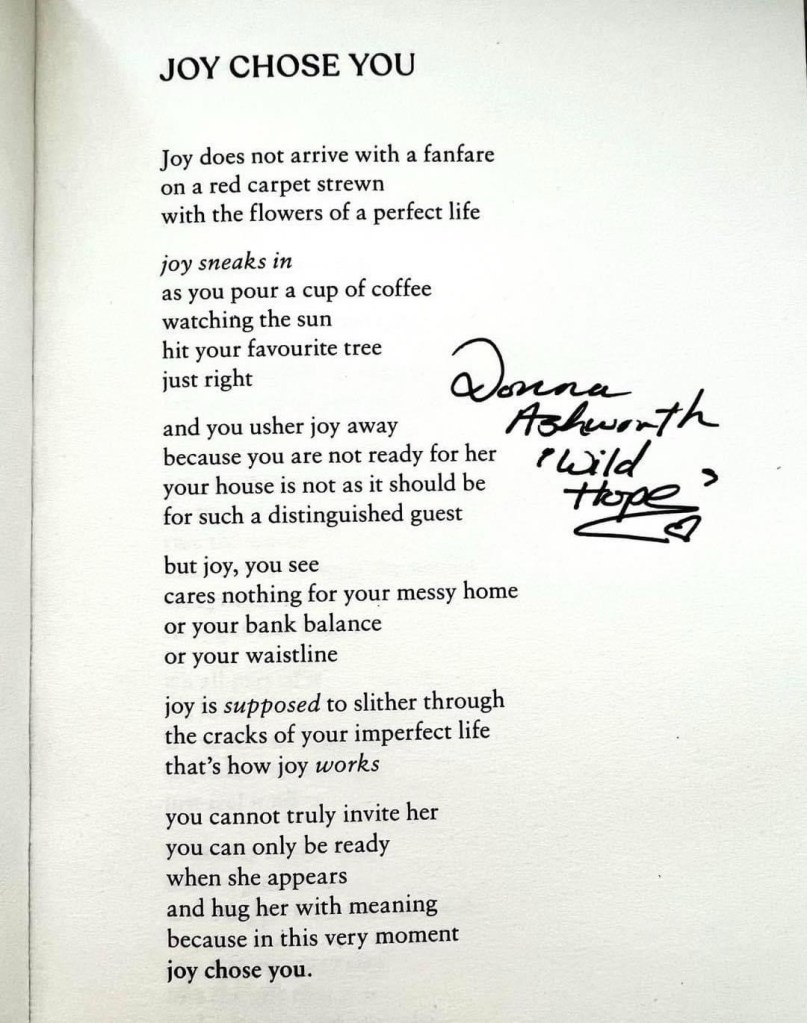
Enjoy this poem on joy by Donna Ashworth:

Doing things for the joy of doing them

When we were kids, we didn’t worry too much about whether we were the best at coloring or pretend or sports. We did things because they were fun and filled us with joy. Later, somehow, we became worried about whether we should continue when we were never going to be competitive in it. We worried about how we looked, whether we would be mocked. Perhaps our parents decided lessons were a waste because we weren’t the stand out they had hoped we would be. The fun of it got lost and gave way to the competition in it.

That’s a shame. Author Kurt Vonnegut had an epiphany about this that changed his life:

When I was 15, I spent a month working on an archeological dig. I was talking to one of the archeologists one day during our lunch break and he asked those kinds of ‘getting to know you’ questions you ask young people: Do you play sports? What’s your favorite subject? And I told him, no I don’t play any sports. I do theater, I’m in choir, I play the violin and piano, I used to take art classes.

“And he went wow. That’s amazing! And I said, ‘Oh no, but I’m not any good at any of them.’

“And he said something then that I will never forget and which absolutely blew my mind because no one had ever said anything like it to me before: ‘I don’t think being good at things is the point of doing them. I think you’ve got all these wonderful experiences with different skills, and that all teaches you things and makes you an interesting person, no matter how well you do them.’

“And that honestly changed my life. Because I went from a failure, someone who hadn’t been talented enough at anything to excel, to someone who did things because I enjoyed them. I had been raised in such an achievement-oriented environment, so inundated with the myth of Talent, that I thought it was only worth doing things if you could ‘win’ at them.

That’s such a liberating mind shift. Doing things for the joy of them! Not the achievement in them. Not the value to your college application. Not the resume value or the competition.

The joy! Imagine that.

Most this amazing day.

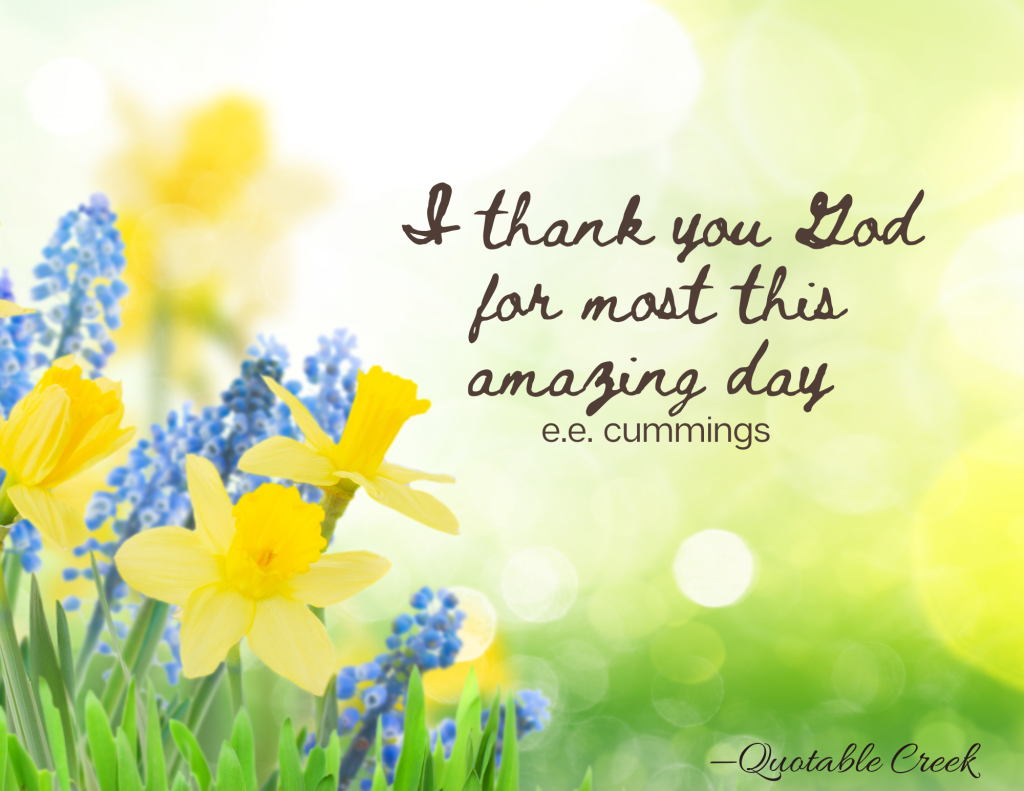
There are some poems that reach so deep, they become part of us that we can call up by heart. This is one for me, ‘I thank you God for most this amazing day’ is a phrase never far from my mind. Something about the inverted syntax seems to sum up that overwhelm, spilling over feeling of joy at creation, at being here in it, at the amazing miracle of it all.

Enjoy the whole poem. It’s spectacular.

i thank You God for most this amazing
day:for the leaping greenly spirits of trees
and a blue true dream of sky;and for everything
which is natural which is infinite which is yes

(i who have died am alive again today
and this is the sun’s birthday;this is the birth
day of life and of love and wings;and of the gay
great happening illimitably earth)

how should tasting touching hearing seeing
breathing any—lifted from the no
of all nothing—human merely being
doubt unimaginable You?

(now the ears of my ears awake and
now the eyes of my eyes are opened)

e.e. cummings

And for a real treat, here it is sung:

Happy spring!

Comfort time.

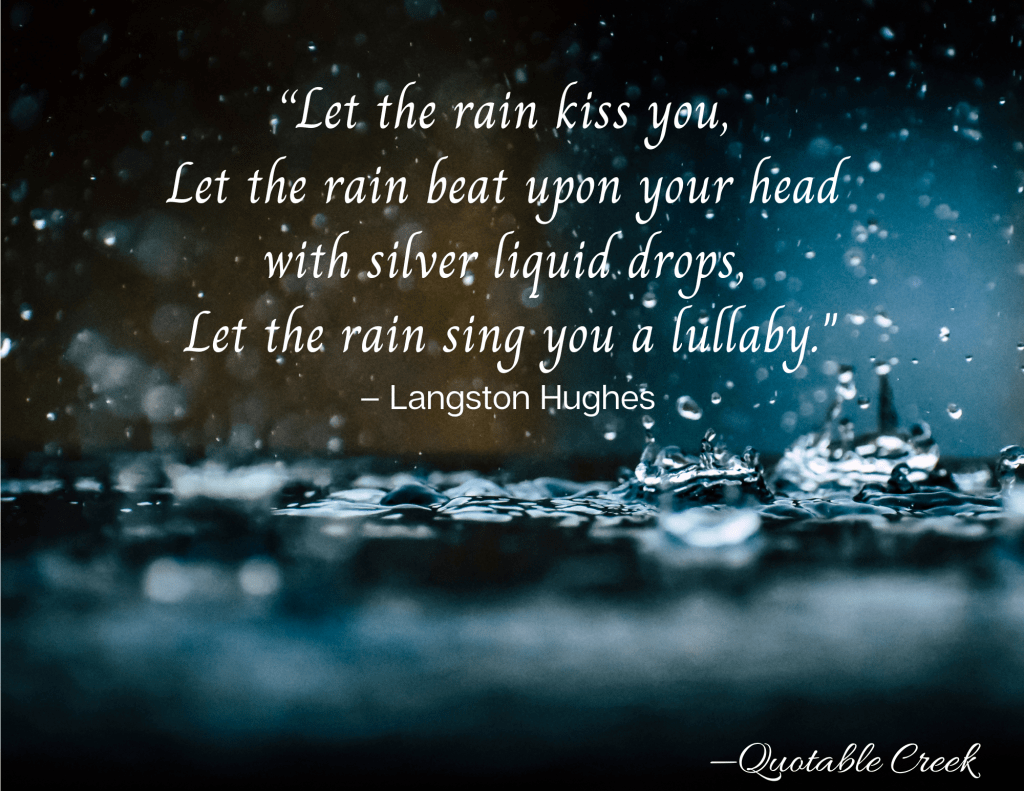
It’s raining here. Again. My drought tolerant landscape must be wondering what’s up. But I am safe, warm, and grateful. Today is a good day for comfort and the things that warm us. Enjoy this poem.

Joy is not made to be a crumb.

Joy is a fascinating emotion. It often springs up in us at surprising times. There is something of a wellspring vibe to it, as if it bubbles up in us with little bearing to our circumstance in life or particular experience. As C. S. Lewis notes,

“I call it Joy. ‘Animal-Land’ was not imaginative. But certain other experiences were… The first is itself the memory of a memory. As I stood beside a flowering currant bush on a summer day there suddenly arose in me without warning, and as if from a depth not of years but of centuries, the memory of that earlier morning at the Old House when my brother had brought his toy garden into the nursery. It is difficult or find words strong enough for the sensation which came over me; Milton’s ‘enormous bliss’ of Eden (giving the full, ancient meaning to ‘enormous’) comes somewhere near it. It was a sensation, of course, of desire; but desire for what?…Before I knew what I desired, the desire itself was gone, the whole glimpse… withdrawn, the world turned commonplace again, or only stirred by a longing for the longing that had just ceased… In a sense the central story of my life is about nothing else… The quality common to the three experiences… is that of an unsatisfied desire which is itself more desirable than any other satisfaction. I call it Joy, which is here a technical term and must be sharply distinguished both from Happiness and Pleasure. Joy (in my sense) has indeed one characteristic, and one only, in common with them; the fact that anyone who has experienced it will want it again… I doubt whether anyone who has tasted it would ever, if both were in his power, exchange it for all the pleasures in the world. But then Joy is never in our power and Pleasure often is.”

The Shape of My Early Life

Joy is distinct from pleasure and happiness. It is an abundance, a bliss, an immeasurable gratitude for the privilege of being. It isn’t meant to be ignored, but embraced, relished, cherished. Not as a byproduct of some other experience, but in itself.

As Mary Oliver says,

“If you suddenly and unexpectedly feel joy, don’t hesitate. Give in to it. There are plenty of lives and whole towns destroyed or about to be. We are not wise, and not very often kind. And much can never be redeemed. Still life has some possibility left. Perhaps this is its way of fighting back, that sometimes something happened better than all the riches or power in the world. It could be anything, but very likely you notice it in the instant when love begins. Anyway, that’s often the case. Anyway, whatever it is, don’t be afraid of its plenty. Joy is not made to be a crumb. (Don’t Hesitate)”

Swan, Poems and Prose Poems

If you should be lucky enough to feel joy bubbling up, savor it.

Choosing joy

Sometimes joy is a matter of perspective. It’s reaching down and being grateful for it all, the mess, the euphoria, the triumphs, and the tragedies. Grateful to be here, to have a voice, to have people to care about, to have a chance to make a difference. Joy in it all is a choice.

In Bread for the Journey, Henri Nouwen unpacks this further:

Joy is what makes life worth living, but for many joy seems hard to find. They complain that their lives are sorrowful and depressing. What then brings the joy we so much desire? Are some people just lucky, while others have run out of luck? Strange as it may sound, we can choose joy. Two people can be part of the same event, but one may choose to live it quite differently from the other. One may choose to trust that what happened, painful as it may be, holds a promise. The other may choose despair and be destroyed by it.  What makes us human is precisely this freedom of choice.

What is the promise behind the circumstances that threaten to steal your joy? Is there something hopeful there? Seeing that promise may just be the key you are looking for.

Joy shadow

How wonderful it would be to count all joy– to recognize the gift in the difficulty, to see the growth in the hardship, to see joy as a reflection of sorrow. Grief, despair, hopelessness, loss can hit so hard, it may feel like we will never feel joy again. And yet joy follows us like a shadow if we can pause to be grateful.

Then a woman said, “Speak to us of Joy and Sorrow.” 

And he answered: 

Your joy is your sorrow unmasked. 

And the selfsame well from which your laughter rises was oftentimes filled with your tears. 

And how else can it be? 

The deeper that sorrow carves into your being, the more joy you can contain. 

Is not the cup that hold your wine the very cup that was burned in the potter’s oven? 

And is not the lute that soothes your spirit, the very wood that was hollowed with knives? 

When you are joyous, look deep into your heart and you shall find it is only that which has given you sorrow that is giving you joy. 

When you are sorrowful look again in your heart, and you shall see that in truth you are weeping for that which has been your delight. 

Some of you say, “Joy is greater than sorrow,” and others say, “Nay, sorrow is the greater.” 

But I say unto you, they are inseparable. 

Together they come, and when one sits alone with you at your board, remember that the other is asleep upon your bed. 

Verily you are suspended like scales between your sorrow and your joy. 

Only when you are empty are you at standstill and balanced. 

When the treasure-keeper lifts you to weigh his gold and his silver, needs must your joy or your sorrow rise or fall. 

Khalil Gibran, Joy and Sorrow, Chapter Viii