Have you ever been at your wits’ end, and then someone’s kind words literally change your whole day and outlook? We can forget how simple words can make profound differences.
Consider this story from NPR:
STEPHANIE COLE: There I was in my black skirt and my white blouse and ready to go the first day. And I had been trained but very, very quickly. And as is true in a department store during Christmas, it was just bustling. You know how it is at Christmas, when everybody’s out shopping and everybody’s in a hurry and all these people around. This woman comes up to me with, I think, a Christmas tree ornament she wanted to buy, and I freeze. I just freeze. All of a sudden, I can’t remember anything. I can’t remember how to run the cash register. I can’t remember anything about the transactions. I am just absolutely frozen – and probably very close to tears. Just – I so wanted this to go right, and it was going so wrong.
She looked at me and paused and, with such a kind expression on her face, said, it’s all right. Take your time. I’m not in a hurry. And that was the release. All of a sudden, I could breathe, I could wait till somebody else could help me. It was going to be OK. It made such an impression that all these years later, not only do I still remember it, but I find myself – those words coming out of my mouth on numerous, many, many occasions over the years. You know, you encounter somebody whose first day on the job or they’re just having a bad day and things are really – you can tell they’re in a bad place. And you can say, it’s OK. I’m not in a hurry. Take your time. And it always makes the situation better. Always, always.
And so this woman, I can’t really remember her face – and certainly, she’s probably dead by now, given how old I was and how old she was – but she gave me that gift without knowing she gave me that gift, and it’s lasted all these years.
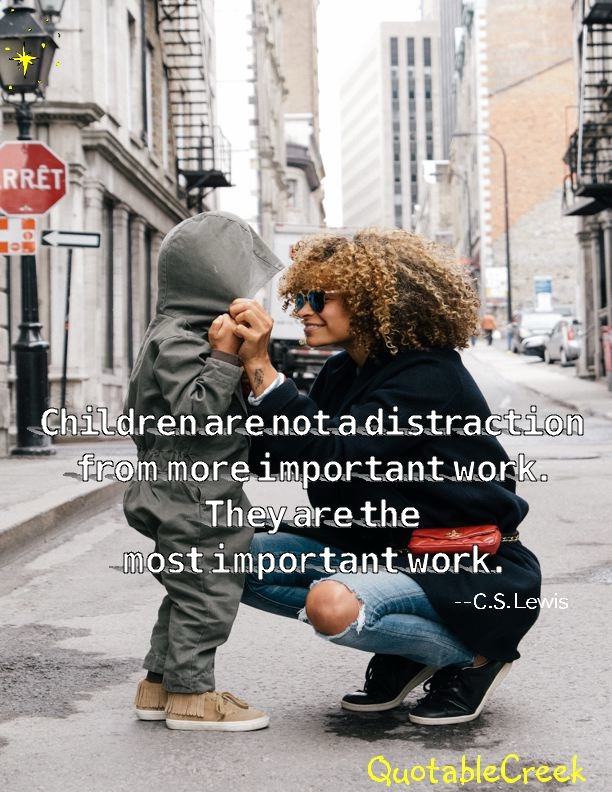
Jaqueline Kennedy once said that, “If you bungle raising your children, I don’t think whatever else you do matters very much.”
Our children are our highest priority. Through our love and attention, they can grow up believing in themselves and their ability to make a difference. For a fascinating discussion on how simple changes in the ways we speak to them and affirm their efforts can make profound differences in their future lives, go here.
It’s not about an A; it’s about engagement. It’s not about learning one skill; it’s about curiosity. It’s not about talent; it’s about effort. Simple shifts, profound results!
What can we do to help? The problems seem great, and we seem so small.
Consider these words from Pope Leo XIV:
“Do not be afraid. Be sprouts of peace where the seed of hatred and resentment is growing; be weavers of unity where polarization and enmity prevail; be the voice of those who have no voice to ask for justice and dignity; be light and salt where the flame of faith and the taste for life are fading.” — Pope Leo XIV
Every giant tree starts as a tiny sprout. Be sprouts of peace.
We have more control and are stronger than we think. What we do makes a difference. Let’s make it a good difference!
There is a Museum of Medieval Torture in Hollywood. Imagine that. All the creative and horrendous ways people came up with to hurt other people. And even in this ‘modern’ era, some people spend time thinking of creative ways to hurt others, including in our penal system where solitary confinement is perhaps one of the harshest. Or in our churches, where shunning, cutting someone off from the community with no further interaction, is still practiced in many faiths.
This cruelty can extend into our most intimate relationships and friendships when one person practices the silent treatment, shutting down communication completely over some perceived transgression. Or even when they ‘ghost’ someone, disappearing completely from another’s life and leaving no trace, with no warning or explanation. And these acts like the bed of nails or drawing and quartering or yore are torture, too, because they are intended to inflict pain and misery.
The silent treatment goes by many names: shunning, social isolation, stonewalling, ghosting. Although psychologists have nuanced definitions for each term, they are all essentially forms of ostracism. And the tactic is nothing new. Ancient Greeks expelled for 10 years citizens who were thought to be a threat to democracy, and early American settlers banished people accused of practicing witchcraft. Religions have frozen out individuals for centuries: Catholics call it excommunication, herem is the highest form of punishment in Judaism, and the Amish practice Meidung. The Church of Scientology recommends total “disconnection” from anyone deemed antagonistic toward the religion.
“My research suggests that two in three individuals have used the silent treatment against someone else; even more have had it done to them,” Williams said. Experts told me that although they need more data to know for certain, instances of the silent treatment have likely increased over the years as new forms of communication have been invented. “Every new method of connection can be used as a form of disconnection,” Williams said.
Ostracism can also manifest in lesser ways: someone walking out of the room in the middle of a conversation, a friend at school looking the other way when you wave at them, or a person addressing comments from everyone in a message thread except you. “Partial ostracism,” Williams told me, might mean monosyllabic replies—a terse period at the end of a one-word text message. But in serious cases, ostracism can take a heavy toll whereby victims become anxious, withdrawn, depressed, or even suicidal.
“Because we humans require social contact for our mental health, the ramifications of isolation can be severe,” Joel Cooper, a psychology professor at Princeton, told me. “In the short term, the silent treatment causes stress. In the long term, the stress can be considered abuse.”
And silent treatment hurts, not just the victim, but the perpetrator as well.
But the silent treatment ultimately harms the person causing it, too. Humans are predisposed to reciprocate social cues, so ignoring someone goes against our nature, Williams said. The perpetrator is therefore forced to justify the behavior in order to keep doing it; they keep in mind all the reasons they’re choosing to ignore someone. “You end up living in a constant state of anger and negativity,” Williams said.
One study found that social rejection provoked a response in its victims similar to that of victims of physical abuse; the anterior cingulate cortex area of the brain—the area thought to interpret emotion and pain—was active in both instances. “Exclusion and rejection literally hurt,” John Bargh, a psychology professor at Yale, told me.
So, in this modern era, what should we do when tempted to give someone the silent treatment? What can we do when we’re on the receiving end?
Perhaps the beginning of an answer is realizing just how damaging that type of behavior can be to ourselves, each other, and the relationship. Realizing that communication, no matter how fraught, is the way back into community. Appreciating that we were put here on this earth to do good, not harm.
I discovered a new word the other day that has me soul-searching. Gramnesia, a portmanteau combining ‘grandparent’ and ‘amnesia’. A grandparent experiencing gramnesia trots out recollections of the good, easy times they had raising their children, and brings those up in a way which can be a tacit criticism of the way those children are now raising their grandkids. In other words, someone experiencing gramnesia has forgotten the complete picture of parenthood.
While it’s natural to look fondly back on the years when your children were little, it may be problematic if you make those now grown children feel it is unnatural to struggle.
As Allie McQuaid says:
In a follow-up Instagram Reel, McQuaid explained that the main reason these comments are unhelpful is that they don’t change the things parents of young kids are struggling with and they minimize the very real stress they’re facing.
“Our boomer parents telling us that we didn’t cry ever (whether that’s true or not is up for debate apparently..) doesn’t change the fact that OUR baby now is crying and needs our care,” McQuaid wrote.
Instead of judging or comparing, perhaps it would be more helpful for grandparents to be curious. What might they learn and discover from how their children are showing up now as parents?
Parenting techniques change. Smacking someone with a paddle may have been acceptable once, but now it’s illegal, for instance. Priorities change. Keeping up with the Joneses or maintaining appearances may not be as important to your kids as quality time with their kids. Perhaps the gramnesiac will have something to learn. and perhaps, too, they’ll discover a way to help, something they may have greatly appreciated when they were going through the challenges of raising children.
And also, as hard as it is to be vulnerable and discuss the hard times, those stories, call them ‘momeries’, (portmanteau of mom and memories) may make your child feel hopeful and encouraged as they shoulder parenting duties, that times will be both tough and rewarding beyond their wildest expectation.
Communication can be tough, particularly after a long silence. Finding inroads, healing thaws, rediscovering common ground takes effort.
Sometimes it’s nice to have a game plan before going into what might be an emotionally-charged conversation.
Consider this one:
So often we get lost in who’s right, who’s wrong. But is that really the point? Harsh words are often spoken in just such a competition to be right. Often the words cause more harm than the original conflict. Is right/wrong really the best way? Especially when the objective is to try to get a friendship back on track.
Being gentle, vulnerable, attentive is true strength. Moving through the world with a genuine sense of curiosity rather than an avowed sense of your own rightness can open the door to a better appreciation of someone else’s point of view and a greater chance of improving, rather than destroying, the remnants of a relationship you hope to save.
A guy cuts you off in traffic. How do you see him? Is he an inconsiderate lout caring little for the aggravation he causes you or a distracted hapless soul, perhaps late for an emergency? How we see this situation, or any situation, can have a profound effect on our lives.
In this thoughtful essay, Elizabeth Gilbert considers the power of perception. She recounts a time when her father and his siblings were reminiscing about their late mother and how she used to take a sip from any glass of milk she poured for them. They agreed on the fact, that she took a sip, but wildly disagreed on their perception of that fact:
At one point, they found themselves sitting around the old kitchen table, eating sandwiches and talking about the past. My uncle, the baby of the family, looked at the refrigerator and said, “I can still see Mom standing there, pouring me a glass of milk. Do you remember that sweet thing she always used to do whenever she got us a glass of milk? Remember how she’d take a tiny sip first, to make sure it wasn’t spoiled? Always looking out for us.”
My father, the analytical engineer of the family, raised his eyebrows. “No,” he said. “You are so wrong. Mom wasn’t sipping our milk to test it for freshness. She was sipping our milk because she always overfilled the glass. She had no sense of spatial relations. It used to drive me crazy.”
My brilliantly sardonic aunt looked at her two brothers like they were the biggest idiots she’d ever seen.
“You’re both wrong,” she said. “Mom was stealing our damn milk.”
So, what have we learned about my grandmother from this story? Was she a devoted caregiver, an incompetent dunderhead or someone who would steal the milk out of the mouths of her children? (Or maybe just an exceptionally thirsty woman.) The world will never know the truth.
But does the truth really matter?
I don’t think so.
Wow! What a remarkable difference in what each brings to the encounter. Now imagine yourself in each of those mindsets: hostile, critical, or grateful. Which would lead to the happier life?
We don’t have control over facts, but we sure have a tremendous amount of control over how we perceive those facts. We owe it to ourselves to try to see the facts in the most favorable light even if that means consciously going over all the possible interpretations of something and actively selecting the best one to pick.
The Japanese Macaques, snow monkeys, are a deeply hierarchical society, their status in the group inherited from their mothers. Living in frigid temperatures, the upper class snow monkeys spend their time in natural hot springs, leaving the rest to huddle in the snow and look on as they luxuriate. The Emperor Penguins also live in frigid conditions, huddled together, but they constantly rotate, letting those most exposed on the outside come to the center for warmth. They take turns. It keeps those in the center from overheating and those on the fringes from freezing.
Sharing is an interesting phenomenon. It’s easy to see that when a society shares its resources, the whole group benefits, but how does that play out in the human species? Do we see the benefit to the whole group from sharing what we have, or do we focus on clutching more and more into our own fists? Some humans are uniquely able, it seems, to rationalize selfish behavior even when looking directly at the needs of others. But others consider their own resources an opportunity to help others. This is true both on an individual level, and on a larger societal level. It’s an interesting matter of perspective.
Friendships are taking a hit these days. Politics, world views, differing opinions are tearing people apart.
What is it that holds people together instead?
One thing is an abiding concern for the other person, despite your differences. If you can advocate against the death penalty on behalf of a stranger, couldn’t you bring yourself to see what is good and redeemable inside a former friend? Inside an enemy even? Searching for common ground is hard work, but really the main point of living in community. Isn’t it?







 QuotableCreek.com