Shining light

In all the din, what is one voice more? Why bother speaking up? No one seems to listen to each other anymore anyway.

But inside you is a well spring, and you’re fueled by truth and an honest desire to help others. Your opinion matters.

Consider these words from Marianne Williamson:

“Our deepest fear is not that we are inadequate. Our deepest fear is that we are powerful beyond measure. It is our light, not our darkness that most frightens us. We ask ourselves, ‘Who am I to be brilliant, gorgeous, talented, fabulous?’ Actually, who are you not to be? You are a child of God. Your playing small does not serve the world. There is nothing enlightened about shrinking so that other people won’t feel insecure around you. We are all meant to shine, as children do. We were born to make manifest the glory of God that is within us. It’s not just in some of us; it’s in everyone. And as we let our own light shine, we unconsciously give other people permission to do the same. As we are liberated from our own fear, our presence automatically liberates others.”

Who are you to speak up?

You are a child of God. Let God’s light shine on a dark world through your words.

Joy in the journey.

Sometimes our eyes and hearts are focussed so far in the distance, that we fail to see what is right in front of us. The people we spend our days with, the beauty surrounding us, the opportunities we have to make a difference. When we zoom in to the detail, the richness of the particular moment can be astounding and surprising. What a beautiful, remarkable world we live in. So full of complexity. Each person we see is as full of contradictions and surprises as we are ourselves. Each living or created thing we see is so full of detail.

Long-term goals are great, but what a shame if we don’t appreciate each step along the way. We may work side by side with someone but barely know their name let alone what their hopes and dreams are. We may be so busy moving forward that we are blind to the heartache of even the people we live with. It is easy to speed through life with eyes averted like people descending in an elevator focussed only on the floor numbers.

Today take time today to enjoy the journey, the mysteries unfolding all around you, the people who share your path, and all the beautiful and startling things right here, right now.

Like, for example, who can not stop and be amazed at this little beagle shaking its jowls, its great ears flopping to the beat, its sturdy paws holding on in front but shifting with its wagging tail in back, the gorgeous landscape behind it? What a fascinating little miracle, right here. Just this.

Kind through and through

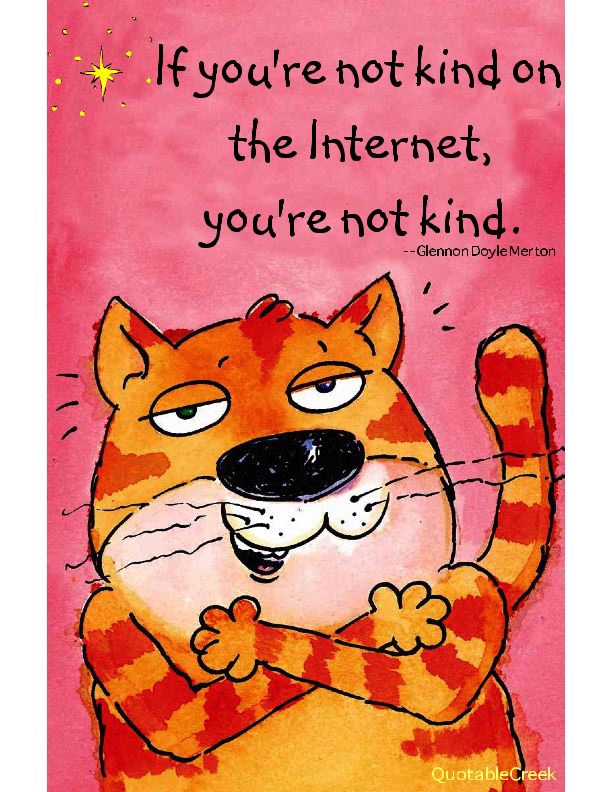
How do you behave when you can be completely anonymous? The internet can shield us from face-to-face contact, and for many people that can lead to snark….or worse. As Glennon Doyle points out, the internet itself is neutral. We bring to it what we are. We get out of it what we seek:

The internet is neither good nor bad. It’s neutral—it becomes for each of us exactly what we bring to it. In our real life and our internet life, we live inside whatever we build. Since we are spending more and more of our lives online, our internet selves must be decent, courageous healers so we can inhabit communities of tolerance and humanity.

Here are a few gut checks:

1. Remember, you are what you post.
Integrity means there is not a real-life you and an internet you. The two are one and the same. If you’re not kind on the internet, you’re not kind.

2. Post with intention.
Before you hit send, ask yourself: Why am I sharing this picture, meme, idea, article? Is your true motivation to spread joy, encourage, enlighten, teach? Or is it to brag? To shame someone? If your intention is pure, then the response will be, too.

3. Dispense compassion.
When people express opinions that differ from yours, take it as a chance to grow. Seek to understand over being understood. Be curious, not defensive. The only way to disarm another human being is by listening.

For those of us with Facebook feeds who follow sites other than just friends and family, we can choose whether we follow fake news or hateful sites. Instead, we can choose sites that help expand our knowledge and compassion. Our feeds are like gardens we can choose how to plant.

And we always have a choice of whether we want to pass on snark, or hate, or false information, or sarcasm. Whether we want to pile on a mob mentality of attack and destruction.

We can choose to make our responses to other people’s posts measured and kind, to rely on facts rather than innuendo, and to simply not respond. We can help build the type of world we want to see, right here on the internet.

Hurting words.

I’m a huge Ted Lasso fan. When an episode ends, I actually groan. This week was a powerful demonstration of how important words are, how the things we say can impact a person for years (for good or bad), and how important genuine, heart-felt communication is to heal old wounds.

Here is the bit I mean. < spoilers>

Tough guy Roy Kent was hurt by the blunt criticism of his skills written in an article by reporter Trent Crimm from Roy’s first game when Roy was just 17. Roy still carries the article around in his wallet decades later.

Do you have any words like that that you’re still metaphorically carrying around years later? Perhaps we remember a mentor’s encouragement that sparked our interest or passion in a chosen career. Perhaps, sadly, we still struggle under the weight of words by someone who condemned us at our worst, saw as as inadequate or a failure. someone who felt we would never measure up.

Words have heft to weigh us down or sustain us. We need to remember that when we choose ours.

Care for the caretakers.

Today, I want to lift up the caregivers. Whether for an aging parent, ailing spouse, struggling child, or young grandchildren, or all or some of these together. It takes a good person to care and do their best to help.

Rosalyn Carter made this insight:

There are only four kinds of people in the world: Those who have been caregivers. Those who are currently caregivers. Those who will be caregivers. And those who will need a caregiver.

We are all interconnected. We all will experience a time when we need help and times when we can offer help. It is a blessing to care about others and to let others care for us. Caring is at the heart of every good thing done in the world.

So, to the caregivers: may God bless you. Your work is making a better world.

Exercising your compassion muscle.

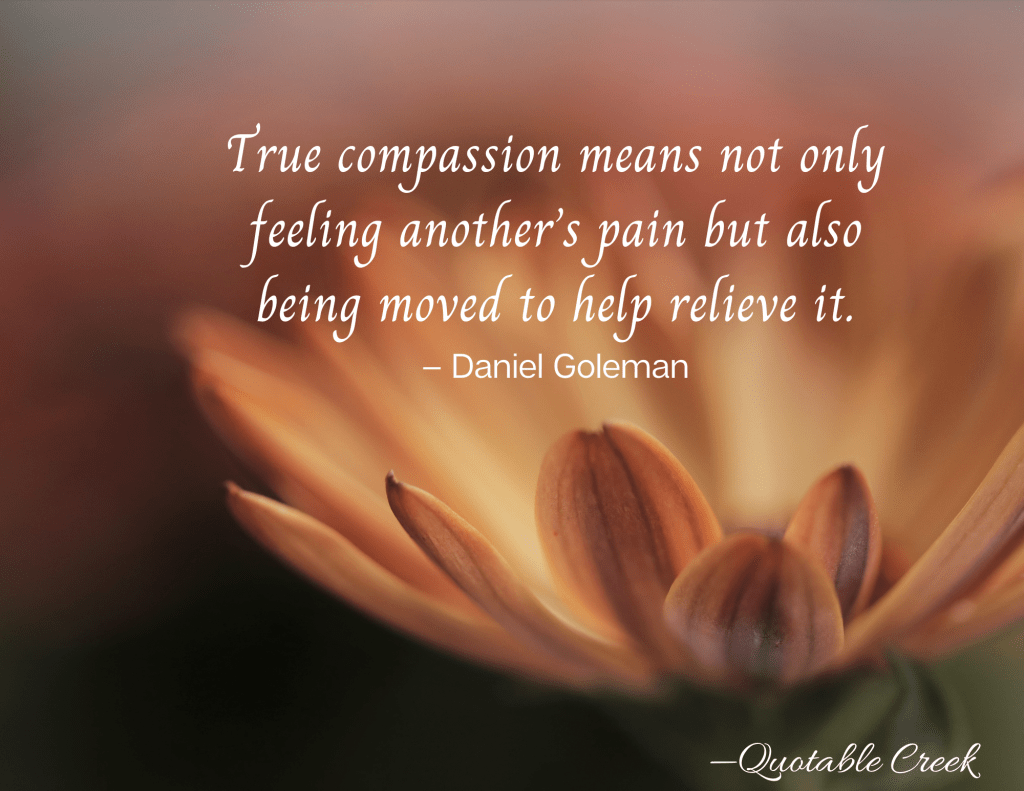
Compassion is an active, engaging emotion. It recognizes that another’s pain is as important as your own and seeks to help alleviate it. It is the emotion behind all social justice reform.

Compassion comes from empathy which is very different from sympathy. Dr. Eric Perry describes the two like this:

To better understand empathy, it is important to distinguish it from sympathy. Sympathy is the ability to understand another person’s situation from your point of view. It is a self-centered point of view that helps you understand what the other person is going through based on your own circumstances. You are able to acknowledge how the other person is feeling but, from a distance. You do not become emotionally connected to the person. For example, you are able to sympathize with someone having problems in their relationship because you have had problems in your own relationship. You do not feel what they are feeling but you have an understanding of what they are experiencing.

Empathy is a bit more complicated and abstract. In order to experience empathy, you must have the ability to identify the emotion and to place yourself in the other person’s position. The focus of empathy is self-less. You are experiencing another person’s emotional life by your ability to connect with them. In a sense, you are vicariously feeling the emotion. For example, through empathy, you are able to feel a stranger’s loss of a child, even if you are childless, by seeing the loss through their perspective. Through this connection, you are able to wear the emotional skin of another and essentially feel with them.

The inability to imagine yourself in someone else’s place in order to understand what they are feeling will result in difficulty in connecting with others.

Narcissists and sociopaths can feel sympathy. They use their knowledge of a person’s emotions, not to help them, but to manipulate and control them. But the empathetic person shares the pain of another and works to alleviate it.

The good new is that compassion is like a muscle and can be practiced and strengthened. In this fascinating article by Greater Good, they outline some steps for increasing your empathy.

They identify four goals to the practice:

  • Bringing attention or awareness to recognizing that there is suffering (cognitive)
  • Feeling emotionally moved by that suffering (affective)
  • Wishing there to be relief from that suffering (intentional)
  • A readiness to take action to relieve that suffering (motivational)

https://greatergood.berkeley.edu/article/item/six_habits_of_highly_compassionate_people

The article is well worth a few minutes to identify and exercise these compassion strengthening muscles. Flex!

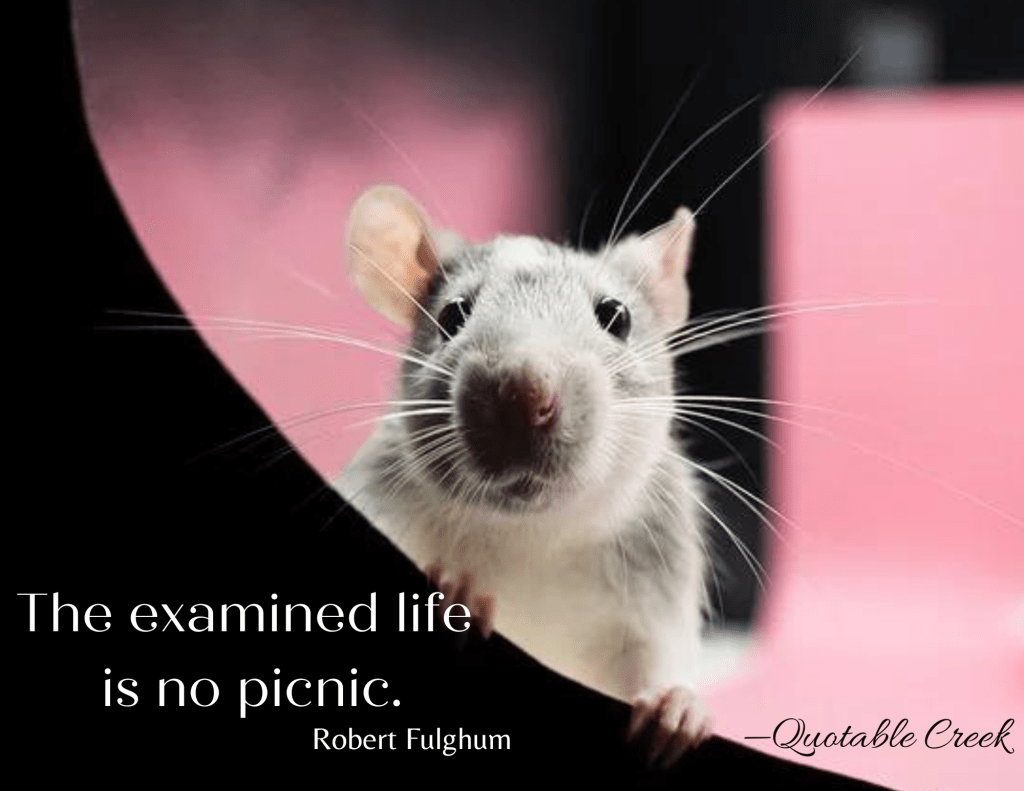
The importance of self reflection.

We’ve always done it this way. Have you heard this? Said it? Maybe it’s time to look at ‘it’ with fresh eyes.

The same is true for the way we act, think, believe. Take a look. Is there anything there that is worth a reconsideration?

As we age, it’s easy to fall into ruts, easy to believe our way is the right way, easy to assume any problems are the other person’s fault.

Self-reflection, hard, soul-deep reflection, the kind of reflection that might be filled with regret and tears and epiphanies and apologies, is a good tune-up for our inner selves. Without it, there will be no progress.

Difficult people.

Do you  have any difficult people in your life? Chances are you can’t force them to be less toxic, but there are steps you can take to be less bothered by the encounter. In this article by Christine Carter, she suggests, among other things, that showing mercy to this difficult person will rebound to you:

Anne Lamott defines mercy as radical kindness bolstered by forgiveness, and it allows us to alter a communication dynamic, even when we are interacting with someone mired in anger or fear or jealousy. We do this by offering them a gift from our heart. You probably won’t be able to get rid of your negative thoughts about them, and you won’t be able to change them, but you can make an effort to be a loving person. Can you buy them a cup of coffee? Can you hold space for their suffering? Can you send a loving-kindness meditation their way?

Forgiveness takes this kindness to a whole new level. I used to think I couldn’t really forgive someone who’d hurt me until they’d asked for forgiveness, preferably in the form of a moving and remorseful apology letter.

But I’ve learned that to heal ourselves we must forgive whether or not we’re asked for forgiveness, and whether or not the person is still hurting us. When we do, we feel happier and more peaceful. This means that you might need to forgive the other person at the end of every day—or, on bad days, every hour. Forgiveness is an ongoing practice, not a one-time deal.

When we find ways to show mercy to even the person who has cost us sleep and love and even our well-being, something miraculous happens. “When we manage a flash of mercy for someone we don’t like, especially a truly awful person, including ourselves,” Anne Lamott writes, “we experience a great spiritual moment, a new point of view that can make us gasp.”

Here’s the real miracle: Our mercy boomerangs back to us. When we show radical kindness, forgiveness, and acceptance—and when we tell the truth in even the most difficult relationship—we start to show ourselves those things. We realize that we can love and forgive and accept even the most terrible aspects of our own being, even if it is only for a moment. We start to show ourselvesthe truth, and this makes us feel free.

Perhaps you can show that difficult person mercy today.

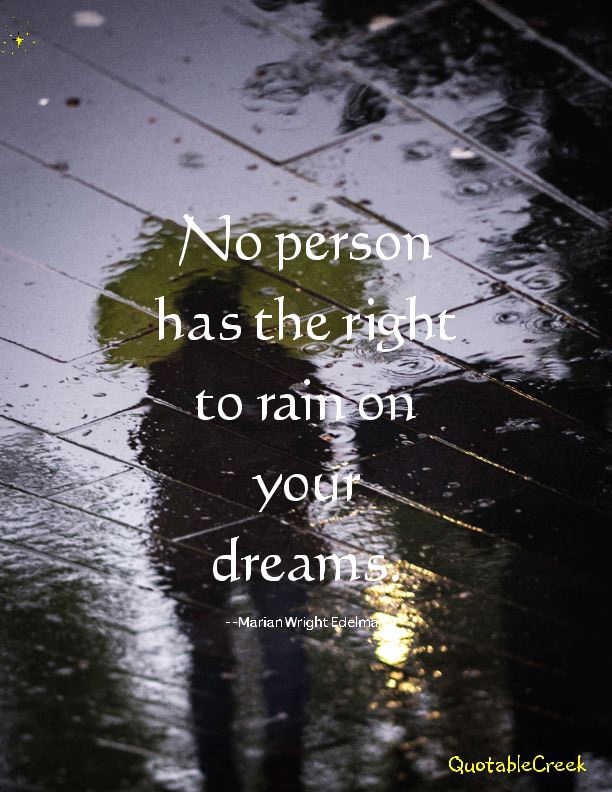
Rain

We can’t choose everything in life, but we can choose what kind of person we want to be.

As we deal with storms across the country and unprecedented blizzard watches here in Southern California, consider the importance of rain. Rain can be like encouragement, bringing nourishment and rebirth to dry parched land. It can promote an abundance of life and energy.

But, in excess, rain can cause flooding and landslides. It can sweep people away into rushing water and leave the landscape devastated.

Our words have the same power. We can be supportive and encouraging, fostering life and vitality in those we engage with. Or we can be harsh and critical, pessimistic and judgmental. Our words can both heal and wound. Our choice.

We can choose to be encouraging and supportive, rather than bleak and pessimistic.

We can avoid being the person who rains on someone else’s parade.

With whatever I have for as long as I can

With the news this week that former President Jimmy Carter has entered home hospice care, many people have been sharing stories about his accomplishments in office—his efforts for peace, his push for environmental stewardship, and his efforts toward energy independence, among others.

But his most striking accomplishments perhaps are what he has done since he lost his re-election bid. Rather than retreat to Georgia and exit the public arena, he began building houses for the poor, and working for democracy—a principle he firmly believed in—around the world, and standing up for women’s rights, even when that stand conflicted with his religion, and working to eradicate disease and so on. He has never stopped showing up to make a difference.

In a world that has grown more cynical and jaded since his entry into the public spotlight, he continues to show us what it means to walk the walk, quietly, humbly, and without fanfare. Here, surely, is a good and faithful servant of God.