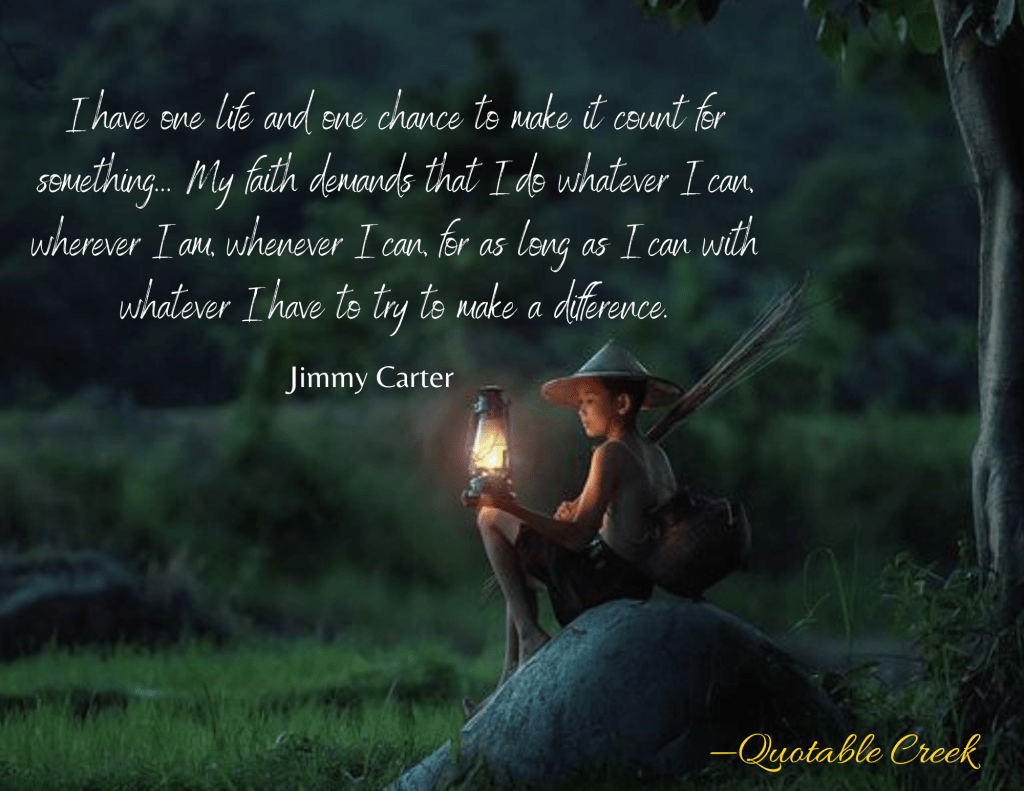
With the news this week that former President Jimmy Carter has entered home hospice care, many people have been sharing stories about his accomplishments in office—his efforts for peace, his push for environmental stewardship, and his efforts toward energy independence, among others.
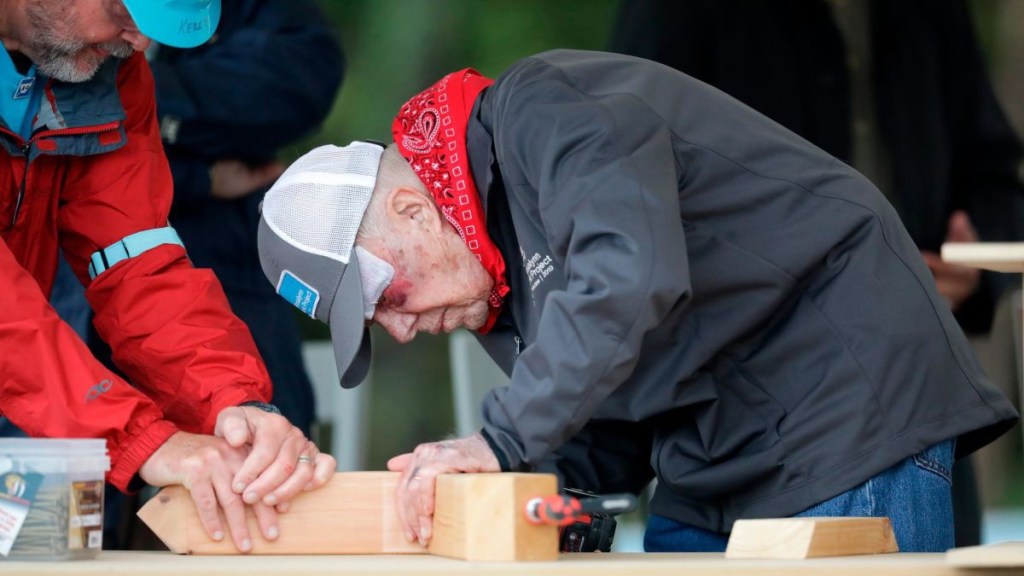
But his most striking accomplishments perhaps are what he has done since he lost his re-election bid. Rather than retreat to Georgia and exit the public arena, he began building houses for the poor, and working for democracy—a principle he firmly believed in—around the world, and standing up for women’s rights, even when that stand conflicted with his religion, and working to eradicate disease and so on. He has never stopped showing up to make a difference.
In a world that has grown more cynical and jaded since his entry into the public spotlight, he continues to show us what it means to walk the walk, quietly, humbly, and without fanfare. Here, surely, is a good and faithful servant of God.
Many trees these days looks dead. And yet spring will come. Bulbs planted long ago under frigid ground are even now pushing out sprouts working their way to the surface. Spring will come.
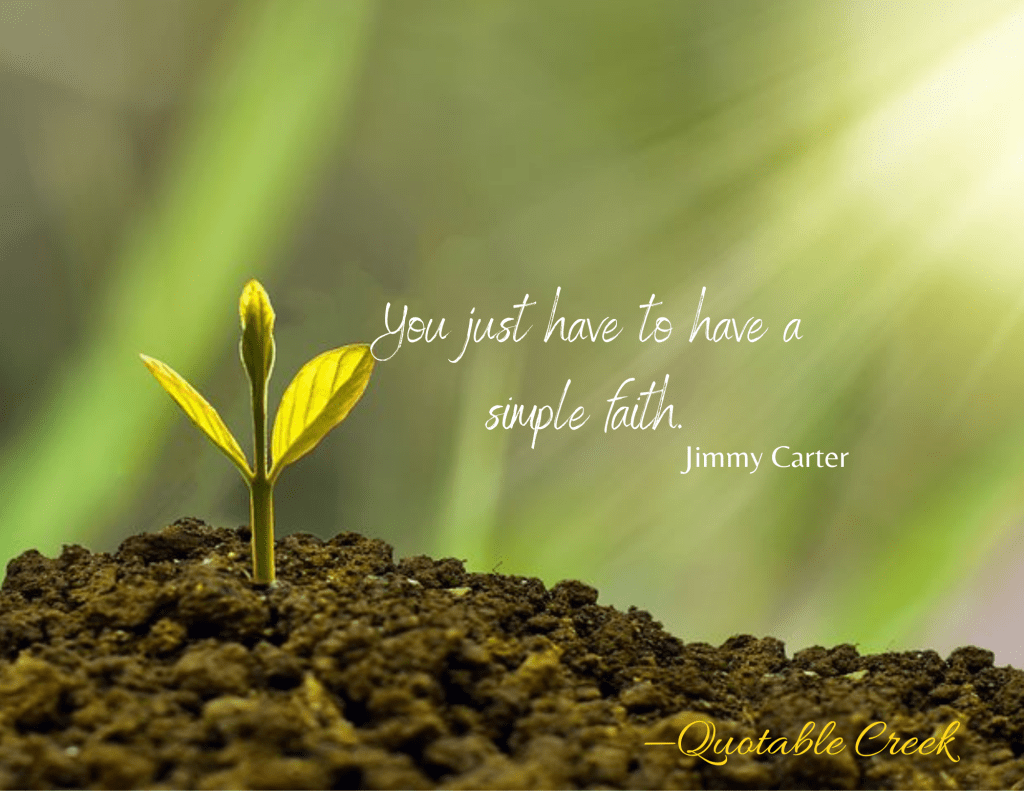
Believing in spring is a bit like an act of faith. Things look bleak and dead, yet we hope for new life and regeneration. Renewal. what was broken can be mended. What was lost can be found. Those who have given up can find hope.
As we hear news that former President Carter is receiving hospice care, I pray his faith sustains and comforts him and his family, and that they find peace. In his words:
God is not my personal valet. God does not build a protective fence around my life, keep me from trouble, fulfill my personal desires, or guarantee my success. However, through prayer God offers me comfort, reassurance, satisfaction, courage, hope, and peace.”
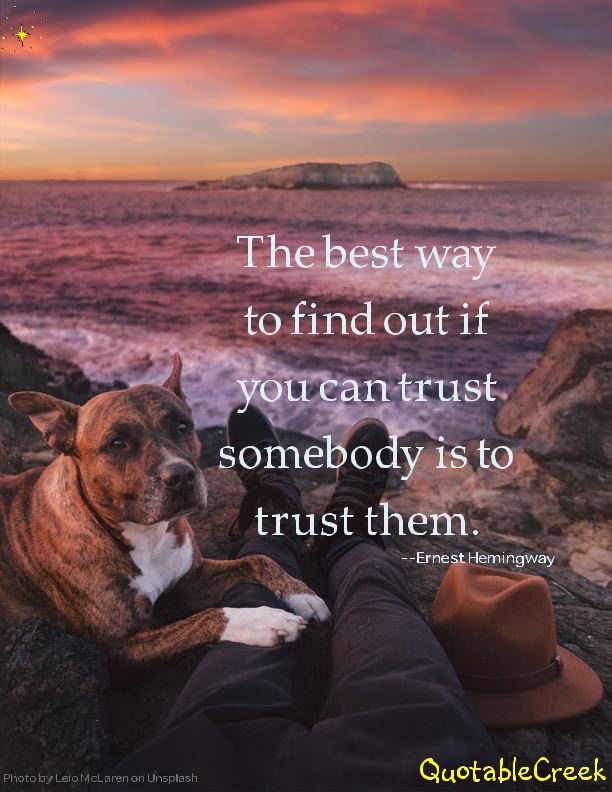
How often do we give others the benefit of the doubt? Do we assume the innocent explanation or conclude the worst? Are we patient, or do we pounce at the very first mistake someone makes in trying to get their thoughts out? Do we search for the best in others, or do we protect ourselves in advance about the damage we fear may be inevitable by opening our hearts to trusting someone again?
Wouldn’t it be lovely to live in a world where everyone gave everyone else the benefit of the doubt? Where perceived offenses weren’t allowed to fester and grow? Where there was trust?
Consider this beautiful poem on friendship by Dinah Maria Craik. Isn’t this how we would like to make each other feel?
Friendship
by Dinah Maria Craik
Oh, the comfort —
the inexpressible comfort of feeling safe with a person —
having neither to weigh thoughts nor measure words,
but pouring them all right out,
just as they are,
chaff and grain together;
certain that a faithful hand will take and sift them,
keep what is worth keeping,
and then with the breath of kindness blow the rest away.
What do we regret most as we contemplate the end of our time here? Maybe the lesson from that regret can inform our present. In an outstanding commencement speech, George Saunders reflects on his own failures and encourages the graduating students to look for opportunities to be kind. He reflects on a memory haunting him from his childhood:
In seventh grade, this new kid joined our class. In the interest of confidentiality, her Convocation Speech name will be “ELLEN.” ELLEN was small, shy. She wore these blue cat’s-eye glasses that, at the time, only old ladies wore. When nervous, which was pretty much always, she had a habit of taking a strand of hair into her mouth and chewing on it.
So she came to our school and our neighborhood, and was mostly ignored, occasionally teased (“Your hair taste good?” — that sort of thing). I could see this hurt her. I still remember the way she’d look after such an insult: eyes cast down, a little gut-kicked, as if, having just been reminded of her place in things, she was trying, as much as possible, to disappear. After awhile she’d drift away, hair-strand still in her mouth. At home, I imagined, after school, her mother would say, you know: “How was your day, sweetie?” and she’d say, “Oh, fine.” And her mother would say, “Making any friends?” and she’d go, “Sure, lots.”
Sometimes I’d see her hanging around alone in her front yard, as if afraid to leave it.
And then — they moved. That was it. No tragedy, no big final hazing.
One day she was there, next day she wasn’t.
End of story.
Now, why do I regret that? Why, forty-two years later, am I still thinking about it? Relative to most of the other kids, I was actually pretty nice to her. I never said an unkind word to her. In fact, I sometimes even (mildly) defended her.
But still. It bothers me.
So here’s something I know to be true, although it’s a little corny, and I don’t quite know what to do with it:
What I regret most in my life are failures of kindness.
Those moments when another human being was there, in front of me, suffering, and I responded . . . sensibly. Reservedly. Mildly.
We all have so many opportunities to make a difference, just by simply being kind, offering a smile, reaching out in friendship. And, when we reflect on the kindnesses that have made the difference to each of us in our own lives, we realize those little shows of kindness are what matter.
Saunders continues to remind each of us that our inner selves, our souls, shine as brightly as ever, and, even as we strive for success, to keep checking in with that inner place, and to believe it exists and greet the world from there:
Do all the other things, the ambitious things — travel, get rich, get famous, innovate, lead, fall in love, make and lose fortunes, swim naked in wild jungle rivers (after first having it tested for monkey poop) – but as you do, to the extent that you can, err in the direction of kindness. Do those things that incline you toward the big questions, and avoid the things that would reduce you and make you trivial. That luminous part of you that exists beyond personality — your soul, if you will — is as bright and shining as any that has ever been. Bright as Shakespeare’s, bright as Gandhi’s, bright as Mother Teresa’s. Clear away everything that keeps you separate from this secret luminous place. Believe it exists, come to know it better, nurture it, share its fruits tirelessly.
When you are confronted with a choice, err in the direction of kindness.
Rob Kenney has a YouTube channel Dad, How Do I? where he teaches his nearly 3 million viewers how to do stuff. He got the idea for his channel wondering about the kids growing up without dads and wanting to help fill that space for them, teaching them how to tie their tie, do their taxes, check their oil, plant a tree, and so on. He tells them he’s proud of them.
What a sweet idea. And resource! But, more importantly, how wonderful it is to see someone consciously being a positive role model, using his know-how to help others, and trying to fill a void.
The truth is we all have the potential to be role models. Whether it’s how we behave under pressure, handle a crowded line, or talk with someone who disagrees, our actions matter. People will see us and think about whether they want to follow our example. We have a responsibility to be a good one.
In a week of mass shootings and other discouraging news, we need a dose of Mr. Rogers, a man who believed passionately in the value of children, just as they are, and dedicated his life to teaching them to manage and express their feelings. What a hero he was.
In this clip from 1969, he makes his case. His lessons are as important today as they were then. Take a listen.
The Parable of the Good Samaritan is well known. In short, a man lies helpless and injured in the road. Religious leaders rush past offering no assistance, while a Samaritan stops and offers the wounded man succor and solace.
What makes one person stop to help while others rush by? Is it the belief that helping is the right way to show up in the world? A religious mandate even? Or is there more to it?
In a famous study at Princeton, researchers evaluated a group of seminarians, specifically discussing the Parable of the Good Samaritan, and then sending them to a task, indeed to lecture on the very parable, where they would necessarily walk right past someone needing help. Even with the parable fresh on their minds, the future pastors for the most part walked right by. Presumably these were nice people who intended to spend a lifetime in service. And yet, they walked right by. They acted in a way incongruent with their professed beliefs.
A surprising result to say the least. But the conclusion from the experiment was that the biggest influencer in whether they stopped to help was not their religious beliefs or their innate kindness, but their perception of time. The more of a hurry they were in, the less likely they were to help.
So how does this inform our choices?
A general kind intent to help is not enough. We are all the Princeton Divinity Students rushing to our next important task and potentially neglecting the plight of others right in our path. We must slow down the clock and really see the people around us. And we need to be ok with the idea that our plans and schedules might be disrupted. Surely stopping to help someone in need will change your day, will inconvenience you, and cause you to spend time and perhaps money in an unplanned way.
But the help you might be able to offer someone in need could be invaluable.
One good thing to come out of despair is the ability, once you are past it, to help someone in the middle of it realize that things will get better, that this, too, will pass. It’s as if we are all climbing our way out of a pit and reaching up to grab the hand of someone who has already made it out. Being able to reach your hand down to someone still in the pit is a blessing from something awful you may have gone through.
Along these lines, was the It Gets Better movement started several years ago, with prominent people from the LGBTQ community sharing their stories to help others who were struggling and feeling desperate.
Perhaps your last few years have been filled with grief. Certainly for many the pandemic has been a season of loss—of community, of norms, of freedoms, and, for many, of loved ones.
As you go forward, remember that we are each other’s support. We are each other’s comfort and hope. Reach out to each other.
For a very powerful rendition of R.E.M.’s, Everybody Hurts, listen to this rendition by priest, Father Ray Kelly. I stumbled onto this video several years ago, and it recently popped up again. I need to store it in a safe place to rewatch as needed. For me at least, it touches the soul and gives me solace.
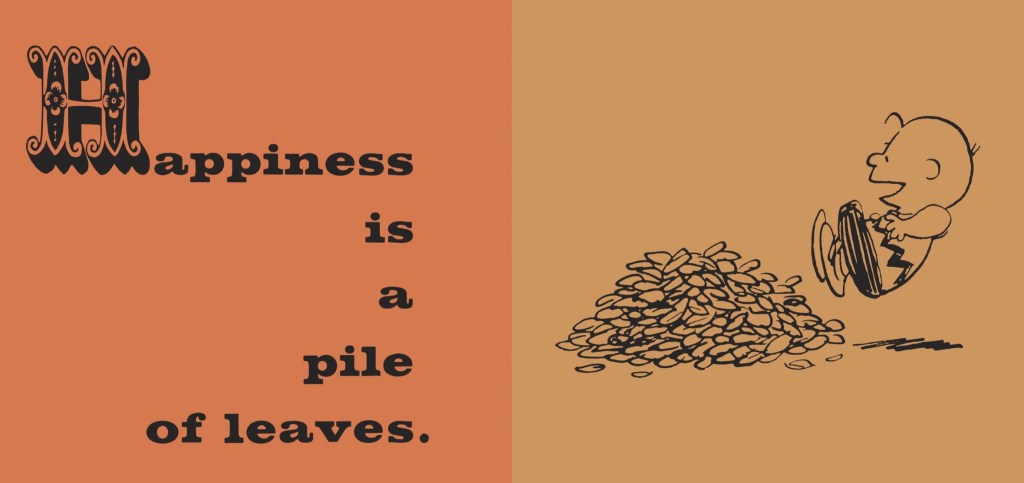
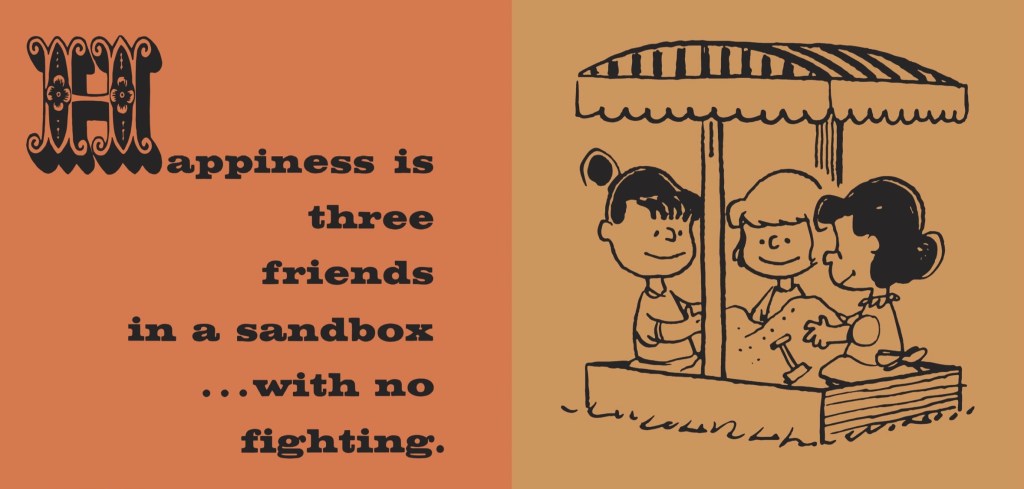
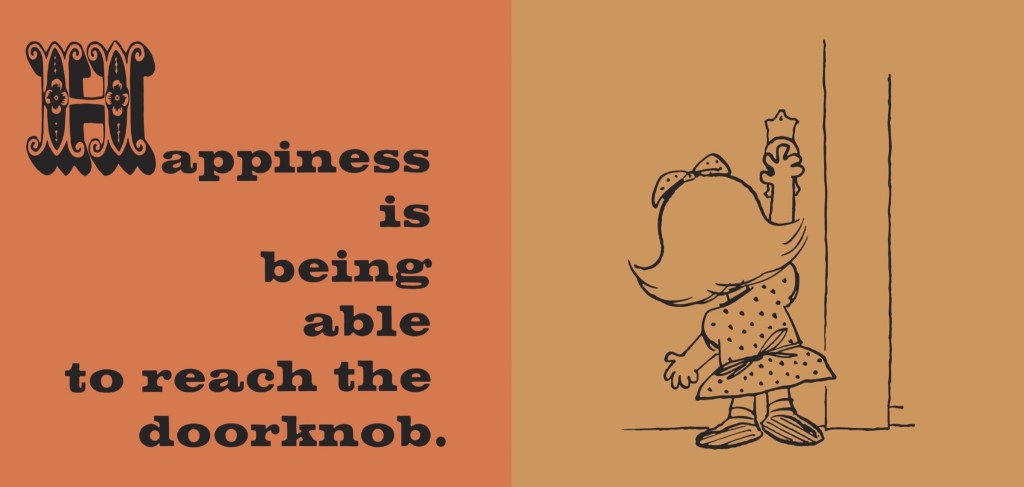
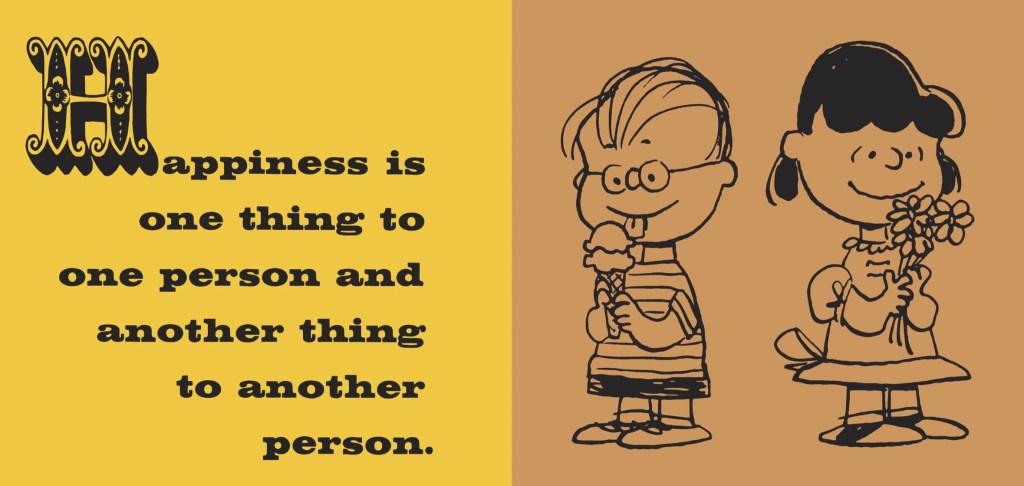
When I was young, I had the book Happiness is a Warm Puppy by Charles Schulz. I was remembering it lately with all the charming little moments it caught:
Each page captures a delightful, sweet, innocent, but meaningful, moment in the life of a child. Each attempting to capture that ineffable notion of happiness. I thought it would be fun to start collecting my own when I feel that surge of happiness, that feeling that all is right in the world, and I’m incredibly lucky and content.
Here are a couple of mine:
Happiness is…
The finches discovering their feeder.
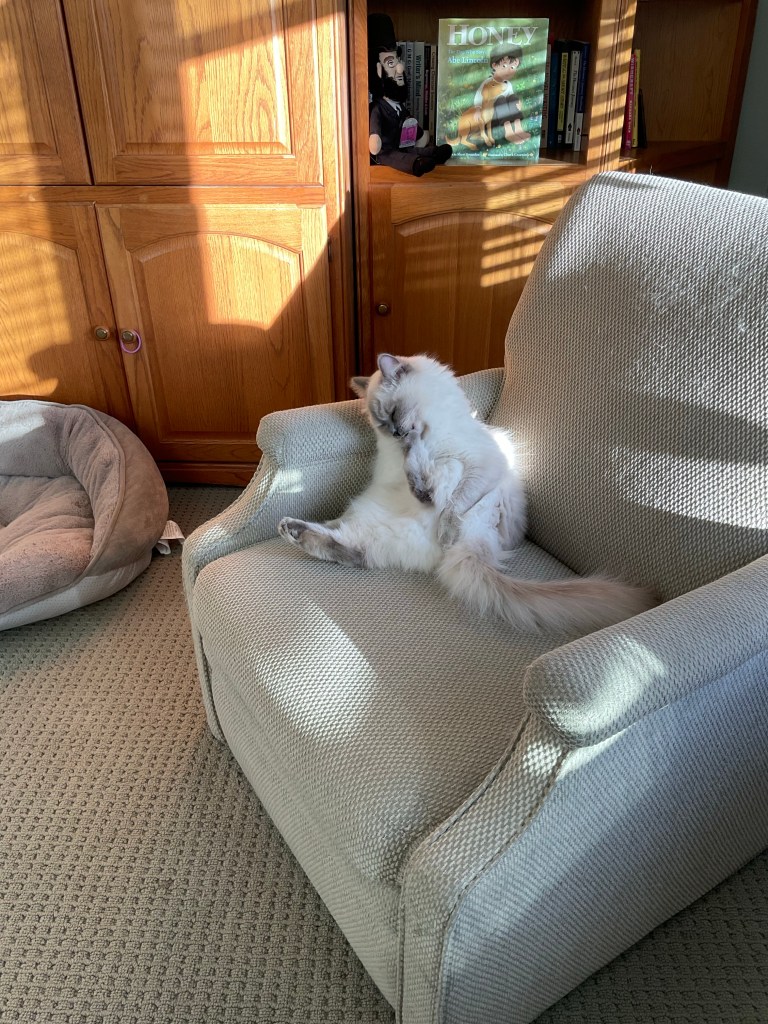
Happiness is….
The cat keeping you company while you work.
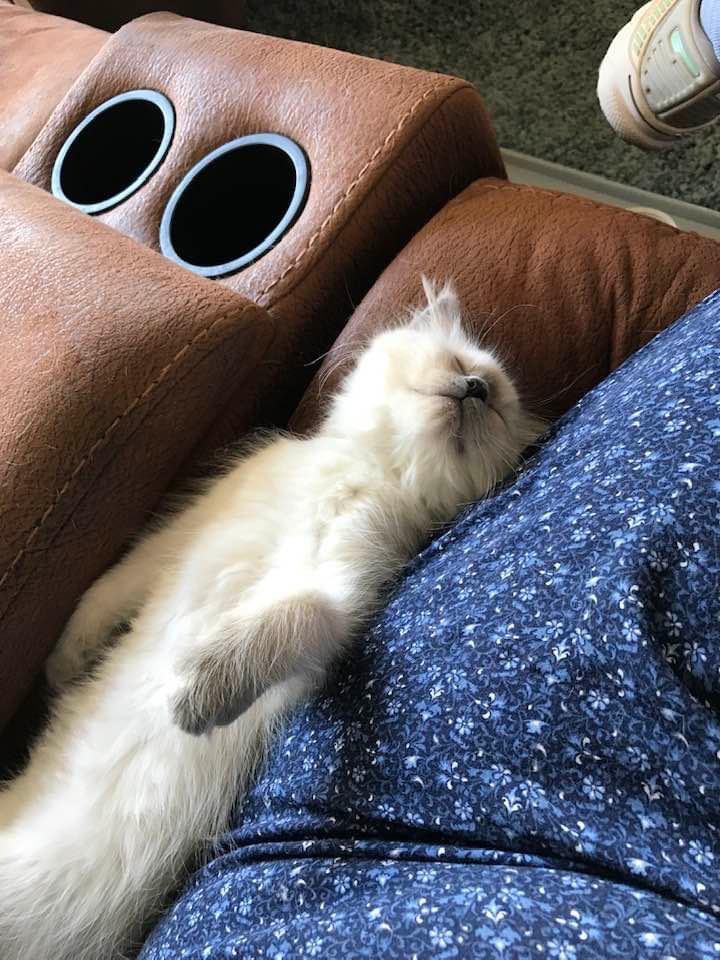
Happiness is…
Being unable to move because the cat picked your lap.
And the list goes on. We each have moments that fill us with happiness and wonder. They slip away quickly because they’re ephemeral. But if we capture them somehow, in a gratitude journal, with a photo album, a list, we can turn to them later and smile. These are our ‘moments’
Schulz recognized that for each of of us, those moments will be unique and personal.
What are some of yours? If you feel comfortable doing so, I would love it if you shared them.
The new year brings with it an expectation to reflect and set intentions for how to perhaps improve from the last. Often these reflections result in an examination of all the ways we’ve fallen short and a profession to do better, eat better, exercise better…be better. Often the premise unspoken is that we’re not enough, we must improve, be different.
I wonder if there is a better way to start a new year. Perhaps in astonishment that we have made it through a year filled with so many challenges and yet we persisted. Perhaps filled with gratitude that our opportunities to contribute and bring joy to others continues. Perhaps thinking about all the small wonders that make up our life and rejoicing.
Each new year is an opportunity to wake up with the enthusiasm of Scrooge after his ghostly visits and realize that here we are, in the thick of it, able to love and be loved, able to contribute, and make a difference, filled with delight:
“Running to the window, he opened it, and put out his head. No fog, no mist; clear, bright, jovial, stirring, cold; cold, piping for the blood to dance to; Golden sunlight; Heavenly sky; sweet fresh air; merry bells. Oh, glorious. Glorious!”
When he finds out from a boy outside his window that it is still Christmas Day, Scrooge says, “I haven’t missed it. Yes, the spirits did it all in one night—they can do anything they want to do.”
Then his thoughts turn, with glee, to anonymous giving, saying to himself, “I’ll send [a turkey] to Bob Cratchit’s! rubbing his hands, and splitting with a laugh. “He shan’t know who sends it. It’s twice the size of Tiny Tim….”
“The chuckle with which he said this, and the chuckle with which he paid for the Turkey, and the chuckle with which he paid for the cab, and the chuckle with which he recompensed the boy, were only to be exceeded by the chuckle with which he sat down breathless in his chair again, and chuckled till he cried.”
Chuckled until he cried. How thin the edge between joy and grief. What a gift it is to be here. How precious in its finiteness. But here we are, dancing, able to bring joy to others. Here now, but not forever.






 QuotableCreek.com