The potential for a loving relationship is in one embrace. The potential for peace is in forgiveness. The potential for harmony is in stillness. The potential for quality conversation is in listening.
Consider the opportunities you have to make your world and the world in general a better kinder place with the actions you sow today.
Listening, truly listening, is rare. Most people are just waiting for their turn to reply. Or maybe not even waiting, but interrupting to say what is on their mind. Two people both talking, but neither listening, and no one, consequently, heard. Too often, we want to avoid the discomfort of listening, particularly if someone is hurting, and so we turn the conversation back to something safe, ourselves.
Celeste Headlee recounts a time when she tried to support her grieving friend, but failed:
A good friend of mine lost her dad some years back. I found her sitting alone on a bench outside our workplace, not moving, just staring at the horizon. She was absolutely distraught and I didn’t know what to say to her. It’s so easy to say the wrong thing to someone who is grieving and vulnerable. So, I started talking about how I grew up without a father. I told her that my dad had drowned in a submarine when I was only 9 months old and I’d always mourned his loss, even though I’d never known him. I just wanted her to realize that she wasn’t alone, that I’d been through something similar and could understand how she felt.
But after I related this story, my friend looked at me and snapped, “Okay, Celeste, you win. You never had a dad, and I at least got to spend 30 years with mine. You had it worse. I guess I shouldn’t be so upset that my dad just died.”
I was stunned and mortified. My immediate reaction was to plead my case. “No, no, no,” I said, “that’s not what I’m saying at all. I just meant that I know how you feel.” And she answered, “No, Celeste, you don’t. You have no idea how I feel.”
She walked away and I stood there helplessly, watching her go and feeling like a jerk. I had totally failed my friend. I had wanted to comfort her, and instead, I’d made her feel worse. At that point, I still felt she misunderstood me. I thought she was in a fragile state and had lashed out at me unfairly when I was only trying to help.
But the truth is, she didn’t misunderstand me at all. She understood what was happening perhaps better than I did. When she began to share her raw emotions, I felt uncomfortable. I didn’t know what to say, so I defaulted to a subject with which I was comfortable: myself.
I may have been trying to empathize, at least on a conscious level, but what I really did was draw focus away from her anguish and turn the attention to me. She wanted to talk to me about her father, to tell me about the kind of man he was, so I could fully appreciate the magnitude of her loss. Instead, I asked her to stop for a moment and listen to my story about my dad’s tragic death.
How often do we do this in our conversations? We listen to the story, only to remember a time when we experienced something similar and then quickly switch focus to our story. Do we sit with a person in their grief, their discomfort, their loneliness? Or do we try to change the topic to something more pleasant?
Headlee continues:
From that day forward, I started to notice how often I responded to stories of loss and struggle with stories of my own experiences. My son would tell me about clashing with a kid in Boy Scouts, and I would talk about a girl I fell out with in college. When a co-worker got laid off, I told her about how much I struggled to find a job after I had been laid off years earlier. But when I began to pay a little more attention to how people responded to my attempts to empathize, I realized the effect of sharing my experiences was never as I intended. What all of these people needed was for me to hear them and acknowledge what they were going through. Instead, I forced them to listen to me and acknowledge me.
Sociologist Charles Derber describes this tendency to insert oneself into a conversation as “conversational narcissism.” It’s the desire to take over a conversation, to do most of the talking and to turn the focus of the exchange to yourself. It is often subtle and unconscious. Derber writes that conversational narcissism “is the key manifestation of the dominant attention-getting psychology in America. It occurs in informal conversations among friends, family and co-workers. The profusion of popular literature about listening and the etiquette of managing those who talk constantly about themselves suggests its pervasiveness in everyday life.” Derber describes two kinds of responses in conversations: a shift response and a support response. The first shifts attention back to yourself, and the second supports the other person’s comment. Here is a simple illustration:
Shift Response Mary: I’m so busy right now. Tim: Me too. I’m totally overwhelmed.
Support Response Mary: I’m so busy right now. Tim: Why? What do you have to get done?
Here’s another example:
Shift Response Karen: I need new shoes. Mark: Me too. These things are falling apart.
Support Response Karen: I need new shoes. Mark: Oh yeah? What kind are you thinking about?
Shift responses are a hallmark of conversational narcissism. They help you turn the focus constantly back to yourself. But a support response encourages the other person to continue their story. These days, I try to be more aware of my instinct to share stories and talk about myself. I try to ask questions that encourage the other person to continue. I’ve also made a conscious effort to listen more and talk less.
I’ve never learned something I didn’t know from talking. It’s in listening that we grow.
While our leaders model interrupting, our children are watching. What are they learning? If constant interruptions become the norm, how will this effect public discourse and civility? How will we work together without listening to each other’s points of view?
Today, perhaps we can model listening. Allowing people to feel heard is a gift we can freely give.
We start so little and helpless, not knowing much of anything, but responding to love, comfort, care, concern. As we grow, there have been people who have brought joy to our lives, people who have helped us step out and grow.
For these people, we offer thanks.
As Mr. Rogers explained:
From the time you were very little, you’ve had people who have smiled you into smiling, people who have talked you into talking, sung you into singing, loved you into loving. So, on this extra special day, let’s take some time to think of those extra special people.
And we have them now, don’t we? Those people who smile us into smiling and love us into loving?
Otters sleep holding hands. In the open water, it would be so easy for them to drift away from each other in the ebb and flow of the tides. They also use kelp to wrap around themselves, but there is something about the image of sleeping otters holding hands to stay connected that is utterly endearing.
We, too, bounce around in rough seas, and it is easy to drift away from those we love. Distractions, distance, inattentiveness add up until you are apart, in the storm separately, rather than braving it together.
Today, work to avoid the drift away from those you love.
Of all the compliments you could receive, perhaps the best is that you feel like shelter. That, in all the storms and chaos that swirl around us, talking to you feels like safety. Not in the sense of being a yes man or echo chamber, or even in the sense of being able to do anything to stop the storm, but in the sense of home.
“I find it shelter when I speak to you,” says Emily Dickinson. What might we do and say to make someone feel that way? Shelter implies that the storm is still swirling, the elements are still fierce, but talking to you is a respite from that and an entry into something welcoming and safe. A place where you are known, and heard, and cared for. A place of comfort.
Certainly there are plenty of people making themselves someone’s storm. Wouldn’t it be wonderful to be someone’s shelter instead?
What can you do in this increasingly chaotic and exhausting world for someone to find it shelter when they talk with you?
Sometimes I think saints must have been extraordinary people, somehow different from the rest of us lugs, vested, perhaps, with some superior spiritual gifts or insights.
But then I realize, as did Vonnegut below, nope, just people like us, doing their best.
Whether we are ever canonized or not, this is our ‘job,’ isn’t it? To ‘behave decently in an indecent society’.
And then comes the hard part, to trust that your behaving decently will make a difference, whether you ever know about it or not.
Sy Montgomery’s delightful book, How To Be a Good Creature, is a ‘Memoir in Thirteen Animals‘. What an interesting way to organize a memoir, focusing on the impact various animals have made on her life and what they have taught her about co-existing as fellow creatures on this planet! It is a profound, yet simple, book.
If you were to write a memoir of your life through that lens, who would the animals be that impacted your life in meaningful and enriching ways? What life lessons did you learn? How were your limits expanded from sharing space with that fellow creature?
For inspiration, consider Montgomery’s words:
All the animals I’ve known–from the first bug I must have spied as an infant, to the moon bears I met in Southeast Asia, to the spotted hens I got to know in Kenya–have been good creatures. Each individual is a marvel and perfect in his or her own way. Just being with any animal is edifying, for each has a knowing that surpasses human understanding. A spider can taste the world with her feet. Birds can see colors we can’t begin to describe. A cricket can sing with his legs and listen with his knees. A dog can hear sounds above the level of human hearing, and can tell if you’re upset even before you’re aware of it yourself. Knowing someone who belongs to another species can enlarge your soul in surprising ways.
I often wish I could go back in time and tell my young, anxious self that my dreams weren’t in vain and my sorrows weren’t permanent. I can’t do that, but I can do something better. I can tell you that teachers are all around to help you: with four legs or two or eight or even none, some with internal skeletons, some without. All you have to do is recognize them as teachers and be ready to hear their truths.
Today, consider the wonder of creation around you and thank your teachers of the non-human persuasion.
Have you ever been lost? Perhaps in a crowd when you look up and realize all the people you know are gone, and, despite the crowd, you are alone. Or maybe driving when nothing is familiar, and you are getting farther and farther from your destination. Or maybe you’ve been lost emotionally, confronted with too many choices and unsure of which way to move forward.
In most of these scenarios, when we are deeply and profoundly lost, we need help. There is someone who knows where you are and where you are trying to be and can help point out the way for you. Or someone who can make an announcement over the PA that they are holding on to a lost child. Or someone who can help you walk through your choices and make the best decision.
There are times when asking for help is our best option. And despite all our tendencies to want to solve the problem ourselves or keep the problem hidden from the world or to tough it out, seeking help is a brave and rewarding choice.
If you are feeling lost, do not be afraid to ask for help. And for a heart-warming video that demonstrates how rewarding it is both to be found and to help someone who is lost, go here to see a baby bird stuck in a PVC pipe and separated from its parents get reunited through the help of a young man who finds the experience one of the most meaningful he has ever lived.
We wish for peace but quarrel with our neighbor. We tremble from talk of war but allow ourselves to respond to others with hate, sarcasm, anger, and animosity. We expect leaders to be the adults in the room, but mock and deride them mercilessly. Peace, it seems, is something for other people out there to do and strive for because we are angry and fed up and impatient, and peace isn’t in our everyday lexicon at the moment.
But we can fight for peace, by controlling ourselves, treating each other respectfully, and speaking out against injustice. Take a minute to watch this beautiful video.
Let there be peace on earth And let it begin with me Let there be peace on earth The peace that was meant to be With God as our father Brothers all are we Let me walk with my brother In perfect harmony
Let peace begin with me Let this be the moment now With every step I take Let this be my solemn vow To take each moment And live each moment To take each moment And live each moment To take each moment And live each moment In peace eternally Let there be peace on earth Let there be peace on earth Let there be peace on earth And let it begin With me (me) With me
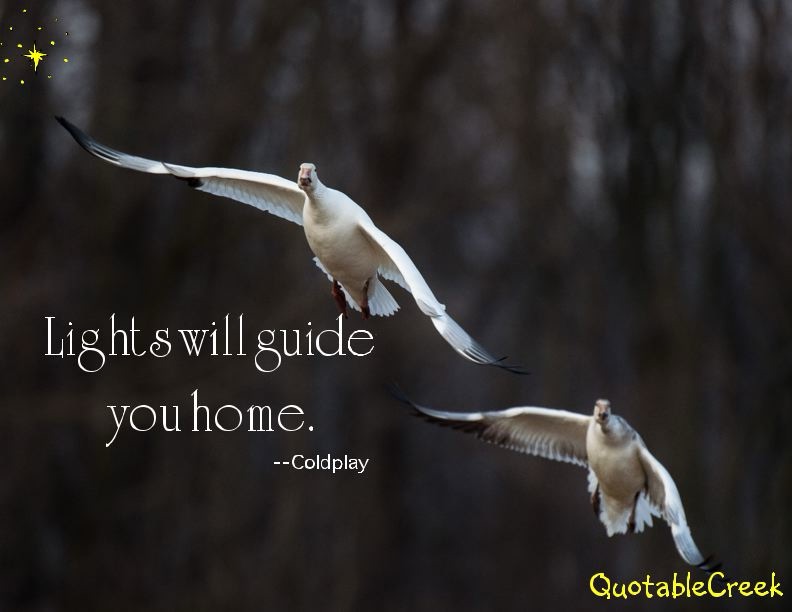
Consider the story of The Tenth Goose told by Richard R. Powell in his book Wabi Sabi for Writers:
Nine Canada geese lift off a clear mountain lake; droplets from their wings cast lines of rings behind them on the glassy surface as they rise. Light gray feathers reflect amber light from the early morning sun, a clean glow off each curved body. You watch their broad wings grip air, watch nine bodies rise and fall in rhythm against the dark forest behind them. Each bird’s neck kinks in counter-time to its wing beats so that all nine heads remain level and each set of eyes gazes steadily out at the cool dawn, bright mystery of sight amid the shiny black head feathers. Closer now, you make out the expressionless curve of their beaks, see one goose’s thin moist tongue as she honks; hear the whistle of air across wing feathers as they pass over your head. Then you notice that there is a tenth goose far back, low to the water, working hard to catch up, honking softly, as if each wing beat hurts. This goose loses a feather as she passes close over you and you watch the feather spiral and glide to the ground. You pick it up and it looks perfect, each barbule lying neatly against its neighbor, the tiny whorl of fluff near the calamus soft to the touch. Then you see that the shaft is not perfect; it is cracked open from the middle to the tip.
You keep that feather, tuck it under the strap around your car’s sun visor, look at it every day you drive to work and remember the tenth goose. Remember your own efforts to keep up. And somehow, that tenth goose gives you courage. You wonder if she will find enough food or if winter will separate her from the rest, separate her from life. She speaks to you in a dream one night. In the distracted moments of the day she speaks to you, in the elevator or while you wait in traffic. Then one night she is there in your dream again, as silent as her feather in your car. She tips her head at you and that beak, with its lumpy prominence like a Roman nose, bobs up and down and you realize she is giving you permission to speak. In the dream you speak and she turns her head to hear you and you tell her your fear of dying and your hopes while living and she comes and rattles her beak between your fingers.
There is beauty and strength in the broken places, a beauty that continues on even when everything is a struggle, that faces setbacks with determination. Sometimes we are one of the nine geese, sure and strong, in sync, but sometimes we are the tenth goose struggling to keep up. And there is beauty in that, too:
It is a kind of beauty on the edge of defeat, a beauty tenacious and brave, and it is the beauty left behind when the warm, honking goose is gone. And not just flown away–but dead and gone. That feather remains as a testament to the beauty in living; and even when the feather dries and cracks and is eventually eaten by insects or the drab extension of time, it will live on in the imaginations of those who hear the story of the tenth goose.
Remember the Story of the Tenth Goose and take heart.








 QuotableCreek.com