Last week at the DNC, we glimpsed Gus, the son of vice-presidential candidate Tim Walz, in an unguarded, moment, filled with pride and love, crying, and saying, ‘That’s my dad!’ For me and millions of others, that raw, unfiltered emotion choked us up. It was a beautiful moment, such a clear window into a pure love.
But for many others, trained perhaps to hide their own emotions and toughen up as they age, that moment led to mockery and cruel responses.
What accounts for such wildly different responses?
Perhaps the difference lies in how we view vulnerability, which in turn, colors how we trust others. Do we feel like we must mask our emotions and vulnerabilities? Do we feel like we must project only a polished and tough persona?
Brené Brown says,
Vulnerability is not winning or losing; it’s having the courage to show up and be seen when we have no control over the outcome. Vulnerability is not weakness; it’s our greatest measure of courage.
Do we really believe the bully is the strong one? Perhaps the strong one is the one brave enough to be honest and true.
Toni Morrison had a gift for complexity and nuance in her writing. Multi-dimensional characters and lots of gray area rule the day in her work.
I found it interesting to hear this perspective from her:
I just think goodness is more interesting. Evil is constant. You can think of different ways to murder people, but you can do that at age five. But you have to be an adult to consciously, deliberately be good — and that’s complicated.
It’s an age-old question whether people are inherently good, whether altruism is learned or instinctive, whether selflessness develops naturally.
But there definitely is an intentionality to doing good, choosing kindness, forgiving, welcoming, holding your tongue. And as we grow older and cast off our childish ways, we learn the wisdom of restraint and forbearance.
And we learn the power of good because often we are on the receiving end of it and know how much it matters.
And then when it’s our turn, we want to pass it on.
It’s remarkable how powerful words, just words, are. Most of us can remember a criticism that hurt, maybe more than we can remember a compliment.
In the hands of a parent, words can be deflating or encouraging, critical or comforting. A parent who is never satisfied no matter the child’s achievement can inflict lifelong damage. And the effect of those words will last with that child well into adulthood and inform how they, in turn, will talk with their own children. A sad cycle.
These days, lies have a horrible power to cause almost irreversible damage. Social media can amplify those lies, and, before you can think twice, your words can become venom.
No doubt words have power. The question becomes how do we want to use that power. In this award-winning speech, Mohammed Qahtani makes a case for choosing wisely.
How broad is your focus? On your own needs and wants, or broader? It seems that a broad focus, on others as much or more than ourselves increases empathy and happiness.
As Daniel Goleman said:
Self-absorption in all its forms kills empathy, let alone compassion. When we focus on ourselves, our world contracts as our problems and preoccupations loom large. But when we focus on others, our world expands. Our own problems drift to the periphery of the mind and so seem smaller, and we increase our capacity for connection – or compassionate action.
Does this seem true as you think about the people in your life?
The other thing that happens when you turn your concern to others is the whole world opens up. There is so much to learn, to do, to care about. So many places to put your time and efforts. So many people to love and help.
Sometimes life is hard. Really hard. Relationships falter. Obstacles seem insurmountable. And just getting to the next day feels overwhelming. At times like these, we have to remember that it is OK to struggle.
We don’t have to be perfect. We do not need to have all the answers. Sometimes all we have are questions. But that is often a good place to start. And then we begin again, one foot in front of the other, perhaps not seeing the whole path ahead, but just enough to know where to put each foot.
“Just because something is difficult doesn’t mean it’s impossible. Uncomfortable? Yes. Exhausting and overwhelming and painfully hard? Yes. But not impossible. And it won’t necessarily feel this difficult and debilitating forever. You’ve made it through similar hard things before. You’ve survived every single bad day and every obstacle the universe has ever thrown at you. You’ve survived all the things you felt convinced would break you. Every single one. And this is evidence that you can make it through this too.
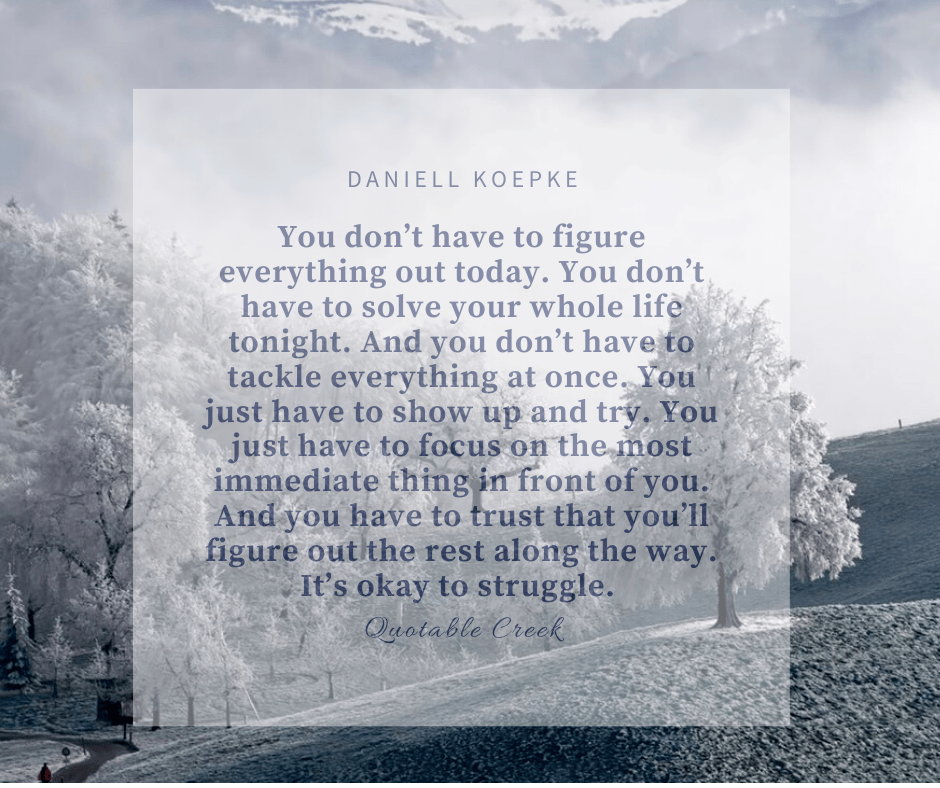
“You don’t have to figure everything out today. You don’t have to solve your whole life tonight. And you don’t have to tackle everything at once. You just have to show up and try. You just have to focus on the most immediate thing in front of you. And you have to trust that you’ll figure out the rest along the way. It’s okay to struggle. It’s okay to feel overwhelmed. And its okay to make mistakes. You’re still learning how to navigate this new path. It’s going to take time, and you’re allowed to give yourself that time. You don’t have to be perfect. You don’t have to get all A’s or be the best version of yourself or outperform everyone else. All you have to do is show up and try. It’s always been enough before. It will be enough this time too.”
— Daniell Koepke
Here’s to you finding the light to take that next step, and then the next and the next, until your path leads you out of this present darkness. It is OK to struggle.
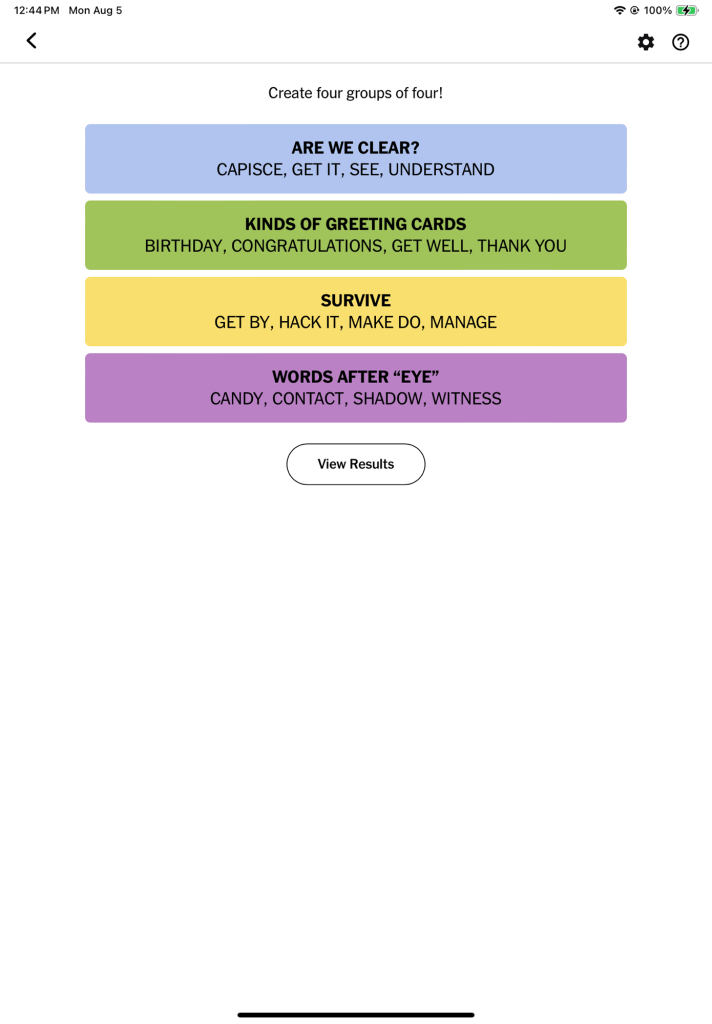
Every morning, I wake up and play games. My favorite these days is Connections, a collection of 16 words that you need to group in four groups of four based on a shared connection. Here’s the solution from one last week:
Now, looking at the solution, it’s easy to see the connections. Not so, though, when the words are all scrambled and the connections are unclear. Words may have more than one meaning or be multiple parts of speech. Often the answers are homonyms or are missing a letter. It can be challenging to find the connections among the words.
So, too, with the connections among people. There are some obvious superficial connections perhaps— gender, political affiliation, nationality, religion, age. But what of those deeper, hidden ones? How do we find those to help us feel more like a community?
I thought about this when reading an article about how an introvert, Jay Krasnow, made friends. He had struggled to find true connections at work functions or forced social gatherings, but when he dug deeper, to consider the things he was passionate about and find others who shared those passions, he found the connection he was looking for. He explains:
My failure at connecting wasn’t due to a lack of trying. I spent my 20′s and 30′s collecting and studying books on how to network, forge friendships and build character.
Yet, my principal achievement from reading these books was that I became adept at identifying when other people had read these same books. Meanwhile, my networking skills didn’t significantly improve. Even worse, I felt that by reading books with titles like “How to Talk to Anyone,” I was turning myself into a robot that spewed out inauthentic lines to people who I genuinely wanted to know.
There had to be a better way to build relationships.
For Jay, he decided to start a book club, not one reading the same book, but one where you came and told people about the book you were currently reading. It took off, people came. And those relationships centered on a shared passion spilled over into other friendships:
Connecting with other people through books seemed natural, but I didn’t know if anyone would come. I was prepared to read my book quietly if no one else showed up. Fortunately, both my friends came, and we were joined by one other person we didn’t know.
After the first event, more people started coming, and I started making new friends almost immediately.
The group’s membership grew exponentially. It wasn’t long before I was inviting my new friends to dinners and other events. Because we had established we shared a similar passion, it was easy to branch out from there and find other things to do and talk about.
I wonder if this is what the world needs right now— connections based on a shared love or passion. So much of identity seems tied into a shared hatred or shared anger over something. It seems like that just leads to more loneliness and separation.
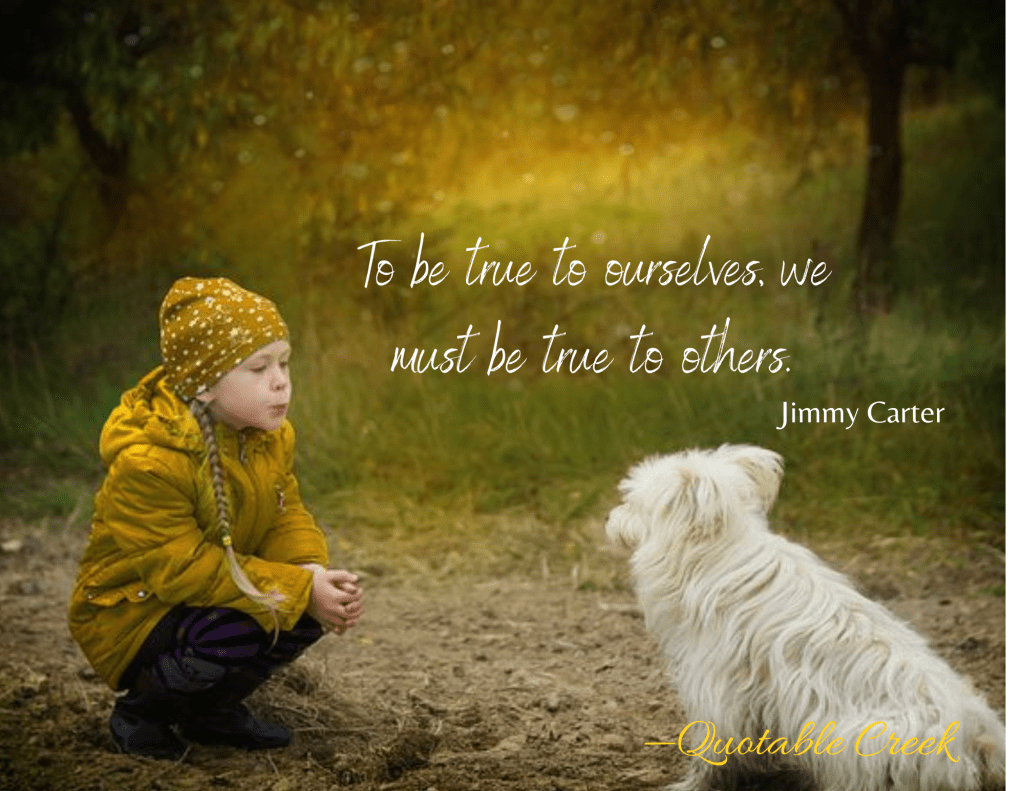
One of my personal heroes, Jimmy Carter, almost 100 years old, is trying to hang on to vote in this election. He has been such a wonderful example of walking the walk. He says:
“My faith demands – this is not optional – my faith demands that I do whatever I can, wherever I can, whenever I can, for as long as I can with whatever I have to try to make a difference.”
What a wonderful way to look at our possible impact. Using what we have, not waiting until we have more or better resources or to be older and wiser, or wishing we were younger and stronger. Right now with what’s available.
And wherever we find ourselves, adopting a bloom where you’re planted attitude. Even if we are in our own harsh spot. Considering what can we do here.
And always looking for opportunities to do good. Not necessarily solving the world’s problems, but doing your own little bit of good. Right here, right now.
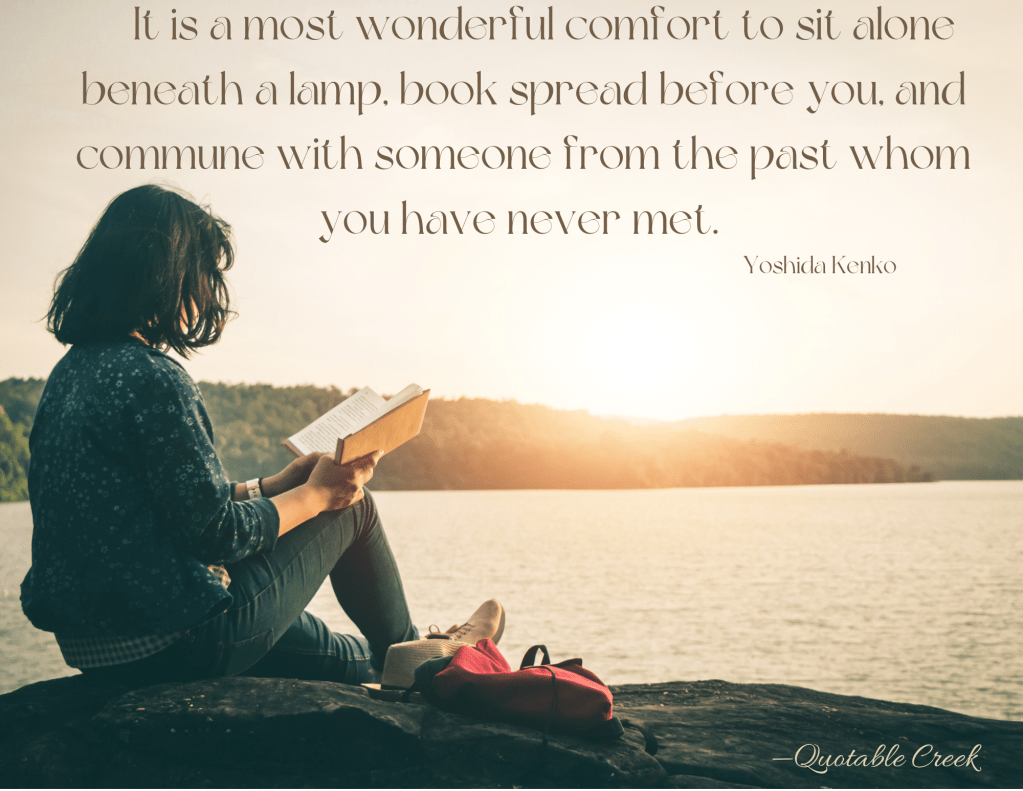
There is a sort of magic in reading a book. Someone, maybe long dead, has perhaps expressed deep feelings or new thoughts or complex theories, writing out of their aloneness, and connecting with someone they have never met and may never meet.
And yet the impact of that shared space over a book can be life-changing. It can help you feel less alone in this big world. It can help you feel empathy for others in a way you may never have experienced without the book. It can open your heart and mind in new and wonderful ways.
It certainly changes things depending on your perspective. Someone who thinks of life as a contest is always striving, comparing what he has to others. The one who views life as a burden might sigh a lot. And so on.
But what if we thought of life as a gift? Unearned, given out of love, no strings attached. Something to be grateful for. Something to savor and enjoy but also something to treasure. Would that affect what we see when we open our eyes in the morning? Face challenges? Greet people? Pick a career?
Brian Zhand says:
Most of us are scripted to think that life is a game and the purpose of life is to win. But the divine truth is that life is a gift and the purpose of life is to learn to love well.
The truth is being here is a gift, an opportunity, a chance to do some good. Open your gift.
How often do you admire someone but keep that thought to yourself? Perhaps someone took a risk, spoke truth to power or behaved well in a tough situation. You admired them for it but kept that admiration to yourself. How much good might that have done if you told them, perhaps given them a bit of encouragement to stand strong again? How much might your words give them much-needed support when they were feeling low?
Chimamanda Adichie encourages us to never admire quietly. She says:
If I admire something about someone, I tell them. We humans are so fragile. It’s important we give people their flowers while they are here. Never admire quietly.
Don’t be stingy with kind words and compliments. They could very well be the fuel that keeps those good deeds coming.


 QuotableCreek.com