Celebrate love.

hidingplace

Love rejoices in the idiosyncrasies of another. Love says, “Look at this! Isn’t it amazing?” Love is curious and exhilarated, bold and exuberant. Love delights and comforts and feels safe. Love makes you better– more whole– and fills you with warmth.

In celebration of love–all kinds of love–here is a beautiful poem:

Bird Understander
by Craig Arnold
Of many reasons I love you here is one
the way you write me from the gate at the airport
so I can tell you everything will be alright
so you can tell me there is a bird
trapped in the terminal      all the people
ignoring it       because they do not know
what to do with it       except to leave it alone
until it scares itself to death
it makes you terribly terribly sad
You wish you could take the bird outside
and set it free or       (failing that)
call a bird-understander
to come help the bird
All you can do is notice the bird
and feel for the bird       and write
to tell me how language feels
impossibly useless
but you are wrong
You are a bird-understander
better than I could ever be
who make so many noises
and call them song
These are your own words
your way of noticing
and saying plainly
of not turning away
from hurt
you have offered them
to me       I am only
giving them back
if only I could show you
how very useless
they are not

SaveSave

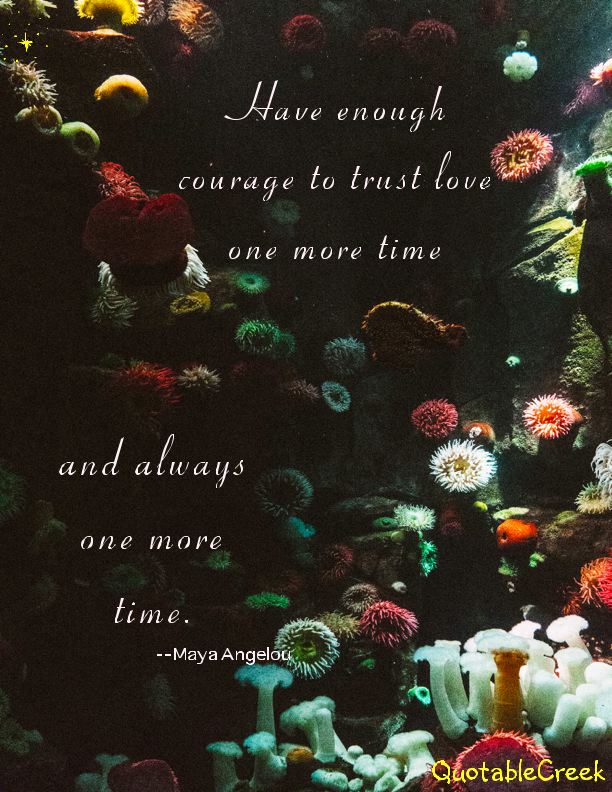
And always one more time.

mayalove

It takes courage to love, doesn’t it? Particularly after we’ve been hurt and know how vulnerable we can be. How much safer it would be to protect ourselves from being completely known, from loving wholeheartedly, from reaching out to others. But living behind a facade is a recipe for loneliness. Walling others out also walls us in. Going it alone directly contradicts the foundational truth that we are all interconnected whether we choose to be or not.

Love is the great adventure. It is the answer to the what, how, and why we are here. So have the courage to trust love one more time…and always one more time.

Consider the hummingbird

hummingdoyle

In his essay, Joyas Volardores, Brian Doyle begins with a very close look at a hummingbird, a creature whose heart makes up a good bit of its tiny body. They are remarkable creatures. We, too, are creatures whose hearts makes up a good bit of us, and Doyle ends his essay with a look at how our hearts, no matter how we protect ourselves and wall them off, are imminently fragile, with facades that can be shattered in an instant.

So much held in a heart in a lifetime. So much held in a heart in a day, an hour, a moment. We are utterly open with no one in the end—not mother and father, not wife or husband, not lover, not child, not friend. We open windows to each but we live alone in the house of the heart. Perhaps we must. Perhaps we could not bear to be so naked, for fear of a constantly harrowed heart. When young we think there will come one person who will savor and sustain us always; when we are older we know this is the dream of a child, that all hearts finally are bruised and scarred, scored and torn, repaired by time and will, patched by force of character, yet fragile and rickety forevermore, no matter how ferocious the defense and how many bricks you bring to the wall. You can brick up your heart as stout and tight and hard and cold and impregnable as you possibly can and down it comes in an instant, felled by a woman’s second glance, a child’s apple breath, the shatter of glass in the road, the words I have something to tell you, a cat with a broken spine dragging itself into the forest to die, the brush of your mother’s papery ancient hand in the thicket of your hair, the memory of your father’s voice early in the morning echoing from the kitchen where he is making pancakes for his children.

Today, consider the hummingbird. Let it fill us with wonder and appreciation for all of creation, but especially our own hearts, and let it remind us of how tender and fragile each of is really, truth be told.


Love in the little things.

vangogh

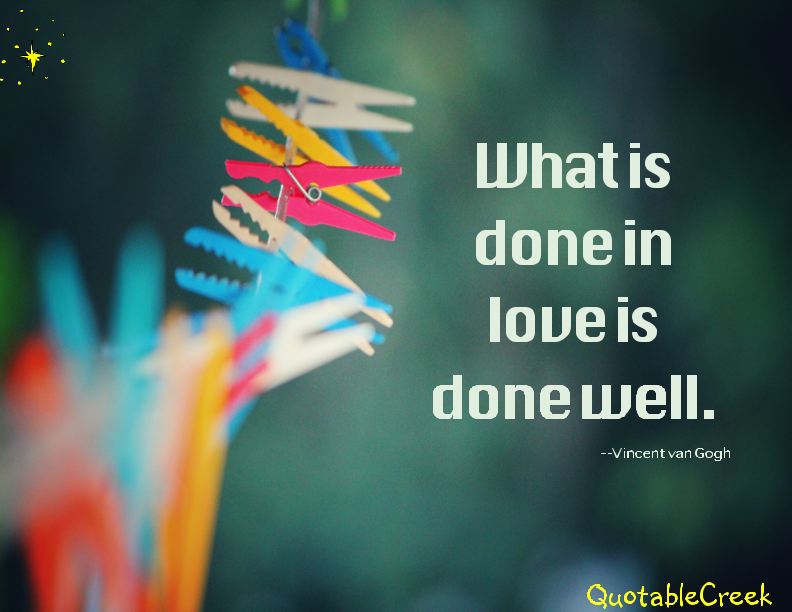
It’s hard to miss the grand gestures of love–the dramatic proposals, flashy gifts, wining and dining. But love is also in the little invisible day-to-day things–making someone their favorite meal, putting gas in your partner’s car before their trip, folding laundry, wiping runny noses and tying little shoelaces, remembering someone’s birthday, keeping someone company in a hospital room. All those little silent, maybe unnoticed, labors of love are the glue in the fabric of our relationships.

What little thing has someone done for you today? Maybe there’s a little thing you can do in return…

SaveSave

How to keep Christmas?

xmasheart

Love wins.

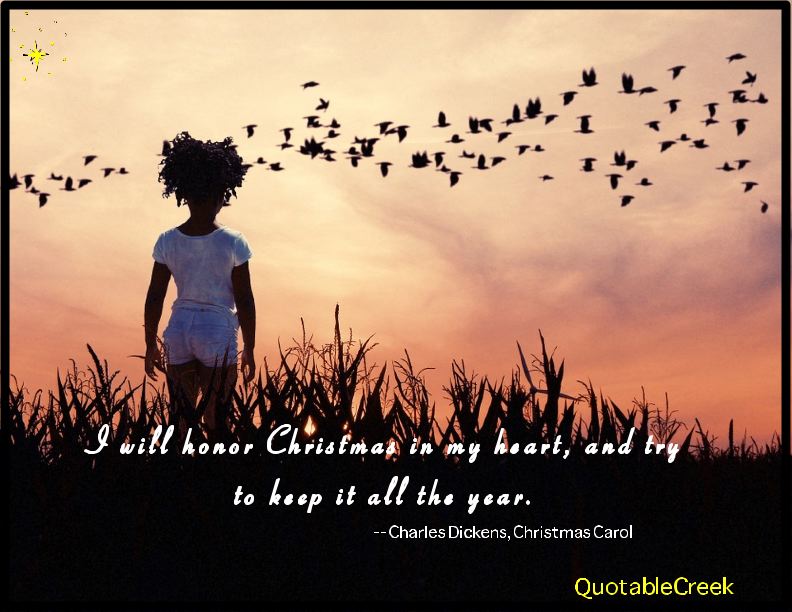
Isn’t that the bottom line of Christmas? Strip away all the decorations and gifts and songs and celebrations, and what remains is: love wins. It’s about love. God loves us, and we are to love each other. And even in a world divided by hate, blind to oneness, driven by greed, love will win. Because that’s the point of Christmas.

It’s about the love.

Fill ‘er up.

lovelife

Love is a bit like air. We can’t see it, but we can tell when it isn’t there. Love is transformative–of families, of workplaces, of schools, of neighborhoods. It is limitless. It is free. It multiplies when applied to any situation.

What better ingredient to sprinkle in every corner of our lives than love?

Let love blossom.

osho

If you look for thorns, you’ll see thorns. If you look for love, you’ll see it all around you. And if you look for opportunities to make a difference, to shower people with love, and to take a stand for all that is good and right in the world, those opportunities will be there.

What opportunities do you see in the day ahead?

Love hard.

worstofus

What if the world knew you only by the worst thing you’ve ever done? Assume everything’s public, no secrets, anything can be known by everyone. That’s a tough scenario, isn’t it? What would people think if they could see all the bad things you’ve done, the cruel things you’ve said, the opportunities to be kind you’ve missed?

Some of us live that reality–known by one event, judged by all and found lacking–the drug addict, the convict, the molester, the drop-out, the neglectful mom. And yet each of us is incredibly complex, capable of both good and bad, cruelty and kindness, and, most importantly, redemption.

How all of our souls hunger for someone to see that, even when we make mistakes, there is good in us, too, that we aren’t all bad. That mistake shouldn’t define us. Imagine how much more that is true for someone who has been shunned by society because of one wrong turn.

What can we do to look at each other as we see ourselves, complex, erring individuals worthy of love? What can we do to recognize that we are all kin?

What (or who) is your woods?

tothewoods

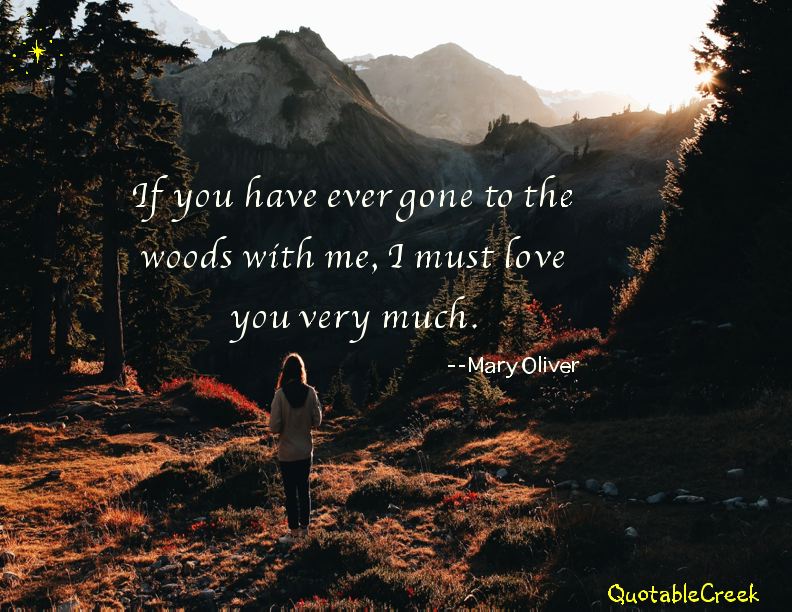
We don’t let just anyone see us vulnerable, hear our secret stories, watch us struggle. To most of the world, we carry a bit of a shield between them and our tender parts. But there are some few we trust to see the real person behind the mask. We must love those people very much to be so naked and exposed.

Because we need to lay those masks down sometimes, don’t we? We can’t live a life of posture. And so we seek out places where and people with whom we can relax and let down our hair, unafraid of judgment, unconcerned with being deemed eccentric.  Perhaps to be part of nature, to rest among creation until we lose sight of where we stop and others begin.

In this poem, Mary Oliver takes us into her sacred space–the woods.

She must love us very much.


How I Go To the Woods

by Mary Oliver  

Ordinarily, I go to the woods alone, with not a single friend, for they are all smilers and talkers and therefore unsuitable.

I don’t really want to be witnessed talking to the catbirds or hugging the old black oak tree. I have my way or praying, as you no doubt have yours.  

Besides, when I am alone I can become invisible. I can sit on the top of a dune as motionless as an uprise of weeds, until the foxes run by unconcerned. I can hear the almost unhearable sound of the roses singing.

If you have ever gone to the woods with me, I must love you very much. 

Dance. Now.

stilldancing

Have you ever been to a ghost town? You see the saloon and can picture it with card games going on and drinks being slid down the bar to thirsty patrons. The hoofbeats of horses maybe bringing strangers into town, the scurry to safety if a gunfight breaks out, breaking glass, swishing skirts, laughter and tears. Lives lived and lost all as rich and complicated, full of joy and strife, as your own. And those people who once lived there, chugging their whiskey and loading their pistols— Read More