Starting now.

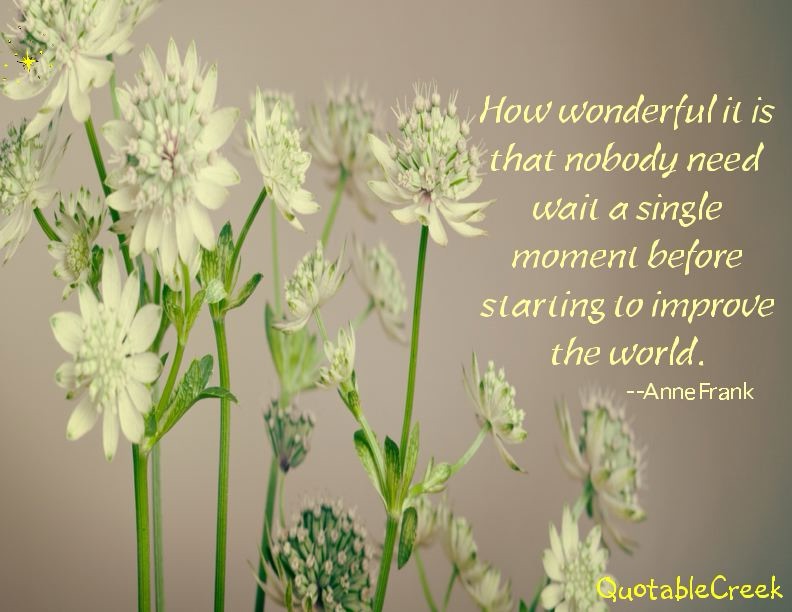
What tools do we need before we start to improve the world? What are we waiting for? Perhaps we are waiting for extra money or time. Perhaps we are waiting for retirement. Perhaps we are waiting to get all our own issues squared away first before we start thinking about helping someone else with theirs. Perhaps we are waiting for someone to ask us for help.

But consider Anne Frank. Forced to live in hiding to avoid the Nazi round-up and murder of Jews, she had little contact with the outside world. She, herself, was in mortal danger around the clock. She was just a kid, really, someone we think of helping rather than being the helper. And yet her attitude was so full of optimism and hope, it continues to shine now, decades later, lighting a weary world.

What a difference an attitude makes! She didn’t wait for the right time or resources. She didn’t wait until she could have a huge impact on the world. She didn’t wait until she was old or famous or wealthy. She didn’t even wait until she was safe. She started right then with what she had. A cheerful disposition, a concern for her family and the others in hiding with her, a willingness to step forward and try to make the world a better place.

What can you do to improve the world? Isn’t it wonderful that you can start right now?

Shining light in dark places.

Miep Gies was a young office worker when she hid and supported Anne Frank and her family, protecting them from Nazis and the danger of being sent to a concentration camp. After Anne and her family were betrayed and captured, Miep collected Anne’s diaries and eventually returned them to Anne’s father, Otto, who survived the war. That diary has been read by millions of people now, inspiring acts of heroism and showing, in a very intimate way, the horror of WWII as viewed through the eyes of an innocent, complex, lovely, vibrant girl, Anne.

Miep wasn’t famous or rich or particularly accomplished, yet she managed through her actions to shine a very bright light on hate and replace it with a more powerful portrait of love. Anne, too, wasn’t famous or rich or accomplished, although we can see now how she was a gifted author, but her words have been inspiring and a powerful force against evil in the world.

No matter our position or age or wealth or gender, we each can make a contribution that makes the world more bright.

What is the light you can turn on in a dark room?

Happy day.

What is one bright thing in your day? One shining star or saving grace? Sometimes the simplest of things can light up our mood and day, and start things in the right direction.

For inspiration, consider this poem:

Success 
by Ralph Waldo Emerson
To laugh often and much;
To win the respect of intelligent people and the affection of children;
To earn the appreciation of honest critics and endure the betrayal of false friends;
To appreciate beauty,
To find the best in others,
To leave the world a bit better, whether by a healthy child,
A garden patch or a redeemed social condition;
To know even one life has breathed easier because you have lived.
This is to have succeeded.

Happy this day.

Dust you are.

The world existed before us and will go on after us. That’s a hard thing to wrap our minds around because we see things from our point of view. It’s hard to picture a scenario without ourselves in it. And yet, that day will come. Our chance to make our mark will end. While it seems at first like a very sobering thought, it can be uplifting because it reminds us that we are here now; this is our time to dance, to love, to give, to celebrate, to reach out to the other dust particles like ourselves and do our bit. This is our moment. Let’s make the most of it.

Moving past the past.

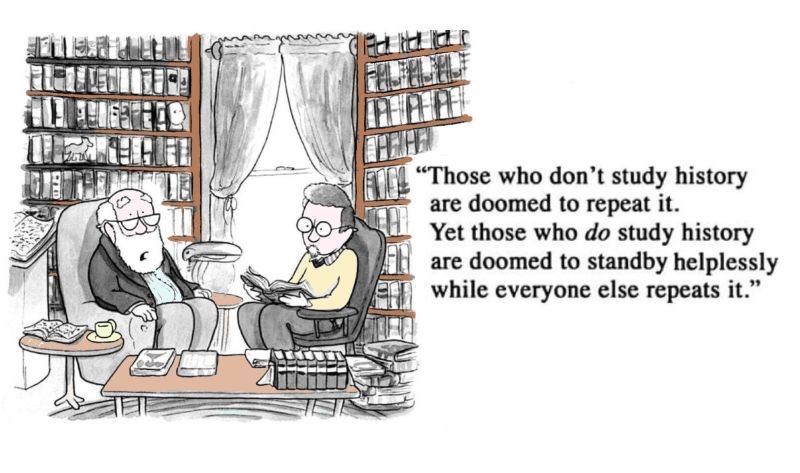
One of the greatest frustrations of life is not being able to change the past, whether it is to remedy that stupid thing you just said or the larger elements of fractures in society leading to war. The only things we can really do with the past are to live with it, learn from it, and figure out how to move forward. For those who study history, seeing ugly patterns reemerge and take shape can be horrifying.

And yet, it is not all gloom and doom. Indeed, we are not helpless:

One of the curses of history is that we cannot go back and change the course leading to disasters, no matter how much we might wish to. The past has its own terrible inevitability. But it is never too late to change the future.”

― Heather Cox Richardson

We can learn from history what it takes to resist. We can remember who the real heroes were in dark times and emulate them. We can draw on community and coalitions to fight for the common good. We can continue to believe that integrity counts, that honesty and fidelity and honor matter, that kindness will always heal, and that love is, not only good, but the answer to any question.

We can fight. With whatever tools we have: words, money, presence, we can take a stand, doing our little bit of good.

As Desmond Tutu said:

Do your little bit of good where you are; it’s those little bits of good put together that overwhelm the world.

It’s time to overwhelm the world.

Reteaching loveliness.

You and everyone around you are buds, waiting to fully bloom. Sometimes we need reminders of that fact.

Consider this poem from Galway Kinnell:

Relearning Loveliness

The bud

Stands for all things,

Even for those things that don’t flower,

For everything flowers, from within, of self-blessing:

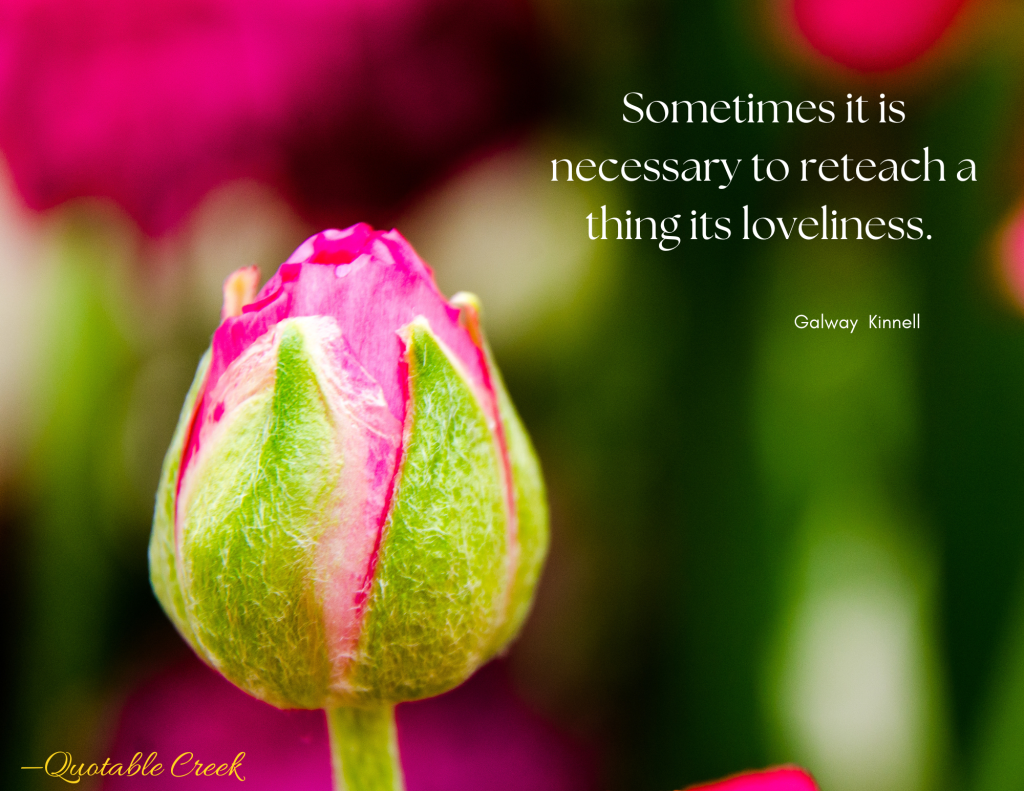
Though sometimes it is necessary to reteach a thing its loveliness,

To put a hand on the brow

Of the flower,

And retell it in words and in touch,

It is lovely

Until it flowers again from within, of self-blessing.

Bless the comforters.

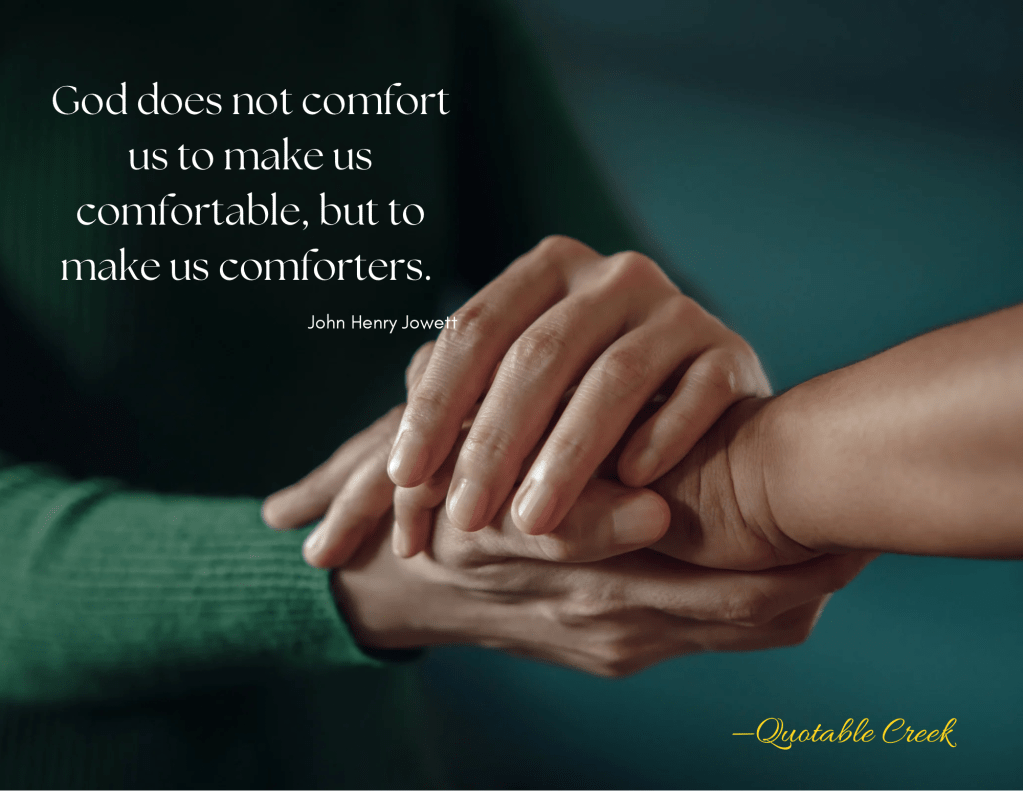
Bless the comforters, those who reach out and see others hurting and grief stricken, and offer them solace. Who sit with those going through difficult times, and give of their presence. Who offer kind, comforting words.

We sometimes think those who are good at comforting don’t know loss of their own, but the opposite is probably true.

As said by Rainer Maria Rilke:

Do not assume that he who seeks to comfort you now lives untroubled among the simple and quiet words that sometimes do you good. His life may also have much sadness and difficulty, that remains far beyond yours. Were it otherwise, he would never have been able to find such words.

Perhaps the only good to come of great loss is the ability to recognize it in others and offer them comfort and companionship.

Bless the comforters.

Persevere

Sometimes things hum along nicely, and you can feel a deep sense of progress in yourself, your relationships, and the world.

Sometimes the opposite is true.

You feel yourself retreating and losing hope. Your relationships fray. Progress in the world is wiped away.

At times like these, we need to hunker down and draw on a well of hope inside in each of us that springs up with the knowledge that we can do better, we deserve better, and we will fight for ourselves and each other to make the world better.

We may not know yet the battleground we will be called to or the terms of engagement.

We do, though, know the weaponry we will fight with.

Love, honesty, integrity, justice, compassion. These tools of the light will vanquish darkness. We can’t forget what is good and right.

Finally, brethren, whatsoever things are true, whatsoever things are honest, whatsoever things are just, whatsoever things are pure, whatsoever things are lovely, whatsoever things are of good report; if there be any virtue, and if there be any praise, think on these things. Philippians 4:8

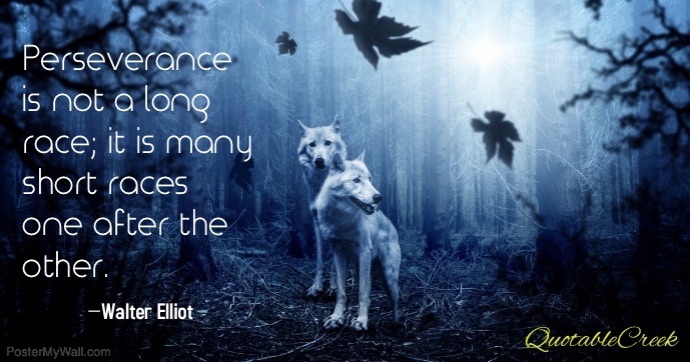
We must persevere.

Love is nearby.

Sometimes a good walk can change your perspective. Consider these words from Anne Lamott:

My husband said something a few years ago that I often quote: 80% of everything that is true and beautiful can be experienced in any ten minute walk. Even in the darkest and most devastating times, love is nearby if you know what to look for. It does not always appear at first to be lovely, but instead may take the form of a hot mess or a snoring old dog. Or someone you have sworn to never, ever forgive (for a possibly very good reason, if you ask me). But mixed in will also be familiar signs of love: wings, good-hearted people, cats (when they are in the right mood), a spray of wild flowers, a cup of tea. What are we even talking about when we talk of love? What is it?

On a ten minute walk anywhere…, love abounds and abides, flirts and weeps with us. It is there for the asking, which is the easy part. Our lives’ toughest work is in the receiving. Love presents most obviously in babies and kids being cuddled, yet also as patience with annoying humans we live or work with or are. We feel love upon seeing our favorite neighbors and first responders, we see it in fund-raising efforts, peace marches, kindergarten classrooms, gardens. When flowers don’t stir feeling of love in me, something is gumming up the works.

What at first unlovely things do you see around you that are really love? What evidence of love do you see on your walk? In your day? In your home?

Love is everywhere. We just sometimes need to make sure to notice.

Love like water.

We hear we should fight fire with fire or get down in the gutter and fight dirty with the rest of them, but is this the best way? Won’t everyone just be hurt? Won’t our young lose role models for the importance of virtue?

What of other, softer, ways to resist?

Consider these words from Richard Rudd:

The Softening

Softness is one of the great secrets of all spiritual practice. 

When we become soft, we become like water. 

We let life come to us. 

We trust in its flow, and we allow ourselves to be taken in whichever direction it chooses. 

This is true power because it comes from love, and love is the softest thing in the universe, and yet it is the most powerful. 

When you soften your attitude to yourself, to others, and to life, you release the natural wisdom that lies within you. 

Your body softens, your thoughts soften, and your heart softens. 

Through softness, you find clarity and purpose without needing to force anything. 

Your life becomes a gentle unfolding rather than a constant battle.