If you look for thorns, you’ll see thorns. If you look for love, you’ll see it all around you. And if you look for opportunities to make a difference, to shower people with love, and to take a stand for all that is good and right in the world, those opportunities will be there.
Sometimes turning off the news is the best form of mental health protection.
But then we remember. In times of darkness, there are always those working to light a path, helping, fighting for the common good, making progress.
And maybe we, too, can help.
Maybe not in large, brokering peace kind of ways. But in small ways that, combined together with the small ways of many, many others, may help to right a wrong or turn a tide.
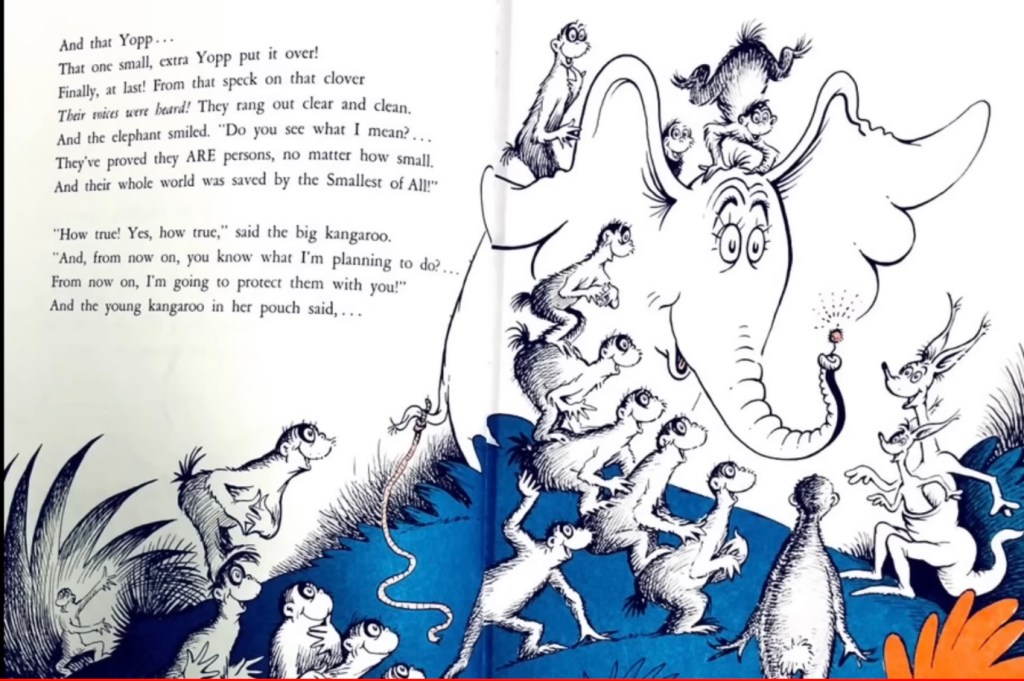
I think of Horton Hears a Who by Dr. Seuss, everyone shouting and banging on pots to be heard, but it is the final Yopp of a child that turns the tide, saving their world.
Are you good at receiving? Giving often comes naturally, but receiving can be challenging. The mom who wears the pasta necklace and hangs the cotton puff ornament on the tree is sending a powerful message that her child matters, that she loves their thoughtfulness, and that she is honored and grateful to receive their gifts.
The host who immediately opens a guest’s gift of wine and serves it is saying that they value their guests’ choices and are welcoming their contributions to the synergistic experience that is a social gathering.
Henri Nouwen offers this powerful insight:
When someone gives us a watch but we never wear it, that watch is not really received. When someone offers us an idea but we do not respond to it, that idea is not truly received. When someone introduces us to a friend but we ignore him or her, that friend does not feel well received.
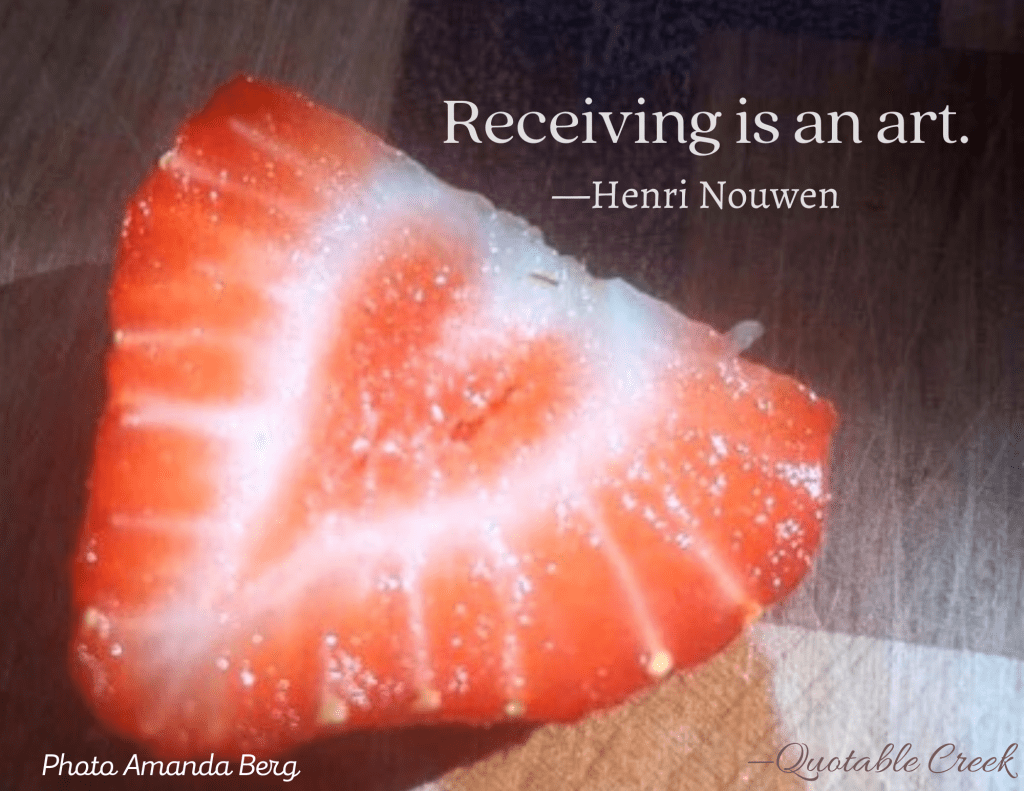
Receiving is an art. It means allowing the other to become part of our lives. It means daring to become dependent on the other. It asks for the inner freedom to say, “Without you I wouldn’t be who I am.” Receiving with the heart is, therefore, a gesture of humility and love. So many people have been deeply hurt because their gifts were not well received. Let us be good receivers.
Henri Nouwen, Bread for the Journey
These words cause us to pause and consider. Are we good receivers? Do we value those gifts and those givers in a way that causes us to open up and expand our walls, and even, perhaps, our sense of self? Can we give up our need to be in control and let our defenses down enough that others around us can share in the very creation of our lives?
Today, in the United States, we celebrate a country that allows its citizens input into this remarkable experiment of a government of the people, by the people, and for the people. A government rejecting the reign of kings and queens born into their roles in favor of ordinary individuals working for the common good together.
We honor this country and its principles of equality, freedom, and justice for all. Our understanding of those concepts has evolved over time, and taken some steps back, but today let us be grateful for how far we’ve come and consider the steps that we each might take today and every day to make this country move closer to the ideals for which it stands. It is a privilege coupled with responsibility to be an American.
When we are being welcoming, the focus is outward not inward. We look to what would make the other person comfortable, not what would make us comfortable. We don’t invite vegetarians, and then serve meat. Or teetotalers and serve alcohol. We get out of our own perspective and walk in the guest’s shoes to consider what would make them comfortable.
Aesop illustrated this premise with the Tale of the Fox and the Stork:
A fox invites a stork to eat with him and provides soup in a bowl, which the fox can lap up easily; however, the stork cannot drink it with its beak. The stork then invites the fox to a meal, which is served in a narrow-necked vessel. It is easy for the stork to access but impossible for the fox. The moral drawn is that the trickster must expect trickery in return and that the golden rule of conduct is for one to do to others what one would wish for oneself.
The same is true, presumably, when welcoming people to the Lord’s table. What would make others comfortable? How can you reach more people? What about the way you do things might be off putting? How can you step out of your own perspective to consider what would make others in the community feel welcomed and comfortable? Our job isn’t to be a bar to spreading the word but a conduit.
Desmond Tutu talks about the importance of a broad welcome:
We are made for goodness. We are made for love. We are made for friendliness. We are made for togetherness. We are made for all of the beautiful things that you and I know. We are made to tell the world that there are no outsiders. All are welcome: black, white, red, yellow, rich, poor, educated, not educated, male, female, gay, straight, all, all, all. We all belong to this family, this human family, God’s family.
Not long ago, the world shut down, and most people were asked to sequester and stay home while essential workers reported, still, for duty. It was a strange time, involving so many swiftly moving facts to assimilate and assess forward progress.
But that question of ‘essential’ is an interesting one. Some of the jobs labeled ‘essential’ or not were surprising choices.
How does one determine what is ‘essential’? What of the artist? With so many schools cutting art and music programs as non-essential, I wonder what the world would look like filled just with grammarians and mathematicians. Surely, art, though it puts no food on the table and sets no broken bones, is essential to the human spirit.
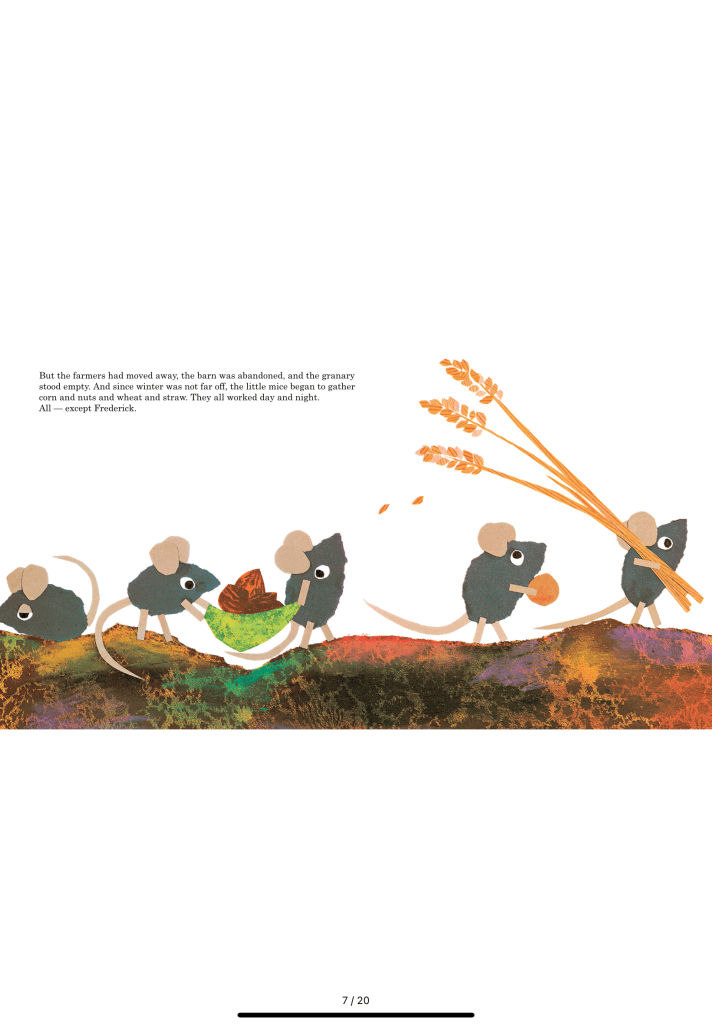
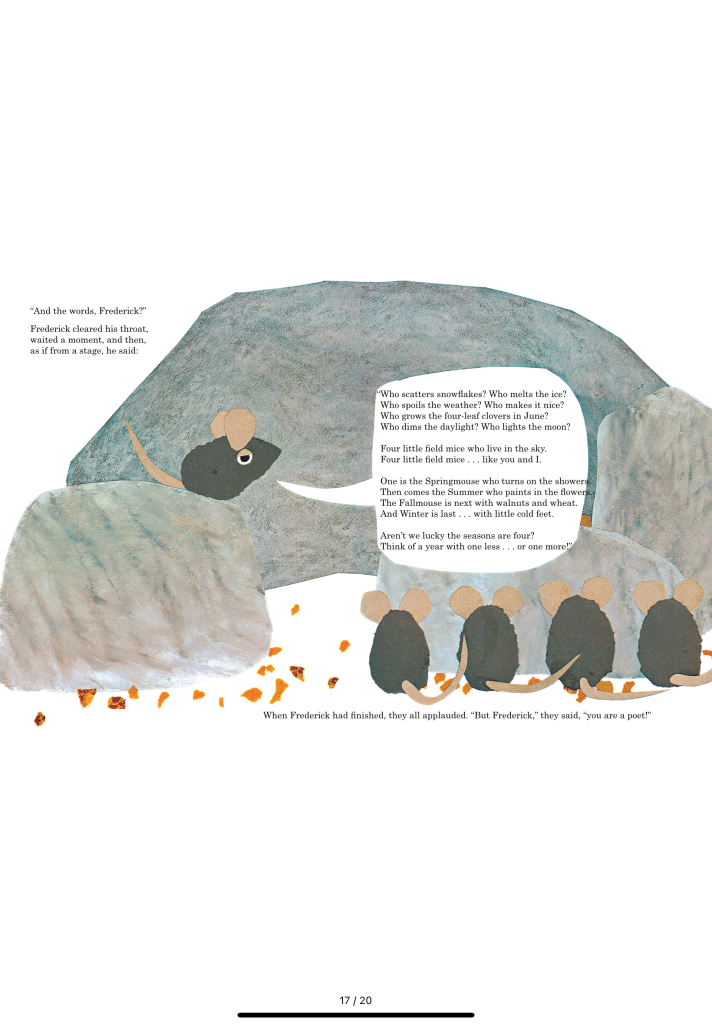
Such is the theme of Frederick by Leo Lionni. While four mice toil to set up stores of grain for winter, one mouse collects color, and sounds, and words.
And when winter came, and the mice were cold and hungry, Frederick’s words sustained them.
So lift a glass in praise to the artists, the writers, the musicians. Those who lift us up and sustain us and offer us beauty for our souls.
When we think about our own personal heroes, can we see a pattern? How did they rise to the challenges presented in their day?
How are we rising to the occasions and the challenges presented in our time? Right now. Are there injustices we can speak up against? Are there places where our voices will make a difference? What are the rights and wrongs happening right now today?
I am about one-fourth of the way through Charles Dickens’s, David Copperfield. It’s astonishingly good, as are most of his books. And, like others, it calls out some of the injustices of his day—child labor, poorhouses, domestic violence, emotional cruelty, sexism, bullying and so on. With his wide audience and engaging stories, he had tremendous power and is credited for being the impetus for many social justice reforms.
However, he had his own blind spots.
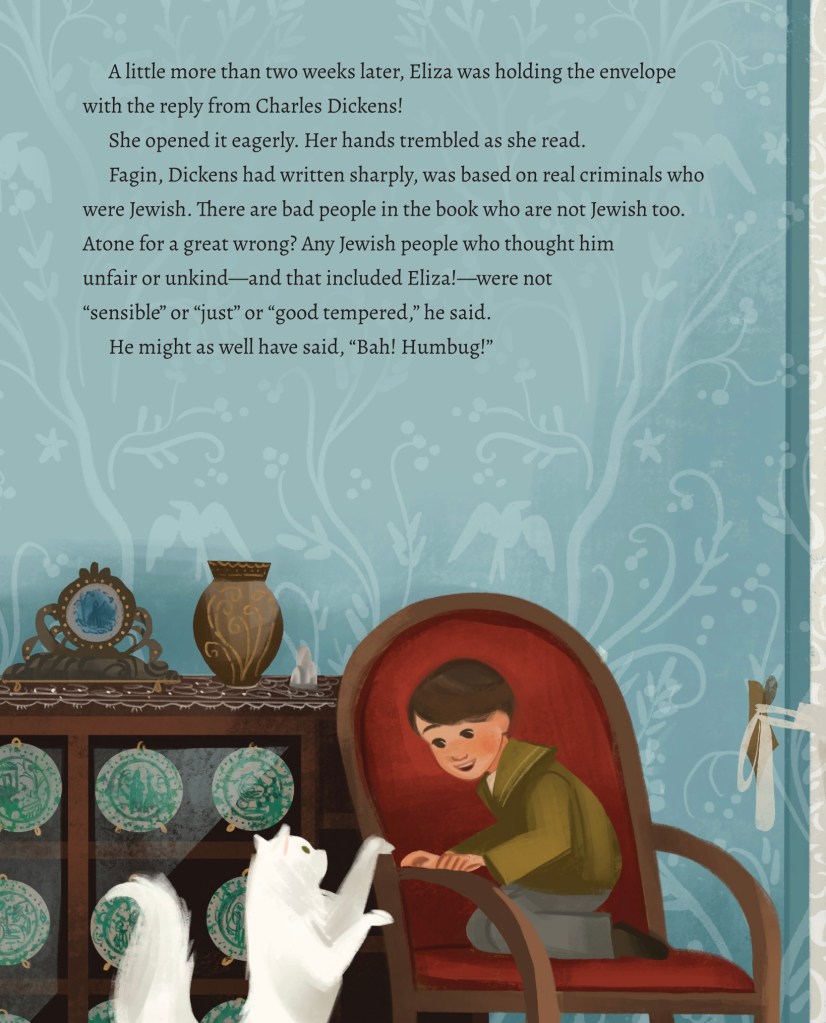
One reader, Eliza Davis, wrote to him, accusing him of portraying her people, those of Jewish ancestry, in stereotypical and negative ways. She cited Fagin, from Oliver Twist, a cruel and selfish man teaching young street urchins to steal. Eliza begged him to show more complexity in his Jewish characters.
Dickens was unimpressed.
Dear Mr. Dickens, By Nancy Churnin
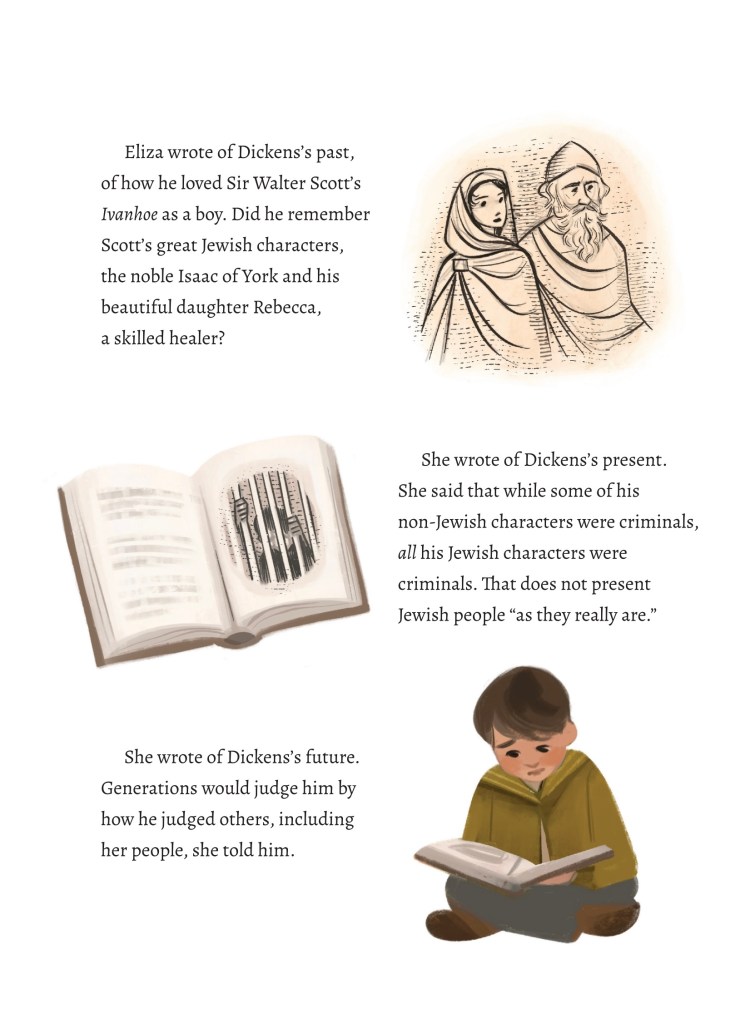
However, taking a page from Dickens’ own, Christmas Carol and the transformation of Ebenezer Scrooge, Eliza wrote him again:
Dear Mr. Dickens, by Nancy Churnin
And this time, Dickens was moved. And changed. From then on, his Jewish characters were complex and kind, and the exchange between Eliza and Dickens is credited for having a part in reducing anti-Semitic views and laws of the day.
Eliza had the same tools at hand as Dickens himself: pen, paper, and a keen sense of justice. While she lacked his fame, she made up for it by essentially teaming with him to bring about change.
What are the injustices of our day? It can be challenging to see them, sometimes, because we’ve been so steeped in things the way they are, that they seem normal. But if we pretend we are explaining our world to an alien, for instance, we might be hard-pressed to answer some of their questions. It is in those places, those places we know to be wrong, that we can strive to be the heroes of our own lives.
Not every problem can be solved. Not every complaint wants a ‘solution’. Sometimes the heart just craves company, someone to walk beside in trying times.
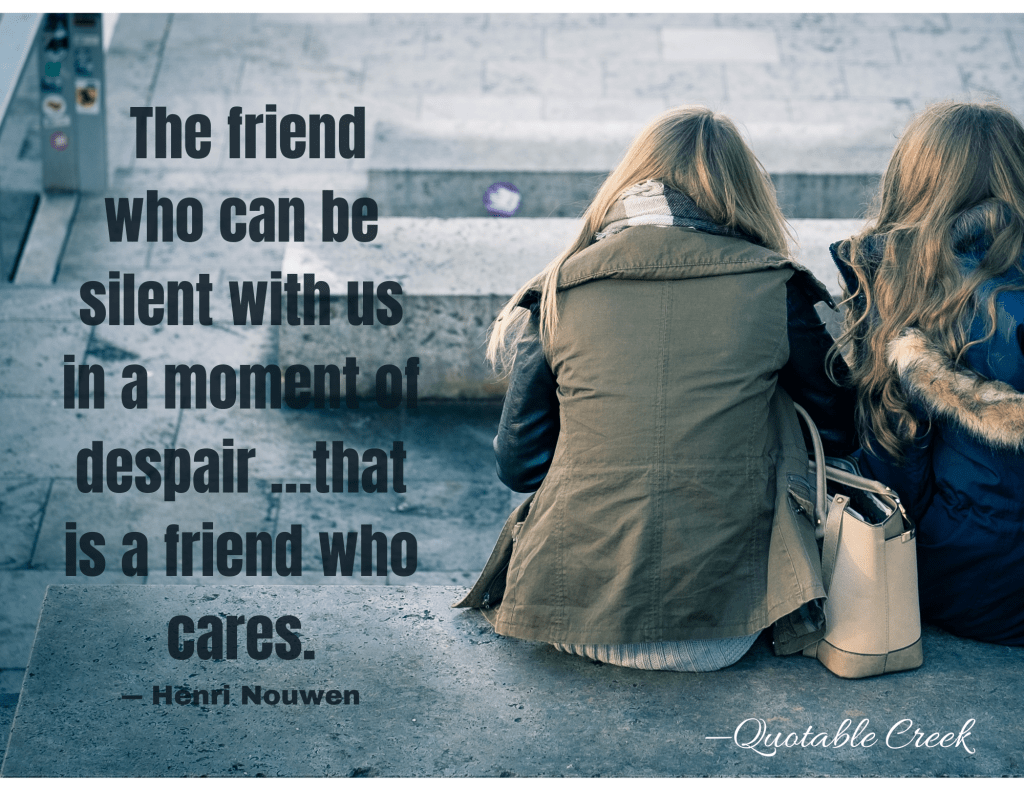
As Henri Nouwen says,
When we honestly ask ourselves which person in our lives means the most to us, we often find that it is those who, instead of giving advice, solutions, or cures, have chosen rather to share our pain and touch our wounds with a warm and tender hand. The friend who can be silent with us in a moment of despair or confusion, who can stay with us in an hour of grief and bereavement, who can tolerate not knowing, not curing, not healing and face with us the reality of our powerlessness, that is a friend who cares.”
― Henri Nouwen, Out of Solitude: Three Meditations on the Christian Life
Standing up to fear changes a person. It helps you to put matters in perspective. Where once fear loomed over you, insurmountable, now you can honor the courage it took to move past it into unfamiliar territory.
Eleanor Roosevelt was a courageous woman. Despite her husband’s attempts to placate the South, she regularly bucked segregation and was a vocal proponent of civil rights. She was able to call out racism and force others to see it for what it was:
By 1939, ER decided to attack the hypocritical way in which the nation dealt with racial injustice. She wanted her fellow citizens to understand how their guilt in “writing and speaking about democracy and the American way without consideration of the imperfections within our system with regard to its treatment . . . of the Negro” encouraged racism. Americans, she told Ralph Bunche in an interview for Gunnar Myrdal’s American Dilemma, wanted to talk “only about the good features of American life and to hide our problems like skeletons in the closet.” Such withdrawal only fueled violent responses; Americans must therefore recognize “the real intensity of feeling” and “the amount of intimidation and terrorization” racism promotes and act against such “ridiculous” behavior.
You can’t clearly see a problem before you if you are too scared to look at it and call it out for what it is. Where are the injustices in your immediate orbit? Are there people being treated unfairly? How can you add your voice to help identify the problem and move toward healing? These problems are right here, close to home.
As Eleanor Roosevelt said:
Where after do human rights begin? In small places, close to home– so close and so small that they cannot be seen on any map of the world. Yet they are the world of the individual person: The neighborhood he lives in; the school or college he attends; the factory, farm or office where he works. Such are the places where every man, woman, and child seeks equal justice, equal opportunity, equal dignity without discrimination. Unless these rights have meaning there, they have little meaning anywhere. Without concerted citizen action to uphold them close to home, we shall look in vain for progress in the larger world.
Fear is a crippler. It keeps you rooted in a course of action you know to be wrong. Focusing on the fear helps it to loom even larger before you. Instead, focus on the better world you are trying to help build. Spreading love and justice is exciting and uplifting. Being part of something bigger than yourself, working for a common goal, in an effort to improve people’s circumstance is rewarding.
You don’t have to see the whole path in front of you. Take, and keep taking, that next step forward.
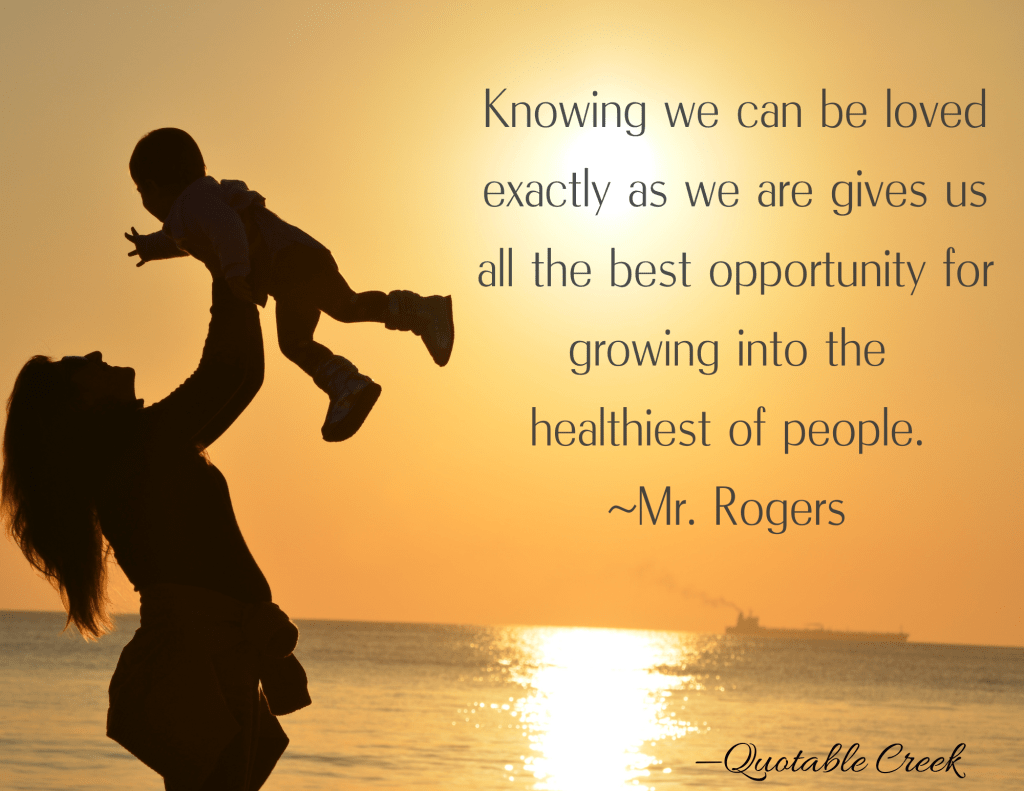
Mr. Rogers had a gift for seeing each child he encountered as an individual, a neighbor, someone worthy of respect just as they are. No need to impress him, or to put on an act, or to pretend. He accepted children. Period. No strings attached.
How wonderful.
Do you feel you are enough, just as you are? Sometimes our families, friends, or societies give us the message that we aren’t. That we need to be thinner, richer, smarter, younger, more attractive. Something different from what we are. That we must think the same as they do and fall in line. It’s exhausting.
What a gift it is to accept people, including ourselves, just as is. No one is perfect, so why pretend we are? We each have strengths and weaknesses, things we’re working on and things we’ve got sorted. Instead of finding flaws, we can look at ourselves and each other as complicated works in progress, with value just as we are, giving ourselves and each other ‘the best opportunity for growing into the healthiest of people.’








 QuotableCreek.com