If you look carefully, can you tell who is suffering a storm in their lives? Maybe the fog of depression, the tumult of marital strife, the buffeting of indecision, the downpour of failure? Often a calm demeanor masks these inner storms. Maybe you’ve experienced some rough weather of your own. In all of these situations, your personal sunshine–a warm smile and cheerful disposition–can quiet the storms, or at least make people feel not quite so lonely until the sun shines again. Today, bring your sunshine with you; you never know who is in a stormy place.
What tools do we need before we start to improve the world? What are we waiting for? Perhaps we are waiting for extra money or time. Perhaps we are waiting for retirement. Perhaps we are waiting to get all our own issues squared away first before we start thinking about helping someone else with theirs. Perhaps we are waiting for someone to ask us for help.
But consider Anne Frank. Forced to live in hiding to avoid the Nazi round-up and murder of Jews, she had little contact with the outside world. She, herself, was in mortal danger around the clock. She was just a kid, really, someone we think of helping rather than being the helper. And yet her attitude was so full of optimism and hope, it continues to shine now, decades later, lighting a weary world.
What a difference an attitude makes! She didn’t wait for the right time or resources. She didn’t wait until she could have a huge impact on the world. She didn’t wait until she was old or famous or wealthy. She didn’t even wait until she was safe. She started right then with what she had. A cheerful disposition, a concern for her family and the others in hiding with her, a willingness to step forward and try to make the world a better place.
What can you do to improve the world? Isn’t it wonderful that you can start right now?
Miep Gies was a young office worker when she hid and supported Anne Frank and her family, protecting them from Nazis and the danger of being sent to a concentration camp. After Anne and her family were betrayed and captured, Miep collected Anne’s diaries and eventually returned them to Anne’s father, Otto, who survived the war. That diary has been read by millions of people now, inspiring acts of heroism and showing, in a very intimate way, the horror of WWII as viewed through the eyes of an innocent, complex, lovely, vibrant girl, Anne.
Miep wasn’t famous or rich or particularly accomplished, yet she managed through her actions to shine a very bright light on hate and replace it with a more powerful portrait of love. Anne, too, wasn’t famous or rich or accomplished, although we can see now how she was a gifted author, but her words have been inspiring and a powerful force against evil in the world.
No matter our position or age or wealth or gender, we each can make a contribution that makes the world more bright.
What is one bright thing in your day? One shining star or saving grace? Sometimes the simplest of things can light up our mood and day, and start things in the right direction.
For inspiration, consider this poem:
Success by Ralph Waldo Emerson To laugh often and much; To win the respect of intelligent people and the affection of children; To earn the appreciation of honest critics and endure the betrayal of false friends; To appreciate beauty, To find the best in others, To leave the world a bit better, whether by a healthy child, A garden patch or a redeemed social condition; To know even one life has breathed easier because you have lived. This is to have succeeded.
The world existed before us and will go on after us. That’s a hard thing to wrap our minds around because we see things from our point of view. It’s hard to picture a scenario without ourselves in it. And yet, that day will come. Our chance to make our mark will end. While it seems at first like a very sobering thought, it can be uplifting because it reminds us that we are here now; this is our time to dance, to love, to give, to celebrate, to reach out to the other dust particles like ourselves and do our bit. This is our moment. Let’s make the most of it.
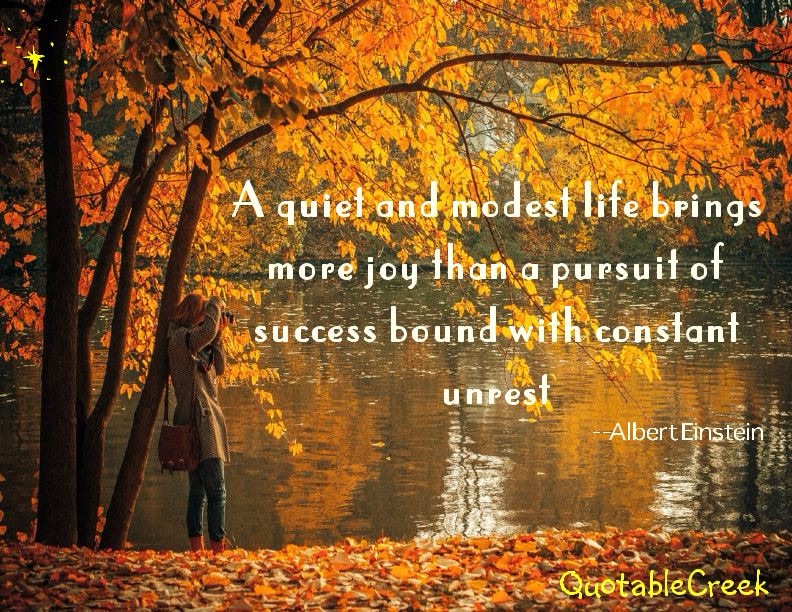
Apparently, one day in 1922, Albert Einstein was caught short, unable to leave a tip on his lunch bill. Instead, he scrolled:
“A quiet and modest life brings more joy than a pursuit of success bound with constant unrest.”
Einstein hoped his words would prove valuable to the young waiter some day. Ironically, that scrolled message recently fetched over a million dollars at auction. More valuable, indeed.
But, setting humor aside, isn’t Einstein right? What are the moments that bring us joy?
Are they in the hustle and bustle and endless striving, or are they in life’s quiet moments, those moments with no posturing, no striving, no achieving? Just being.
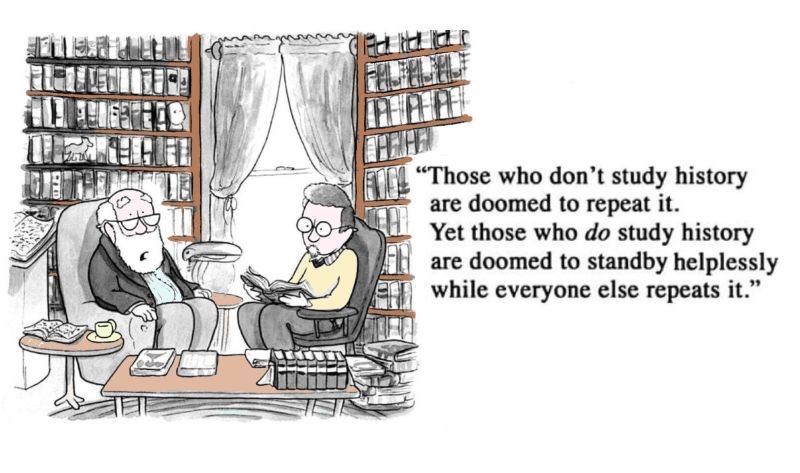
One of the greatest frustrations of life is not being able to change the past, whether it is to remedy that stupid thing you just said or the larger elements of fractures in society leading to war. The only things we can really do with the past are to live with it, learn from it, and figure out how to move forward. For those who study history, seeing ugly patterns reemerge and take shape can be horrifying.
And yet, it is not all gloom and doom. Indeed, we are not helpless:
One of the curses of history is that we cannot go back and change the course leading to disasters, no matter how much we might wish to. The past has its own terrible inevitability. But it is never too late to change the future.”
― Heather Cox Richardson
We can learn from history what it takes to resist. We can remember who the real heroes were in dark times and emulate them. We can draw on community and coalitions to fight for the common good. We can continue to believe that integrity counts, that honesty and fidelity and honor matter, that kindness will always heal, and that love is, not only good, but the answer to any question.
We can fight. With whatever tools we have: words, money, presence, we can take a stand, doing our little bit of good.
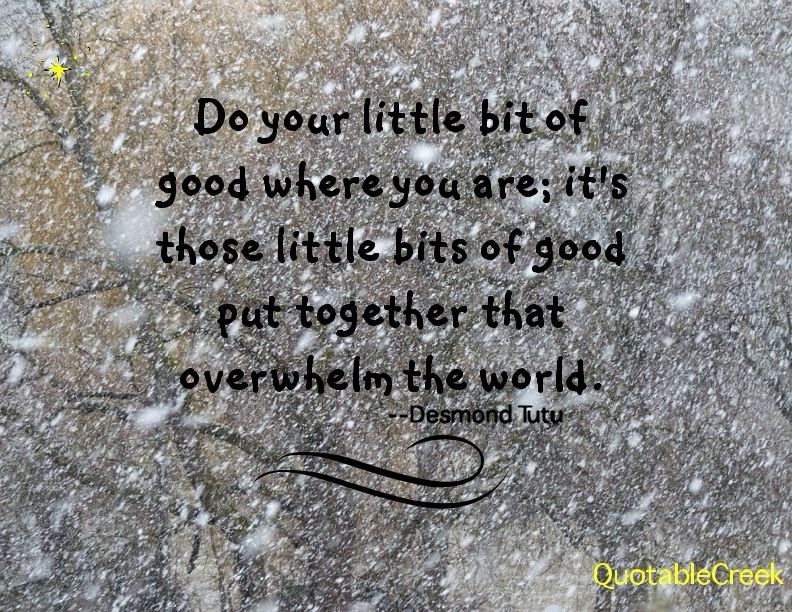
As Desmond Tutu said:
Do your little bit of good where you are; it’s those little bits of good put together that overwhelm the world.
In 2016, Pope Francis sainted Mother Teresa. She was a beloved paragon of a selfless life, ministering to the poor and dying, shining a light on the importance of the little things and the love of family. After her death, her diaries showed her struggles with doubt. Once feeling clearly called to her mission, in the last several decades of her life she felt God’s absence. She said,
Lord, my God, who am I that You should forsake me? The Child of your Love–and now become as the most hated one–the one–You have thrown away as unwanted–unloved. I call, I cling, I want–and there is no One to answer–no One on Whom I can cling–no, No One.–Alone … Where is my Faith–even deep down right in there is nothing, but emptiness & darkness–My God–how painful is this unknown pain–I have no Faith–I dare not utter the words & thoughts that crowd in my heart–& make me suffer untold agony.
So many unanswered questions live within me afraid to uncover them–because of the blasphemy–If there be God –please forgive me–When I try to raise my thoughts to Heaven–there is such convicting emptiness that those very thoughts return like sharp knives & hurt my very soul.–I am told God loves me–and yet the reality of darkness & coldness & emptiness is so great that nothing touches my soul. Did I make a mistake in surrendering blindly to the Call of the Sacred Heart?
And on until her death, she felt God’s absence, rather than his presence. And yet she persisted doing the work to which she had been called, living a life of faith.
Some may call her a hypocrite to have an outward smile of peace and an inner crisis of faith, but isn’t her struggle every one’s struggle? Who among us doesn’t struggle with doubt? Don’t we all rely on faith when our paths grow dark and twisting?
St. Teresa of Calcutta inspires us to hang on during the dark nights of the soul, to continue to walk the walk, to be faithful and steadfast, and to shine light in the dark places. She can aptly be considered the Patron Saint of Doubters.