Thankful for teachers.

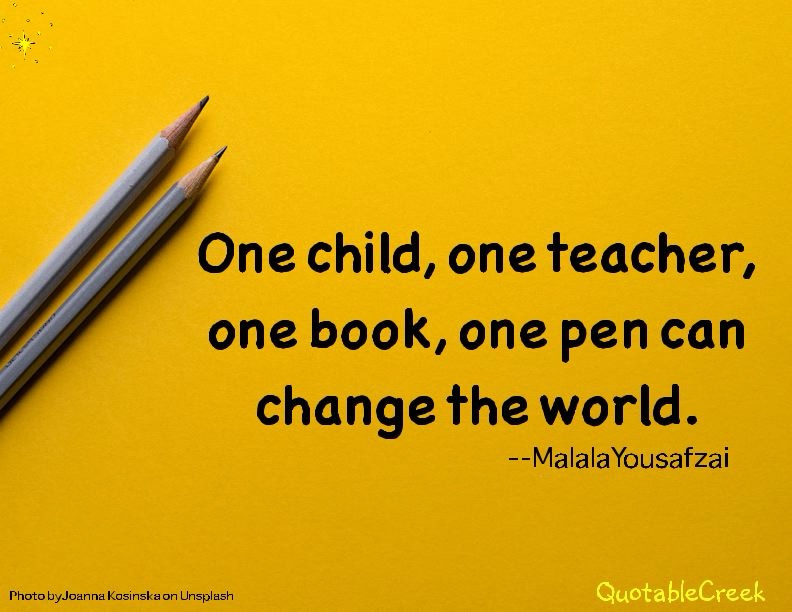
We are each born helpless. How we got from there to where we are now depended on the generosity of many people. Among those are our teachers, those people who devoted their time to making sure we understood the world around us and how to negotiate the ups and downs of the road ahead. Those teachers who went beyond the lesson plan to help us learn not just facts, but how to think and analyze, how to care and feel, and how to reach out to others deserve our unending gratitude.

Everyday saints.

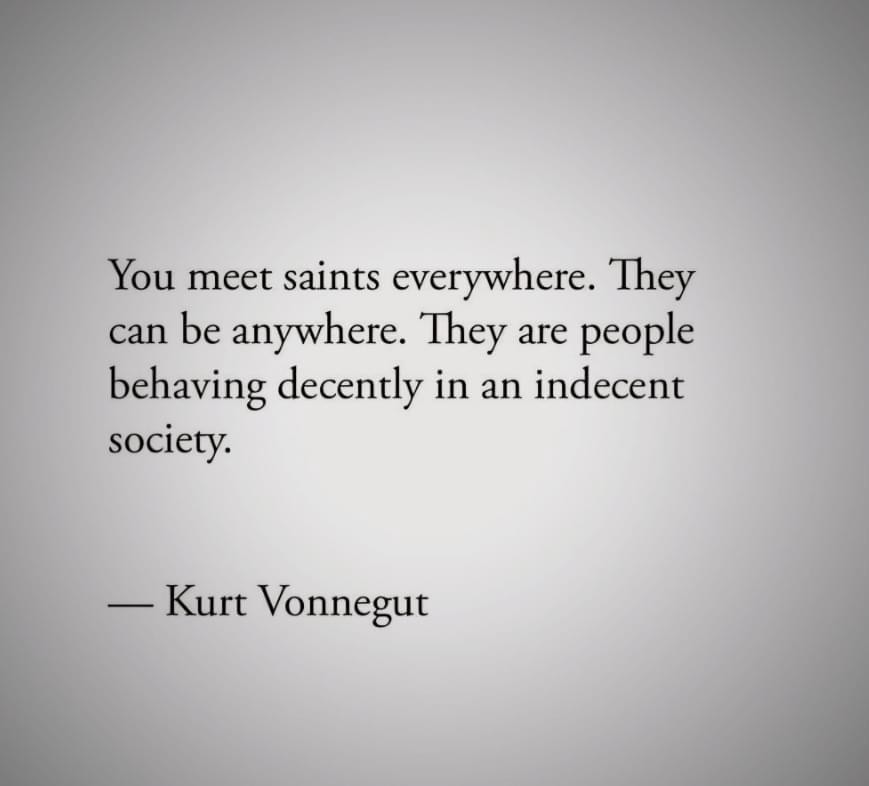
Sometimes I think saints must have been extraordinary people, somehow different from the rest of us lugs, vested, perhaps, with some superior spiritual gifts or insights.

But then I realize, as did Vonnegut below, nope, just people like us, doing their best.

Whether we are ever canonized or not, this is our ‘job,’ isn’t it? To ‘behave decently in an indecent society’.

And then comes the hard part, to trust that your behaving decently will make a difference, whether you ever know about it or not.

Just keep making those ripples.

Your imperfect offering.

Perfection can be the enemy of progress. When we need to move forward, we often wait until we come up with a perfect solution, sometimes so long that the opportunity to make our contribution passes. It is not only ok to be fallible, it is all we’ve got to work with: Our imperfect, fallible, often short-sighted selves doing our best to make the world a better place right here, right now, with what is right in front of us.

Take a minute to watch this lovely video of Leonard Cohen singing a reminder that perfection isn’t an option; we must do our best now.

I shall not pass this way again.

There is an elephant in the room. We don’t talk about it, we try not to think about it, we pretend it doesn’t exist. That elephant is the fact that we are all on a one way journey through this life. Our time is limited. None of us knows in advance when our end of the journey will come, but that end will come.

When we pull ourselves out of denial and gaze directly at this elephant, we can realize something important: our opportunities should be seized now. That good we can do? Don’t put it off. That kind word? Say it. That gift or remembrance? Give it now.

We will not have this place and time and opportunity to make a difference again.

Let it begin with me.

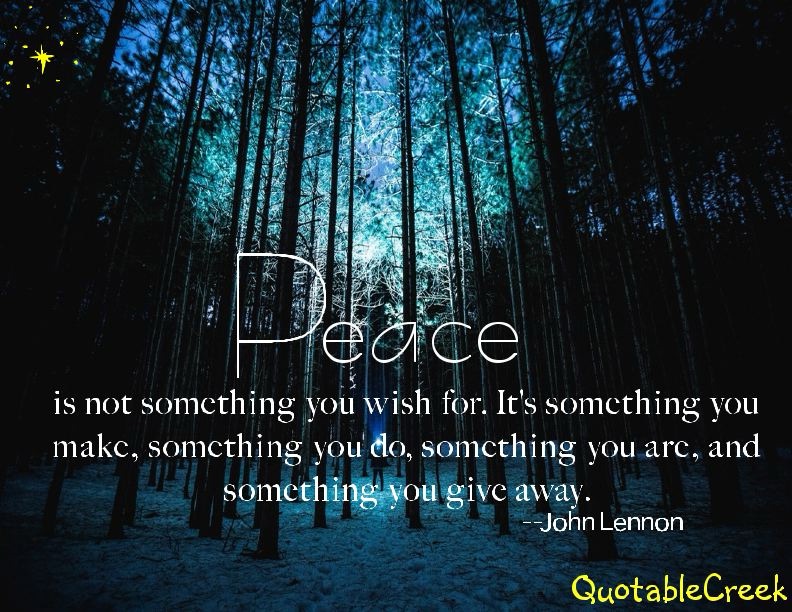
We wish for peace but quarrel with our neighbor. We tremble from talk of war but allow ourselves to respond to others with hate, sarcasm, anger, and animosity. We expect leaders to be the adults in the room, but mock and deride them mercilessly. Peace, it seems, is something for other people out there to do and strive for because we are angry and fed up and impatient, and peace isn’t in our everyday lexicon at the moment.

But we can fight for peace, by controlling ourselves, treating each other respectfully, and speaking out against injustice. Take a minute to watch this beautiful video.

Let there be peace on earth
And let it begin with me
Let there be peace on earth
The peace that was meant to be
With God as our father
Brothers all are we
Let me walk with my brother
In perfect harmony

Let peace begin with me
Let this be the moment now
With every step I take
Let this be my solemn vow
To take each moment
And live each moment
To take each moment
And live each moment
To take each moment
And live each moment
In peace eternally
Let there be peace on earth
And let it begin
With me (me)
With me

Songwriters: Jill Jackson / Sy Miller

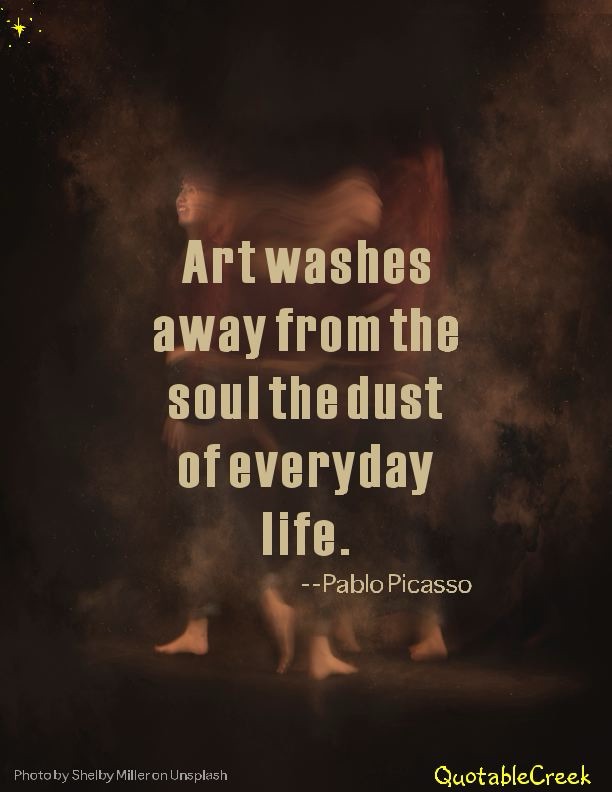
Wiping the dust off our souls.

It is so easy to get discouraged when living a creative life. Your words are criticized; your paintings don’t sell. “They” don’t believe you have any promise. Sometimes the struggle to be commercially successful in a creative field can be so daunting that you abandon the art. But then you remember that art isn’t about “them” or “success” or “critical acclaim” at all. It’s about bringing your truths into the light, being creative, pushing yourself, being you.

Nowhere is this better illustrated than in the case of Henri Rousseau, a forty year old toll collector who wanted to paint. His work was derided, and yet he continued. He found joy in the painting. Not until the end of his life did anyone take his work seriously. As summarized by Maria Popova:

Long before history came to celebrate him as one of the greatest artists of his era, long before he was honored by major retrospectives by such iconic institutions as the MoMA and the Tate Museum, long before Sylvia Plath began weaving homages to him into her poetry, he spent a lifetime being not merely dismissed but ridiculed. And yet Rousseau — who was born into poverty, began working alongside his plumber father as a young boy, still worked as a toll collector by the age of forty, and was entirely self-taught in painting — withstood the unending barrage of harsh criticism with which his art was met during his entire life, and continued to paint from a deep place of creative conviction, with an irrepressible impulse to make art anyway…. [Rousseau’s life is] an emboldening real-life story, and a stunningly illustrated one, of remarkable resilience and optimism in the face of public criticism, of cultivating a center so solid and a creative vision so unflinching that no outside attack can demolish it and obstruct its transmutation into greatness.

The message from Rousseau’s life speaks to all of us: he was a success all along. He persevered with a remarkable resilience to produce work that spoke to him and pursued a passion that made him happy. That, the pursuit of great art, rather than the financial success was what gave his journey depth and meaning and lifted up his soul.

Adulting.

Toni Morrison had a gift for complexity and nuance in her writing. Multi-dimensional characters and lots of gray area rule the day in her work.

I found it interesting to hear this perspective from her:

I just think goodness is more interesting. Evil is constant. You can think of different ways to murder people, but you can do that at age five. But you have to be an adult to consciously, deliberately be good — and that’s complicated.

It’s an age-old question whether people are inherently good, whether altruism is learned or instinctive, whether selflessness develops naturally.

But there definitely is an intentionality to doing good, choosing kindness, forgiving, welcoming, holding your tongue. And as we grow older and cast off our childish ways, we learn the wisdom of restraint and forbearance.

And we learn the power of good because often we are on the receiving end of it and know how much it matters.

And then when it’s our turn, we want to pass it on.

Spit venom or heal a broken soul?

It’s remarkable how powerful words, just words, are. Most of us can remember a criticism that hurt, maybe more than we can remember a compliment.

In the hands of a parent, words can be deflating or encouraging, critical or comforting. A parent who is never satisfied no matter the child’s achievement can inflict lifelong damage. And the effect of those words will last with that child well into adulthood and inform how they, in turn, will talk with their own children. A sad cycle.

These days, lies have a horrible power to cause almost irreversible damage. Social media can amplify those lies, and, before you can think twice, your words can become venom.

No doubt words have power. The question becomes how do we want to use that power. In this award-winning speech, Mohammed Qahtani makes a case for choosing wisely.

Bringing the sun.

How broad is your focus? On your own needs and wants, or broader? It seems that a broad focus, on others as much or more than ourselves increases empathy and happiness.

As Daniel Goleman said:

Self-absorption in all its forms kills empathy, let alone compassion. When we focus on ourselves, our world contracts as our problems and preoccupations loom large. But when we focus on others, our world expands. Our own problems drift to the periphery of the mind and so seem smaller, and we increase our capacity for connection – or compassionate action.


― Daniel Goleman, Social Intelligence: The New Science of Human Relationships

Does this seem true as you think about the people in your life?

The other thing that happens when you turn your concern to others is the whole world opens up. There is so much to learn, to do, to care about. So many places to put your time and efforts. So many people to love and help.

Connections in a big old world.

Every morning, I wake up and play games. My favorite these days is Connections, a collection of 16 words that you need to group in four groups of four based on a shared connection. Here’s the solution from one last week:

Now, looking at the solution, it’s easy to see the connections. Not so, though, when the words are all scrambled and the connections are unclear. Words may have more than one meaning or be multiple parts of speech. Often the answers are homonyms or are missing a letter. It can be challenging to find the connections among the words.

So, too, with the connections among people. There are some obvious superficial connections perhaps— gender, political affiliation, nationality, religion, age. But what of those deeper, hidden ones? How do we find those to help us feel more like a community?

I thought about this when reading an article about how an introvert, Jay Krasnow, made friends. He had struggled to find true connections at work functions or forced social gatherings, but when he dug deeper, to consider the things he was passionate about and find others who shared those passions, he found the connection he was looking for. He explains:

My failure at connecting wasn’t due to a lack of trying. I spent my 20′s and 30′s collecting and studying books on how to network, forge friendships and build character. 

Yet, my principal achievement from reading these books was that I became adept at identifying when other people had read these same books. Meanwhile, my networking skills didn’t significantly improve. Even worse, I felt that by reading books with titles like “How to Talk to Anyone,” I was turning myself into a robot that spewed out inauthentic lines to people who I genuinely wanted to know. 

There had to be a better way to build relationships.

For Jay, he decided to start a book club, not one reading the same book, but one where you came and told people about the book you were currently reading. It took off, people came. And those relationships centered on a shared passion spilled over into other friendships:

Connecting with other people through books seemed natural, but I didn’t know if anyone would come. I was prepared to read my book quietly if no one else showed up. Fortunately, both my friends came, and we were joined by one other person we didn’t know.

After the first event, more people started coming, and I started making new friends almost immediately. 

The group’s membership grew exponentially. It wasn’t long before I was inviting my new friends to dinners and other events. Because we had established we shared a similar passion, it was easy to branch out from there and find other things to do and talk about.

I wonder if this is what the world needs right now— connections based on a shared love or passion. So much of identity seems tied into a shared hatred or shared anger over something. It seems like that just leads to more loneliness and separation.

Time to try a new approach.