What is your woods?

We don’t let just anyone see us vulnerable, hear our secret stories, watch us struggle. To most of the world, we carry a bit of a shield between them and our tender parts. But there are some few we trust to see the real person behind the mask. We must love those people very much to be so naked and exposed.

Because we need to lay those masks down sometimes, don’t we? We can’t live a life of posture. And so we seek out places where and people with whom we can relax and let down our hair, unafraid of judgment, unconcerned with being deemed eccentric.  Perhaps to be part of nature, to rest among creation until we lose sight of where we stop and others begin.

In this poem, Mary Oliver takes us into her sacred space–the woods.

She must love us very much.

How I Go To the Woods 

by Mary Oliver  

Ordinarily, I go to the woods alone, with not a single friend, for they are all smilers and talkers and therefore unsuitable. 

I don’t really want to be witnessed talking to the catbirds or hugging the old black oak tree. I have my way or praying, as you no doubt have yours.  

Besides, when I am alone I can become invisible. I can sit on the top of a dune as motionless as an uprise of weeds, until the foxes run by unconcerned. I can hear the almost unhearable sound of the roses singing. 

If you have ever gone to the woods with me, I must love you very much. 
Why is beauty?

Have you ever wondered why everything is so beautiful? Have you stood rapt in the brilliant colors of a sunset, or listening to birdsong in the morning, or watching the way a caterpillar humps along with all its little feet working together? Perhaps there are logical, book smart reasons, like flowers are beautiful to attract bees, or animals are beautiful to attract mates or to warn predators they’re toxic, or some such thing, but don’t those answers beg the question really? Why is beauty? Could the answer be that it is to inspire awe in us? And our job is to notice.

A master violinist can play Bach on a precious instrument, and most people will just walk by:

We are living in a place filled with beauty if we only stop to notice. For inspiration, consider Mary Oliver’s poem, The Summer Day:

The Summer Day

Who made the world?
Who made the swan, and the black bear?
Who made the grasshopper?
This grasshopper, I mean-
the one who has flung herself out of the grass,
the one who is eating sugar out of my hand,
who is moving her jaws back and forth instead of up and down-
who is gazing around with her enormous and complicated eyes.
Now she lifts her pale forearms and thoroughly washes her face.
Now she snaps her wings open, and floats away.
I don't know exactly what a prayer is.
I do know how to pay attention, how to fall down
into the grass, how to kneel down in the grass,
how to be idle and blessed, how to stroll through the fields,
which is what I have been doing all day.
Tell me, what else should I have done?
Doesn't everything die at last, and too soon?
Tell me, what is it you plan to do
with your one wild and precious life?

What a gift we have been given to have the chance to notice the beauty all around us today!

Touching, kissy words.

Spring has sprung, and nothing beats a morning walk for plugging into springtime energy. Birds twittering, gentle breezes, heady fragrances. And that good vibe can carry you through a mundane day.

Consider this from Mary Oliver

How lovely to think of a morning walk as a gateway into gratitude, and that all of creation is whistling, slapping, stamping, shining, humming, and turning right there with you. In gratitude.

What are your touching, kissing words of gratitude?

Are you lonely?

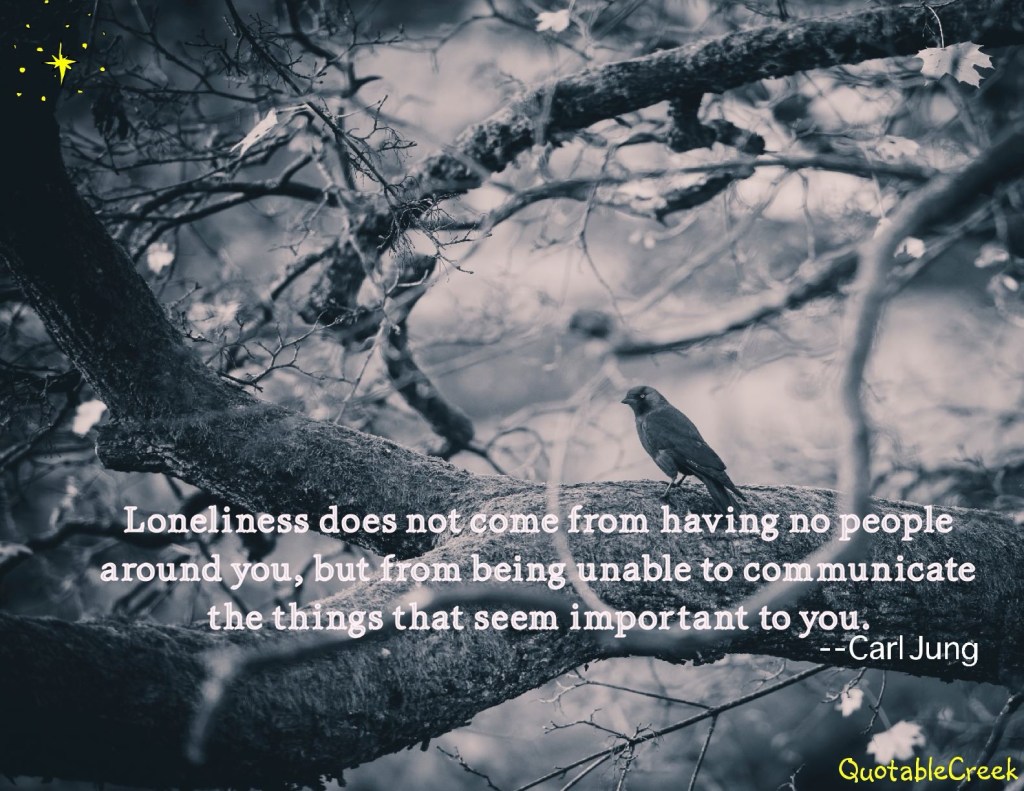
Are you lonely? Does your heart long to be heard and understood? For someone to get you? And for you to really hear someone in return? Are you yearning to share your heart’s stories with someone else?

Loneliness has nothing to do, really, with being alone. In fact, the worst way to be lonely might be when you are with someone else but not feeling connected.

Is there a way to ease our heart’s loneliness?

One possibility is to open yourself up. Share your true thoughts and feelings, not the masks you wear in the world, but your true self. And then be a safe place for someone else to be naked emotionally with you. Scary, yes. But what good is it if you’re not being yourself in your own relationships?

To speak to that loneliness in all of us, take a moment to savor this beautiful poem by Mary Oliver and listen for the world calling you into your place in the family of things.

Wild Geese

by Mary Oliver

You do not have to be good.
You do not have to walk on your knees
For a hundred miles through the desert, repenting.
You only have to let the soft animal of your body
love what it loves.
Tell me about despair, yours, and I will tell you mine.
Meanwhile the world goes on.
Meanwhile the sun and the clear pebbles of the rain
are moving across the landscapes,
over the prairies and the deep trees,
the mountains and the rivers.
Meanwhile the wild geese, high in the clean blue air,
are heading home again.
Whoever you are, no matter how lonely,
the world offers itself to your imagination,
calls to you like the wild geese, harsh and exciting —
over and over announcing your place
in the family of things.

Be still my soul and steadfast.

No one knows what tomorrow will bring, and that can be frightening. We are in a volatile time. It helps to keep our attention on the present and what we can do here and now.

The great poets help calm our souls. Take comfort today from these tender words from Mary Oliver:

Be still, my soul, and steadfast.
Earth and heaven both are still watching
though time is draining from the clock
and your walk, that was confident and quick,
has become slow.

So, be slow if you must, but let
the heart still play its true part.
Love still as once you loved, deeply
and without patience. Let God and the world
know you are grateful. That the gift has been given.


+ Mary Oliver

We do not know what tomorrow brings, but we will approach it with full souls, grateful and loving, ready to meet the day with a steadfast heart.

A fighting hope.

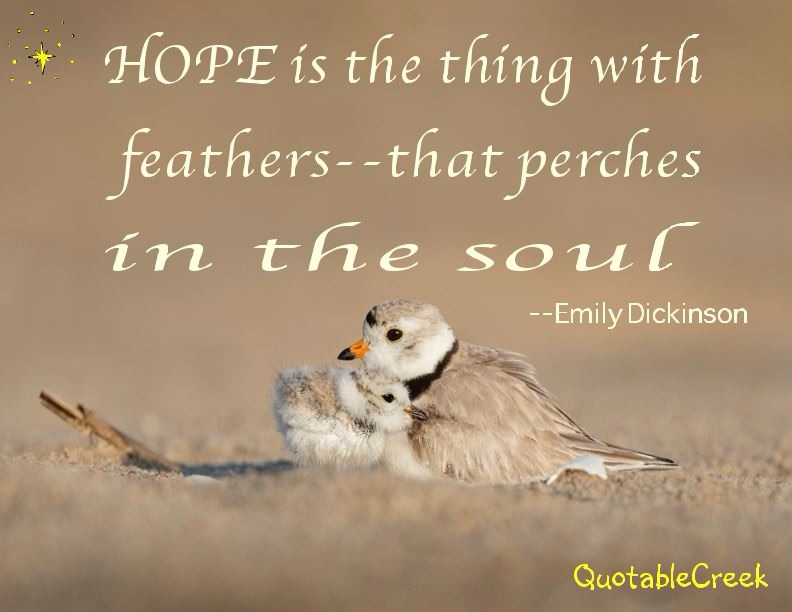
We begin the year with hope. Hope for peace; hope for good health; hope for reconciliation and redemption; hope for progress on our journeys and throughout the world. Emily Dickinson’s poem is a lovely metaphor to return to when drawing on this hope to get us through rough days:

“Hope” is the thing with feathers –

That perches in the soul –

And sings the tune without the words –

And never stops – at all –

And sweetest – in the Gale – is heard –

And sore must be the storm –

That could abash the little Bird

That kept so many warm –

I’ve heard it in the chillest land –

And on the strangest Sea –

Yet – never – in Extremity,

It asked a crumb – of me.

Hope is active, isn’t it? Sometimes singing, sometimes soaring, sometimes hanging on by its toenails. Faith is different. Mary Oliver describes this difference beautifully in her book, Upstream:

In the winter I am writing about, there was much darkness. Darkness of nature, darkness of event, darkness of the spirit. The sprawling darkness of not knowing. We speak of the light of reason. I would speak here of the darkness of the world, and the light of _______. But I don’t know what to call it. Maybe hope. Maybe faith, but not a shaped faith–only, say a gesture, or a continuum of gestures. But probably it is closer to hope, that is more active, and far messier than faith must be. Faith, as I imagine it, is tensile, and cool, and has no need of words. Hope, I know is a fighter and a screamer.

As we go forward, let us hope for a better world for every one, but let it be an active hope–a fighting, kicking and screaming hope– a hope that urges us into that battle of making the world the better place.

What questions are we asking ourselves?

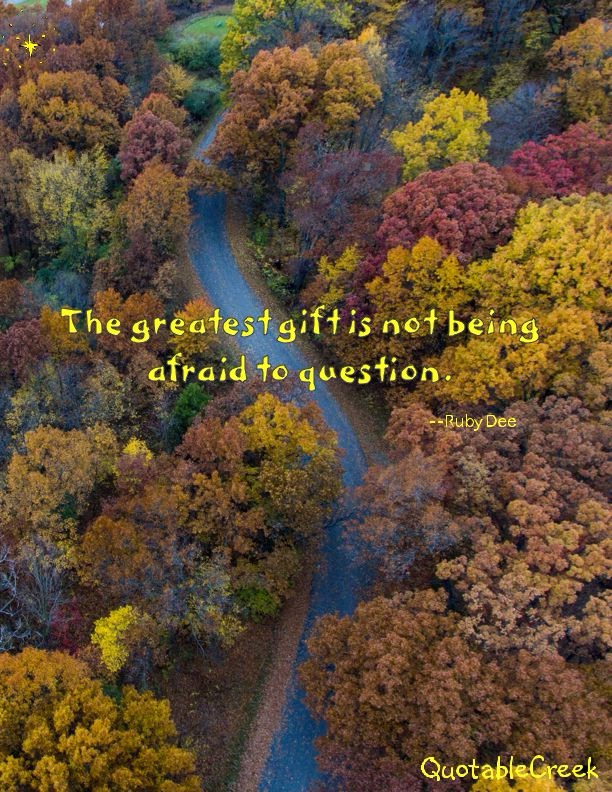
What questions do we frame for ourselves at the end of the day? What are the questions that have caused us to soul-search and perhaps take a new path? What questions have forced you to look at something a different way?

Sometimes the questions are more important than the answers. There are some that resonate so deeply with us, we may spend a lifetime trying to answer them. In her piece about the beauty of these profound questions, Karen Horneffer-Ginter identifies some that have been meaningful to her:

When used properly, questions have the potential to connect us to the world of another. A heartfelt “How are you?” or “How was your day?” can become the bridge that keeps us in relationship to the lives of those we love. Sometimes, too, questions create a bridge within ourselves, allowing us to hear what’s going on at a deeper level. We know when we’ve encountered a question that has this potential because it stays with us — maybe for the day, maybe for our whole lives. It taps us on the shoulder to wake us up, or it wiggles its way in more deeply, opening us up to seeing things in a new way.

I still recall first encountering Judith Duerk’s chorus of questions about how my life might have been different if there had been a sacred circle to step into. Mary Oliver asking me about my plans for this one wild and precious life, Oriah Mountain Dreamer wanting to know what I ache for and if I dare to dream of meeting my heart’s longing, and Angeles Arrien reminding me of the questions asked in some indigenous cultures: When did you stop singing? When did you stop dancing? I think of my friend Ming, asking me at lunch one day if I thought writing was my fullest and truest expression. All these questions have remained close companions across the years.

The questions that have been consuming my thoughts and are my close companions these days are What does it mean to be welcoming? How does welcome look? How does it change the mix if it is accepted? What are the stumbling blocks to be truly welcoming? Where does fear creep in to inhibit welcome? How will my life be different because I have welcomed another into it? How will it disrupt my comfort zone, and how will I get my ego out of the way to be more accepting?

What are the questions in your heart, questions that are your close companions? And just the framing of those questions can be significant, as she suggests above. Consider the difference between ‘What do I have to do today?’ and ‘What do I get to do today?’ That simple shift helps us move from feeling burdened to being grateful for all the opportunities presented by the day.

What are the questions that have been your close companions? What do you get to do today to help answer them?

What is it you plan on doing with your one wild and precious life?

In her poem, The Summer Day, Mary Oliver writes:

The Summer Day

Who made the world?
Who made the swan, and the black bear?
Who made the grasshopper?
This grasshopper, I mean-
the one who has flung herself out of the grass,
the one who is eating sugar out of my hand,
who is moving her jaws back and forth instead of up and down-
who is gazing around with her enormous and complicated eyes.
Now she lifts her pale forearms and thoroughly washes her face.
Now she snaps her wings open, and floats away.
I don't know exactly what a prayer is.
I do know how to pay attention, how to fall down
into the grass, how to kneel down in the grass,
how to be idle and blessed, how to stroll through the fields,
which is what I have been doing all day.
Tell me, what else should I have done?
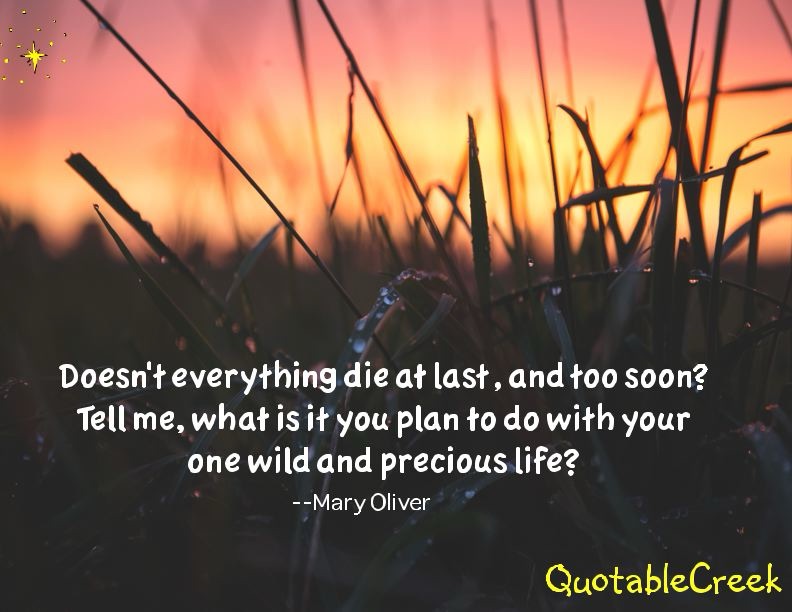
Doesn't everything die at last, and too soon?
Tell me, what is it you plan to do
with your one wild and precious life?

What does it mean to pray? What exactly is a prayer? Is it reciting certain words in unison at a church on Sundays, or is it also something infinitely more?

Is it noticing the creator in the delicate creation? Is it paying attention? Is it being grateful? Is it flinging yourself down on the grass to contemplate not just the meaning of life, but the meaning of your life?

Yes, life is short, over far too soon. But, while we are here, there is opportunity. To pray, to notice, to attend, to use our lives to make a difference.

What is it you plan to do with your one wild and precious life?

Edges called Perhaps.

How many angels can dance on the head of a pin? Is there any way we could ever truly know?

There are so many issues for which we may never have answers, true answers, like who’s ‘right’ and who’s ‘wrong’, and yet we cling to our answers as if our lives depend on it. And we cling to our questions, from our points of view, without realizing there are so many other questions that have equal or even more merit.

Consider Mary Oliver’s poem, Angels:

Is it possible that we aren’t even asking the right questions? Is there room for Perhaps in our edges?

The singing leaf and your busy heart.

Let heaven and nature sing.

There is a thrum, a life force, a joy at the core of it all, and sometimes we need to tune in to it and listen.

As Mary Oliver wrote:

What can I say that I have not said before?

So I’ll say it again.

The leaf has a song in it.

Stone is the face of patience.

Inside the river there is an unfinishable story and you are somewhere in it

And it will never end until all ends.

Take your busy heart to the art museum and the chamber of commerce

But take it also to the forest.

The song you heard singing in the leaf when you were a child

Is singing still.

I am of years lived, so far, seventy-four,

And the leaf is singing still.

Where will you take your busy heart today? Can you hear the leaf singing?