Savor the joy.

Joy is a fascinating emotion. It often springs up in us at surprising times. There is something of a wellspring vibe to it, as if it bubbles up in us with little bearing to our circumstance in life or particular experience. As C. S. Lewis notes,

“I call it Joy. ‘Animal-Land’ was not imaginative. But certain other experiences were… The first is itself the memory of a memory. As I stood beside a flowering currant bush on a summer day there suddenly arose in me without warning, and as if from a depth not of years but of centuries, the memory of that earlier morning at the Old House when my brother had brought his toy garden into the nursery. It is difficult to find words strong enough for the sensation which came over me; Milton’s ‘enormous bliss’ of Eden (giving the full, ancient meaning to ‘enormous’) comes somewhere near it. It was a sensation, of course, of desire; but desire for what?…Before I knew what I desired, the desire itself was gone, the whole glimpse… withdrawn, the world turned commonplace again, or only stirred by a longing for the longing that had just ceased… In a sense the central story of my life is about nothing else… The quality common to the three experiences… is that of an unsatisfied desire which is itself more desirable than any other satisfaction. I call it Joy, which is here a technical term and must be sharply distinguished both from Happiness and Pleasure. Joy (in my sense) has indeed one characteristic, and one only, in common with them; the fact that anyone who has experienced it will want it again… I doubt whether anyone who has tasted it would ever, if both were in his power, exchange it for all the pleasures in the world. But then Joy is never in our power and Pleasure often is.” The Shape of My Early Life

Joy is distinct from pleasure and happiness. It is an abundance, a bliss, an immeasurable gratitude for the privilege of being. It isn’t meant to be ignored, but embraced, relished, cherished. Not as a byproduct of some other experience, but in itself.

As Mary Oliver says, 

“If you suddenly and unexpectedly feel joy,

don’t hesitate.

Give in to it.

There are plenty of lives and whole towns destroyed or about to be.

We are not wise, and not very often kind.

And much can never be redeemed.

Still life has some possibility left.

Perhaps this is its way of fighting back,

that sometimes something happened better than all the riches or power in the world.

It could be anything, but very likely you notice it in the instant when love begins.

Anyway, that’s often the case.

Anyway, whatever it is,

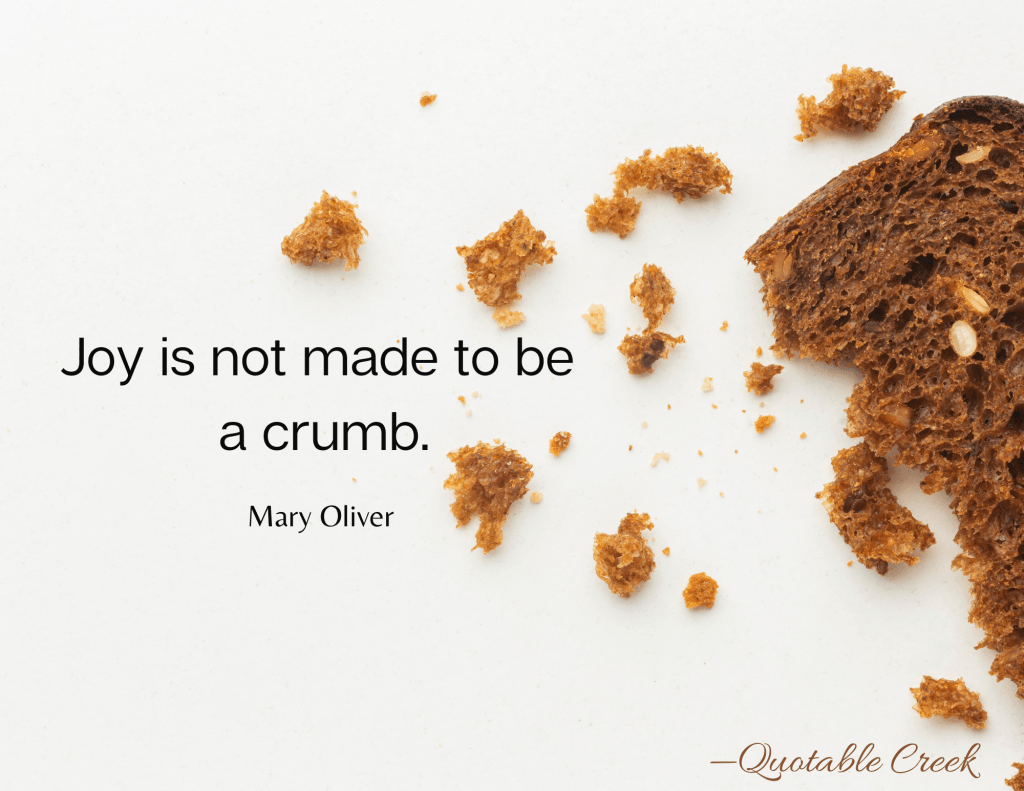
don’t be afraid of its plenty. Joy is not made to be a crumb.

Swan, Poems and Prose Poems

If you should be lucky enough to feel joy bubbling up, savor it. Don’t hesitate.
What gorgeous thing.

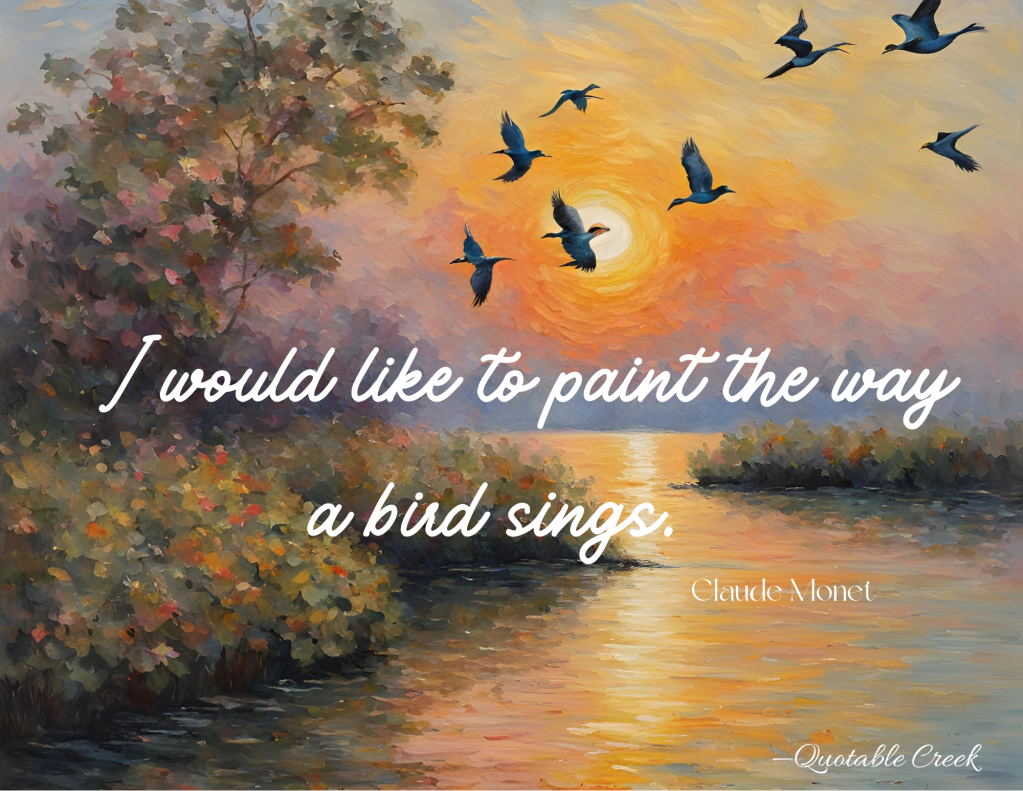
I confess there are times I leave the conversation. Not bodily, but heart, mind, and soul. I drift. Such a time happened the other night. I was having dinner with a group of long-time friends. We were outside in one’s lovely yard which overlooks a golf course and the hills beyond. My wandering off, metaphorically speaking, began with a flock of ducks flying overhead across the darkening sky. And then birds broke into song all about us, flitting from bush to bush. It was such a joyful moment. And although I tried to call my friends’ attention to the ducks and birds, it maybe was just a singular moment for me, astonished by the joy in it all. A moment to savor.

Mary Oliver often captures such moments.

Consider her poem, What Gorgeous Thing about the ineffable joy in bird song:

I do not know what gorgeous thing
the bluebird keeps saying,
his voice easing out of his throat,
beak, body into the pink air
of the early morning. I like it
whatever it is. Sometimes
it seems the only thing in the world
that is without dark thoughts.
Sometimes it seems the only thing
in the world that is without
questions that can’t and probably
never will be answered, the
only thing that is entirely content
with the pink, then clear white
morning and, gratefully, says so.

There is a wordless something in nature that communicates both nothing and everything, and sometimes we just need to drink it all in. (And then get back to the conversation before you’re missed.)

Crisp fall days

There is something glorious about a crisp October day. The crunch of leaves, the astonishing colors, the bite of a cold breeze. Something is changing, as old as time. Resting in order to be reborn again. Renewal is coming. But, for now, the dropping of leaves. The advancing cold of winter. A time to rest.

Enjoy this Mary Oliver poem on this last day of October.

Loving what’s mortal

As we age, there is loss. That loss is like a presence that follows us relentlessly like a shadow. No avoiding it. No pretending. We are mortal. The people we love are mortal, perhaps imminently so. This is part of the rules of engagement. And while most of us avoid thinking too much about it, poets like Mary Oliver offer life instructions:

To live in this world, you must be able to do three things:

To love what is mortal

To hold it against your bones knowing your own life depends on it;

And, when the time comes, to let it go, to let it go.

I honestly don’t know which of these three rules is the hardest. Right now, they each seem nearly impossible. But having the courage to follow these instructions feels like the answer.

Her full poem is below.

Look, the trees
are turning
their own bodies
into pillars

of light,
are giving off the rich
fragrance of cinnamon
and fulfillment,

the long tapers
of cattails
are bursting and floating away over
the blue shoulders

of the ponds,
and every pond,
no matter what its
name is, is

nameless now.
Every year
everything
I have ever learned

in my lifetime
leads back to this: the fires
and the black river of loss
whose other side

is salvation,
whose meaning
none of us will ever know.
To live in this world

you must be able
to do three things:
to love what is mortal;
to hold it

against your bones knowing
your own life depends on it;
and, when the time comes to let it go,
to let it go.

“In Blackwater Woods” by Mary Oliver, from American Primitive. © Back Bay Books, 1983.

It’s the details.

Sometimes things can be startling.

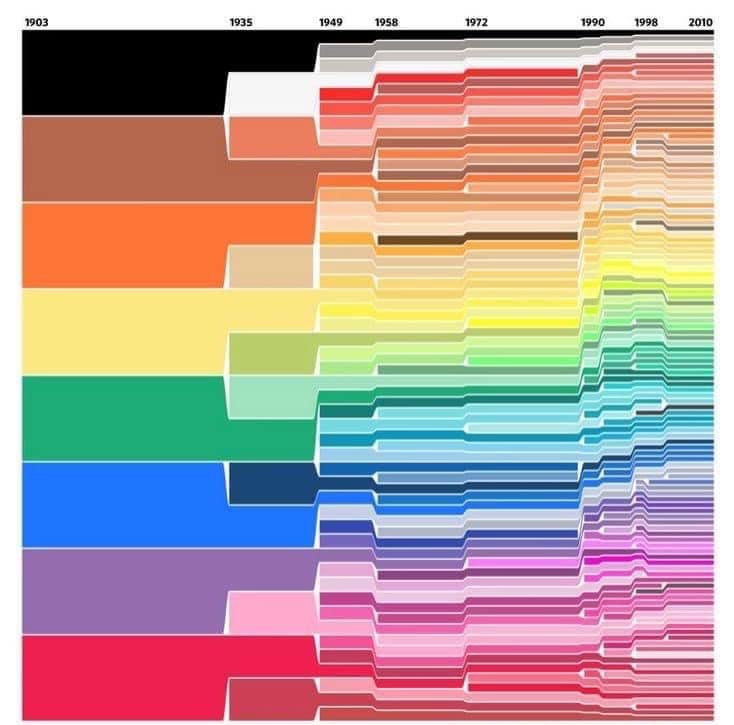
Look, for example, at the evolution of the color choices in the crayon:

Or in ice cream:

We are definitely not living in a plain vanilla, white bobby socks, only primary color world. We are living in a vibrant, color-and-detail everywhere world. Some days it feels wondrous to just soak it all in and enjoy the variety.

Mary Oliver says it best.

Instructions for Living a Life

Pay attention.

Be astonished.

Tell about it.

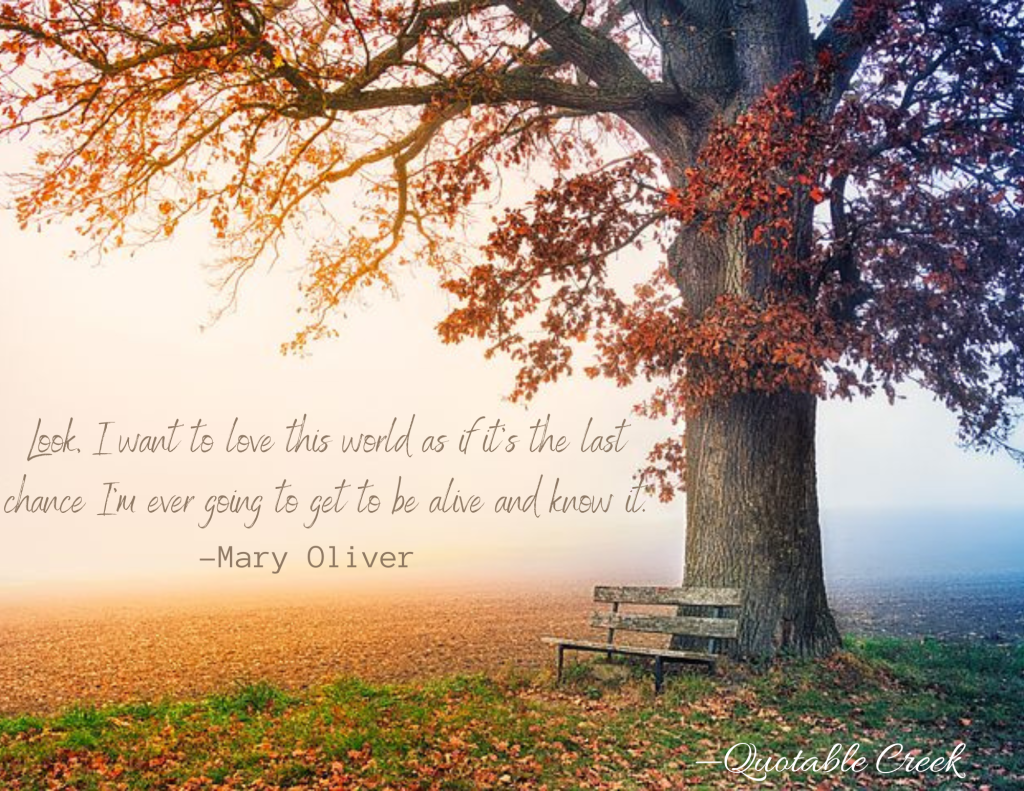
Our last chance to be alive.

Now is our time to be alive. It will not come again. This is our last chance to savor nature and all of its wonder, to spend time with loved ones, to do good, to spread joy. This is it. This is our opportunity.

In the movie, Michael, an angel comes to Earth to influence the course of events. He, apparently, smells of cookies. But there is a scene, after ‘battle’ (he’s that kind of angel), when he is savoring the day. He is soaking it in, just enjoying being corporeal, waltzing with the breeze.

If only we could hold on to that wonder, awe, and appreciation, live in the moment, truly appreciate all we’ve been given here. What a fine world that would be.

Somewhere a black bear

Spring is my favorite season. The birdsong, the colors, the blooms, jasmine-filled breezes. All of it. Yes, please.

We have yet more rain here in Cali, but even so, the birds are singing their hearts out. And the buds are forming, and the bulbs are up. And the hills are so beautifully green. And somewhere close, the bears are stirring.

Enjoy this spring poem by Mary Oliver.

SPRING

Somewhere

a black bear

has just risen from sleep

and is staring

down the mountain.

All night

in the brisk and shallow restlessness

of early spring

I think of her,

her four black fists

flicking the gravel,

her tongue

like a red fire

touching the grass,

the cold water.

There is only one question:

how to love this world.

I think of her

rising

like a black and leafy ledge

to sharpen her claws against

the silence

of the trees.

Whatever else

my life is

with its poems

and its music

and its glass cities,

it is also this dazzling darkness

coming

down the mountain,

breathing and tasting;

all day I think of her—

her white teeth,

her wordlessness,

her perfect love.

Mary Oliver, House of Light

Spring is also all of this —the wild, the fecundity, the passion, the thirst, and the quenching of thirst. The one question: how to love this world. Life’s yes. This, please.

Joy is not made to be a crumb.

Joy is a fascinating emotion. It often springs up in us at surprising times. There is something of a wellspring vibe to it, as if it bubbles up in us with little bearing to our circumstance in life or particular experience. As C. S. Lewis notes,

“I call it Joy. ‘Animal-Land’ was not imaginative. But certain other experiences were… The first is itself the memory of a memory. As I stood beside a flowering currant bush on a summer day there suddenly arose in me without warning, and as if from a depth not of years but of centuries, the memory of that earlier morning at the Old House when my brother had brought his toy garden into the nursery. It is difficult or find words strong enough for the sensation which came over me; Milton’s ‘enormous bliss’ of Eden (giving the full, ancient meaning to ‘enormous’) comes somewhere near it. It was a sensation, of course, of desire; but desire for what?…Before I knew what I desired, the desire itself was gone, the whole glimpse… withdrawn, the world turned commonplace again, or only stirred by a longing for the longing that had just ceased… In a sense the central story of my life is about nothing else… The quality common to the three experiences… is that of an unsatisfied desire which is itself more desirable than any other satisfaction. I call it Joy, which is here a technical term and must be sharply distinguished both from Happiness and Pleasure. Joy (in my sense) has indeed one characteristic, and one only, in common with them; the fact that anyone who has experienced it will want it again… I doubt whether anyone who has tasted it would ever, if both were in his power, exchange it for all the pleasures in the world. But then Joy is never in our power and Pleasure often is.”

The Shape of My Early Life

Joy is distinct from pleasure and happiness. It is an abundance, a bliss, an immeasurable gratitude for the privilege of being. It isn’t meant to be ignored, but embraced, relished, cherished. Not as a byproduct of some other experience, but in itself.

As Mary Oliver says,

“If you suddenly and unexpectedly feel joy, don’t hesitate. Give in to it. There are plenty of lives and whole towns destroyed or about to be. We are not wise, and not very often kind. And much can never be redeemed. Still life has some possibility left. Perhaps this is its way of fighting back, that sometimes something happened better than all the riches or power in the world. It could be anything, but very likely you notice it in the instant when love begins. Anyway, that’s often the case. Anyway, whatever it is, don’t be afraid of its plenty. Joy is not made to be a crumb. (Don’t Hesitate)”

Swan, Poems and Prose Poems

If you should be lucky enough to feel joy bubbling up, savor it.

Praying our way into gratitude.

There are as many ways to pray as there are people praying. But what is it, exactly? Maybe it’s easier to answer what it isn’t: a flamboyant show, a chance to pose and preen publicly, a subterfuge, a droning recitation of memorized but not considered words.

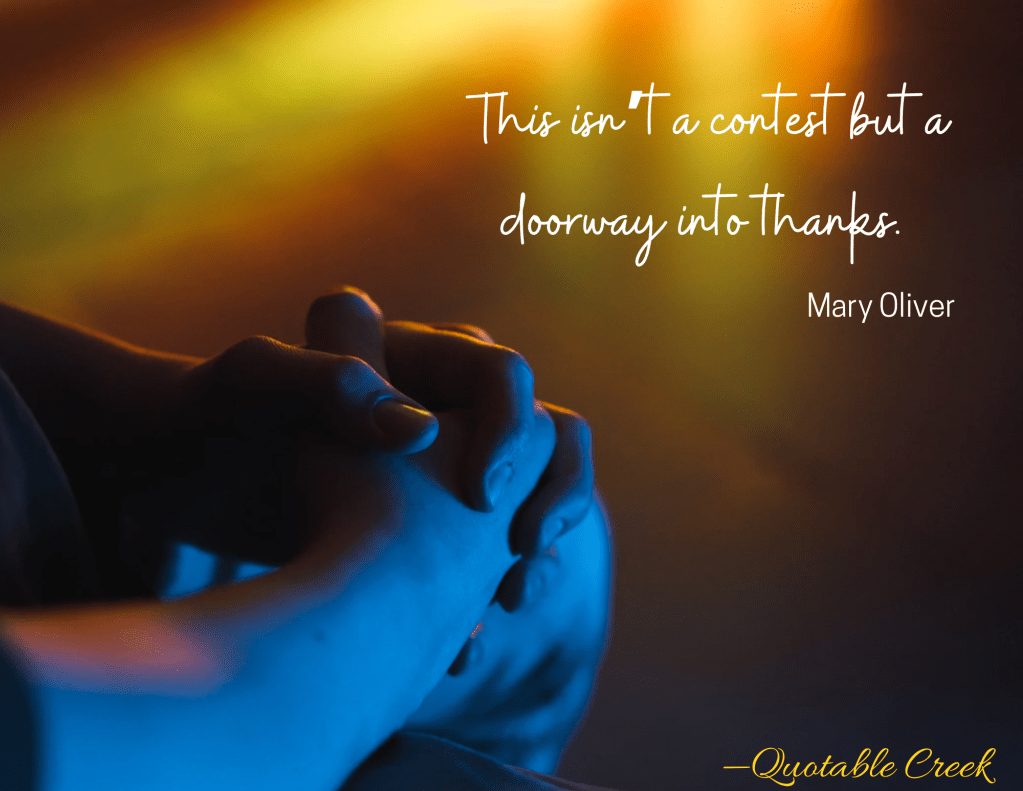
What prayer actually is, though, is more complicated: a bridge between ourselves and the mysterious, a chance to become small, and yet fully individual, in a vastness, an experience of awe. Mary Oliver’s definition above in her poem Praying is lovely: a doorway into thanks. Consider the whole poem:

Praying

It doesn’t have to be

The blue iris, it could be

Weeds in a vacant lot, or a few

Small stones; just

Pay attention, then patch

A few words together and don’t try

To make them elaborate,

This isn’t a contest but the doorway

Into thanks, and a silence in

Which another voice may speak.

Pay attention; see the beauty around you; give thanks. Rinse and repeat.

Pay attention

The Rose Parade is always a joyous start to the new year, the pageantry, the vivid colors, the community. The floats are huge, once nearly 100 feet tall. (Disney 2004). Every inch must be covered with something organic—mostly flowers, of course, but also oatmeal, potatoes, beans, seeds, and so on. The illusions created are remarkable. Look at the bicycles in the photo above (Kaiser 2023). Every detail created out of flowers and organic material. You think you’re looking at bicycles, but really you’re looking at a masterful combination of organic material:

The pink and yellow bikes are made from cut straw flowers confetti, while the blue bike is made from blue statice. The black bike tires are made from onion seeds and the handlebars are comprised of dark lettuce seeds. Other flowers and materials used include pampas grass, banana leaf, red and pink anthurium, commadore fern, Italian ruscus, lemon leaf, and green dianthus.

https://www.latfusa.com/article/2022/12/the-kaiser-permanente-rose-parade-float-has-40000-roses

In many ways, a Rose Parade float is a metaphor for life: you think you see things one way, but really everything is a combination of multitudes of factors—point of view, back story, nuance, history. Very little is as objective as we first think. This is particularly true when it comes to looking at each other. We are all a combination of life experience, history, bias, personality, filters and so on. We each bring that myriad of factors to our encounters.

Our job in everything is to look closely and pay attention, to move past assumption and bias. Jumping to hasty conclusions will get you trying to ride bicycles made of pampas grass.