All the concentric circles of who we are.

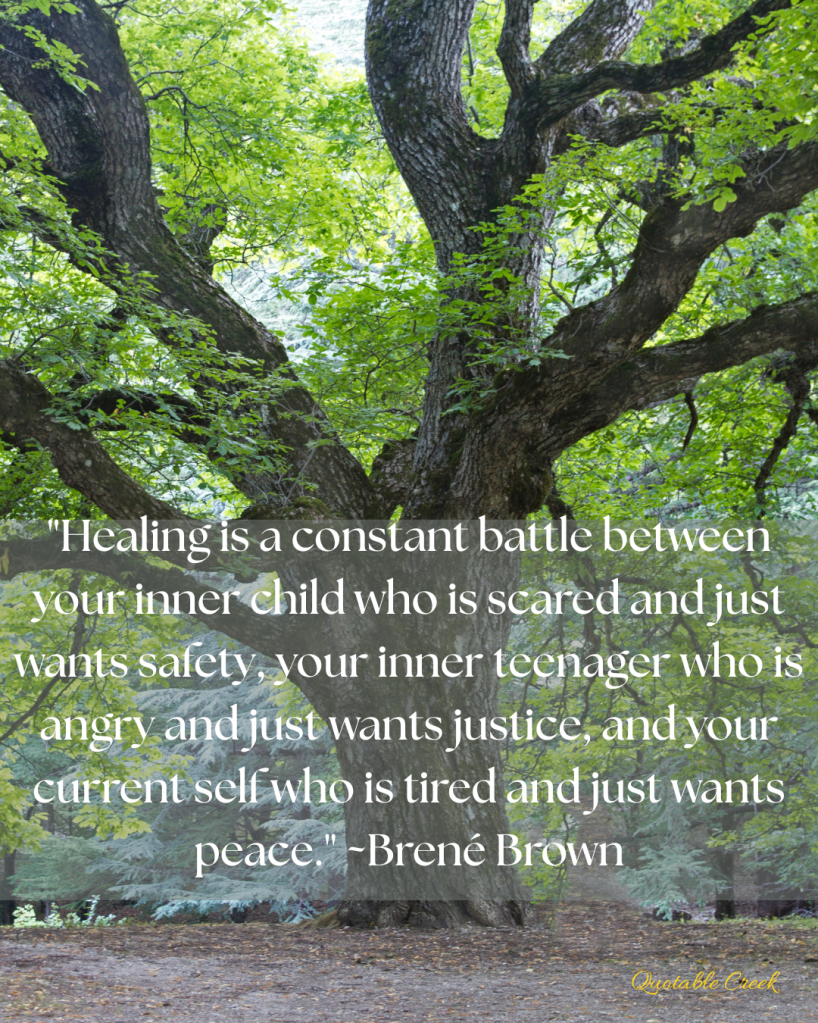
We are complicated and carry with us all the ages we have been and life experiences we have had. As Sandra Cisneros put it:

What they don’t understand about birthdays and what they never tell you is that when you’re eleven, you’re also ten, and nine, and eight, and seven, and six, and five, and four, and three, and two, and one. And when you wake up on your eleventh birthday you expect to feel eleven, but you don’t.

So at 63, we can still long for a parent’s unconditional love rather than constant harsh judgment or expectation, or quiver in excitement over an upcoming holiday, or find ourselves sleepless over a stupid thing we said yet again. There is no ta-da moment where we wake up and suddenly make only good decisions and wise pronouncements.

It is all a becoming.

And hopefully those experiences we have had at all those prior ages help increase our empathy and understanding of others bumbling along, also becoming. Because what it really is, this thing called life, is putting one foot in front of the other and keeping on, striving.

Moving past the past.

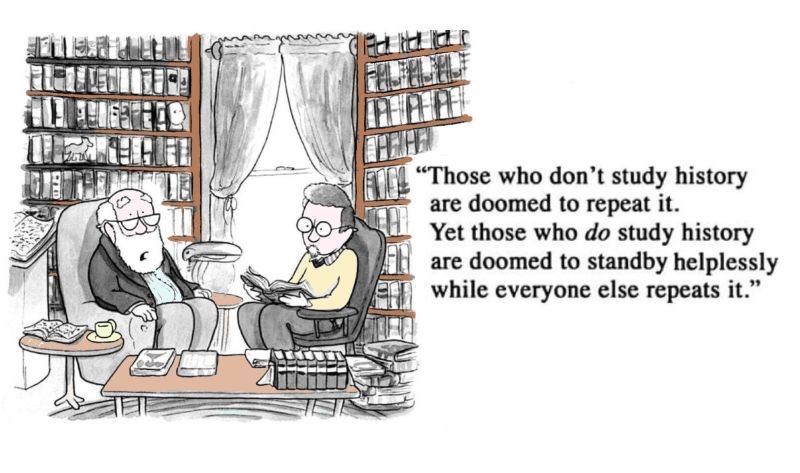
One of the greatest frustrations of life is not being able to change the past, whether it is to remedy that stupid thing you just said or the larger elements of fractures in society leading to war. The only things we can really do with the past are to live with it, learn from it, and figure out how to move forward. For those who study history, seeing ugly patterns reemerge and take shape can be horrifying.

And yet, it is not all gloom and doom. Indeed, we are not helpless:

One of the curses of history is that we cannot go back and change the course leading to disasters, no matter how much we might wish to. The past has its own terrible inevitability. But it is never too late to change the future.”

― Heather Cox Richardson

We can learn from history what it takes to resist. We can remember who the real heroes were in dark times and emulate them. We can draw on community and coalitions to fight for the common good. We can continue to believe that integrity counts, that honesty and fidelity and honor matter, that kindness will always heal, and that love is, not only good, but the answer to any question.

We can fight. With whatever tools we have: words, money, presence, we can take a stand, doing our little bit of good.

As Desmond Tutu said:

Do your little bit of good where you are; it’s those little bits of good put together that overwhelm the world.

It’s time to overwhelm the world.

Misunderstandings.

One of the most frustrating things is to be misunderstood. To have your explanations fall on deaf ears or a hardened heart.

Once I lost a friendship because my friend believed I had done something I hadn’t done. My assurances fell flat. Worse, I knew who had actually done the thing I had been accused of but didn’t say because that might jeopardize their friendship. So I became the exiled one. And watched that other friendship prosper. The protected friend knew I had paid the penalty for their own actions but wasn’t about to confess.

Misunderstandings can be so frustrating. Much better to be punished for something you actually did, a choice freely made, even if wrong. There is sense in that. But misunderstandings bring a helpless feeling coupled with an anger at the injustice of it all.

I wonder how many relationships have been lost over misunderstandings, for reasons that weren’t even true. Or how many people, even, wrongfully convicted. What of all that hurt and loss over things that aren’t even true?

What do you do in the face of that kind of senseless tragedy? One thing, of course, is to fess up if someone is bearing a penalty for something you did. But beyond that maybe is the way we open our own ears and soften our hearts to make sure that we’re not the ones cutting people off and ending relationships over things we might be wrong about.

No one captures this angst of being misunderstood better than Nina Simone with her prayer, O Lord, please don’t let me be misunderstood.

An apology that heals the hurt

“I’m sorry, but…” Some apologies make things better, and some just don’t. In fact, they might make things worse by blaming the person you hurt or showing that there is just no true awareness of what went wrong.

Generally, the apologies that have an excuse fall in the latter category. A good apology makes you feel seen and heard, that someone has looked at things from your point of view and understood the negative impact they have made. A good apology requires us to stand in the shoes of the person we’ve wronged and feel what they are feeling. Not what we would feel if we were in their shoes, but what they’re feeling.

Then, when we feel the harm we’ve caused, it should change us, make us not want to cause that harm again to that person or others, and make us want to make amends. It shouldn’t leave us where we were. If it does, if we repeat the same hurtful words or behavior, perhaps we haven’t yet done the work that goes into reconciliation.

Back into the other person’s shoes we go until we understand and grow. This is how progress is made, how relationships heal and grow stronger, how trust is restored. And, because we humans are very fallible creatures, it’s not a one and done thing, but a continuing process. Evaluating the effect we are having on people, making sure we are treading softly, taking responsibility and making amends when we don’t. Perhaps two steps forward, one step back, but staying in relationship, rebuilding trust, and moving forward together.

Mistake police

In this world of constant scrutiny and omnipresent recordings, mistakes seem to have moved from a necessary part of learning to an instant cause for condemnation.

We can all think back to learning to walk and talk or play a sport where the mistakes were a part of learning. Fear of falling down would keep everyone from walking. In order to learn how to make a basket, lots of shots will bounce off the rim and backboard.

When we moved on to raising children, focusing on the mistakes could cripple a child emotionally. Instead, we celebrated the steps forward, the successes. Noted the progress. We don’t expect a toddler to write a dissertation. We celebrate the milestones as they come.

I wonder if that approach would help move our troubled world forward. Celebrating the progress. Looking for the successes. Embracing the common ground. Letting everyone feel that they can continue to learn from their mistakes, that that is part of being human. A world with a little bit of breathing room. We all will mess up. We can show each other grace when we do.

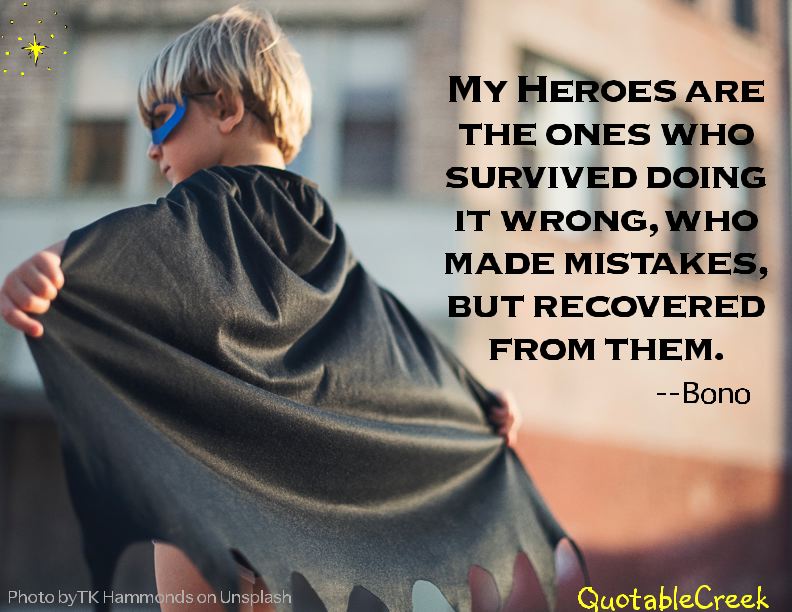
Being the heroes of our own story

We each decide if we are to be the hero of the story our lives are writing. We each will hear calls to adventure and must decide whether we will rise to the occasion. We each struggle with challenges and learn, or not, from the experience. What will your story be? How will you meet the challenges you encounter?

In this short film, Matthew Winkler outlines Joseph Campbell’s Hero Journey, a path we all must take.

How will we fare?

It’s OK to struggle.

Sometimes life is hard. Really hard. Relationships falter. Obstacles seem insurmountable. And just getting to the next day feels overwhelming. At times like these, we have to remember that it is OK to struggle.

We don’t have to be perfect. We do not need to have all the answers. Sometimes all we have are questions. But that is often a good place to start. And then we begin again, one foot in front of the other, perhaps not seeing the whole path ahead, but just enough to know where to put each foot.

“Just because something is difficult doesn’t mean it’s impossible. Uncomfortable? Yes. Exhausting and overwhelming and painfully hard? Yes. But not impossible. And it won’t necessarily feel this difficult and debilitating forever. You’ve made it through similar hard things before. You’ve survived every single bad day and every obstacle the universe has ever thrown at you. You’ve survived all the things you felt convinced would break you. Every single one. And this is evidence that you can make it through this too.

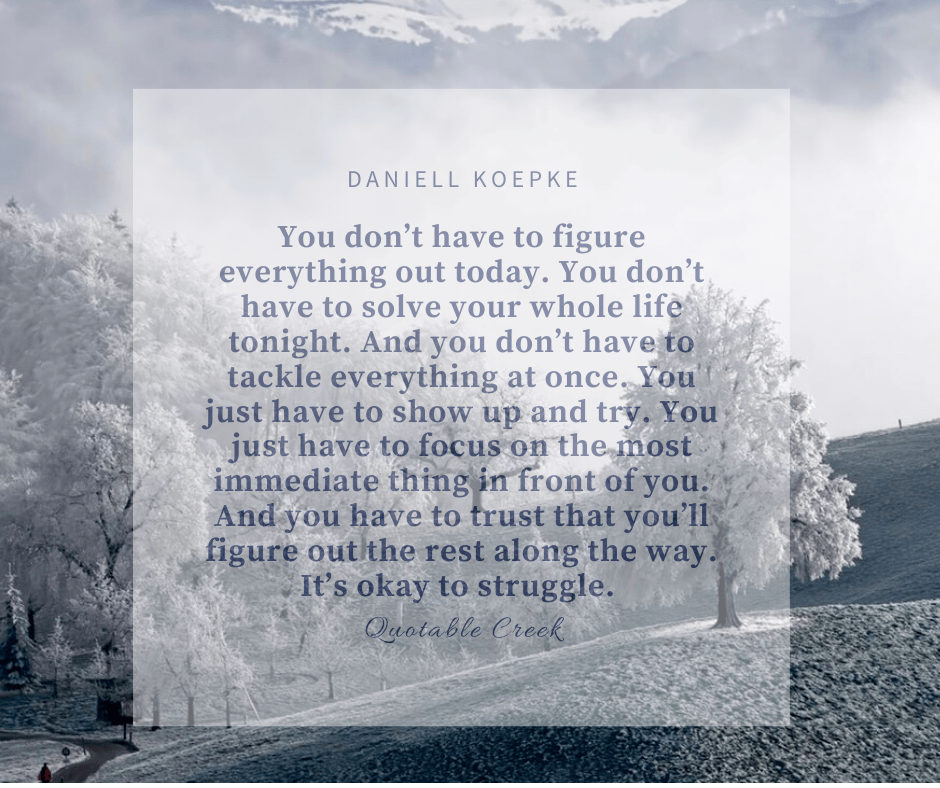
“You don’t have to figure everything out today. You don’t have to solve your whole life tonight. And you don’t have to tackle everything at once. You just have to show up and try. You just have to focus on the most immediate thing in front of you. And you have to trust that you’ll figure out the rest along the way. It’s okay to struggle. It’s okay to feel overwhelmed. And its okay to make mistakes. You’re still learning how to navigate this new path. It’s going to take time, and you’re allowed to give yourself that time. You don’t have to be perfect. You don’t have to get all A’s or be the best version of yourself or outperform everyone else. All you have to do is show up and try. It’s always been enough before. It will be enough this time too.”

— Daniell Koepke

Here’s to you finding the light to take that next step, and then the next and the next, until your path leads you out of this present darkness. It is OK to struggle.

Mistake inventory=growth inventory.

mistake

Who among us can make it from birth to grave without a mistake? Mistakes are such an inevitable part of trying something new, of learning, of growing that it would be impossible. And yet we don’t like to admit that we make mistakes. Constantly. But perhaps the real harm is in not learning from our mistakes, not stretching our view of the world to admit a new insight, not bending our routine to reflect a better way of doing something, not opening up to a perspective we hadn’t considered. As we take stock of ourselves today, let’s consider all the ways we’ve grown in our beliefs, our behaviors, and  insights. We used to believe the world was flat, but now we see it is round, and that makes a world of difference.

Mistakes are to learn from.

mistakes

Mistakes are inevitable. As you practice a piano piece, you’ll hit some clunkers. Go on. As you learn to walk, you’ll stumble. Keep walking. As you reach out in kindness, you may be rebuffed. Keep being kind.

Consider this fascinating account of some of Thomas Edison’s unknown mistakes:

“One of the things that makes Edison stand out as an innovator was he was very good at reducing the risk of innovation—he’s not an inventor that depends on just one thing,” DeGraaf says. “He knows that if one idea or one product doesn’t do well he has others…that can make up for it.”

Chances are you haven’t heard of Edison’s botched ideas, several of which are highlighted here, because the Ohio native refused to dwell on them. DeGraaf says, “Edison’s not a guy that looks back. Even for his biggest failures he didn’t spend a lot of time wringing his hands and saying ‘Oh my God, we spent a fortune on that.’ He said, ‘we had fun spending it.’”
Read more: https://www.smithsonianmag.com/innovation/7-epic-fails-brought-to-you-by-the-genius-mind-of-thomas-edison-180947786/#I8co0DAKgoFZTybb.99

Keep stretching. Keep innovating. Keep reaching out. One attempt may not work, but you have thousands, maybe millions, in you.

No worries.

halfface

It turns out artists make a lot of mistakes. We only think they are wonderfully talented, with perfect products immediately dripping off their paintbrushes or keyboards, because we see the finished product and not all of the drafts and abandoned projects along the way. So when we sit down to write or draw or craft or hum out a melody, we can set aside the worry that we aren’t up for the task if our first efforts are less than perfect. Mistakes are the training ground. The more the better because each teaches us what doesn’t work or how something could work better. It is all practice making us more perfect. What’s a failure is being scared to start.