I’m spring

As I age, I have a new appreciation for those poets like Dylan Thomas raging against mortality. I do not want to go gentle into that good night. I like it here.

Here is a new variation on that theme I enjoyed:

Sorrow Is Not My Name
BY ROSS GAY

—after Gwendolyn Brooks

No matter the pull toward brink. No
matter the florid, deep sleep awaits.
There is a time for everything. Look,
just this morning a vulture
nodded his red, grizzled head at me,
and I looked at him, admiring
the sickle of his beak.
Then the wind kicked up, and,
after arranging that good suit of feathers
he up and took off.
Just like that. And to boot,
there are, on this planet alone, something like two million naturally occurring sweet things,
some with names so generous as to kick
the steel from my knees: agave, persimmon,
stick ball, the purple okra I bought for two bucks
at the market. Think of that. The long night,
the skeleton in the mirror, the man behind me
on the bus taking notes, yeah, yeah.
But look; my niece is running through a field
calling my name. My neighbor sings like an angel
and at the end of my block is a basketball court.
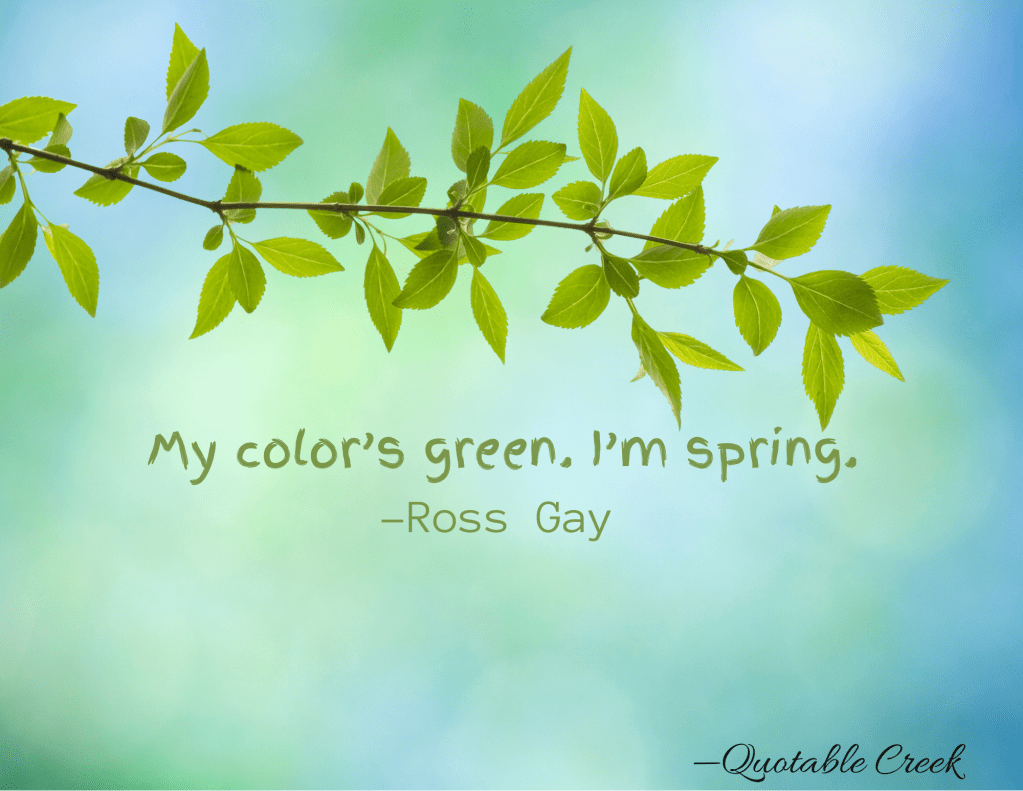
I remember. My color’s green. I’m spring.

Spring yet?

Spring can be sneaky. Just when you feel that winter will last forever, a pop of green will peak out of the snow, or a leafless tree will bud, or a bird will sing, and you will remember the colorful, fragrant, joyful days of spring.

Inside every winter heart, a vibrant spring lies just waiting to bloom again.

Somewhere a black bear

Spring is my favorite season. The birdsong, the colors, the blooms, jasmine-filled breezes. All of it. Yes, please.

We have yet more rain here in Cali, but even so, the birds are singing their hearts out. And the buds are forming, and the bulbs are up. And the hills are so beautifully green. And somewhere close, the bears are stirring.

Enjoy this spring poem by Mary Oliver.

SPRING

Somewhere

a black bear

has just risen from sleep

and is staring

down the mountain.

All night

in the brisk and shallow restlessness

of early spring

I think of her,

her four black fists

flicking the gravel,

her tongue

like a red fire

touching the grass,

the cold water.

There is only one question:

how to love this world.

I think of her

rising

like a black and leafy ledge

to sharpen her claws against

the silence

of the trees.

Whatever else

my life is

with its poems

and its music

and its glass cities,

it is also this dazzling darkness

coming

down the mountain,

breathing and tasting;

all day I think of her—

her white teeth,

her wordlessness,

her perfect love.

Mary Oliver, House of Light

Spring is also all of this —the wild, the fecundity, the passion, the thirst, and the quenching of thirst. The one question: how to love this world. Life’s yes. This, please.

Breathe in this new day.

When we lose our way or feel overwhelmed, we can return to nature and be renewed. Hear the birds singing their spring song. Watch them collect twigs and bits for their nests. See the long grass ripple in a gentle wind like ocean waves. Breathe in the sweet earthy fragrance of the morning. Feel small and surrounded by an amazing, complicated system that has been pulsating with life for millions of years. That awe is good for us:

“It has long been established that a healthy diet and lots of sleep and exercise bolster the body’s defenses against physical and mental illnesses. But the new study, whose findings were just published in the journal Emotion, is one of the first to look at the role of positive emotions in that arsenal.

“That awe, wonder, and beauty promote healthier levels of cytokines suggests that the things we do to experience these emotions—a walk in nature, losing oneself in music, beholding art—has a direct influence upon health and life expectancy,” says UC Berkeley psychologist Dacher Keltner, a coauthor of the study.” 

Breathe in the day, full of life and possibility. Breathe out the stress, the worry, the defeat. In. Out. In. Out. In.

Being a good creature

Sy Montgomery’s delightful book, How To Be a Good Creature, is a ‘Memoir in Thirteen Animals‘. What an interesting way to organize a memoir, focusing on the impact various animals have made on her life and what they have taught her about co-existing as fellow creatures on this planet! It is a profound, yet simple, book.

If you were to write a memoir of your life through that lens, who would the animals be that impacted your life in meaningful and enriching ways? What life lessons did you learn? How were your limits expanded from sharing space with that fellow creature?

For inspiration, consider Montgomery’s words:

All the animals I’ve known–from the first bug I must have spied as an infant, to the moon bears I met in Southeast Asia, to the spotted hens I got to know in Kenya–have been good creatures. Each individual is a marvel and perfect in his or her own way. Just being with any animal is edifying, for each has a knowing that surpasses human understanding. A spider can taste the world with her feet. Birds can see colors we can’t begin to describe. A cricket can sing with his legs and listen with his knees. A dog can hear sounds above the level of human hearing, and can tell if you’re upset even before you’re aware of it yourself. Knowing someone who belongs to another species can enlarge your soul in surprising ways.

I often wish I could go back in time and tell my young, anxious self that my dreams weren’t in vain and my sorrows weren’t permanent. I can’t do that, but I can do something better. I can tell you that teachers are all around to help you: with four legs or two or eight or even none, some with internal skeletons, some without. All you have to do is recognize them as teachers and be ready to hear their truths.

Today, consider the wonder of creation around you and thank your teachers of the non-human persuasion.

Dog commentary

In challenging times, there are always bright moments of light to lift us up. People singing from balconies out onto deserted streets in Italy, others joining together to amplify the voices of the unheard, and, in one of the most delightful examples, an out of work sports color commentator putting his talents to use to give people a glimmer of cheer during dark times. Sidelined by the coronavirus and the consequent shut down of sports, Andrew Cotter has been making videos providing the color commentary for his two dogs’ adventures. Meet Olive and Mabel as you make way for a bit of delight:

Get dirty

The daffodils are coming. Planted last fall–before the snow, before the holidays, before the pandemic– they are starting to poke up. Soon they will be blooming everywhere adding cheer to the lives of whomever might see them.

A garden is a microcosm of life. Seasons of vibrance and beauty fall away into a frozen landscape seemingly devoid of color. But then, maybe when you’ve almost forgotten, there is blossoming and rebirth.

Gardeners and children know something that many of us have forgotten: there is joy in the dirt.

Literally.

It turns out, “Prozac may not be the only way to get rid of your serious blues. Soil microbes have been found to have similar effects on the brain and are without side effects and chemical dependency potential.”

Studies show the benefits gardeners and children will swear by of playing in the dirt are actually based on science.

It’s true. Mycobacterium vaccae is the substance under study and has indeed been found to mirror the effect on neurons that drugs like Prozac provide. The bacterium is found in soil and may stimulate serotonin production, which makes you relaxed and happier. Studies were conducted on cancer patients and they reported a better quality of life and less stress. Lack of serotonin has been linked to depression, anxiety, obsessive compulsive disorder and bipolar problems. The bacterium appears to be a natural antidepressant in soil and has no adverse health effects. These antidepressant microbes in soil may be as easy to use as just playing in the dirt.

So go ahead. Get dirty.

Spring is still on.

Patience is tough. But even in the most aggravating times of waiting, nature keeps going and sends us messages of hope. Dead looking trees budding, flowers blossoming, birds singing and looking for places to build their nests. Warmth seeping back into the frigid ground.

Spring hasn’t been cancelled.

Hold on.

Heaven under our feet.

What do you think heaven looks like? Certainly, if we can see there, it is a place of great beauty and marvelous complexity where we marvel at God’s creation. If we can hear there, music that stirs the soul must be the score. And so on through our senses

But what if we are not corporeal in heaven and don’t have senses per se? What then? Perhaps it is a place of harmony, of communion, with everyone different but united in common purpose.

These are good things, yes? Appreciating beauty in God’s creation, enjoying music that stirs the soul, being so present in our bodies that we marvel at its systems? And, of course, communion, harmony, peace? These are good things.

Perhaps, today, we can take time to bring a bit of heaven to earth. Pause to admire the beauty around us, savor, marvel, be astonished. And then with our senses full and renewed, have courage to bring peace and harmony to our day.

Awe inspires.

When we lose our way or feel overwhelmed, we can return to nature and be renewed. Hear the birds singing their spring song. Watch them collect twigs and bits for their nests. See the long grass ripple in a gentle wind like ocean waves. Breathe in the sweet earthy fragrance of the morning. Feel small and surrounded by an amazing, complicated system that has been pulsating with life for millions of years. That awe is good for us:

“It has long been established that a healthy diet and lots of sleep and exercise bolster the body’s defenses against physical and mental illnesses. But the new study, whose findings were just published in the journal Emotion, is one of the first to look at the role of positive emotions in that arsenal.

“That awe, wonder, and beauty promote healthier levels of cytokines suggests that the things we do to experience these emotions—a walk in nature, losing oneself in music, beholding art—has a direct influence upon health and life expectancy,” says UC Berkeley psychologist Dacher Keltner, a coauthor of the study.”

Breathe in the day, full of life and possibility. Breathe out the stress, the worry, the defeat. In. Out. In. Out. In.