The light that is you.

All things break.

Including us.

Nothing lasts.

Including us.

And yet most of us internalize myths that we are meant to live pain-free lives and that there is always more time. How much more could we accomplish if we embrace the reality instead?

We’re breakable. But our vulnerability is our strength. And when we mend from something painful, we are likely to have tools and skills and sensitivities that may help us and make us more empathic going forward. Breaking and mending is part of growth. Part of change. Part of evolving. To be scared of breaking is to be scared of living.

Time’s short. Now is the time to reach out, apologize, help…whatever it is you’re waiting for a different day to do. There is no promised day. Things don’t just happen. Time doesn’t heal all wounds. We help heal the broken world, and our own broken selves, by continuing to love even in the darkness.

Binding up wounds.

So much of our suffering is invisible. Loneliness, sorrow, depression, not fitting in. We can bind up our own cuts and scrapes, but how do we bind up those kind of wounds?

There is an old parable about heaven and hell. In both, people are forced to eat with spoons that are too long to feed themselves. In hell, they are starving. In heaven, they feed each other.

When it comes to these invisible hurts, we are healed by kindness, one to another. We don’t know when we are being kind that it may help someone, but it certainly can’t hurt. And it may be just the long-spooned nourishment that someone else needs.

To inspire acts of kindness today, watch this video of a poor baby elephant stuck in a muddy hole. The gratitude its mother shows its rescuers will melt your heart.

Dancing animals

In this age of technology and instant gratification, sometimes we forget the simple pleasures. Like meandering, and chatting people up, and pausing to soak it all in. Kurt Vonnegut used to like to walk into town for a single envelope when he had something to mail, ignoring his wife’s argument that he could buy more than one envelope at a time.

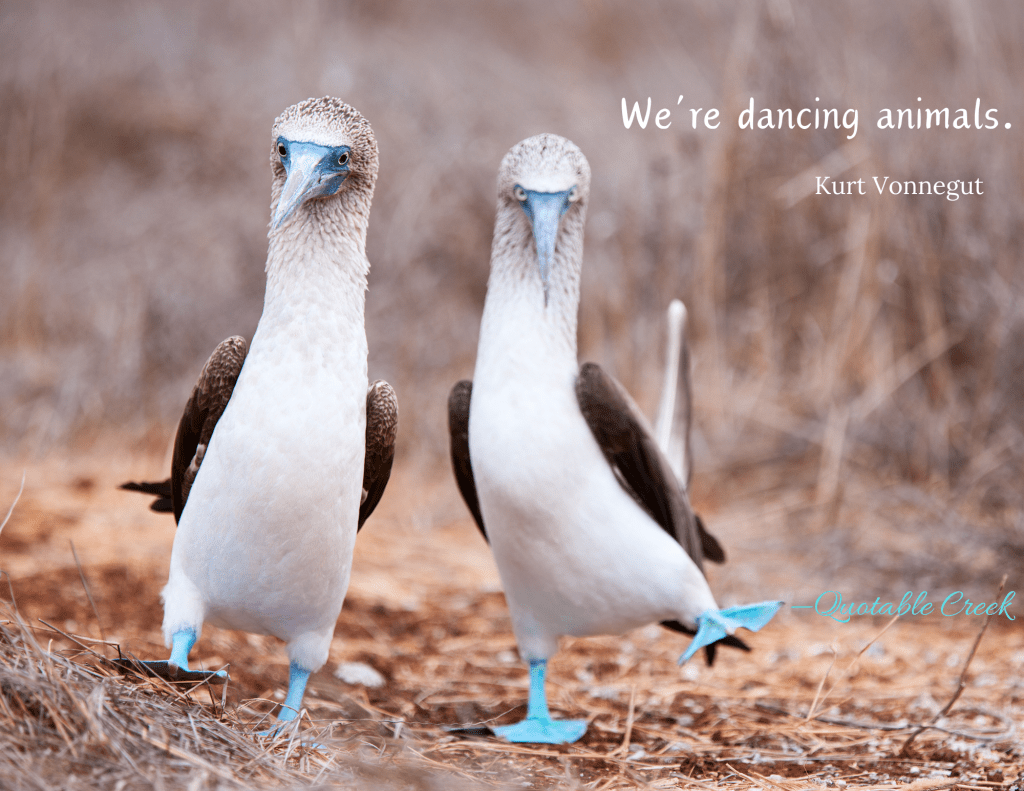
Vonnegut responds, “…And so I pretend not to hear her. And go out to get an envelope because I’m going to have a hell of a good time in the process of buying one envelope. I meet a lot of people. And see some great looking babies. And a fire engine goes by. And I give them the thumbs up. And I’ll ask a woman what kind of dog that is. And, and I don’t know. The moral of the story is – we’re here on Earth to fart around. And, of course, the computers will do us out of that. And what the computer people don’t realize, or they don’t care, is we’re dancing animals. You know, we love to move around. And it’s like we’re not supposed to dance at all anymore.”

Of course, an author depends on immersing themself in the midst of living, noticing details, trying to hold on to it all long enough to capture it in words. But don’t we all benefit from farting around and noticing the little things? Kind of like writing ‘I was here’ in graffiti. We’re here. This is our now.

Time to be a dancing animal.

Embracing life.

Reading history is one of the best ways ironically to really enter the present. As James Baldwin says:

One must say Yes to life and embrace it whenever it is found — and it is found in terrible places; nevertheless, there it is.
For nothing is fixed, forever and forever and forever, it is not fixed; the earth is always shifting, the light is always changing, the sea does not cease to grind down rock. Generations do not cease to be born, and we are responsible to them because we are the only witnesses they have.
The sea rises, the light fails, lovers cling to each other, and children cling to us. The moment we cease to hold each other, the moment we break faith with one another, the sea engulfs us and the light goes out. ~James Baldwin

We look at our past and see people making their ways, making mistakes, celebrating triumphs, struggling but then getting back up. And this is true during objectively awful times of war or suffering as well as in more relatively peaceful times. People go on. They find a way to come together, to survive, to do better.

I wonder what historians will say fifty years from now about the times we are in right now. Will they point to the divisions between us or the attempts to heal and grow. Will they see in us the grit and forbearance we can recognize in our ancestors?

What is it you plan on doing with your one wild and precious life?

In her poem, The Summer Day, Mary Oliver writes:

The Summer Day

Who made the world?
Who made the swan, and the black bear?
Who made the grasshopper?
This grasshopper, I mean-
the one who has flung herself out of the grass,
the one who is eating sugar out of my hand,
who is moving her jaws back and forth instead of up and down-
who is gazing around with her enormous and complicated eyes.
Now she lifts her pale forearms and thoroughly washes her face.
Now she snaps her wings open, and floats away.
I don't know exactly what a prayer is.
I do know how to pay attention, how to fall down
into the grass, how to kneel down in the grass,
how to be idle and blessed, how to stroll through the fields,
which is what I have been doing all day.
Tell me, what else should I have done?
Doesn't everything die at last, and too soon?
Tell me, what is it you plan to do
with your one wild and precious life?

What does it mean to pray? What exactly is a prayer? Is it reciting certain words in unison at a church on Sundays, or is it also something infinitely more?

Is it noticing the creator in the delicate creation? Is it paying attention? Is it being grateful? Is it flinging yourself down on the grass to contemplate not just the meaning of life, but the meaning of your life?

Yes, life is short, over far too soon. But, while we are here, there is opportunity. To pray, to notice, to attend, to use our lives to make a difference.

What is it you plan to do with your one wild and precious life?

But soft!

Are there any more beautiful words in English literature than these: “But soft! What light through yonder window breaks?”

These are Romeo’s words when he gazes at Juliet above on the balcony, but what if we were to bring these words into our everyday encounters?

But soft! Listen to the hush here, the rapt attention, all of his focus on her, just her. What if we were to whisper these words to ourselves before we talk with someone? But soft! The world fades, the focus sharpens, all of our attention is on that person. But soft! reminds us not just to be calm and attentive, but also to be gentle and reverent. Wouldn’t any conversation shift if it were preceded by such a lovely call to silence? Wouldn’t But soft! be a perfect pairing of words to bring back into common usage?

“What light through yonder window breaks?” Again, what if we were to look at each other this way? As light, as beings capable of making the world a brighter place. Even those with much of darkness about them have an inner light, a spark of good. What if we were to ignore the dark and focus on the light in each other? What a compliment it is to be called a light! Wouldn’t someone noticing our light make each of us want to shine ever more brightly? And wouldn’t that, accordingly, make the world an ever brighter place?

Look around. Someone wants your attention.

But soft!

What light through yonder window breaks?

Why is beauty?

Have you ever wondered why everything is so beautiful? Have you stood rapt in the brilliant colors of a sunset, or listening to birdsong in the morning, or watching the way a caterpillar humps along with all its little feet working together? Perhaps there are logical, book smart reasons, like flowers are beautiful to attract bees, or animals are beautiful to attract mates or to warn predators they’re toxic, or some such thing, but don’t those answers beg the question really? Why is beauty? Could the answer be that it is to inspire awe in us? And our job is to notice.

A master violinist can play Bach on a precious instrument, and most people will just walk by:

We are living in a place filled with beauty if we only stop to notice. For inspiration, consider Mary Oliver’s poem, The Summer Day:

The Summer Day

Who made the world?
Who made the swan, and the black bear?
Who made the grasshopper?
This grasshopper, I mean-
the one who has flung herself out of the grass,
the one who is eating sugar out of my hand,
who is moving her jaws back and forth instead of up and down-
who is gazing around with her enormous and complicated eyes.
Now she lifts her pale forearms and thoroughly washes her face.
Now she snaps her wings open, and floats away.
I don't know exactly what a prayer is.
I do know how to pay attention, how to fall down
into the grass, how to kneel down in the grass,
how to be idle and blessed, how to stroll through the fields,
which is what I have been doing all day.
Tell me, what else should I have done?
Doesn't everything die at last, and too soon?
Tell me, what is it you plan to do
with your one wild and precious life?

What a gift we have been given to have the chance to notice the beauty all around us today!

I shall not pass this way again.

There is an elephant in the room. We don’t talk about it, we try not to think about it, we pretend it doesn’t exist. That elephant is the fact that we are all on a one way journey through this life. Our time is limited. None of us knows in advance when our end of the journey will come, but that end will come.

When we pull ourselves out of denial and gaze directly at this elephant, we can realize something important: our opportunities should be seized now. That good we can do? Don’t put it off. That kind word? Say it. That gift or remembrance? Give it now.

We will not have this place and time and opportunity to make a difference again.

Open your gift.

How would you complete this sentence?

Life is a/an —-.

  • Adventure
  • Contest
  • Marathon
  • Burden
  • Race
  • Test
  • ?

It certainly changes things depending on your perspective. Someone who thinks of life as a contest is always striving, comparing what he has to others. The one who views life as a burden might sigh a lot. And so on.

But what if we thought of life as a gift? Unearned, given out of love, no strings attached. Something to be grateful for. Something to savor and enjoy but also something to treasure. Would that affect what we see when we open our eyes in the morning? Face challenges? Greet people? Pick a career?

Brian Zhand says:

Most of us are scripted to think that life is a game and the purpose of life is to win. But the divine truth is that life is a gift and the purpose of life is to learn to love well.

The truth is being here is a gift, an opportunity, a chance to do some good. Open your gift.

Self control in an out of control world.

Not gonna lie. These days are wild. The news cycle is intense, and it can feel dizzying. I wonder what students in school in the future will study about these years. It will definitely be a large chapter with tons of footnotes! And yet, as we work our way through this present, how can we keep our psyches from spinning out of control right with the swirls of events?

One thing to keep in mind is to focus our attention and efforts on the things over which we have control.

Consider this graphic:

Try to let the things in the gray area consume less of your time and attention, focusing on what is in your control. It can be frustrating, no doubt, but therein lies our sanity in crazy times.