Not gonna lie. These days are wild. The news cycle is intense, and it can feel dizzying. I wonder what students in school in the future will study about these years. It will definitely be a large chapter with tons of footnotes! And yet, as we work our way through this present, how can we keep our psyches from spinning out of control right with the swirls of events?
One thing to keep in mind is to focus our attention and efforts on the things over which we have control.
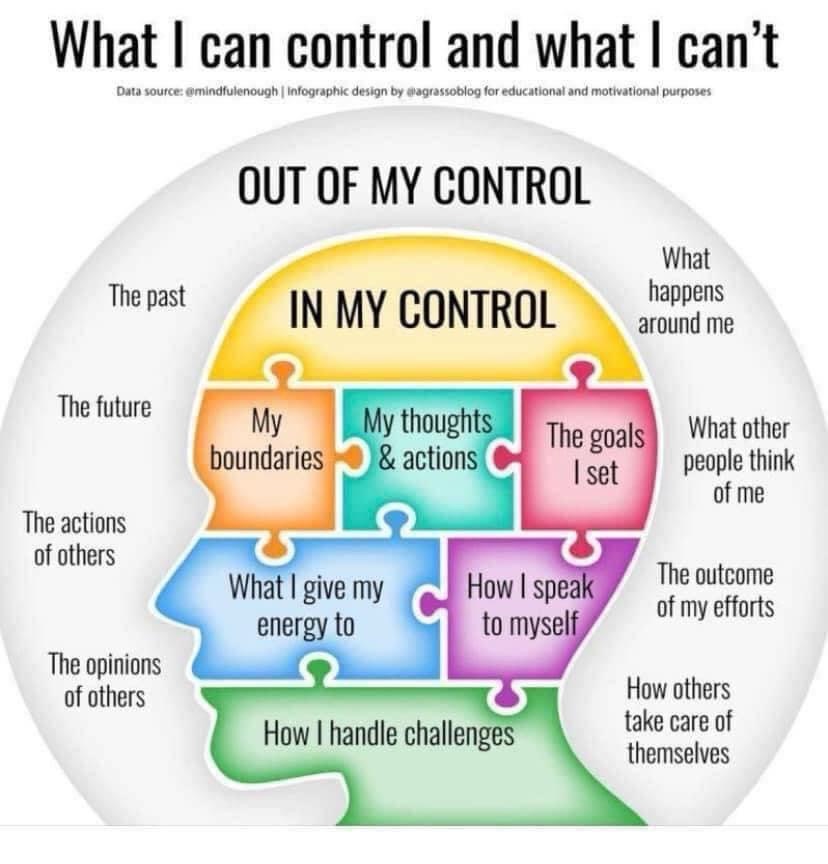
Consider this graphic:
Try to let the things in the gray area consume less of your time and attention, focusing on what is in your control. It can be frustrating, no doubt, but therein lies our sanity in crazy times.
This moment we are in is but one in the collection of moments that make a life, a story, a history. Each moment building on the last, forward toward a powerful culmination. To stay hopeful and earnest in each moment, no matter how dire, is a testament to what we hold dear, to hope, to a belief that all things will ultimately work together for good.
As Howard Zinn says,
TO BE HOPEFUL in bad times is not just foolishly romantic. It is based on the fact that human history is a history not only of cruelty, but also of compassion, sacrifice, courage, kindness. What we choose to emphasize in this complex history will determine our lives. If we see only the worst, it destroys our capacity to do something. If we remember those times and places—and there are so many—where people have behaved magnificently, this gives us the energy to act, and at least the possibility of sending this spinning top of a world in a different direction. And if we do act, in however small a way, we don’t have to wait for some grand utopian future. The future is an infinite succession of presents, and to live now as we think human beings should live, in defiance of all that is bad around us, is itself a marvelous victory.
Do not give up on the beliefs you have. To be decent, kind, not returning hate for hate, to speak truth to power, to retain hope for a brighter future, a future willing to work for. That is a marvelous victory.
I was scrolling on what used to be called Twitter and read the following post.
This really struck me. What am I doing with the power, life, opportunities, strengths, etc., that I actually have? Not the ones I dream of having, or used to have, or might someday have, or ones I admire in someone else. Mine. Right here, right now.
What an amazing world this is, every bit of it connected to something else, and all together. Under every footstep we take are millions of organisms working out their life journeys. As is true in every breath we take, bite we eat, even into our own interior microscopic landscapes. The whole world is simply thrumming with life force, of which we are a part. We can spend a lifetime studying how it all fits together, and would still probably fall short of understanding the full complexity.
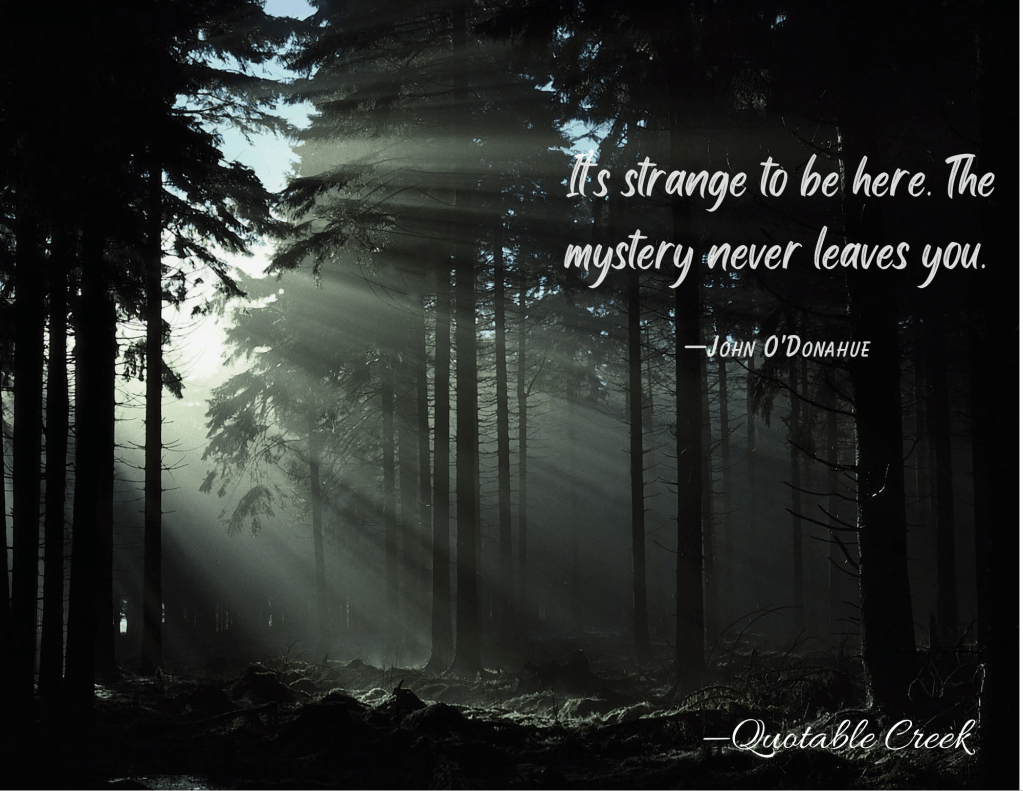
Irish philosopher and poet, John O’Donohue puts it this way
Well, I think it makes a huge difference, when you wake in the morning and come out of your house, whether you believe you’re walking into dead geographical location, which is used to get to a destination, or whether you’re emerging out into a landscape that is just as much if not more alive as you, but in a totally different form, and if you go towards it with an open heart and a real, watchful reverence, that you will be absolutely amazed at what it will reveal to you.
Perhaps if we realized the enormity of life force we are wandering amongst, we would walk more softly, breathe more deeply, and open our eyes wide in surprise and delight at the beauty of it all.
Standing up to fear changes a person. It helps you to put matters in perspective. Where once fear loomed over you, insurmountable, now you can honor the courage it took to move past it into unfamiliar territory.
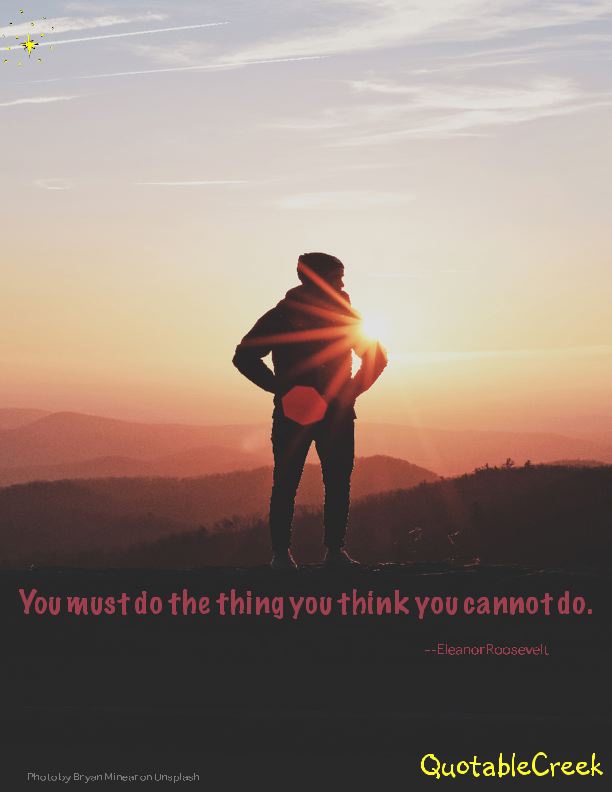
Eleanor Roosevelt was a courageous woman. Despite her husband’s attempts to placate the South, she regularly bucked segregation and was a vocal proponent of civil rights. She was able to call out racism and force others to see it for what it was:
By 1939, ER decided to attack the hypocritical way in which the nation dealt with racial injustice. She wanted her fellow citizens to understand how their guilt in “writing and speaking about democracy and the American way without consideration of the imperfections within our system with regard to its treatment . . . of the Negro” encouraged racism. Americans, she told Ralph Bunche in an interview for Gunnar Myrdal’s American Dilemma, wanted to talk “only about the good features of American life and to hide our problems like skeletons in the closet.” Such withdrawal only fueled violent responses; Americans must therefore recognize “the real intensity of feeling” and “the amount of intimidation and terrorization” racism promotes and act against such “ridiculous” behavior.
You can’t clearly see a problem before you if you are too scared to look at it and call it out for what it is. Where are the injustices in your immediate orbit? Are there people being treated unfairly? How can you add your voice to help identify the problem and move toward healing? These problems are right here, close to home.
As Eleanor Roosevelt said:
Where after do human rights begin? In small places, close to home– so close and so small that they cannot be seen on any map of the world. Yet they are the world of the individual person: The neighborhood he lives in; the school or college he attends; the factory, farm or office where he works. Such are the places where every man, woman, and child seeks equal justice, equal opportunity, equal dignity without discrimination. Unless these rights have meaning there, they have little meaning anywhere. Without concerted citizen action to uphold them close to home, we shall look in vain for progress in the larger world.
Fear is a crippler. It keeps you rooted in a course of action you know to be wrong. Focusing on the fear helps it to loom even larger before you. Instead, focus on the better world you are trying to help build. Spreading love and justice is exciting and uplifting. Being part of something bigger than yourself, working for a common goal, in an effort to improve people’s circumstance is rewarding.
You don’t have to see the whole path in front of you. Take, and keep taking, that next step forward.
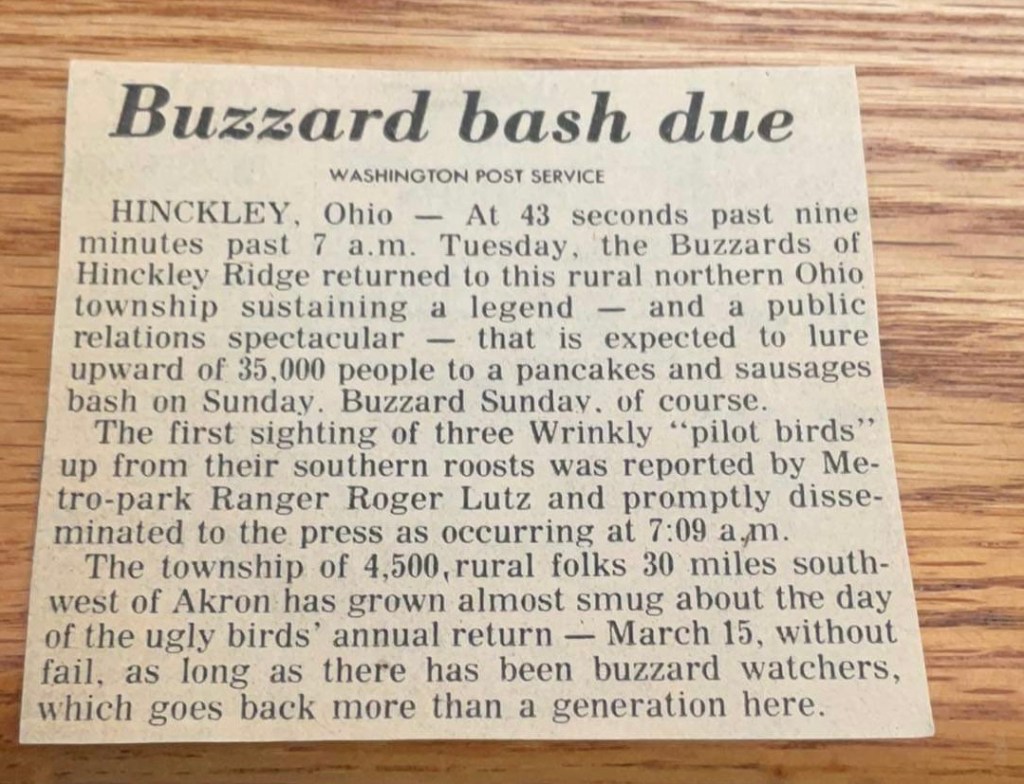
Recently, I pulled down an old scrapbook from my junior high days to show my granddaughter Lily who is just that same age now as I was then. It contained many ‘treasures’. Among the many letters and cards from my late grandmother was one talking about the buzzards coming back home to Hinckley, Ohio, a phenomenon which I remember amused me. Imagine celebrating buzzards!
She wrote:
It should cheer you somewhat to know that the buzzards returned to Hinckley, Ohio, on schedule on March 15th. It is always a comfort to know those gorgeous creatures ‘do their thing’ each year, as anticipated. It would be a bit discouraging to prepare pancakes and sausages for 35,000 eager folks, and have no buzzards to join in the celebration!
Oh, how I loved her, her humor and wit, her warmth and love, her writing style. I have always felt such a kinship with her and reading over her letters makes her feel so close.
Her letter got me thinking. First, about buzzards. Sure enough, a quick bit of googling shows that buzzards are still returning to Hinckley on schedule and have been celebrated since 1818!
And then about the cyclical quality of nature. The monarchs go south and then back. The swallows return to San Juan Capistrano. The elephant seals come back to Cambria. We humans who love animals mark their going and celebrate their homecoming, yes, even the buzzards, and note the steady passage of time.
And finally about how those we’ve lost stay with us even after they’ve gone. Lily has a freckle on her right hand which I’ve told her is her Nana freckle. I load it up with kisses often when I see her. When I’m gone, I hope that freckle will remind her of how very much I loved her. My grandmother and I were separated by thousands of miles, but our letters exchanged helped us stay close. Those letters remind me now to pause and share bits of life, simple moments, with the people I love. Those moments become the memories and precious treasure later.
Even the ones about buzzards.
(I couldn’t quite bring myself to make the lead picture with buzzards. Lol)
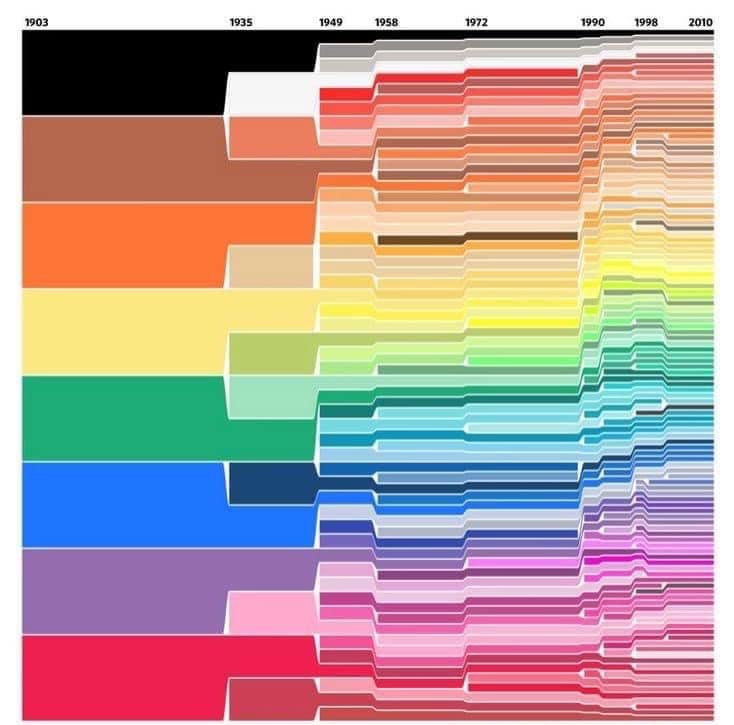
Look, for example, at the evolution of the color choices in the crayon:
Or in ice cream:
We are definitely not living in a plain vanilla, white bobby socks, only primary color world. We are living in a vibrant, color-and-detail everywhere world. Some days it feels wondrous to just soak it all in and enjoy the variety.
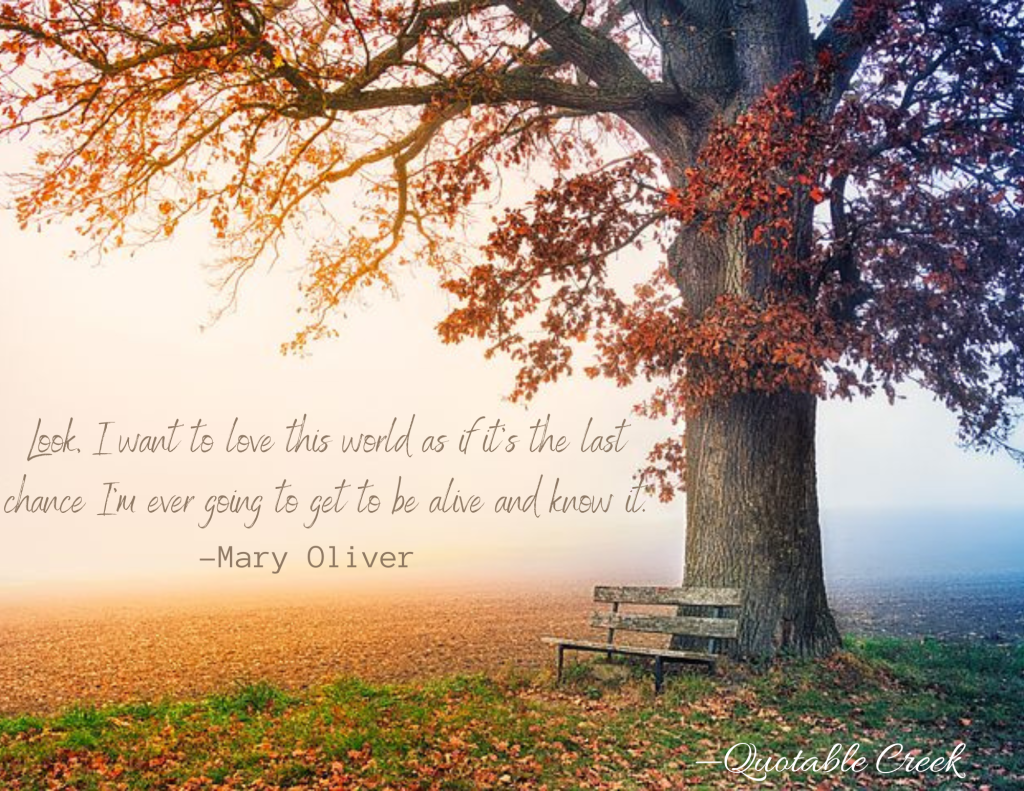
Now is our time to be alive. It will not come again. This is our last chance to savor nature and all of its wonder, to spend time with loved ones, to do good, to spread joy. This is it. This is our opportunity.
In the movie, Michael, an angel comes to Earth to influence the course of events. He, apparently, smells of cookies. But there is a scene, after ‘battle’ (he’s that kind of angel), when he is savoring the day. He is soaking it in, just enjoying being corporeal, waltzing with the breeze.
If only we could hold on to that wonder, awe, and appreciation, live in the moment, truly appreciate all we’ve been given here. What a fine world that would be.
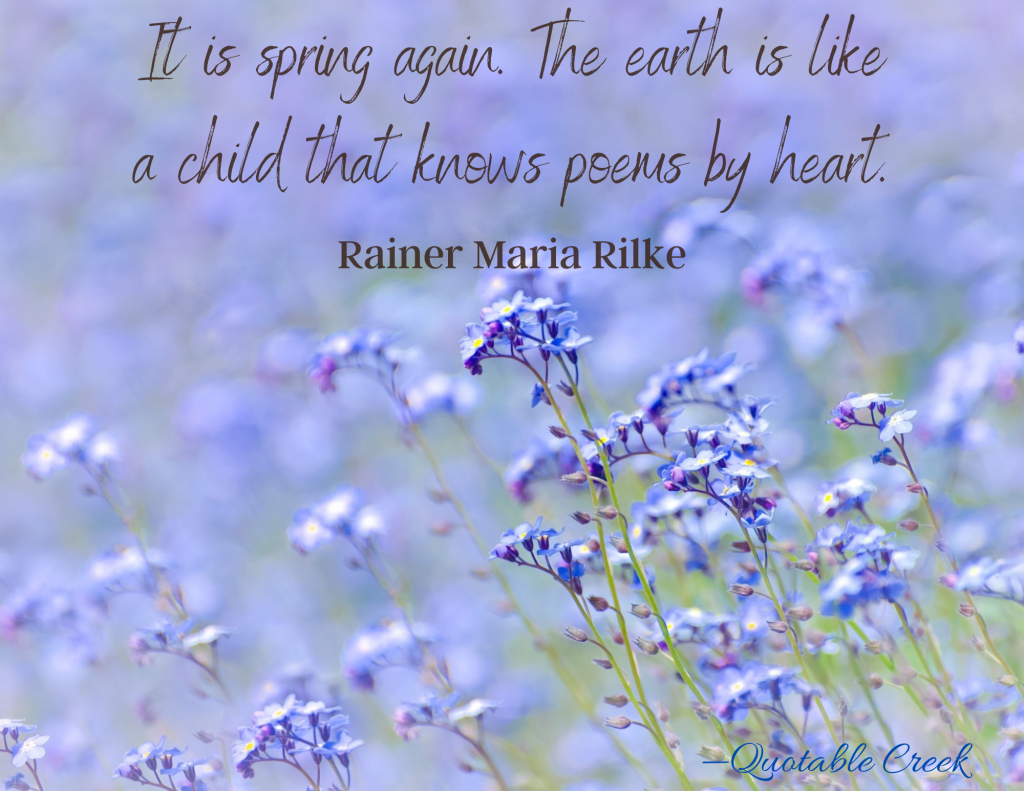
Spring is my favorite season. The birdsong, the colors, the blooms, jasmine-filled breezes. All of it. Yes, please.
We have yet more rain here in Cali, but even so, the birds are singing their hearts out. And the buds are forming, and the bulbs are up. And the hills are so beautifully green. And somewhere close, the bears are stirring.
Enjoy this spring poem by Mary Oliver.
SPRING
Somewhere
a black bear
has just risen from sleep
and is staring
down the mountain.
All night
in the brisk and shallow restlessness
of early spring
I think of her,
her four black fists
flicking the gravel,
her tongue
like a red fire
touching the grass,
the cold water.
There is only one question:
how to love this world.
I think of her
rising
like a black and leafy ledge
to sharpen her claws against
the silence
of the trees.
Whatever else
my life is
with its poems
and its music
and its glass cities,
it is also this dazzling darkness
coming
down the mountain,
breathing and tasting;
all day I think of her—
her white teeth,
her wordlessness,
her perfect love.
Mary Oliver, House of Light
Spring is also all of this —the wild, the fecundity, the passion, the thirst, and the quenching of thirst. The one question: how to love this world. Life’s yes. This, please.







 QuotableCreek.com