It certainly changes things depending on your perspective. Someone who thinks of life as a contest is always striving, comparing what he has to others. The one who views life as a burden might sigh a lot. And so on.
But what if we thought of life as a gift? Unearned, given out of love, no strings attached. Something to be grateful for. Something to savor and enjoy but also something to treasure. Would that affect what we see when we open our eyes in the morning? Face challenges? Greet people? Pick a career?
Brian Zhand says:
Most of us are scripted to think that life is a game and the purpose of life is to win. But the divine truth is that life is a gift and the purpose of life is to learn to love well.
The truth is being here is a gift, an opportunity, a chance to do some good. Open your gift.
How often do you admire someone but keep that thought to yourself? Perhaps someone took a risk, spoke truth to power or behaved well in a tough situation. You admired them for it but kept that admiration to yourself. How much good might that have done if you told them, perhaps given them a bit of encouragement to stand strong again? How much might your words give them much-needed support when they were feeling low?
Chimamanda Adichie encourages us to never admire quietly. She says:
If I admire something about someone, I tell them. We humans are so fragile. It’s important we give people their flowers while they are here. Never admire quietly.
Don’t be stingy with kind words and compliments. They could very well be the fuel that keeps those good deeds coming.
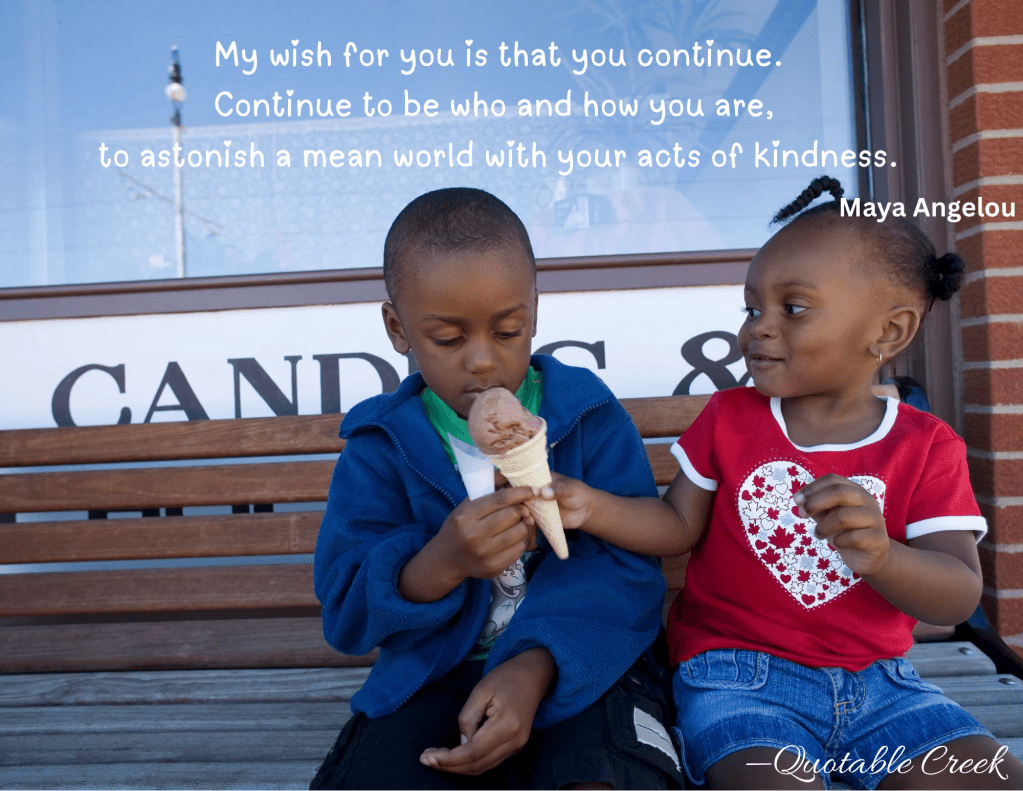
Astonishing a mean world is quite the life goal. Flipping the script. Not buying in to the smallness, pettiness, and cruelty you see around you.
Imagine the ripple effects of such kindness.
Perhaps you’ve heard the story of the man and the starfish. In sum, a man is walking along the beach at low tide finding starfish that have landed too far above the water line to survive. He dislodges them and throws them back into the ocean. A bystander is astonished and scolds him, saying that he will never be able to make a difference as there are miles and miles of beach with hundreds of stranded starfish. The man responds, tossing another back into the ocean, “Made a difference to that one,” he remarks.
Making a difference doesn’t have to be a grand gesture. It can be quite small, perhaps only affecting the person in front of you right now. Perhaps the difference is choosing an unexpected response to cruelty. Perhaps the response is to not lose hope.
Hang in there. The starfish are right in front of you on your path if you choose to see them.
This moment we are in is but one in the collection of moments that make a life, a story, a history. Each moment building on the last, forward toward a powerful culmination. To stay hopeful and earnest in each moment, no matter how dire, is a testament to what we hold dear, to hope, to a belief that all things will ultimately work together for good.
As Howard Zinn says,
TO BE HOPEFUL in bad times is not just foolishly romantic. It is based on the fact that human history is a history not only of cruelty, but also of compassion, sacrifice, courage, kindness. What we choose to emphasize in this complex history will determine our lives. If we see only the worst, it destroys our capacity to do something. If we remember those times and places—and there are so many—where people have behaved magnificently, this gives us the energy to act, and at least the possibility of sending this spinning top of a world in a different direction. And if we do act, in however small a way, we don’t have to wait for some grand utopian future. The future is an infinite succession of presents, and to live now as we think human beings should live, in defiance of all that is bad around us, is itself a marvelous victory.
Do not give up on the beliefs you have. To be decent, kind, not returning hate for hate, to speak truth to power, to retain hope for a brighter future, a future willing to work for. That is a marvelous victory.
In his letter to the early church at Corinth, Paul sets out how love shows up in the world in his effort to help them get along. It is a frequent text for weddings:
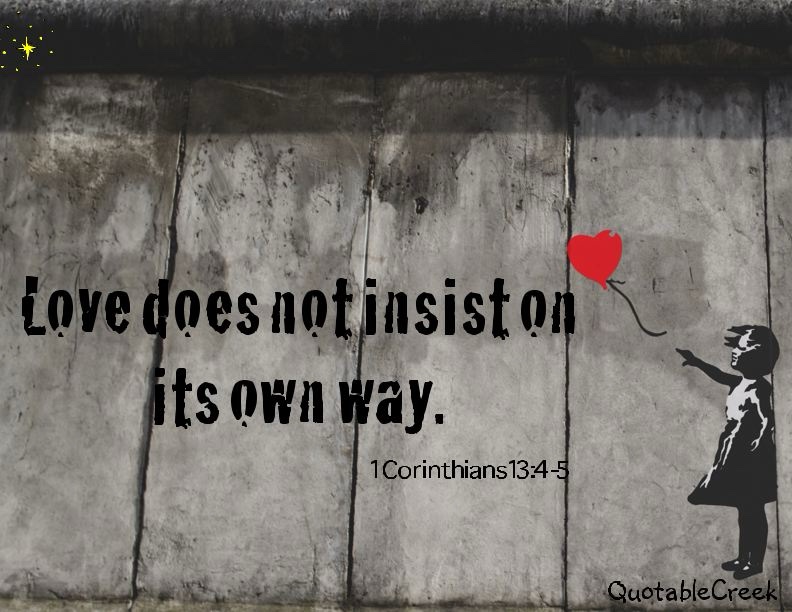
“Love is patient and kind; love does not envy or boast; it is not arrogantor rude. It does not insist on its own way; it is not irritable or resentful…” 1 Corinthians 13:4-5.
To those about to marry, an interesting exercise is to substitute the name of your beloved each time the word ‘Love’ appears. And an even more interesting exercise, for all of us, is to substitute our own names instead of the word ‘love’:
I am patient and kind; I do not envy or boast; I am not arrogant or rude. I do not insist on my own way; I am not irritable or resentful….
How did you do? For many of us, this simple recitation shows us the exact ways and times we are being less than loving and calls us to consider those actions. Must we insist on our own way? How do we know what is right? Isn’t it possible that someone else may be right, too? Are we becoming impatient with others? Can we take a minute to rein ourselves in, breathe deeply, and begin again? Are we holding grudges? Can we let the past go and try to make our present the best possible? And so on.
These checks we can do to measure our progress and monitor our moods against the ideal of love can be very helpful to keep us on track showing up in this world as close to lovingly as we can get.
It’s okay to be heartbroken for more than one group of people at the same time. When it comes to showing compassion, we don’t have to pick sides. Sometimes, often really, maybe even always, there is hurt and anguish everywhere, and we can mourn the lot of it.
Beware people who tell you not to be concerned for this group or that group and the hurt they feel.
Beware those who try to dehumanize others.
Beware those who lump you in as the ‘enemy’ for working to assure people are treated humanely.
Beware people who draw lines between us and them.
Beware those who try to limit you to a label or single identity.
Our hearts are big enough to embrace it all. What we must save is love.
How do we read the news and not get overwhelmed or angry, disconnected or depressed? How do we keep showing up with compassion and grace in a world where there is so much hate? How do we keep ourselves on the right path through the midst of it all? How do we continue to show up from a place of compassion, forgiveness, and grace? how do we keep our hearts from growing hard?
In this thoughtful letter, Rabbi Yael Levy shares his insights on how to pray with the news:
The 17th of the Hebrew month Tammuz initiates a three-week period of mourning that leads to Tisha b’Av, which is the day that marks the destruction of the Temples in Jerusalem in 586 BCE and 70 CE.
Tradition teaches that the Temple was destroyed because hatred became the operating principle in the community. The scorn, contempt and disdain that characterized daily interactions caused the Divine Presence to flee and leave the Temple vulnerable to attack.
These next three weeks ask us to reflect on the hatred that we allow to take root in our hearts. The wisdom of the tradition acknowledges that hatred can sometimes feel energizing and “so right,” but allowing it to fill our bodies and guide our actions leads to destruction.
Many years ago I was taught the practice of praying with the news. I have shared it over the years and always find myself returning to it during this season.
In this practice, each time we read or listen to a news report that enrages us, we turn our attention to those harmed by what is happening and pray for their healing and well-being. Doing so encourages us to acknowledge feelings of anger, grief and despair, and at the same time it turns our attention toward connection and compassion. Praying with the news can help us learn to bear witness to devastation and mayhem, while keeping our hearts soft, our minds calm, and our actions clear.
I am struggling mightily with this practice these days in the wake of continued violence and oppression in this country and throughout the world. Hatred can sometimes feel like such a welcome harbor. Not only does it feel so right, it can also act as a shield, creating the illusion that I don’t have to acknowledge the grief and heartbreak I am experiencing.
I need practices to help quiet the rage and fear, to loosen the constriction of hatred and to help me be with overwhelming grief. I need practices to help me return to compassion, love, joy and possibility. I find praying with the news both painful and helpful. It keeps me connected, allows sorrow, and grounds me in care and love.
What is the formula for a happy life? What are the variables? How do things like gratitude and expectations factor in?
In his essay, The Structure of Gratitude, David Brooks says:
I’m sometimes grumpier when I stay at a nice hotel. I have certain expectations about the service that’s going to be provided. I get impatient if I have to crawl around looking for a power outlet, if the shower controls are unfathomable, if the place considers itself too fancy to put a coffee machine in each room. I’m sometimes happier at a budget motel, where my expectations are lower, and where a functioning iron is a bonus and the waffle maker in the breakfast area is a treat.
Included in, The Way of Gratitude, Readings for a Joyful Life.
He concludes that “Gratitude happens when some kindness exceeds expectations, when it is undeserved.” So, maybe as a formula it would look like “If kindness>expectations= gratitude.” So are our expectations the linchpin variable. To be happy and grateful, we should keep our expectations low? Or is there more to it?
He notes that there are some people who are ‘dispositionally’ grateful:
These people may have big ambitions, but they have preserved small anticipations. As most people get on in life and earn more status, they often get used to more respect and nicer treatment. But people with dispositional gratitude take nothing for granted. They take a beginner’s thrill at a word of praise, at another’s good performance or at each sunny day. These people are present-minded and hyper-responsive. This kind of dispositional gratitude is worth dissecting because it induces a mentality that stands in counterbalance to the mainstream threads of our culture. We live in a capitalist meritocracy. This meritocracy encourages people to be self-sufficient–masters of their own fate. But people with dispositional gratitude are hyperaware of their continual dependence on others. They treasure the way they have been fashioned by parents, friends and ancestors who were in some ways their superiors. They’re glad the ideal of individual autonomy is an illusion.
Included in, The Way of Gratitude, Readings for a Joyful Life
What a powerful way to look at things. In a very real sense, people with dispositional gratitude are able to see behind the veil into a truer, richer reality, full of wonder and generosity beyond anything any one of us deserves or merits. They are witnesses to the abundance we all share but few notice. Any one of us is capable of dropping our expectations and stepping into a magical world full of abundance if only we have the eyes to see.
Are you good at receiving? Giving often comes naturally, but receiving can be challenging. The mom who wears the pasta necklace and hangs the cotton puff ornament on the tree is sending a powerful message that her child matters, that she loves their thoughtfulness, and that she is honored and grateful to receive their gifts.
The host who immediately opens a guest’s gift of wine and serves it is saying that they value their guests’ choices and are welcoming their contributions to the synergistic experience that is a social gathering.
Henri Nouwen offers this powerful insight:
When someone gives us a watch but we never wear it, that watch is not really received. When someone offers us an idea but we do not respond to it, that idea is not truly received. When someone introduces us to a friend but we ignore him or her, that friend does not feel well received.
Receiving is an art. It means allowing the other to become part of our lives. It means daring to become dependent on the other. It asks for the inner freedom to say, “Without you I wouldn’t be who I am.” Receiving with the heart is, therefore, a gesture of humility and love. So many people have been deeply hurt because their gifts were not well received. Let us be good receivers.
Henri Nouwen, Bread for the Journey
These words cause us to pause and consider. Are we good receivers? Do we value those gifts and those givers in a way that causes us to open up and expand our walls, and even, perhaps, our sense of self? Can we give up our need to be in control and let our defenses down enough that others around us can share in the very creation of our lives?