On days that seem dark and heavy, mired with concerns about the future, it is nice to remember that babies are being born, people are proposing, family members are coming home, and we are all here today.
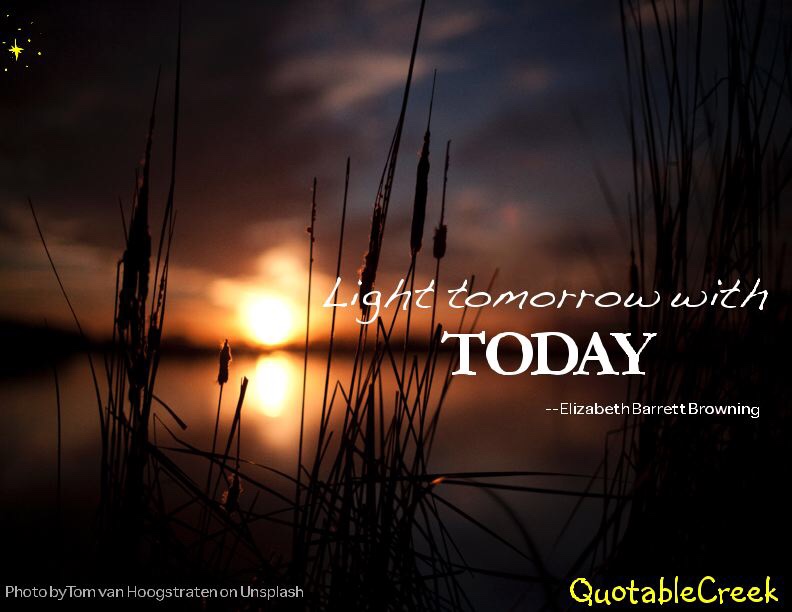
Today, where we still have power to work toward better tomorrows.
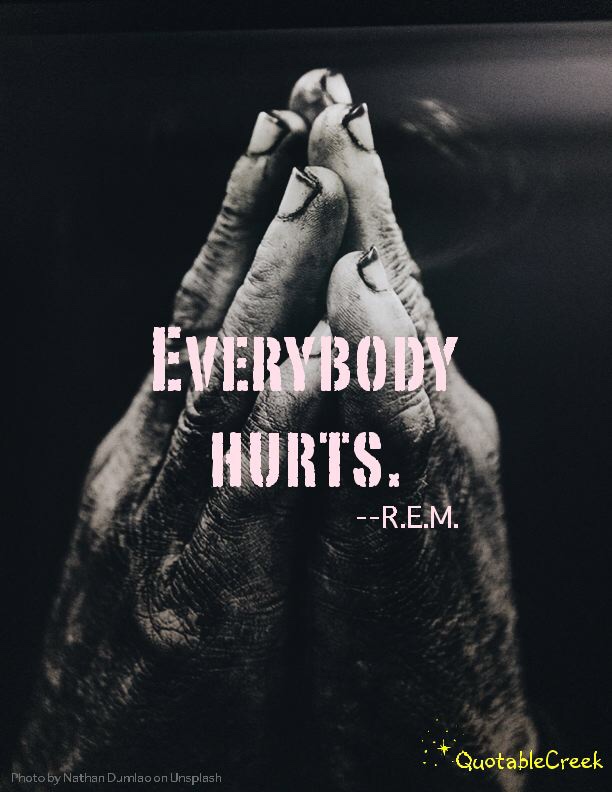
Please take a moment to watch Father Ray Kelly sing Everybody Hurts and remember that we need to reach out to each other. We are each other’s comfort and hope.
Lyrics
When your day is long And the night The night is yours alone When you’re sure you’ve had enough Of this life Well hang on Don’t let yourself go ‘Cause everybody cries And everybody hurts sometimes
Sometimes everything is wrong Now it’s time to sing along When your day is night alone (hold on) (Hold on) if you feel like letting go (hold on) If you think you’ve had too much Of this life Well, hang on
Cause everybody hurts Take comfort in your friends Everybody hurts Don’t throw your hand Oh, no Don’t throw your hand If you feel like you’re alone No, no, no, you’re not alone
If you’re on your own In this life The days and nights are long When you think you’ve had too much Of this life To hang on
Well, everybody hurts sometimes Everybody cries And everybody hurts sometimes And everybody hurts sometimes So, hold on, hold on Hold on, hold on Hold on, hold on Hold on, hold on
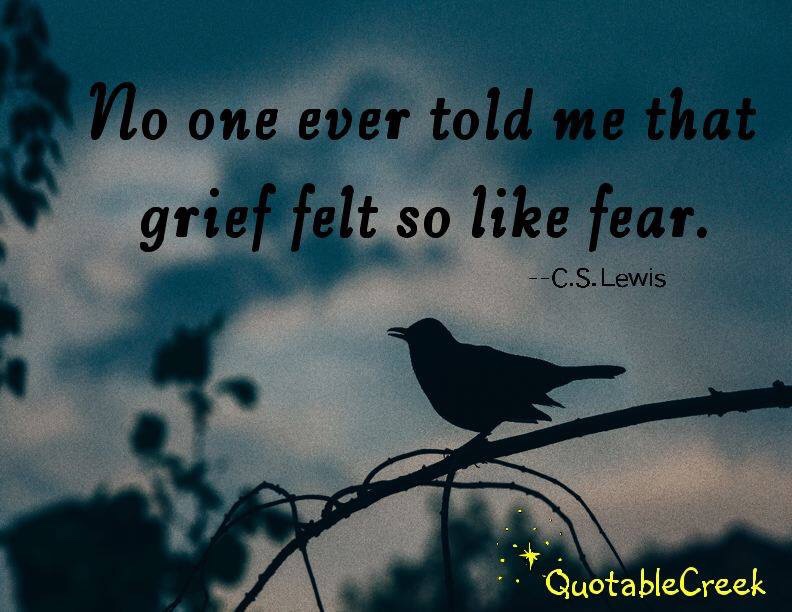
We are grieving, collectively, the world over, all of us. Grieving the past we’ve lost and the loss of the future we expected. Things will be forever different for us. There are stages to this grief, and we will all experience it differently. But it is in acceptance where we will find the ability to process it and move forward into an uncertain future. This is our now. This is what we have to work with.
In this excellent article on grief, David Kessler shares his thoughts on what we are all going through:
“Yes, we’re also feeling anticipatory grief. Anticipatory grief is that feeling we get about what the future holds when we’re uncertain. Usually it centers on death. We feel it when someone gets a dire diagnosis or when we have the normal thought that we’ll lose a parent someday. Anticipatory grief is also more broadly imagined futures. There is a storm coming. There’s something bad out there. With a virus, this kind of grief is so confusing for people. Our primitive mind knows something bad is happening, but you can’t see it. This breaks our sense of safety. We’re feeling that loss of safety. I don’t think we’ve collectively lost our sense of general safety like this. Individually or as smaller groups, people have felt this, but all together this is new. We are grieving on a micro and a macro level.”
The article is well worth a read, as it helps us put the issues we face now in perspective and give voice to our feelings. He states:
“Understanding the stages of grief is a start. But whenever I talk about the stages of grief, I have to remind people that the stages aren’t linear and may not happen in this order. It’s not a map but it provides some scaffolding for this unknown world. There’s denial, which we say a lot of early on: This virus won’t affect us. There’s anger: You’re making me stay home and taking away my activities. There’s bargaining: Okay, if I social distance for two weeks everything will be better, right? There’s sadness: I don’t know when this will end. And finally there’s Acceptance. This is happening; I have to figure out how to proceed.
“Acceptance, as you might imagine, is where the power lies. We find control in acceptance. I can wash my hands. I can keep a safe distance. I can learn how to work virtually.”
Sometimes dealing with a problem begins with naming it. Grief, that’s what it is. Have compassion on yourself and others. This is hard.
Let St. Francis of Assisi’s timeless prayer soothe your soul today:
Lord, make me an instrument of your peace. Where there is hatred, let me bring love. Where there is offense, let me bring pardon. Where there is discord, let me bring union. Where there is error, let me bring truth. Where there is doubt, let me bring faith. Where there is despair, let me bring hope. Where there is darkness, let me bring your light. Where there is sadness, let me bring joy. O Master, let me not seek as much to be consoled as to console, to be understood as to understand, to be loved as to love, for it is in giving that one receives, it is in self-forgetting that one finds, it is in pardoning that one is pardoned, it is in dying that one is raised to eternal life
And, for a special soul-reviving treat, listen to Sarah McLachlan as she sings these precious words. Maybe listen a few times.
Enjoy this lovely version of Let There Be Peace On Earth by Vince Gill and his daughter. May these words, quotations, and pictures bring comfort to your soul.
Amid a country-wide quarantine in Italy, a beautiful voice sings out into the empty streets, only to be joined by more voices, until their chorus warms the entire world. Enjoy this reminder that, even as we struggle. we belong to each other.
A Siena, città alla quale sono molto legato, si sta in casa ma si canta insieme come se si fosse per la strada. Mi sono commosso pic.twitter.com/IDPqNEj3h3
In every darkness, a bit of light will shine to light your way. It may be in the acts of kindness and generosity you see, in words of wisdom you remember and hold close to your heart, or memories of past struggles that you have gotten through to the other side. We draw strength and courage from each other, working together. That community will sustain us.
In his book, Healing the Divide, editor James Crews collects poem of kindness and compassion. Here is one by Danusha Laméris for you to carry with you today:
“I’ve been thinking about the way, when you walk down a crowded aisle, people pull in their legs to let you by. Or how strangers still say ‘bless you’ when someone sneezes, a leftover from the Bubonic plague. ‘Don’t die,’ we are saying. And sometimes, when you spill lemons from your grocery bag, someone else will help you pick them up. Mostly, we don’t want to harm each other. We want to be handed our cup of coffee hot, and to say thank you to the person handing it. To smile at them and for them to smile back. For the waitress to call us honey when she sets down the bowl of clam chowder, and for the driver in the red pick-up truck to let us pass. We have so little of each other, now. So far from tribe and fire. Only these brief moments of exchange. What if they are the true dwelling of the holy, these fleeting temples we make together when we say, ‘Here have my seat,’ ‘Go ahead—you first,’ ‘I like your hat.’”
We will get through this present darkness. Hold tight to the little kindnesses, savor them, and spread them where you can to light the way for those behind you.
For more, a reminder that we were made for times like these.
What do you think heaven looks like? Certainly, if we can see there, it is a place of great beauty and marvelous complexity where we marvel at God’s creation. If we can hear there, music that stirs the soul must be the score. And so on through our senses
But what if we are not corporeal in heaven and don’t have senses per se? What then? Perhaps it is a place of harmony, of communion, with everyone different but united in common purpose.
These are good things, yes? Appreciating beauty in God’s creation, enjoying music that stirs the soul, being so present in our bodies that we marvel at its systems? And, of course, communion, harmony, peace? These are good things.
Perhaps, today, we can take time to bring a bit of heaven to earth. Pause to admire the beauty around us, savor, marvel, be astonished. And then with our senses full and renewed, have courage to bring peace and harmony to our day.
Sometimes it’s easy to respond in love. People are kind; you’re kind in return. Someone is generous to you; you pay it forward to someone else.
But sometimes it isn’t easy at all. Sometimes it feels like the world is on fire, and everyone is rushing around thinking only of saving themselves. You feel vulnerable, exposed, in danger. You are on emotional high alert, alarms clanging. What then?
It is in these times, that any shows of love shine like light in darkness. Focusing on expressing your love gives the people you care about safe harbor. Focusing on being gentle with the people around you can calm the tide.
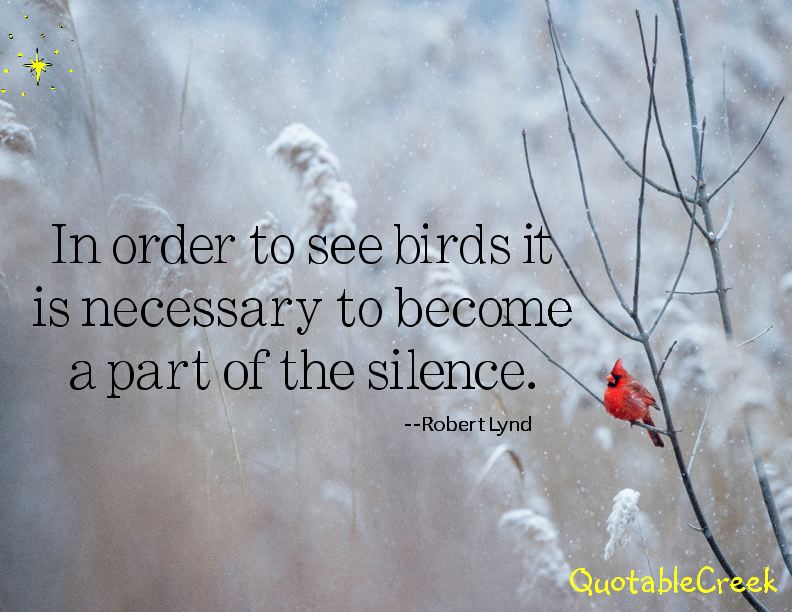
Consider the birds. They have so much to teach us. They sing; they fly; they soar. When the storm is over, they come out and sing, fly, and soar again. They vary dramatically from the tiny hummingbird to the great bald eagle, but they have so much in common. And, when we are quiet, they remind us to look up, to look to the future and the possibility that lies there. It turns out considering the birds is good for our well-being, keeping depression at bay.
Be still and notice the birds. Do you see the vulture with its huge wings soaring above you? Do you hear the hawk shriek? Do you see the crows tuck in their wings and dive to open them again and rise only after you gasp, worried?
Watch the little sparrows bathe in a puddle, delighting in the way the water splashes around them. Listen to them sing.






 QuotableCreek.com