How are we?

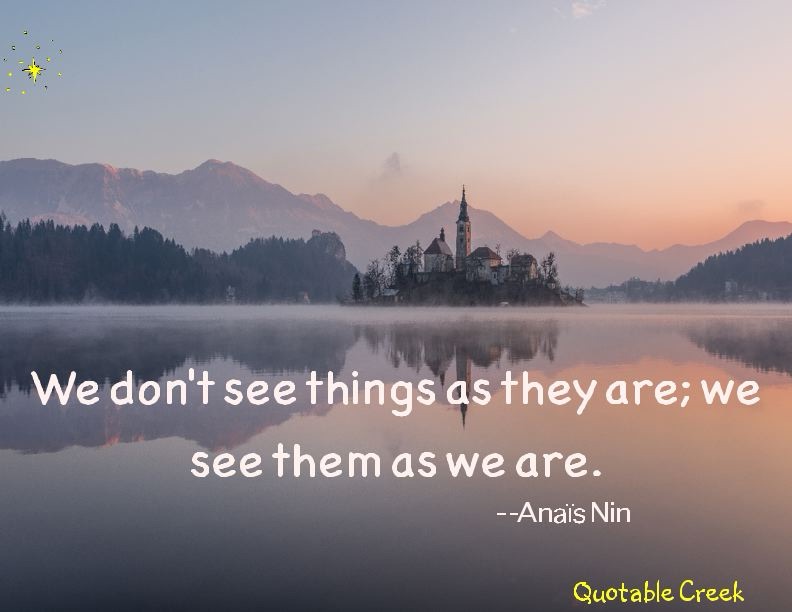
A guy cuts you off in traffic. How do you see him? Is he an inconsiderate lout caring little for the aggravation he causes you or a distracted hapless soul, perhaps late for an emergency? How we see this situation, or any situation, can have a profound effect on our lives.

In this thoughtful essay, Elizabeth Gilbert considers the power of perception. She recounts a time when her father and his siblings were reminiscing about their late mother and how she used to take a sip from any glass of milk she poured for them. They agreed on the fact, that she took a sip, but wildly disagreed on their perception of that fact:

At one point, they found themselves sitting around the old kitchen table, eating sandwiches and talking about the past. My uncle, the baby of the family, looked at the refrigerator and said, “I can still see Mom standing there, pouring me a glass of milk. Do you remember that sweet thing she always used to do whenever she got us a glass of milk? Remember how she’d take a tiny sip first, to make sure it wasn’t spoiled? Always looking out for us.”

My father, the analytical engineer of the family, raised his eyebrows. “No,” he said. “You are so wrong. Mom wasn’t sipping our milk to test it for freshness. She was sipping our milk because she always overfilled the glass. She had no sense of spatial relations. It used to drive me crazy.”

My brilliantly sardonic aunt looked at her two brothers like they were the biggest idiots she’d ever seen.

“You’re both wrong,” she said. “Mom was stealing our damn milk.”

So, what have we learned about my grandmother from this story? Was she a devoted caregiver, an incompetent dunderhead or someone who would steal the milk out of the mouths of her children? (Or maybe just an exceptionally thirsty woman.) The world will never know the truth.

But does the truth really matter?

I don’t think so.

Wow! What a remarkable difference in what each brings to the encounter. Now imagine yourself in each of those mindsets: hostile, critical, or grateful. Which would lead to the happier life?

We don’t have control over facts, but we sure have a tremendous amount of control over how we perceive those facts. We owe it to ourselves to try to see the facts in the most favorable light even if that means consciously going over all the possible interpretations of something and actively selecting the best one to pick.

Enjoy the journey.

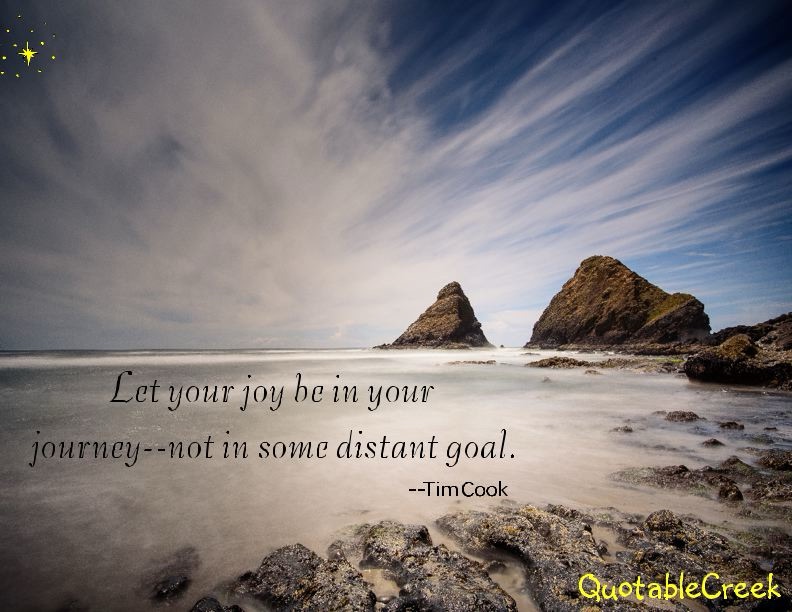
Sometimes our eyes and hearts are focussed so far in the distance, that we fail to see what is right in front of us. The people we spend our days with, the beauty surrounding us, the opportunities we have to make a difference. When we zoom in to the detail, the richness of the particular moment can be astounding and surprising. What a beautiful, remarkable world we live in. So full of complexity. Each person we see is as full of contradictions and surprises as we are ourselves. Each living or created thing we see is so full of detail.

Long-term goals are great, but what a shame if we don’t appreciate each step along the way. We may work side by side with someone but barely know their name let alone what their hopes and dreams are. We may be so busy moving forward that we are blind to the heartache of even the people we live with. It is easy to speed through life with eyes averted like people descending in an elevator focussed only on the floor numbers.

Today take time today to enjoy the journey, the mysteries unfolding all around you, the people who share your path, and all the beautiful and startling things right here, right now.

Like, for example, who can not stop and be amazed at this little beagle shaking its jowls, its great ears flopping to the beat, its sturdy paws holding on in front but shifting with its wagging tail in back, the gorgeous landscape behind it? What a fascinating little miracle, right here. Just this.

Little miracle of the day.

Tending roses.

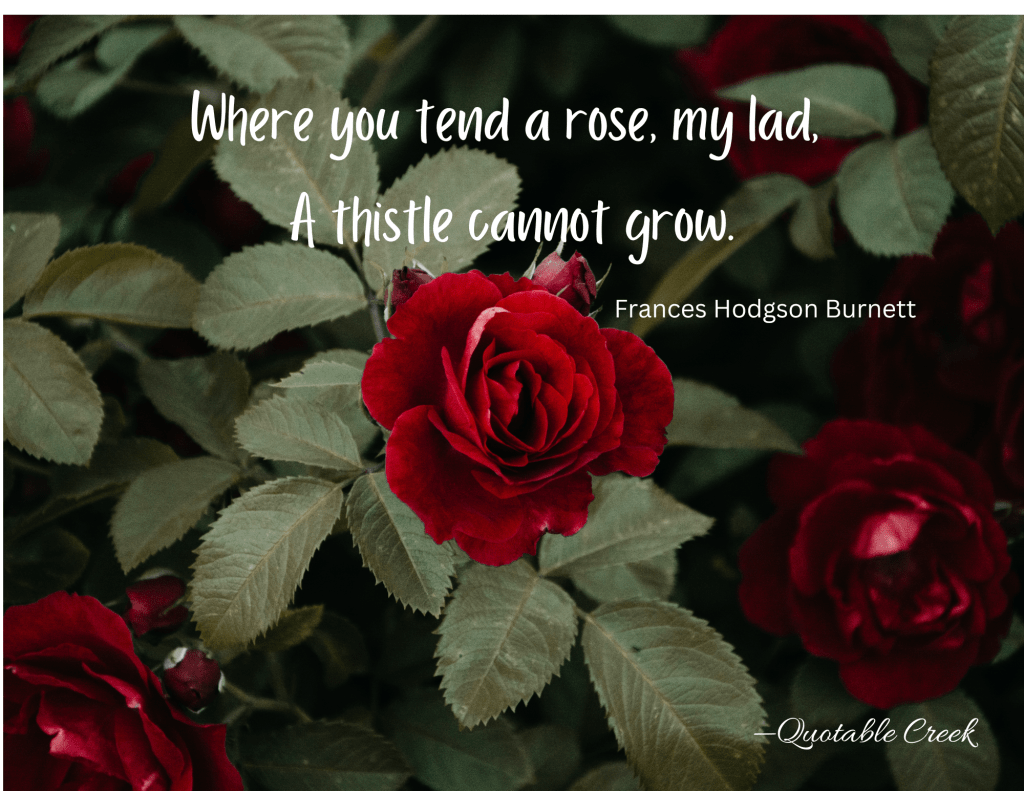
‘If you look the right way, you can see that the whole world is a garden,’ muse the characters in Frances Hodgson Burnett’s The Secret Garden. And, perhaps, on a more intimate level, so our mind is too a garden.

We cultivate our thoughts, enrich them with information, learn, grow, stretch. But weeds can overrun any garden, and we can find our minds overcome with anxiety, negative thinking, and endless catastrophic thinking.

But Burnett notes:

Much more surprising things can happen to any one who, when a disagreeable or discouraged thought comes into his mind, just has the sense to remember in time and push it out by putting in an agreeable determinedly courageous one. Two things cannot be in one place.

When we find ourselves overcome with negative thoughts, we can imagine our mind a garden. Something we can lovingly tend, plucking weeds, nourishing blooms, replacing gloom with gratitude, planting seeds of possibility and promise.

While there are many things in this world we cannot control, we still can control our thoughts and find a way to focus on ones that keep our mental garden thriving.

I’m ready.

I’m listening, world. What do you have to teach me? Where should my attention be, to understand and, finally, get it, the great purpose and plan of it all?

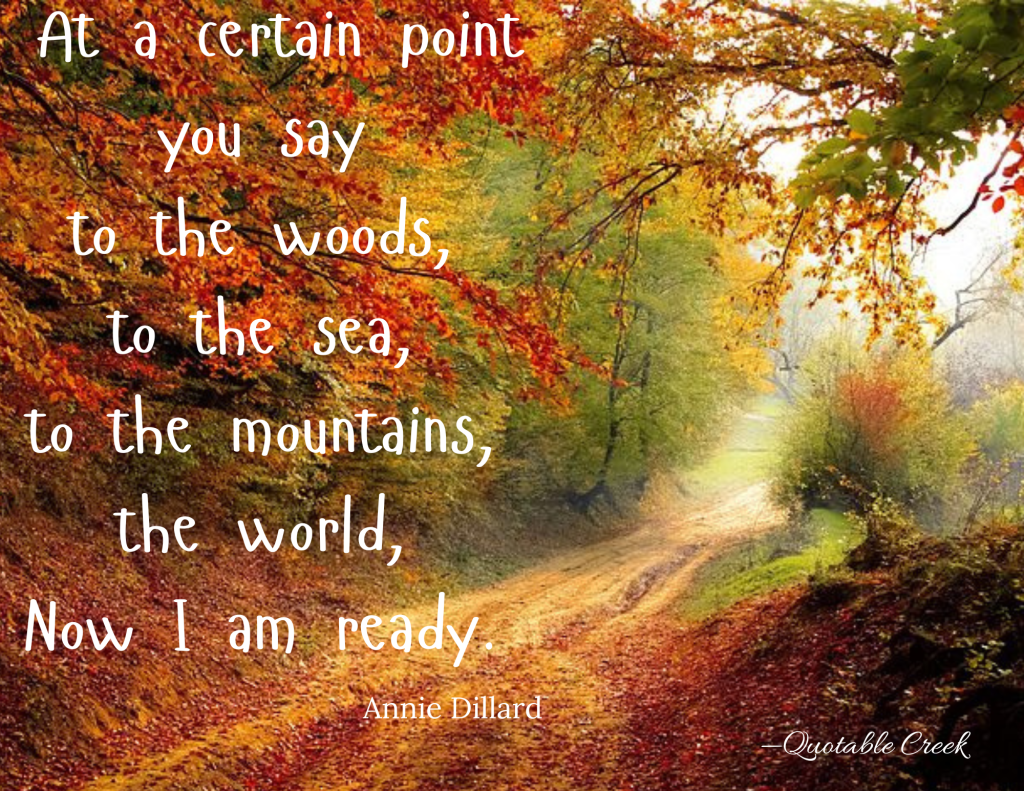
Annie Dillard, in Teaching a Stone to Talk writes:

At a certain point, you say to the woods, to the sea, to the mountains, the world, Now I am ready. Now I will stop and be wholly attentive. You empty yourself and wait, listening. After a time you hear it: there is nothing there. There is nothing but those things only, those created objects, discrete, growing or holding, or swaying, being rained on or raining, held, flooding or ebbing, standing, or spread. You feel the world’s word as a tension, a hum, a single chorused note everywhere the same. This is it: this hum is the silence. Nature does utter a peep – just this one. The birds and insects, the meadows and swamps and rivers and stones and mountains and clouds: they all do it; they all don’t do it. There is a vibrancy to the silence, a suppression, as if someone were gagging the world. But you wait, you give your life’s length to listening, and nothing happens. The ice rolls up, the ice rolls back, and still that single note obtains. The tension, or lack of it, is intolerable. The silence is not actually suppression: instead, it is all there is.

And later:

The silence is all there is. It is the alpha and the omega. It is God’s brooding over the face of the waters; it is the blended note of ten thousand things, the whine of wings. You take a step in the right direction to pray into this silence, and even to address the prayer to ‘World.’ Distinctions blur. Quit your tents. Pray without ceasing.

Perhaps the aha moment isn’t in understanding as much as in being, a part within a vast whole, caught up in the mystery and the magnitude.

Surprise!

How much do our expectations get in the way of our gratefulness? If we were expecting nothing, would our eyes open more to all the gifts we receive each day. Brother David Steindhal-Rast explores just this link between surprise and gratitude:

Have you ever noticed how your eyes open a bit wider when you are surprised? It is as if you had been asleep, merely day-dreaming or sleepwalking through some routine activity, and you hear your favorite tune on the radio, or look up from the puddles on the parking lot and see a rainbow, or the telephone rings and it’s the voice of an old friend, and all of a sudden you’re awake. Even an unwelcome surprise shakes us out of complacency and makes us come alive. We may not like it at first, but looking back, we can always recognize it as a gift. Humdrum equals deadness; surprise equals life. In fact, my favorite name for the One I worship in wonder – the only name that does not limit God – is Surprise.

Right this moment, as I remember spiritual giants I have been privileged to meet – Mother Teresa, Thomas Merton, Dorothy Day, His Holiness the Dalai Lama – I can still feel the life energy they radiated. But how did they come by this vitality? There is no lack of surprises in this world, but such radiant aliveness is rare. What I observed was that these people were all profoundly grateful, and then I understood the secret.

Surprise is a seed. Gratefulness sprouts when we rise to the challenge of surprise

A surprise does not make us automatically alive. Aliveness is a matter of give-and-take, of response. If we allow surprise to merely baffle us, it will stun us and stunt our growth. Instead, every surprise is a challenge to trust in life and so to grow. Surprise is a seed. Gratefulness sprouts when we rise to the challenge of surprise. The great ones in the realm of Spirit are so intensely alive because they are so deeply grateful.

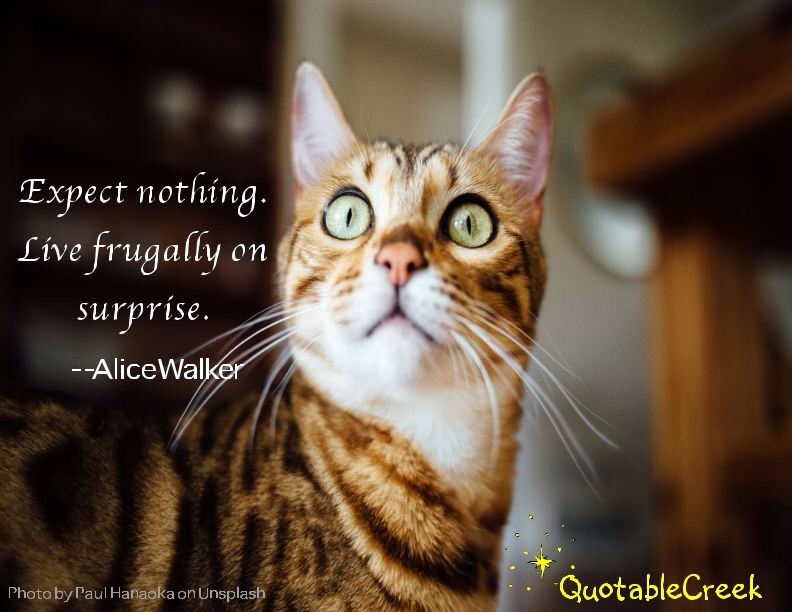
Gratefulness can be improved by practice. But where shall beginners begin? The obvious starting point is surprise. You will find that you can grow the seeds of gratefulness just by making room. If surprise happens when something unexpected shows up, let’s not expect anything at all. Let’s follow Alice Walker’s advice. “Expect nothing. Live frugally on surprise.”

To expect nothing may mean not taking for granted that your car will start when you turn the key. Try this and you will be surprised by a marvel of technology worthy of sincere gratitude. Or you may not be thrilled by your job, but if for a moment you can stop taking it for granted, you will taste the surprise of having a job at all, while millions are unemployed. If this makes you feel a flicker of gratefulness, you’ll be a little more joyful all day, a little more alive.

Once we stop taking things for granted our own bodies become some of the most surprising things of all.

Once we stop taking things for granted our own bodies become some of the most surprising things of all. It never ceases to amaze me that my body both produces and destroys 15 million red blood cells every second. Fifteen million! That’s nearly twice the census figure for New York City. I am told that the blood vessels in my body, if lined up end to end, would reach around the world. Yet my heart needs only one minute to pump my blood through this filigree network and back again. It has been doing so minute by minute, day by day, for the past 75 years and still keeps pumping away at 100,000 heartbeats every 24 hours. Obviously this is a matter of life and death for me, yet I have no idea how it works and it seems to work amazingly well in spite of my ignorance.

I do not know how my eyes adapt, yet when I chant by candlelight they are 100,000 times more sensitive to light than when I read outdoors on the porch at noon. I wouldn’t know how to give instructions to the 35 million digestive glands in my stomach for digesting one single strawberry; fortunately, they know how to do their job without my advice. When I think of this as I sit down to eat, my heart brims with gratefulness.

From the humble starting point of daily surprises, the practice of gratefulness leads to these transcendent heights.

In those moments, I can identify with the Psalmist who cried out in amazement, “I am fearfully and wonderfully made.” (Ps.139:14) From there it is only a small step to seeing the whole universe and every smallest part of it as surprising. From the humble starting point of daily surprises, the practice of gratefulness leads to these transcendent heights. Thomas Carlyle pointed to these peaks of spiritual awareness when he wrote, “Worship is transcendent wonder” – transcendent surprise.

Surprise is a seed; let it sprout and blossom today to color your life with gratitude.

Self control in an out of control world.

Not gonna lie. These days are wild. The news cycle is intense, and it can feel dizzying. I wonder what students in school in the future will study about these years. It will definitely be a large chapter with tons of footnotes! And yet, as we work our way through this present, how can we keep our psyches from spinning out of control right with the swirls of events?

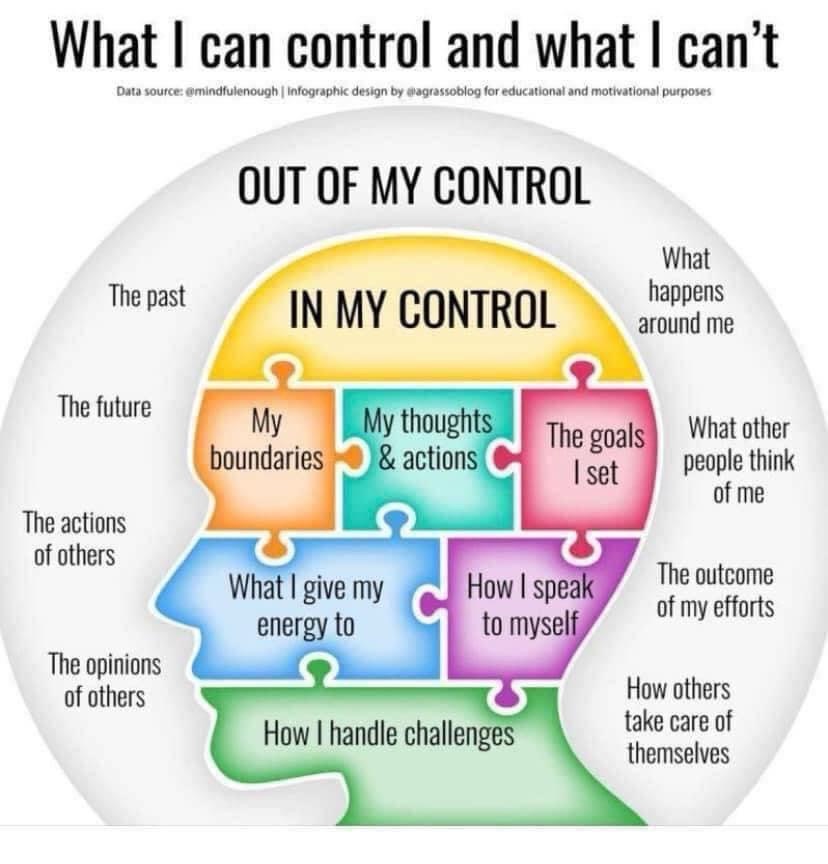
One thing to keep in mind is to focus our attention and efforts on the things over which we have control.

Consider this graphic:

Try to let the things in the gray area consume less of your time and attention, focusing on what is in your control. It can be frustrating, no doubt, but therein lies our sanity in crazy times.

Remember the puggle.

Black white. Up down. Left right. In out. We are a people who love to categorize. Categories simplify things and help us to sort out our place in the world.

But then there’s that puggle, a baby platypus. Classified as a mammal but laying eggs with a duck-like bill, aquatic, poisonous. No wonder the platypus astounded the scientific community when it was first discovered in 1799. Indeed, the skin of the first platypus discovered, preserved in the British museum of Natural History, still bears the marks made by the curator at the time who tried to pry off the bill, convinced the creature was a fake.

The puggle doesn’t categorize easily.

While categorizing can be helpful, it can also be limiting if we fail to see outside the norms and lines we draw. And when it comes to humans, where do we draw the lines? We humans are nearly impossible to sort into classifications because we have so many unique characteristics. Categorizing might even keep us from looking for and seeing the individuals behind the label.

We can find differences and commonalities among any group of people.

We are all puggles.

An open house for emotions

This has been a week of extreme emotions for me. When I try to think of a metaphor for that, it’s tough because the emotions varied so much. Weather, maybe? Tornados to still winds, gentle rains to pounding storms, beating sun to numbing cold.

And then I remembered this poem by Rumi. I am not my emotions, though they might overwhelm me. Consider the emotions as visitors, and myself a guest house where a crowd of sorrows may enter and take up some space for a while before they pack their bags and move along.

The Guest House

by Jelalludin Rumi


This being human is a guest house.
Every morning a new arrival.
A joy, depression, a meanness,
some momentary awareness comes
as an unexpected visitor.
Welcome and entertain them all!
Even if they’re a crowd of sorrows,
who violently sweep your house
empty of its furniture,
still, treat each guest honorably.
He may be clearing you out
for some new delight.
The dark thought, the shame, the malice,
meet them at the door laughing,
and invite them in.
Be grateful for whoever comes,
because each has been sent
as a guide from beyond.

Looking closely.

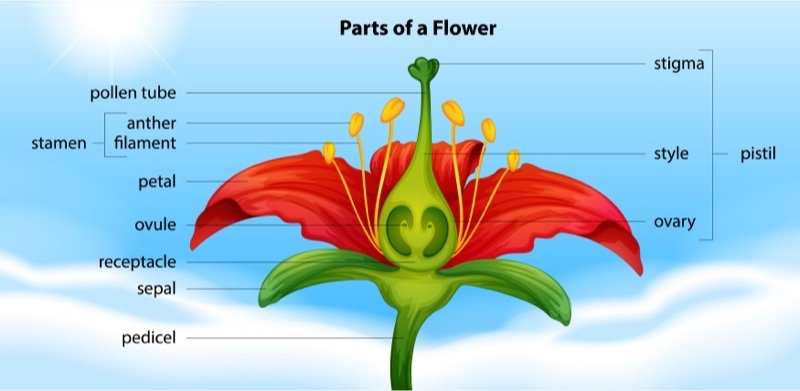
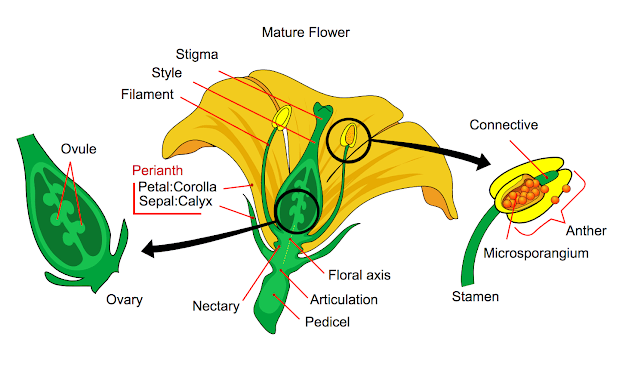
One of the lessons from my elementary school days that still stands out in memory was flower dissection day. I was astonished with the intricacy in a flower. Where before I saw just a flower, now I saw intricate systems for reproduction, male and female organs, color and smell to attract pollinators, a whole interconnection of systems. And this was just what I could see with my naked eye. Later I would discover the microscopic diversity and complexity of plant life. But then as a little 8 year old girl, I was gobsmacked with the complexity of it all.

Isn’t it all miraculous?

These days I need to stop and remember to let my much older self still stand in awe of the complexities of life. The interconnectedness of creation in all its abundance, from the dung beetle pushing its treasured clomp up a hill backwards with its hind feet, to the elements swirling together in a once in a generation storm.

Standing in awe requires both decentering ourselves and paying attention, absorbing both the tiniest details and the grand ones, and realizing our small place in the midst of it all. And even we humans are an amazing complexity of systems and organisms functioning together to keep us alive, made up of around 30 trillion human cells, and 39 trillion non-human microbial cells living on and in us. Our own body is essentially made up of many separate ecosystems. It is staggering.

I love being gobsmacked.

Praying our way into gratitude.

There are as many ways to pray as there are people praying. But what is it, exactly? Maybe it’s easier to answer what it isn’t: a flamboyant show, a chance to pose and preen publicly, a subterfuge, a droning recitation of memorized but not considered words.

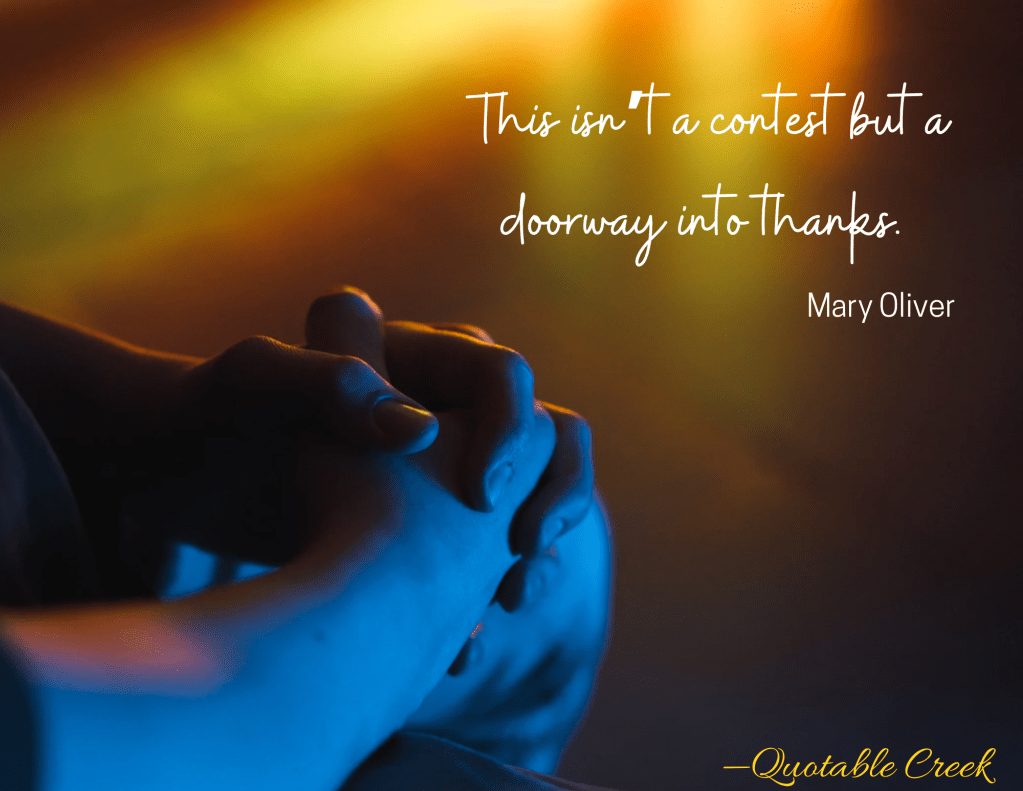
What prayer actually is, though, is more complicated: a bridge between ourselves and the mysterious, a chance to become small, and yet fully individual, in a vastness, an experience of awe. Mary Oliver’s definition above in her poem Praying is lovely: a doorway into thanks. Consider the whole poem:

Praying

It doesn’t have to be

The blue iris, it could be

Weeds in a vacant lot, or a few

Small stones; just

Pay attention, then patch

A few words together and don’t try

To make them elaborate,

This isn’t a contest but the doorway

Into thanks, and a silence in

Which another voice may speak.

Pay attention; see the beauty around you; give thanks. Rinse and repeat.