Kind words now

In The Adventure of Tom Sawyer, Tom and Huck attend their own funeral, overhearing all the nice things the town members had to say about them, the kinds of things they rarely heard in life.

As the service proceeded, the clergyman drew such pictures of the graces, the winning ways, and the rare promise of the lost lads that every soul there, thinking he recognized these pictures, felt a pang in remembering that he had persistently blinded himself to them always before, and had as persistently seen only faults and flaws in the poor boys. The minister related many a touching incident in the lives of the departed, too, which illustrated their sweet, generous natures, and the people could easily see, now, how noble and beautiful those episodes were, and remembered with grief that at the time they occurred they had seemed rank rascalities, well deserving of the cowhide. The congregation became more and more moved, as the pathetic tale went on, till at last the whole company broke down and joined the weeping mourners in a chorus of anguished sobs, the preacher himself giving way to his feelings, and crying in the pulpit.

There was a rustle in the gallery, which nobody noticed; a moment later the church door creaked; the minister raised his streaming eyes above his handkerchief, and stood transfixed! First one and then another pair of eyes followed the minister’s, and then almost with one impulse the congregation rose and stared while the three dead boys came marching up the aisle, Tom in the lead, Joe next, and Huck, a ruin of drooping rags, sneaking sheepishly in the rear! They had been hid in the unused gallery listening to their own funeral sermon!

Aunt Polly, Mary, and the Harpers threw themselves upon their restored ones, smothered them with kisses and poured out thanksgivings, while poor Huck stood abashed and uncomfortable, not knowing exactly what to do or where to hide from so many unwelcoming eyes. He wavered, and started to slink away, but Tom seized him and said:

“Aunt Polly, it ain’t fair. Somebody’s got to be glad to see Huck.”

“And so they shall. I’m glad to see him, poor motherless thing!” And the loving attentions Aunt Polly lavished upon him were the one thing capable of making him more uncomfortable than he was before.

Suddenly the minister shouted at the top of his voice: “Praise God from whom all blessings flow — Sing! — and put your hearts in it!”

And they did. Old Hundred swelled up with a triumphant burst, and while it shook the rafters Tom Sawyer the Pirate looked around upon the envying juveniles about him and confessed in his heart that this was the proudest moment of his life.

The Adventures of Tom Sawyer, by Mark Twain

I wonder why we save the kind words for funerals. Eulogies, literally translated ‘good words’, are maybe needed even more before our loved ones pass, at a time when relationships can be mended and people thanked. Before opportunities are lost. When the ripple effects from the kindness can travel far and wide.

What kinds of things get in the way of saying the kind words now? Fear, stubbornness, pride, anger? What if we could lay these all down now, before our opportunity to be heard is gone?
Good tidings

Before his crucifixion, Jesus told his disciples: “Peace I leave with you; my peace I give you. I do not give to you as the world gives. Do not let your hearts be troubled and do not be afraid.” (John 14:27.)

Today, as we celebrate Easter, remember his words and his sacrifice. For a lovely story and song in the Easter spirit, go here:

Grace is upon us
Open your heart
It is done

Grace is upon us
Open your heart
This is love,

The Lord is here
This is love

Come to the highest point of the mountain
At the earliest possible moment

With appreciation to MovedByLove.com, consider this beautiful parable of a saint:

The story of the Holy Shadow 
Osho

There once lived a saint so good that the angels came from heaven to see how a man could be so godly. This saint went about his daily life diffusing virtue as the stars diffuse light and the flowers scent, without being aware of it. His day could be summed up by two words — he gave, he forgave — yet these words never passed his lips. They were expressed in his ready smile, his kindness, forbearance, and charity.

The angels said to God, “Lord, grant him the gift of miracles.”

God replied, “Ask what it is that he wishes.”

They said to the saint, “Would you like the touch of your hands to heal the sick?”

“No,” answered the saint. “I would rather God do that.”

“Would you like to convert guilty souls and bring back wandering hearts to the right path?”

“No, that is the angels’ mission. It is not for me to convert.”

“Would you like to become a model of patience, attracting men by the luster of your virtues, and thus glorifying God?”

“No,” replied the saint. “If men should be attracted to me, they would become estranged from God.” “What is it that you desire, then?” asked the angels.

“What can I wish for?” asked the saint smiling. “That God gives me his grace; with that would I not have everything?”

The angels said, “You must ask for a miracle, or one will be forced upon you.”

“Very well,” said the saint. “That I may do a great deal of good without ever knowing it.”

The angels were perplexed. They took counsel and resolved upon the following plan: every time the saint’s shadow fell behind him or to either side, so that he could not see it, it would have the power to cure disease, soothe pain, and comfort sorrow.

When the saint walked along, his shadow, thrown on the ground on either side or behind him, made arid paths green, caused withered plants to bloom, gave clear water to dried-up brooks, fresh color to pale children, and joy to unhappy men and women.

The saint simply went about his daily life diffusing virtue as the stars diffuse light and the flowers scent, without being aware of it. The people, respecting his humility, followed him silently, never speaking to him about his miracles. Soon they even forgot his name, and called him “The Holy Shadow.”

This is the ultimate: one has to become the holy shadow, just a shadow of God. This is the greatest revolution that can happen to a human being: the transfer of the center. You are no longer your own center; God becomes your center. You live like his shadow. You are not powerful, because you don’t have any center to be powerful. You are not virtuous; you don’t have any center to be virtuous. You are not even religious; you don’t have any center to be religious. You are simply not, a tremendous emptiness, with no barriers and blocks, so the divine can flow through you unhindered, uninterpreted, untouched — so the divine can flow through you as he is, not as you would like him to be. He does not pass through your center — there is none. The center is lost.

This is the meaning of this sutra: that finally you have to sacrifice your center so you cannot think in terms of the ego again, you cannot utter “I,” to annihilate yourself utterly, to erase yourself utterly. Nothing belongs to you; on the contrary, you belong to God. You become a holy shadow. 

Happy Easter!

Spring yet?

Spring can be sneaky. Just when you feel that winter will last forever, a pop of green will peak out of the snow, or a leafless tree will bud, or a bird will sing, and you will remember the colorful, fragrant, joyful days of spring.

Inside every winter heart, a vibrant spring lies just waiting to bloom again.

Shining light

In all the din, what is one voice more? Why bother speaking up? No one seems to listen to each other anymore anyway.

But inside you is a well spring, and you’re fueled by truth and an honest desire to help others. Your opinion matters.

Consider these words from Marianne Williamson:

“Our deepest fear is not that we are inadequate. Our deepest fear is that we are powerful beyond measure. It is our light, not our darkness that most frightens us. We ask ourselves, ‘Who am I to be brilliant, gorgeous, talented, fabulous?’ Actually, who are you not to be? You are a child of God. Your playing small does not serve the world. There is nothing enlightened about shrinking so that other people won’t feel insecure around you. We are all meant to shine, as children do. We were born to make manifest the glory of God that is within us. It’s not just in some of us; it’s in everyone. And as we let our own light shine, we unconsciously give other people permission to do the same. As we are liberated from our own fear, our presence automatically liberates others.”

Who are you to speak up?

You are a child of God. Let God’s light shine on a dark world through your words.

Joy in the journey.

Sometimes our eyes and hearts are focussed so far in the distance, that we fail to see what is right in front of us. The people we spend our days with, the beauty surrounding us, the opportunities we have to make a difference. When we zoom in to the detail, the richness of the particular moment can be astounding and surprising. What a beautiful, remarkable world we live in. So full of complexity. Each person we see is as full of contradictions and surprises as we are ourselves. Each living or created thing we see is so full of detail.

Long-term goals are great, but what a shame if we don’t appreciate each step along the way. We may work side by side with someone but barely know their name let alone what their hopes and dreams are. We may be so busy moving forward that we are blind to the heartache of even the people we live with. It is easy to speed through life with eyes averted like people descending in an elevator focussed only on the floor numbers.

Today take time today to enjoy the journey, the mysteries unfolding all around you, the people who share your path, and all the beautiful and startling things right here, right now.

Like, for example, who can not stop and be amazed at this little beagle shaking its jowls, its great ears flopping to the beat, its sturdy paws holding on in front but shifting with its wagging tail in back, the gorgeous landscape behind it? What a fascinating little miracle, right here. Just this.

Kind through and through

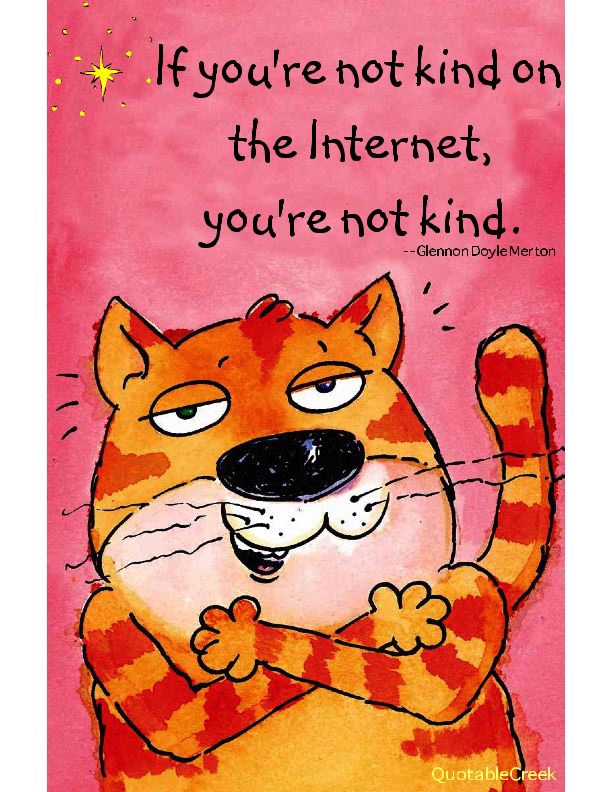
How do you behave when you can be completely anonymous? The internet can shield us from face-to-face contact, and for many people that can lead to snark….or worse. As Glennon Doyle points out, the internet itself is neutral. We bring to it what we are. We get out of it what we seek:

The internet is neither good nor bad. It’s neutral—it becomes for each of us exactly what we bring to it. In our real life and our internet life, we live inside whatever we build. Since we are spending more and more of our lives online, our internet selves must be decent, courageous healers so we can inhabit communities of tolerance and humanity.

Here are a few gut checks:

1. Remember, you are what you post.
Integrity means there is not a real-life you and an internet you. The two are one and the same. If you’re not kind on the internet, you’re not kind.

2. Post with intention.
Before you hit send, ask yourself: Why am I sharing this picture, meme, idea, article? Is your true motivation to spread joy, encourage, enlighten, teach? Or is it to brag? To shame someone? If your intention is pure, then the response will be, too.

3. Dispense compassion.
When people express opinions that differ from yours, take it as a chance to grow. Seek to understand over being understood. Be curious, not defensive. The only way to disarm another human being is by listening.

For those of us with Facebook feeds who follow sites other than just friends and family, we can choose whether we follow fake news or hateful sites. Instead, we can choose sites that help expand our knowledge and compassion. Our feeds are like gardens we can choose how to plant.

And we always have a choice of whether we want to pass on snark, or hate, or false information, or sarcasm. Whether we want to pile on a mob mentality of attack and destruction.

We can choose to make our responses to other people’s posts measured and kind, to rely on facts rather than innuendo, and to simply not respond. We can help build the type of world we want to see, right here on the internet.

Breathe in this new day.

When we lose our way or feel overwhelmed, we can return to nature and be renewed. Hear the birds singing their spring song. Watch them collect twigs and bits for their nests. See the long grass ripple in a gentle wind like ocean waves. Breathe in the sweet earthy fragrance of the morning. Feel small and surrounded by an amazing, complicated system that has been pulsating with life for millions of years. That awe is good for us:

“It has long been established that a healthy diet and lots of sleep and exercise bolster the body’s defenses against physical and mental illnesses. But the new study, whose findings were just published in the journal Emotion, is one of the first to look at the role of positive emotions in that arsenal.

“That awe, wonder, and beauty promote healthier levels of cytokines suggests that the things we do to experience these emotions—a walk in nature, losing oneself in music, beholding art—has a direct influence upon health and life expectancy,” says UC Berkeley psychologist Dacher Keltner, a coauthor of the study.” 

Breathe in the day, full of life and possibility. Breathe out the stress, the worry, the defeat. In. Out. In. Out. In.

Hurting words.

I’m a huge Ted Lasso fan. When an episode ends, I actually groan. This week was a powerful demonstration of how important words are, how the things we say can impact a person for years (for good or bad), and how important genuine, heart-felt communication is to heal old wounds.

Here is the bit I mean. < spoilers>

Tough guy Roy Kent was hurt by the blunt criticism of his skills written in an article by reporter Trent Crimm from Roy’s first game when Roy was just 17. Roy still carries the article around in his wallet decades later.

Do you have any words like that that you’re still metaphorically carrying around years later? Perhaps we remember a mentor’s encouragement that sparked our interest or passion in a chosen career. Perhaps, sadly, we still struggle under the weight of words by someone who condemned us at our worst, saw as as inadequate or a failure. someone who felt we would never measure up.

Words have heft to weigh us down or sustain us. We need to remember that when we choose ours.

How to organize.

My daughter recently organized her library, not by any of the more common methods of organizing books—genre, audience, age, author last name, — but by color of the cover. I must say, this startled me. It upset my Dewey-decimal apple cart. But look how lovely it is!

I have always focused on organization, both as a lawyer and, now, as an author. It is so vital to figure out your system for how something is to be done. How to organize the information in the most compelling way. Generally, for instance, an appellate brief is organized chronologically, but often that isn’t the most persuasive way. Some testimony needs to be highlighted, some evidence footnoted. And so on. The organization of the brief is a hidden layer adding content. The same is true for stories, sometimes jumbling the timeline or telling things from multiple points of view adds layers and juxtapositions you simply couldn’t get in any other way.

Or, for that matter, consider organizing socks. As a little girl I tried out organizing my socks from white to black with all the colors in the middle in a lovely spectrum (she is my daughter!) but then realized that wasn’t as efficient as organizing them for their intended use—play, school, dress, etc. I’ve had similar questions in my closet. What goes with what? How should things be ordered? Currently my blouses and tops are organized from sleeveless to long-sleeved. But color would certainly be fun, or seasons, or play to formal. The possibilities are endless. But this brings me somewhat round about to my point.

Everything is organized, and we need to pay attention to how.

Consider a grocery store with the popular items at eye level and the tempting items at check out. Or the casino, windowless and clockless to encourage extended gambling. Or a library? What goes in fiction/non-fiction? Is that line ever blurry? Or the church: how would you organize a church? Where should the focus be? How, or do, you make it welcoming? Or a city? Is there a right and wrong side of the tracks? Why?

These kind of questions keep us sharp and open, more able to see when systems aren’t working or when the organization of a thing is manipulating us. And taking things and jumbling up the order, like sorting books by color rather than content, let’s us see with fresh eyes and catch new and interesting juxtapositions, and challenge the very systems we use for categorizing what’s in or out.

Most this amazing day.

There are some poems that reach so deep, they become part of us that we can call up by heart. This is one for me, ‘I thank you God for most this amazing day’ is a phrase never far from my mind. Something about the inverted syntax seems to sum up that overwhelm, spilling over feeling of joy at creation, at being here in it, at the amazing miracle of it all.

Enjoy the whole poem. It’s spectacular.

i thank You God for most this amazing
day:for the leaping greenly spirits of trees
and a blue true dream of sky;and for everything
which is natural which is infinite which is yes

(i who have died am alive again today
and this is the sun’s birthday;this is the birth
day of life and of love and wings;and of the gay
great happening illimitably earth)

how should tasting touching hearing seeing
breathing any—lifted from the no
of all nothing—human merely being
doubt unimaginable You?

(now the ears of my ears awake and
now the eyes of my eyes are opened)

e.e. cummings

And for a real treat, here it is sung:

Happy spring!