Do you have any disagreeable people in your life? People you avoid, maybe?
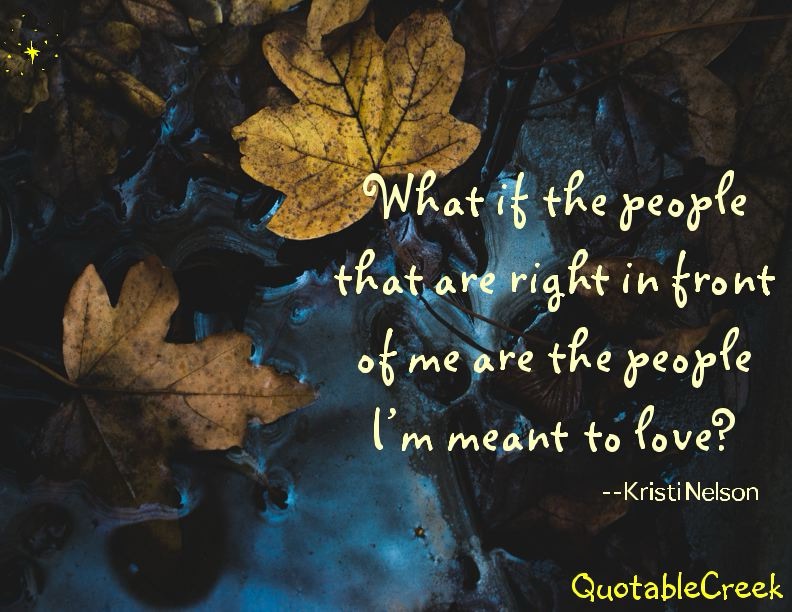
What if they are the ones who need love the most?
Most teachers will tell you that the child who acts out is the one most in need of love and attention. but those kids have learned to ask for it in all the wrong ways. And those children grow up, sometimes into disagreeable adults who still ask for love and attention in all the wrong ways. Maybe they have been disappointed so many times, they’ve learned to strike first, to reject you before you reject them.
Do you know anyone like that?
It’s no particular challenge to love the people who love us. But the ones who rile us, who ruffle our feathers, who are caustic and rude? That takes some serious patience and humility. But, perhaps, that is a place you are desperately needed.
In this age of technology and instant gratification, sometimes we forget the simple pleasures. Like meandering, and chatting people up, and pausing to soak it all in. Kurt Vonnegut used to like to walk into town for a single envelope when he had something to mail, ignoring his wife’s argument that he could buy more than one envelope at a time.
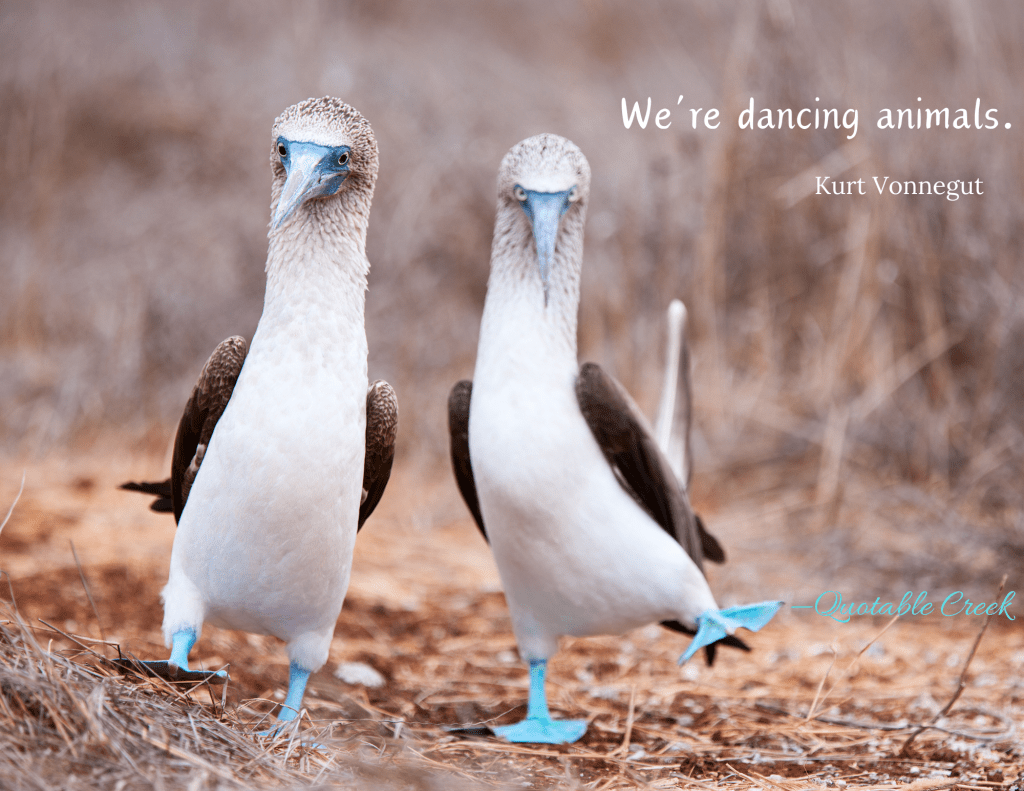
Vonnegut responds, “…And so I pretend not to hear her. And go out to get an envelope because I’m going to have a hell of a good time in the process of buying one envelope. I meet a lot of people. And see some great looking babies. And a fire engine goes by. And I give them the thumbs up. And I’ll ask a woman what kind of dog that is. And, and I don’t know. The moral of the story is – we’re here on Earth to fart around. And, of course, the computers will do us out of that. And what the computer people don’t realize, or they don’t care, is we’re dancing animals. You know, we love to move around. And it’s like we’re not supposed to dance at all anymore.”
Of course, an author depends on immersing themself in the midst of living, noticing details, trying to hold on to it all long enough to capture it in words. But don’t we all benefit from farting around and noticing the little things? Kind of like writing ‘I was here’ in graffiti. We’re here. This is our now.
Today, in the United States, we vote. We celebrate a country that allows its citizens input into this remarkable experiment of a government of the people, by the people, and for the people.
We honor this country and its principles of equality, freedom, and justice for all. Our understanding of those concepts has evolved over time, and taken some steps back, but today let us be grateful for how far we’ve come and consider the steps that we each might take today and every day to make this country move closer to the ideals for which it stands. It is both a privilege and a responsibility to vote.
Reading history is one of the best ways ironically to really enter the present. As James Baldwin says:
One must say Yes to life and embrace it whenever it is found — and it is found in terrible places; nevertheless, there it is. For nothing is fixed, forever and forever and forever, it is not fixed; the earth is always shifting, the light is always changing, the sea does not cease to grind down rock. Generations do not cease to be born, and we are responsible to them because we are the only witnesses they have. The sea rises, the light fails, lovers cling to each other, and children cling to us. The moment we cease to hold each other, the moment we break faith with one another, the sea engulfs us and the light goes out. ~James Baldwin
We look at our past and see people making their ways, making mistakes, celebrating triumphs, struggling but then getting back up. And this is true during objectively awful times of war or suffering as well as in more relatively peaceful times. People go on. They find a way to come together, to survive, to do better.
I wonder what historians will say fifty years from now about the times we are in right now. Will they point to the divisions between us or the attempts to heal and grow. Will they see in us the grit and forbearance we can recognize in our ancestors?
Of all the compliments you could receive, perhaps the best is that you feel like shelter. That, in all the storms and chaos that swirl around us, talking to you feels like safety. Not in the sense of being a yes man or echo chamber, or even in the sense of being able to do anything to stop the storm, but in the sense of home.
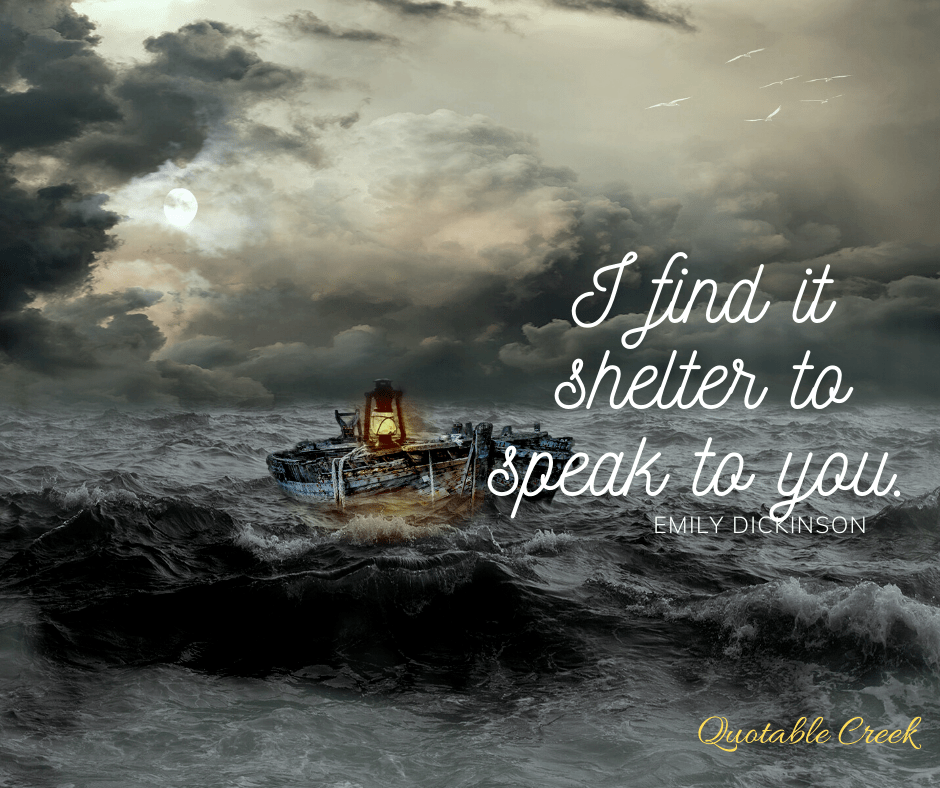
“I find it shelter when I speak to you,” says Emily Dickinson. What might we do and say to make someone feel that way? Shelter implies that the storm is still swirling, the elements are still fierce, but talking to you is a respite from that and an entry into something welcoming and safe. A place where you are known, and heard, and cared for. A place of comfort.
Certainly there are plenty of people making themselves someone’s storm. Wouldn’t it be wonderful to be someone’s shelter instead?
What can you do in this increasingly chaotic and exhausting world for someone to find it shelter when they talk with you?
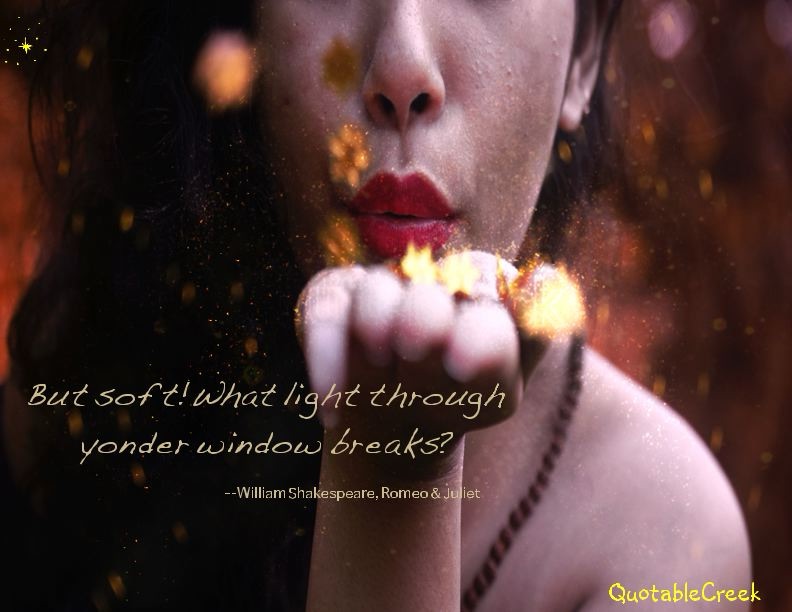
Are there any more beautiful words in English literature than these: “But soft! What light through yonder window breaks?”
These are Romeo’s words when he gazes at Juliet above on the balcony, but what if we were to bring these words into our everyday encounters?
But soft! Listen to the hush here, the rapt attention, all of his focus on her, just her. What if we were to whisper these words to ourselves before we talk with someone? But soft! The world fades, the focus sharpens, all of our attention is on that person. But soft! reminds us not just to be calm and attentive, but also to be gentle and reverent. Wouldn’t any conversation shift if it were preceded by such a lovely call to silence? Wouldn’t But soft! be a perfect pairing of words to bring back into common usage?
“What light through yonder window breaks?” Again, what if we were to look at each other this way? As light, as beings capable of making the world a brighter place. Even those with much of darkness about them have an inner light, a spark of good. What if we were to ignore the dark and focus on the light in each other? What a compliment it is to be called a light! Wouldn’t someone noticing our light make each of us want to shine ever more brightly? And wouldn’t that, accordingly, make the world an ever brighter place?
I’m listening, world. What do you have to teach me? Where should my attention be, to understand and, finally, get it, the great purpose and plan of it all?
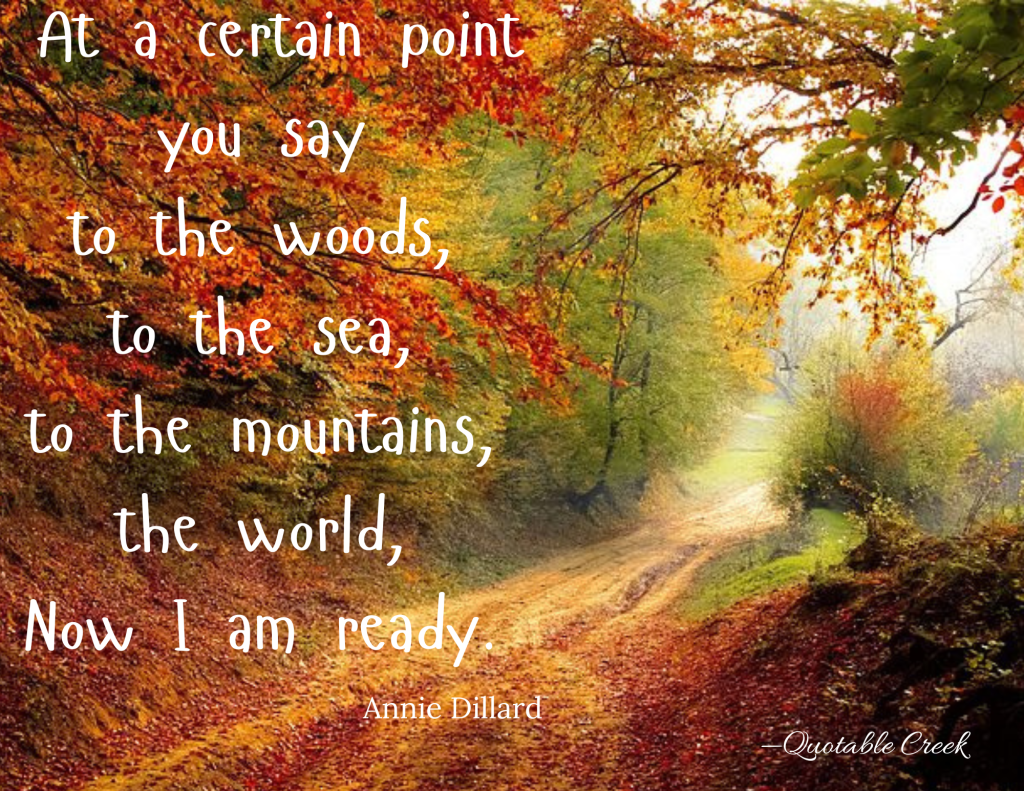
Annie Dillard, in Teaching a Stone to Talk writes:
At a certain point, you say to the woods, to the sea, to the mountains, the world, Now I am ready. Now I will stop and be wholly attentive. You empty yourself and wait, listening. After a time you hear it: there is nothing there. There is nothing but those things only, those created objects, discrete, growing or holding, or swaying, being rained on or raining, held, flooding or ebbing, standing, or spread. You feel the world’s word as a tension, a hum, a single chorused note everywhere the same. This is it: this hum is the silence. Nature does utter a peep – just this one. The birds and insects, the meadows and swamps and rivers and stones and mountains and clouds: they all do it; they all don’t do it. There is a vibrancy to the silence, a suppression, as if someone were gagging the world. But you wait, you give your life’s length to listening, and nothing happens. The ice rolls up, the ice rolls back, and still that single note obtains. The tension, or lack of it, is intolerable. The silence is not actually suppression: instead, it is all there is.
And later:
The silence is all there is. It is the alpha and the omega. It is God’s brooding over the face of the waters; it is the blended note of ten thousand things, the whine of wings. You take a step in the right direction to pray into this silence, and even to address the prayer to ‘World.’ Distinctions blur. Quit your tents. Pray without ceasing.
Perhaps the aha moment isn’t in understanding as much as in being, a part within a vast whole, caught up in the mystery and the magnitude.
Sometimes you can lift out of a moment and say to yourself, ‘This is a wonderful moment. I am so content.’ Everything has a new luster. And sometimes a song might come to mind.
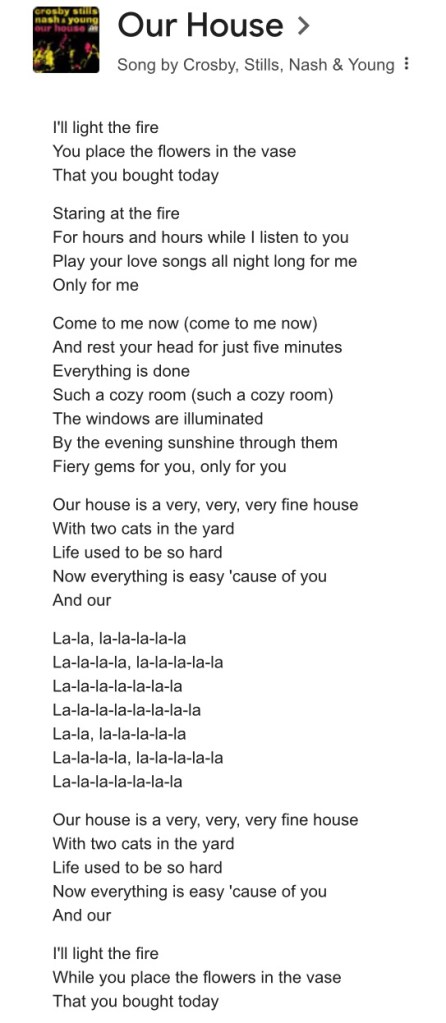
In my case, I was sitting with my husband, watching our two cats (pictured) and thinking about how homey everything felt. It brought to mind the CSNY song, ‘Our House’.
Here are the lyrics:
And, while we were sitting so inclined, my husband did a Google search about the song and learned that Graham Nash and Joni Mitchell had been shopping after dining at Art’s Deli, bought a vase, came back to her two cats, and lit the fire on a drizzly day. Nash sat at her piano and wrote this song in an hour. He must have been feeling what we felt. Content. Full.
How lovely he memorialized it for all of us to share.
There is an elephant in the room. We don’t talk about it, we try not to think about it, we pretend it doesn’t exist. That elephant is the fact that we are all on a one way journey through this life. Our time is limited. None of us knows in advance when our end of the journey will come, but that end will come.
When we pull ourselves out of denial and gaze directly at this elephant, we can realize something important: our opportunities should be seized now. That good we can do? Don’t put it off. That kind word? Say it. That gift or remembrance? Give it now.
We will not have this place and time and opportunity to make a difference again.
None of us knows what the future holds. But we do know the values we hold dear—honesty, integrity, love, compassion, empathy, respect, tolerance. As we raise our children, we instill these values. As adults, we model these values whether we win or lose, succeed or fail, sink or swim. Watching us, they learn, and, as they go forward into their futures, they will bring these values to their own decisions. If each of us does this, we will leave the world a better brighter place for our having been here.