In a difficult and challenging place and time, we are called to continue the fight for what is right and good, true and just, honorable and compassionate. We push forward– listening more, caring more, giving more. We can drown out the din and listen to our hearts which strive for peace and harmony, communion, reconciliation. We must hold fast to our principles and to hope as our anchor, especially now.
A guy cuts you off in traffic. How do you see him? Is he an inconsiderate lout caring little for the aggravation he causes you or a distracted hapless soul, perhaps late for an emergency? How we see this situation, or any situation, can have a profound effect on our lives.
In this thoughtful essay, Elizabeth Gilbert considers the power of perception. She recounts a time when her father and his siblings were reminiscing about their late mother and how she used to take a sip from any glass of milk she poured for them. They agreed on the fact, that she took a sip, but wildly disagreed on their perception of that fact:
At one point, they found themselves sitting around the old kitchen table, eating sandwiches and talking about the past. My uncle, the baby of the family, looked at the refrigerator and said, “I can still see Mom standing there, pouring me a glass of milk. Do you remember that sweet thing she always used to do whenever she got us a glass of milk? Remember how she’d take a tiny sip first, to make sure it wasn’t spoiled? Always looking out for us.”
My father, the analytical engineer of the family, raised his eyebrows. “No,” he said. “You are so wrong. Mom wasn’t sipping our milk to test it for freshness. She was sipping our milk because she always overfilled the glass. She had no sense of spatial relations. It used to drive me crazy.”
My brilliantly sardonic aunt looked at her two brothers like they were the biggest idiots she’d ever seen.
“You’re both wrong,” she said. “Mom was stealing our damn milk.”
So, what have we learned about my grandmother from this story? Was she a devoted caregiver, an incompetent dunderhead or someone who would steal the milk out of the mouths of her children? (Or maybe just an exceptionally thirsty woman.) The world will never know the truth.
But does the truth really matter?
I don’t think so.
Wow! What a remarkable difference in what each brings to the encounter. Now imagine yourself in each of those mindsets: hostile, critical, or grateful. Which would lead to the happier life?
We don’t have control over facts, but we sure have a tremendous amount of control over how we perceive those facts. We owe it to ourselves to try to see the facts in the most favorable light even if that means consciously going over all the possible interpretations of something and actively selecting the best one to pick.
These days it feels a bit like we are bombarded by news, so overwhelming in scope as to cloud out the sun. Overwhelm is on the menu. And joy can feel like an exotic indulgence. And yet, choosing joy can be an act of resistance.
As Maria Popova notes, drawing on her experience in writing The Marginalian:
14. Choose joy. Choose it like a child chooses the shoe to put on the right foot, the crayon to paint a sky. Choose it at first consciously, effortfully, pressing against the weight of a world heavy with reasons for sorrow, restless with need for action. Feel the sorrow, take the action, but keep pressing the weight of joy against it all, until it becomes mindless, automated, like gravity pulling the stream down its course; until it becomes an inner law of nature. If Viktor Frankl can exclaim “yes to life, in spite of everything!” — and what an everything he lived through — then so can any one of us amid the rubble of our plans, so trifling by comparison. Joy is not a function of a life free of friction and frustration, but a function of focus — an inner elevation by the fulcrum of choice. So often, it is a matter of attending to what Hermann Hesse called, as the world was about to come unworlded by its first global war, “the little joys”; so often, those are the slender threads of which we weave the lifeline that saves us.
Delight in the age-salted man on the street corner waiting for the light to change, his age-salted dog beside him, each inclined toward the other with the angular subtlety of absolute devotion.
Delight in the little girl zooming past you on her little bicycle, this fierce emissary of the future, rainbow tassels waving from her handlebars and a hundred beaded braids spilling from her golden helmet.
Delight in the snail taking an afternoon to traverse the abyssal crack in the sidewalk for the sake of pasturing on a single blade of grass.
Delight in the tiny new leaf, so shy and so shamelessly lush, unfurling from the crooked stem of the parched geranium.
I think often of this verse from Jane Hirshfield’s splendid poem “The Weighing”:
So few grains of happiness
measured against all the dark
and still the scales balance.
Yes, except we furnish both the grains and the scales. I alone can weigh the blue of my sky, you of yours.
Pausing to notice and delight in these little moments can counterbalance the great and pressing weight of darkness. It is from each of these moments, we draw value and solace, hope and strength.
And we persevere, weaving the ‘slender threads’ of the lifelines that save us.
Speaking to graduating law students, Julian Aguon said
No offering is too small. No stone unneeded. All of us – whether we choose to become human rights lawyers or corporate counsel, or choose never to practice law at all but instead become professors or entrepreneurs or disappear anonymous among the poor or stay at home and raise bright, delicious children – all of us, without exception, are qualified to participate in the rescue of the world.
And this is true for any profession, calling, or vocation. We each matter. We each contribute to the mix. We each are qualified to rescue this world.
In any time in history, including our own in which we now find ourselves, some individuals stand apart from the crowd on behalf of what is right. Their example inspires others from that moment forward in time.
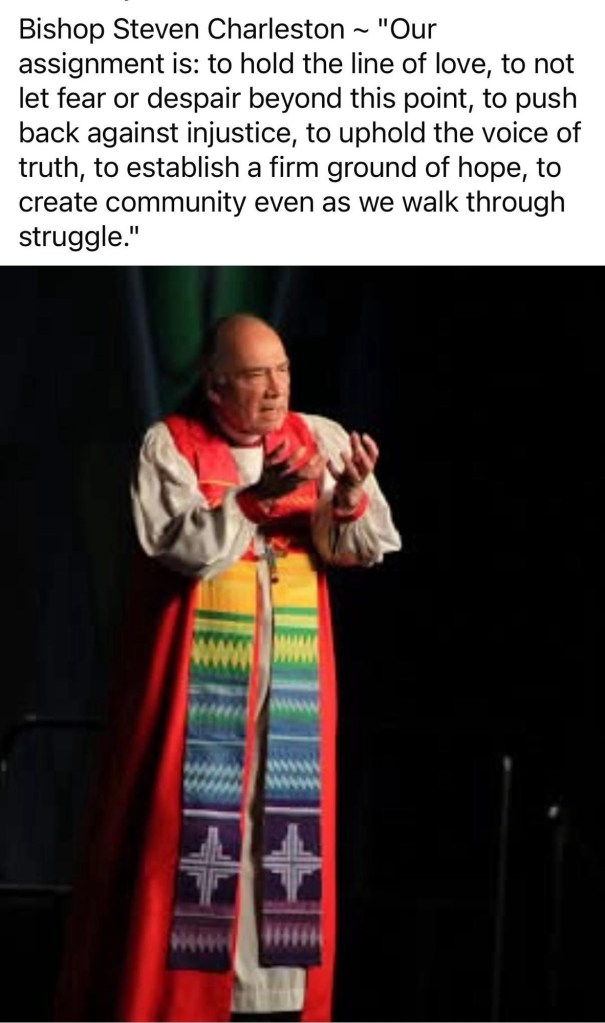
What is our job in these troubled times? During any times, but particularly during times where we are seeing peoples’ rights eroded and trampled, when legal safeguards are flouted, and when authoritarianism is on the rise, our job is to hold the line. Continue to be a place of comfort and succor to the hurting, feed the hungry, grieve with the mourning.
The Japanese Macaques, snow monkeys, are a deeply hierarchical society, their status in the group inherited from their mothers. Living in frigid temperatures, the upper class snow monkeys spend their time in natural hot springs, leaving the rest to huddle in the snow and look on as they luxuriate. The Emperor Penguins also live in frigid conditions, huddled together, but they constantly rotate, letting those most exposed on the outside come to the center for warmth. They take turns. It keeps those in the center from overheating and those on the fringes from freezing.
Sharing is an interesting phenomenon. It’s easy to see that when a society shares its resources, the whole group benefits, but how does that play out in the human species? Do we see the benefit to the whole group from sharing what we have, or do we focus on clutching more and more into our own fists? Some humans are uniquely able, it seems, to rationalize selfish behavior even when looking directly at the needs of others. But others consider their own resources an opportunity to help others. This is true both on an individual level, and on a larger societal level. It’s an interesting matter of perspective.
Friendships are taking a hit these days. Politics, world views, differing opinions are tearing people apart.
What is it that holds people together instead?
One thing is an abiding concern for the other person, despite your differences. If you can advocate against the death penalty on behalf of a stranger, couldn’t you bring yourself to see what is good and redeemable inside a former friend? Inside an enemy even? Searching for common ground is hard work, but really the main point of living in community. Isn’t it?
Have you ever wondered why everything is so beautiful? Have you stood rapt in the brilliant colors of a sunset, or listening to birdsong in the morning, or watching the way a caterpillar humps along with all its little feet working together? Perhaps there are logical, book smart reasons, like flowers are beautiful to attract bees, or animals are beautiful to attract mates or to warn predators they’re toxic, or some such thing, but don’t those answers beg the question really? Why is beauty? Could the answer be that it is to inspire awe in us? And our job is to notice.
A master violinist can play Bach on a precious instrument, and most people will just walk by:
We are living in a place filled with beauty if we only stop to notice. For inspiration, consider Mary Oliver’s poem, The Summer Day:
The Summer Day
Who made the world?
Who made the swan, and the black bear?
Who made the grasshopper?
This grasshopper, I mean-
the one who has flung herself out of the grass,
the one who is eating sugar out of my hand,
who is moving her jaws back and forth instead of up and down-
who is gazing around with her enormous and complicated eyes.
Now she lifts her pale forearms and thoroughly washes her face.
Now she snaps her wings open, and floats away.
I don't know exactly what a prayer is.
I do know how to pay attention, how to fall down
into the grass, how to kneel down in the grass,
how to be idle and blessed, how to stroll through the fields,
which is what I have been doing all day.
Tell me, what else should I have done?
Doesn't everything die at last, and too soon?
Tell me, what is it you plan to do
with your one wild and precious life?
What a gift we have been given to have the chance to notice the beauty all around us today!
I was recently reminded about a story from 2017 where two little boys were caught in a rip tide and swept out to sea. Their entire family and four woud-be rescuers tried to swim out to save them but ended up similarly stranded. Officials on shore stood, helpless, waiting for a rescue boat while the family and would-be rescuers floundered.
But then the people on the beach did a remarkable thing. People from all walks of life, across every possible difference or division, linked arms together and formed a human chain stretching out into the ocean until they reached those stuck and and then passed them person to person, beginning with the little boys, Noah (11) and Stephen (8), and ending with their grandmother who had tried to save them, back to safety.
Stories like this don’t get a lot of press. But it’s why we’re here.
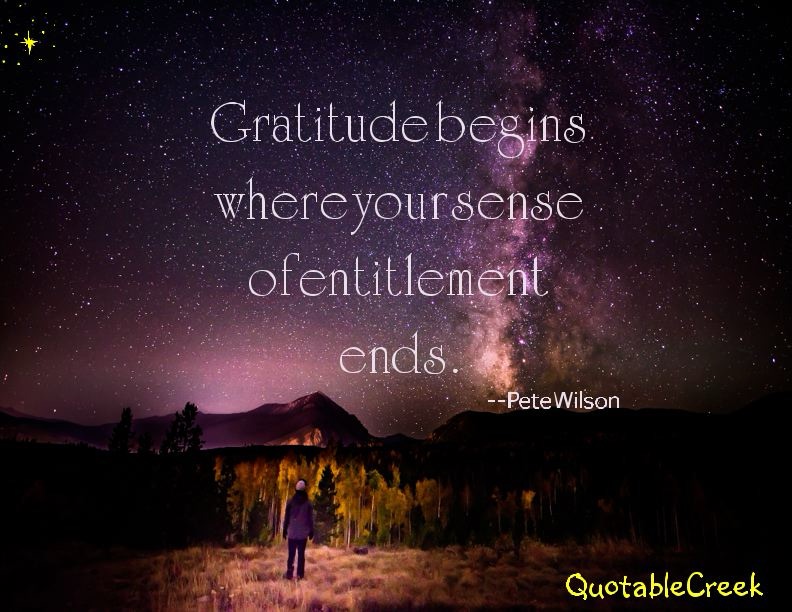
What do you feel entitled to? Your life, job, spouse, happiness, health, good weather? It’s remarkable how we can feel that we have earned our stations in life and are entitled to all the good things.
Until something happens to take it away.
A diagnosis, job loss, natural disaster, and then we realize we weren’t entitled to any of it after all. It was a gift, and we hadn’t been grateful.
Right now, I’m experiencing a bit of a health crisis that has me worried about my eyes and thinking about all the millions of things I love to see. My family, my garden, my cats, my friends, everything, really. What a miracle it is to see.
Maybe today is a good day to pause and think of all the things you love to see. Or hear. Or experience.
Think of all you have been blessed with and be grateful.


 QuotableCreek.com