A heartfelt apology can lead to reconciliation.

goodapology


Some apologies make things worse. They don’t feel like apologies at all. They feel, instead, like just more hurt. Other apologies acknowledge the wound and help it heal. What makes the difference?

In When Sorry Isn’t Enough: Making Things Right with Those You Love, Gary Chapman (of Five Love Languages fame) and Jennifer Thomas suggest that a true apology must have six characteristics:

Expressing regret–It’s important for an apology to be for something you did or said.  The more specific, the more it acknowledges the harm caused, the better. “I’m sorry you’re so sensitive,” doesn’t really feel like an apology because it is just restating some perceived flaw in the victim and isn’t focussing on anything you did wrong. Even if the harm was wholly unintended, when your actions cause another person pain, an apology is warranted. It goes to the very essence of the apology: I did not mean to hurt you.

Accepting responsibility— Yes, the pressures of the world can sometimes lead us to get wound up and stressed and to hurt other people, but that does not make it the world’s fault. We control ourselves. We are responsible if we act badly. Blaming the boss, the dog, the economy, the other drivers is deflecting. Apologies for the state of the world or all its ills will not feel like a real apology to the person you lashed out at. Apologizing for losing your temper or not considering the effects of your actions will.

Making restitution–“How can I make it right?” are powerful words. It shows an acknowledgement that what you did caused someone else harm. Maybe you can’t make it right. Maybe you can never make it right. But listening to the victim explain the damage is a powerful step forward in the process. Listening here is key–no justifying your actions, no quarreling with the facts, no defenses, just listening to the other person share their perspective. If there is something you can do to make things better, do that thing.

Genuinely repenting–If you are truly sorry, and have listened deeply to the pain you’ve caused, you will not want to cause that person pain again. You will stop causing the damage. You will want to change. Maybe you will need to write down the steps you want to take to prevent causing further harm. Maybe you will slip up and need to start again. But the most important thing is that you will try to not do this again. Otherwise, are you really sorry?

Requesting Forgiveness–“Can you forgive me?” are powerful words. They show you care about the relationship. They show you understand you did things wrong. They show you are not in control of the relationship.

Everyone messes up. Not everyone takes responsibility for messing up. When we do take responsibility for the harm we’ve caused, it may strengthen our relationships and help them grow stronger. Trust can reenter, fostering healing.

Randy Pausch, the author of the quote above, gave a powerful Last Lecture before he died young of pancreatic cancer. His timeless words can teach us all a lesson about life and living.



Hope.

hope

Sunrise defeats night. The darkness will be driven away. When in the midst of the darkness, it may feel unending, but as day follows night, this, too, shall pass. The beauty of a sunrise is a lovely image to keep in mind when going through a problem. As sunrise defeats night, so hope conquers a problem. In times of great difficulty, we must hold on to hope that things will improve and that we can help.

Jane Goodall speaks to her hope for our future and, specifically, her hope in our youth in this moving speech.

She is right: if we don’t have hope, we give up, we do nothing. She says, “In this world of violence and fear, we must have hope for a better future.” That hope will sustain us and give us strength to solve the problems we face, as surely as day will follow night if we hold on.

Tickling the funny bone.

dogs

They comfort us, love us, trust us, understand us and make us laugh.We chuckle when they scratch at the door only to steal our seat when we get up to let them out. Sometimes their funny little ways can brighten our days. But what can we do to make them laugh? How can we amuse them? In a blast from the past, very young comic Steve Martin answers this question in a way that is sure to brighten your day.

Joy is joy is joy.

joyis

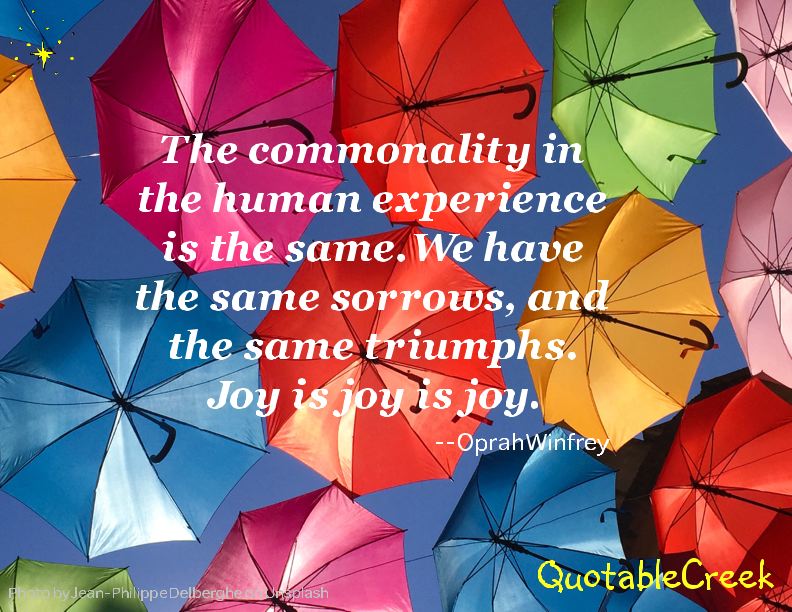
We all are finding our way home. The people we think are the most different from us are really on the same journey. We share this emotional experience that is life–the frustration of setbacks, the joy in birth and creation, the anguish of loss, the delight in discovering a twin soul. If there were some way to view our journeys superimposed on top of each other, so that we could see all the connections we have with each other, that would be a cool eye-opening experience. In the mean time, consider this video of all the different types of creatures using the same foot bridge.

Joy is joy is joy.

The anonymous gift.

angeldoor

There is something about an anonymous gift that brings special joy to both the giver and the receiver. For the person getting the gift, it makes you feel like the whole world cares, that around any corner is the person who cared enough to make your life special. And to the giver, it strips off all the status and pride and self-satisfaction you may get from a public gift and, with the lusciousness of a secret, fills you with love and gratitude that you are in a position to make a difference.

Consider this delightful story about a somewhat anonymous giver, call him George Walker, and his gift to a young boy in the Philippines.

“Dear Timothy, 
I want to be your new pen pal. 
I am an old man, 77 years old, but I love kids; and though we have not met I love you already.
I live in Texas – I will write you from time to time – Good Luck. G. Walker”

Now, after President Bush’s death, we have learned that he was George Walker, but look at how much joy is in his writing when it is semi-anonymous. He is embracing the true spirit of giving.

For more on anonymous giving, take a look at this feature I wrote on anonymous giving filled with inspiring stories.

What are some things you might do anonymously to spread your love?


Struggle.

struggle

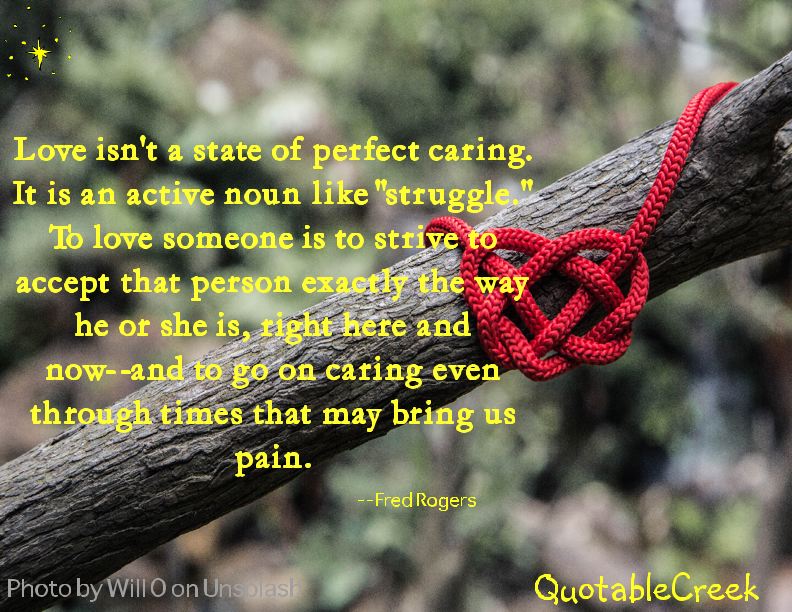
Love isn’t a feeling we fall in and out of. It’s an action we choose to take even when it may be challenging. Sometimes it brings pain. When we think of love as an active verb, like, as Mr. Rogers suggests above, ‘struggle’, rather than as an emotion, it opens our eyes to the fact that we must work at it. It’s a struggle, a constant readjustment and tinkering, constantly expanding our own understanding and empathy. Love is not molding someone to our vision of what they should be, but accepting who they are and supporting them as they blossom. Thinking of love as something more akin to struggle encourages us to keep looking for new and better ways to show up for the people in our lives, to view the relationships as evolving rather than static, and to appreciate all the little successes and breakthroughs in those relationships along the way.

Lighten up

groucho

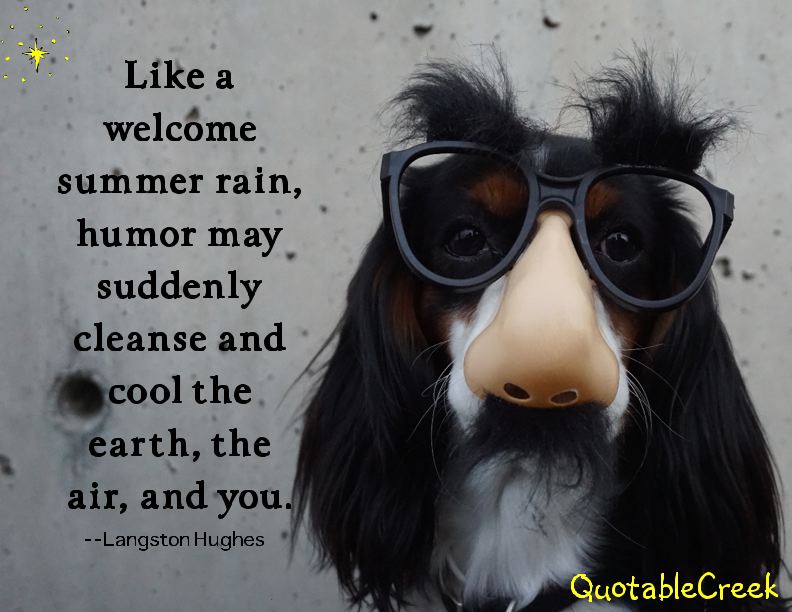
Heard a good joke lately? Watched a funny cat video perhaps? Maybe a picture of a spaniel in a Groucho mask?

Humor is always good for the heart and soul. It can even, maybe, cure what ails you. Dr Cynthia Thaik, a cardiologist, says:

An old Yiddish proverb says, “What soap is to the body, laughter is to the soul.” Everyone knows that laughter makes you feel good and puts you in high spirits, but did you also know that laughter actually causes physiological responses that protect the body from disease and help your vital organs repair themselves? A good laugh can be compared to a mild workout, as it exercises the muscles, gets the blood flowing, decreases blood pressure and stress hormones, improves sleep patterns and boosts the immune system. Furthermore, a study by the John Hopkins University Medical School showed that humor and laughter can also improve memory and mental performance. Yet despite the fact that laughter has so many benefits, far too many of us forget to even crack a smile every once in a while, let alone laugh.

She suggests some ways to lighten up with humor. Finding the humor in a bad situation can make it better. Mirth releases endorphins and is contagious, a twofer! Surrounding yourself with funny people or remembering funny incidents can lift your mood.

Take time to laugh today. If you need help finding your funny, consider this. Or you can always get a dog and put him in a Groucho mask.