Soul sharing

We were made to create. To shine. To share all the things that make us happy and bring us joy. Even, for that matter, the things that hurt and keep us up. Creativity allows our souls to sneak out of the shadows in our inner selves and dance with other brave souls. Creativity gives us the opportunity to touch others deep down where their real selves dwell. To commune. And that’s a very cool thing.

Cultivating gratitude

In this beautiful film set to the words of Brother David Steindhl-Rast, you can’t help but see much of what makes life good and affirming. What if we learn to appreciate each day as if it is our first day…and our last? What if we appreciate each miracle as it presents itself to us throughout the day…the miracle of sight, of running water, of food, of laughter? What then?

Struggle.

struggle

Love isn’t a feeling we fall in and out of. It’s an action we choose to take even when it may be challenging. Sometimes it brings pain. When we think of love as an active verb, like, as Mr. Rogers suggests above, ‘struggle’, rather than as an emotion, it opens our eyes to the fact that we must work at it. It’s a struggle, a constant readjustment and tinkering, constantly expanding our own understanding and empathy. Love is not molding someone to our vision of what they should be, but accepting who they are and supporting them as they blossom. Thinking of love as something more akin to struggle encourages us to keep looking for new and better ways to show up for the people in our lives, to view the relationships as evolving rather than static, and to appreciate all the little successes and breakthroughs in those relationships along the way.

How do you heal a broken heart?

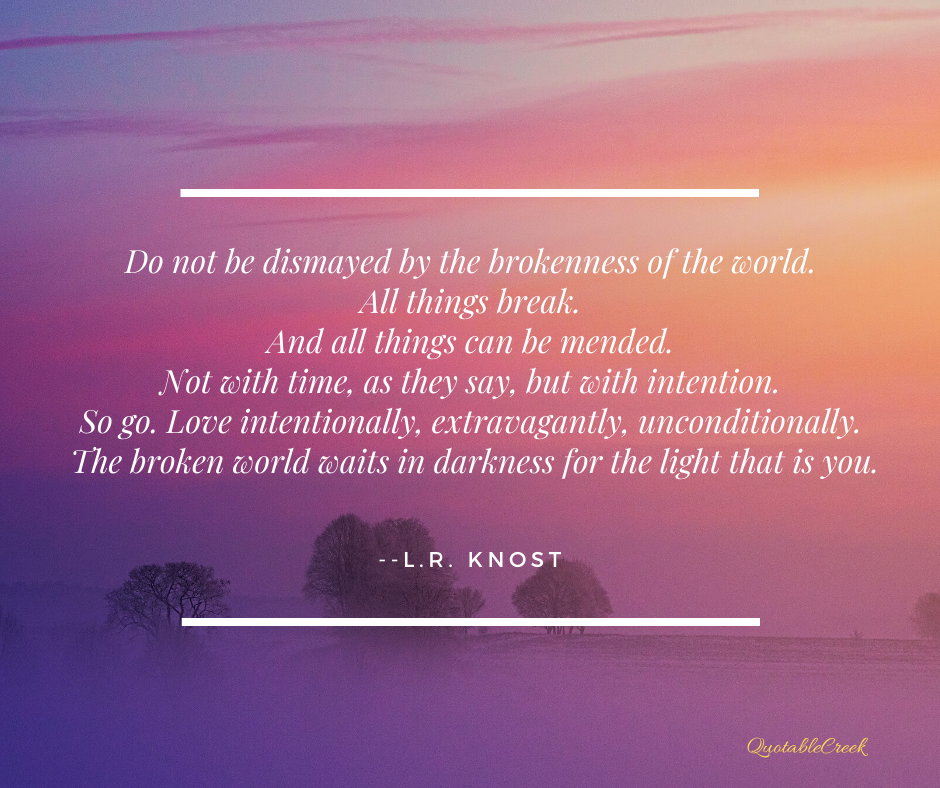
Do not be dismayed by the brokenness of the world. All things break. And all things can be mended. Not with time, as they say, but with intention. So go. Love intentionally, extravagantly, unconditionally. The broken

All things break.

Including us.

Nothing lasts.

Including us.

And yet most of us internalize myths that we are meant to live pain-free lives and that there is always more time. How much more could we accomplish if we embrace the reality instead?

We’re breakable. But our vulnerability is our strength. And when we mend from something painful, we are likely to have tools and skills and sensitivities that may help us and make us more empathic going forward. Breaking and mending is part of growth. Part of change. Part of evolving. To be scared of breaking is to be scared of living.

Time’s short. Now is the time to reach out, apologize, help…whatever it is you’re waiting for a different day to do. There is no promised day. Things don’t just happen. Time doesn’t heal all wounds. We help heal the broken world, and our own broken selves, by continuing to love even in the darkness.

The incredible power of community.

Blue Blueberries Food Fact Facebook Post

In 1943, President Roosevelt had several competing problems to solve; his answer: Victory Gardens. Author Elisa Carbone (Diana’s White House Garden) describes the amazing bit of history this way:

The World War II Victory Garden plan grew out of necessity. There was not enough steel and tin to make both fighter planes and tin cans for vegetables. There were not enough train cars to carry soldiers to the ports and to send food around the country. And with Japan controlling the islands where most of the world’s rubber plants grew, there was not enough rubber for tires for trucks to carry food from the farms to the cities.

The Roosevelts’ plan was a resounding success. In every city and town, vacant land was turned to food production. City parks, suburban and urban yards, vacant lots, and even apartment rooftops were used to grow fruits and vegetables. An estimated 20 million gardens were planted in the  U.S., producing between 9 and 10 million tons of food, over 40 percent of all the produce eaten in the United Sates. Community centers offered classes in canning, and the harvest was put away to feed the country during the winter as well.

This bit of history is remarkable in so many ways. Success depended on wide-spread buy-in from the total population based on their shared concern for and desire to support the troops and win the war. The solution wasn’t based on borrowing or over-spending but directly resulted from an honest appraisal of scarcity. People stepped up, across all divides. The solution stemmed from a deep recognition of the interrelatedness of things. People welcomed the opportunity to help. Each of those facts is powerful alone, but together, it marks a remarkable time in history.

What could we do today with buy-in like that among an entire populace? Can we even imagine anymore what it would feel like to be part of a country where everyone was looking for a way to help a global problem by making changes and contributions at a local level? In 1943, the impetus for the action was a desire to feed the troops and help win the war. What will we care enough about to pull together now?

Home is a place we all must find.

ache

Something there is in each of us that longs for home, that place where we are welcome and accepted and known. Yet in this world of constant mobility and displacement (often involuntary), that feeling of home remains elusive. What if that feeling of home is something we can activate ourselves and bring to ourselves and others? What if we could make everyone feel a bit more at home?

‘Home’ is more than just a place. But what is it really?


In Willie Baronet’s TEDx talk last year, he quoted Glinda from the Wiz: ”Home is a place we all must find, child. It’s not just a place where you eat or sleep. Home is knowing. Knowing your mind, knowing your heart, knowing your courage. If we know ourselves, we’re always home, anywhere.”

What can we do today to bring that feeling of home to everyone we meet?


The Courage to Stand Alone

True belonging doesn't require you to change who you are. It requires you to be who you are.

We are more separated into camps than perhaps we’ve ever been. It is now possible to watch news that confirms your world view, to go to schools or socialize only with people who share your perspective, and to alienate yourself from the rest, the ‘others’. But, even though we may think that being only with birds of our feather, might make us feel more included, it is really making us more lonely. Turns out what we have in common in those homogeneous group is mostly just a common set of people to dislike. Anger, distrust, alienation grows rather than wanes, and we become more apart because echo chambers breed loneliness.

In this fascinating interview, Brene Brown shares what her research has uncovered. That rather than stifle ourselves to fit in by conforming, what is ultimately freeing is showing up authentically in diverse groups. We are stronger in our community because of, not despite, our differences because there is a huge difference between fitting in and belonging.


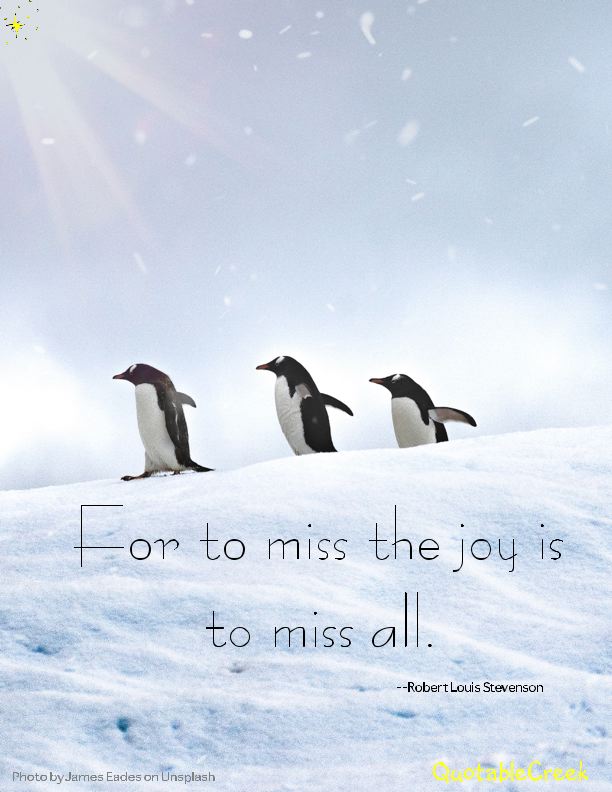
Don’t miss the joy.

penguinjoy

We generally find what we look for. We are good at it, and that skill helps us to recognize that one face in a sea of faces, to ferret out clues at a crime scene, to heed the landmarks that lead us home. But when we are trying to process a barrage of information coming at us all at once and trying to make sense of it without being overcome, we need to look for the unexpected things, the startling things, the beautiful things. We need to seek joy.

In his Book of Delights, Ross Gay goes on a mission to write about something delightful, everyday. And, while he initially thought he would have to scrounge for delights, after a bit of practice, he learned to find them everywhere. The delightful things were abundant and overflowing. More important, those delights made him realize how interconnected we are and that we are caretakers, each for the other. In a world that can seem cold and callous, we are generally good to each other:

I suppose I could spend time theorizing how it is that people are not bad to each other. But that’s really not the point. The point is that in almost every instance of our social lives, we are, if we pay attention, in the midst of an almost constant, if subtle, caretaking – holding doors open, offering elbows at crosswalks, letting someone else go first, helping with the heavy bags, reaching what’s too high or what’s been dropped, pulling someone back to their feet, stopping at the car wreck – at the struck dog, the alternating merge, also known as the zipper. This caretaking is our default mode, and it’s always a lie that convinces us to act or believe otherwise – always.

As we scrounge for our delights, we begin to see them all around us–the groceries grown and harvested for us to enjoy, the clothes crafted and sewn, the traffic signs to keep us safe, the laughter of children, birdsong, smiles from neighbors, our dog eager for her morning walk. As we notice those delights, we metaphorically feel the embrace of a larger community and feel the joy from being lucky enough to be right here, right now, plop in the middle of the mystery of it all.