Sometimes I feel everything in life comes down to the question, ‘Who is my neighbor?’
We are always asking, ‘This one, too?’ And the answer is always, ‘Yes’.
The felon, the refugee, the homeless person, the enemy, the one who hurt you, the one you disagree with, the one who makes your life hard? Yes, always yes.
The potential for a loving relationship is in one embrace. The potential for peace is in forgiveness. The potential for harmony is in stillness. The potential for quality conversation is in listening.
Consider the opportunities you have to make your world and the world in general a better kinder place with the actions you sow today.
Listening, truly listening, is rare. Most people are just waiting for their turn to reply. Or maybe not even waiting, but interrupting to say what is on their mind. Two people both talking, but neither listening, and no one, consequently, heard. Too often, we want to avoid the discomfort of listening, particularly if someone is hurting, and so we turn the conversation back to something safe, ourselves.
Celeste Headlee recounts a time when she tried to support her grieving friend, but failed:
A good friend of mine lost her dad some years back. I found her sitting alone on a bench outside our workplace, not moving, just staring at the horizon. She was absolutely distraught and I didn’t know what to say to her. It’s so easy to say the wrong thing to someone who is grieving and vulnerable. So, I started talking about how I grew up without a father. I told her that my dad had drowned in a submarine when I was only 9 months old and I’d always mourned his loss, even though I’d never known him. I just wanted her to realize that she wasn’t alone, that I’d been through something similar and could understand how she felt.
But after I related this story, my friend looked at me and snapped, “Okay, Celeste, you win. You never had a dad, and I at least got to spend 30 years with mine. You had it worse. I guess I shouldn’t be so upset that my dad just died.”
I was stunned and mortified. My immediate reaction was to plead my case. “No, no, no,” I said, “that’s not what I’m saying at all. I just meant that I know how you feel.” And she answered, “No, Celeste, you don’t. You have no idea how I feel.”
She walked away and I stood there helplessly, watching her go and feeling like a jerk. I had totally failed my friend. I had wanted to comfort her, and instead, I’d made her feel worse. At that point, I still felt she misunderstood me. I thought she was in a fragile state and had lashed out at me unfairly when I was only trying to help.
But the truth is, she didn’t misunderstand me at all. She understood what was happening perhaps better than I did. When she began to share her raw emotions, I felt uncomfortable. I didn’t know what to say, so I defaulted to a subject with which I was comfortable: myself.
I may have been trying to empathize, at least on a conscious level, but what I really did was draw focus away from her anguish and turn the attention to me. She wanted to talk to me about her father, to tell me about the kind of man he was, so I could fully appreciate the magnitude of her loss. Instead, I asked her to stop for a moment and listen to my story about my dad’s tragic death.
How often do we do this in our conversations? We listen to the story, only to remember a time when we experienced something similar and then quickly switch focus to our story. Do we sit with a person in their grief, their discomfort, their loneliness? Or do we try to change the topic to something more pleasant?
Headlee continues:
From that day forward, I started to notice how often I responded to stories of loss and struggle with stories of my own experiences. My son would tell me about clashing with a kid in Boy Scouts, and I would talk about a girl I fell out with in college. When a co-worker got laid off, I told her about how much I struggled to find a job after I had been laid off years earlier. But when I began to pay a little more attention to how people responded to my attempts to empathize, I realized the effect of sharing my experiences was never as I intended. What all of these people needed was for me to hear them and acknowledge what they were going through. Instead, I forced them to listen to me and acknowledge me.
Sociologist Charles Derber describes this tendency to insert oneself into a conversation as “conversational narcissism.” It’s the desire to take over a conversation, to do most of the talking and to turn the focus of the exchange to yourself. It is often subtle and unconscious. Derber writes that conversational narcissism “is the key manifestation of the dominant attention-getting psychology in America. It occurs in informal conversations among friends, family and co-workers. The profusion of popular literature about listening and the etiquette of managing those who talk constantly about themselves suggests its pervasiveness in everyday life.” Derber describes two kinds of responses in conversations: a shift response and a support response. The first shifts attention back to yourself, and the second supports the other person’s comment. Here is a simple illustration:
Shift Response Mary: I’m so busy right now. Tim: Me too. I’m totally overwhelmed.
Support Response Mary: I’m so busy right now. Tim: Why? What do you have to get done?
Here’s another example:
Shift Response Karen: I need new shoes. Mark: Me too. These things are falling apart.
Support Response Karen: I need new shoes. Mark: Oh yeah? What kind are you thinking about?
Shift responses are a hallmark of conversational narcissism. They help you turn the focus constantly back to yourself. But a support response encourages the other person to continue their story. These days, I try to be more aware of my instinct to share stories and talk about myself. I try to ask questions that encourage the other person to continue. I’ve also made a conscious effort to listen more and talk less.
I’ve never learned something I didn’t know from talking. It’s in listening that we grow.
While our leaders model interrupting, our children are watching. What are they learning? If constant interruptions become the norm, how will this effect public discourse and civility? How will we work together without listening to each other’s points of view?
Today, perhaps we can model listening. Allowing people to feel heard is a gift we can freely give.
We start so little and helpless, not knowing much of anything, but responding to love, comfort, care, concern. As we grow, there have been people who have brought joy to our lives, people who have helped us step out and grow.
For these people, we offer thanks.
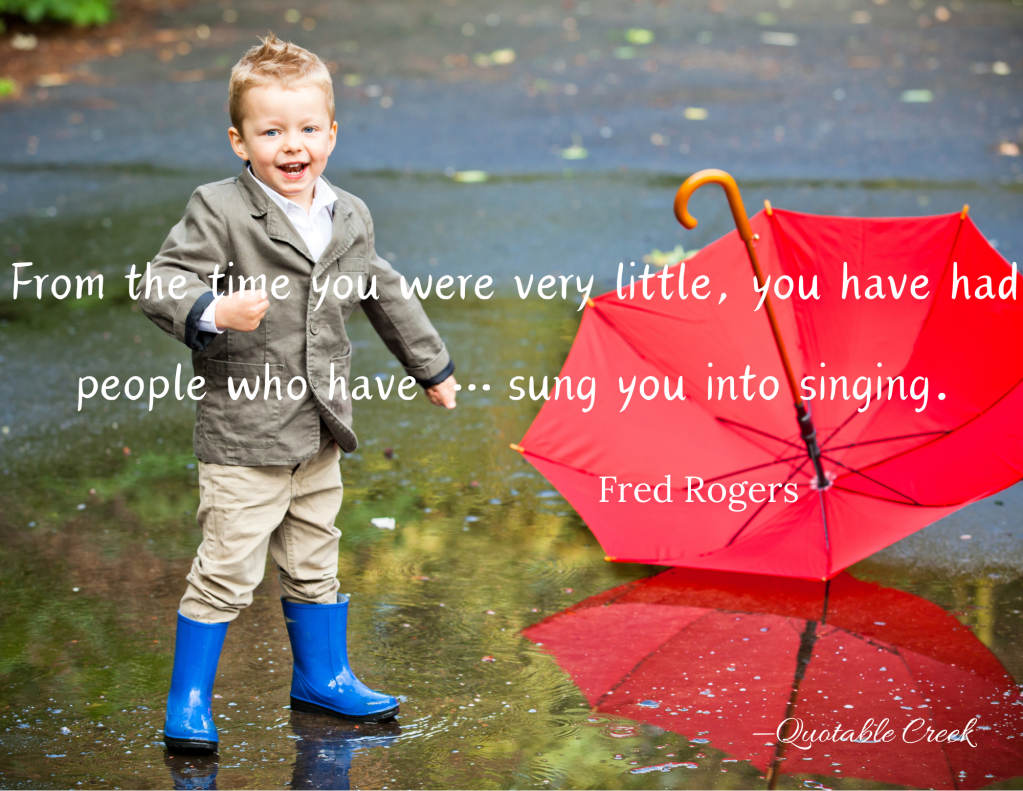
As Mr. Rogers explained:
From the time you were very little, you’ve had people who have smiled you into smiling, people who have talked you into talking, sung you into singing, loved you into loving. So, on this extra special day, let’s take some time to think of those extra special people.
And we have them now, don’t we? Those people who smile us into smiling and love us into loving?
Otters sleep holding hands. In the open water, it would be so easy for them to drift away from each other in the ebb and flow of the tides. They also use kelp to wrap around themselves, but there is something about the image of sleeping otters holding hands to stay connected that is utterly endearing.
We, too, bounce around in rough seas, and it is easy to drift away from those we love. Distractions, distance, inattentiveness add up until you are apart, in the storm separately, rather than braving it together.
Today, work to avoid the drift away from those you love.
Sy Montgomery’s delightful book, How To Be a Good Creature, is a ‘Memoir in Thirteen Animals‘. What an interesting way to organize a memoir, focusing on the impact various animals have made on her life and what they have taught her about co-existing as fellow creatures on this planet! It is a profound, yet simple, book.
If you were to write a memoir of your life through that lens, who would the animals be that impacted your life in meaningful and enriching ways? What life lessons did you learn? How were your limits expanded from sharing space with that fellow creature?
For inspiration, consider Montgomery’s words:
All the animals I’ve known–from the first bug I must have spied as an infant, to the moon bears I met in Southeast Asia, to the spotted hens I got to know in Kenya–have been good creatures. Each individual is a marvel and perfect in his or her own way. Just being with any animal is edifying, for each has a knowing that surpasses human understanding. A spider can taste the world with her feet. Birds can see colors we can’t begin to describe. A cricket can sing with his legs and listen with his knees. A dog can hear sounds above the level of human hearing, and can tell if you’re upset even before you’re aware of it yourself. Knowing someone who belongs to another species can enlarge your soul in surprising ways.
I often wish I could go back in time and tell my young, anxious self that my dreams weren’t in vain and my sorrows weren’t permanent. I can’t do that, but I can do something better. I can tell you that teachers are all around to help you: with four legs or two or eight or even none, some with internal skeletons, some without. All you have to do is recognize them as teachers and be ready to hear their truths.
Today, consider the wonder of creation around you and thank your teachers of the non-human persuasion.
There is an elephant in the room. We don’t talk about it, we try not to think about it, we pretend it doesn’t exist. That elephant is the fact that we are all on a one way journey through this life. Our time is limited. None of us knows in advance when our end of the journey will come, but that end will come.
When we pull ourselves out of denial and gaze directly at this elephant, we can realize something important: our opportunities should be seized now. That good we can do? Don’t put it off. That kind word? Say it. That gift or remembrance? Give it now.
We will not have this place and time and opportunity to make a difference again.
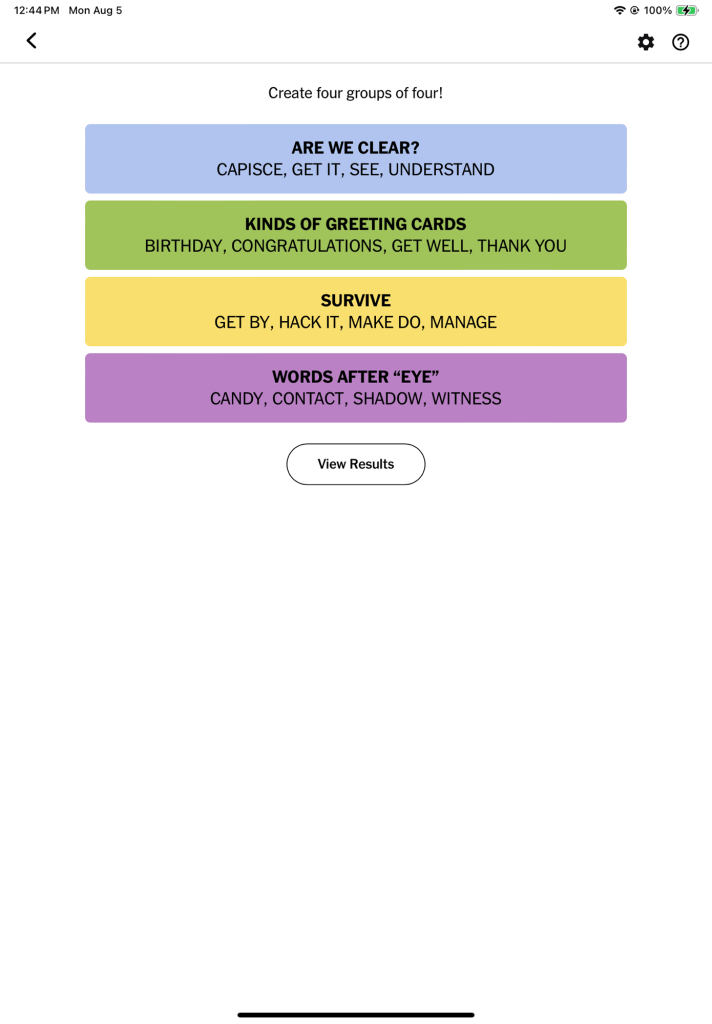
Every morning, I wake up and play games. My favorite these days is Connections, a collection of 16 words that you need to group in four groups of four based on a shared connection. Here’s the solution from one last week:
Now, looking at the solution, it’s easy to see the connections. Not so, though, when the words are all scrambled and the connections are unclear. Words may have more than one meaning or be multiple parts of speech. Often the answers are homonyms or are missing a letter. It can be challenging to find the connections among the words.
So, too, with the connections among people. There are some obvious superficial connections perhaps— gender, political affiliation, nationality, religion, age. But what of those deeper, hidden ones? How do we find those to help us feel more like a community?
I thought about this when reading an article about how an introvert, Jay Krasnow, made friends. He had struggled to find true connections at work functions or forced social gatherings, but when he dug deeper, to consider the things he was passionate about and find others who shared those passions, he found the connection he was looking for. He explains:
My failure at connecting wasn’t due to a lack of trying. I spent my 20′s and 30′s collecting and studying books on how to network, forge friendships and build character.
Yet, my principal achievement from reading these books was that I became adept at identifying when other people had read these same books. Meanwhile, my networking skills didn’t significantly improve. Even worse, I felt that by reading books with titles like “How to Talk to Anyone,” I was turning myself into a robot that spewed out inauthentic lines to people who I genuinely wanted to know.
There had to be a better way to build relationships.
For Jay, he decided to start a book club, not one reading the same book, but one where you came and told people about the book you were currently reading. It took off, people came. And those relationships centered on a shared passion spilled over into other friendships:
Connecting with other people through books seemed natural, but I didn’t know if anyone would come. I was prepared to read my book quietly if no one else showed up. Fortunately, both my friends came, and we were joined by one other person we didn’t know.
After the first event, more people started coming, and I started making new friends almost immediately.
The group’s membership grew exponentially. It wasn’t long before I was inviting my new friends to dinners and other events. Because we had established we shared a similar passion, it was easy to branch out from there and find other things to do and talk about.
I wonder if this is what the world needs right now— connections based on a shared love or passion. So much of identity seems tied into a shared hatred or shared anger over something. It seems like that just leads to more loneliness and separation.
One of my personal heroes, Jimmy Carter, almost 100 years old, is trying to hang on to vote in this election. He has been such a wonderful example of walking the walk. He says:
“My faith demands – this is not optional – my faith demands that I do whatever I can, wherever I can, whenever I can, for as long as I can with whatever I have to try to make a difference.”
What a wonderful way to look at our possible impact. Using what we have, not waiting until we have more or better resources or to be older and wiser, or wishing we were younger and stronger. Right now with what’s available.
And wherever we find ourselves, adopting a bloom where you’re planted attitude. Even if we are in our own harsh spot. Considering what can we do here.
And always looking for opportunities to do good. Not necessarily solving the world’s problems, but doing your own little bit of good. Right here, right now.
How often do you admire someone but keep that thought to yourself? Perhaps someone took a risk, spoke truth to power or behaved well in a tough situation. You admired them for it but kept that admiration to yourself. How much good might that have done if you told them, perhaps given them a bit of encouragement to stand strong again? How much might your words give them much-needed support when they were feeling low?
Chimamanda Adichie encourages us to never admire quietly. She says:
If I admire something about someone, I tell them. We humans are so fragile. It’s important we give people their flowers while they are here. Never admire quietly.
Don’t be stingy with kind words and compliments. They could very well be the fuel that keeps those good deeds coming.





 QuotableCreek.com