In the midst of technological connectedness, loneliness is ever present. That need for close human connection isn’t satisfied by clicks and emojis or political jousting. It requires a deeper sharing of oneself. And how frustrating to have stories to tell but no one to share them with.
Imagine what good you can do simply by being that person who can listen to another’s stories. To ease their loneliness.
Emily Dickinson captured this well:
If I can stop one heart from breaking,
I shall not live in vain;
If I can ease one life the aching,
Or cool one pain,
Or help one lonely person
Into happiness again
I shall not live in vain.
Who do you know that might have stories to tell if only there was someone to listen?
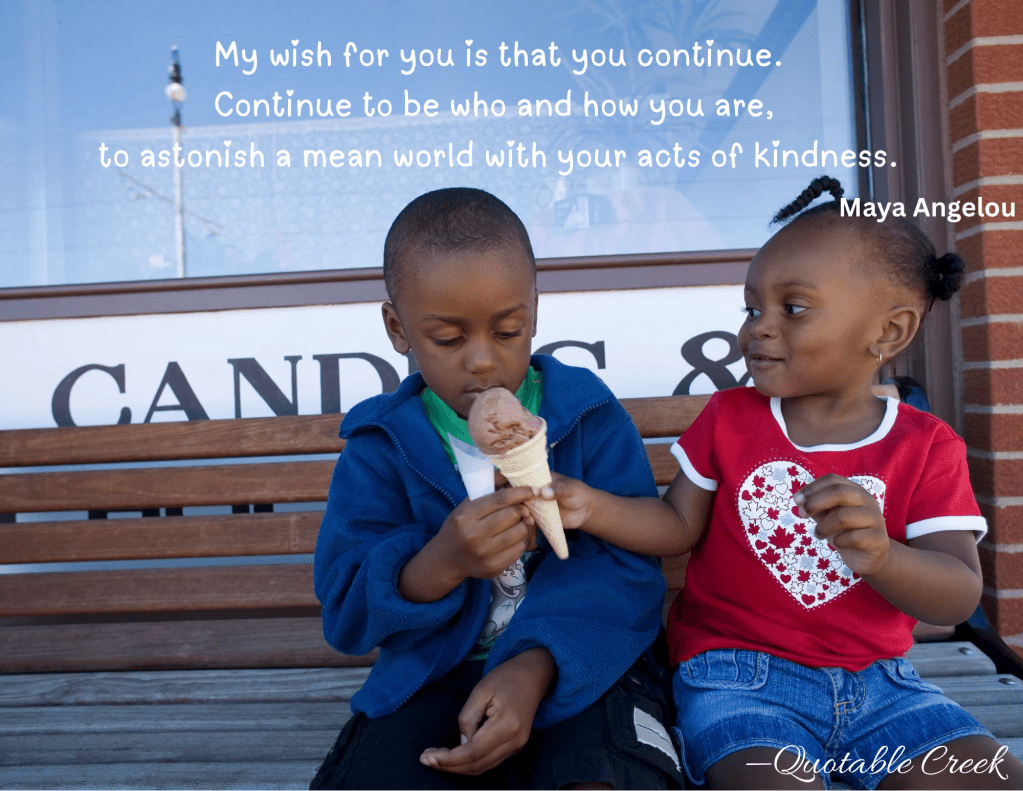
Astonishing a mean world is quite the life goal. Flipping the script. Not buying in to the smallness, pettiness, and cruelty you see around you.
Imagine the ripple effects of such kindness.
Perhaps you’ve heard the story of the man and the starfish. In sum, a man is walking along the beach at low tide finding starfish that have landed too far above the water line to survive. He dislodges them and throws them back into the ocean. A bystander is astonished and scolds him, saying that he will never be able to make a difference as there are miles and miles of beach with hundreds of stranded starfish. The man responds, tossing another back into the ocean, “Made a difference to that one,” he remarks.
Making a difference doesn’t have to be a grand gesture. It can be quite small, perhaps only affecting the person in front of you right now. Perhaps the difference is choosing an unexpected response to cruelty. Perhaps the response is to not lose hope.
Hang in there. The starfish are right in front of you on your path if you choose to see them.
When we find ourselves in challenging times and are unsure which way to turn, let these words help guide you.
Do justice. Peace, justice, love are things we do and bring about, not things we wait for. With our best discernment, we offer ourselves to the world, hoping to make a difference. Kind words, loving hearts, calm demeanors, patience, forbearance, and forgiveness. The way of the One we follow. A servant’s heart but a leader’s strength.
Love mercy. Oh, how the world loves vengeance, cancelling, grudges, getting even, punishment. To love mercy is a kinder, gentler path, one that believes in the redeem-ability of every last one of us. One that doesn’t insist on being avenged or having the last word. One that delights in forgiveness and healing.
Walk humbly. No matter how hard we try to do or be right, we may be wrong. The other guy might be right. And, get this, God loves the other guy as much as God love you.
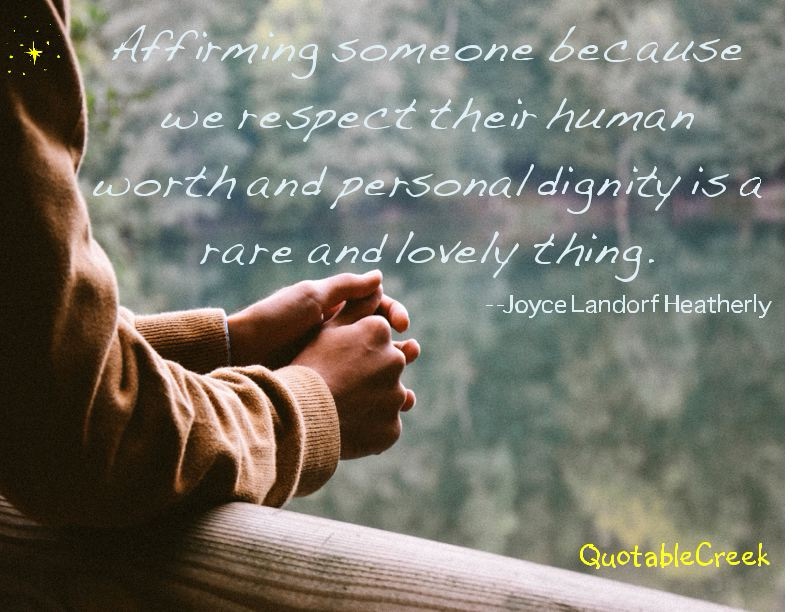
Are there people in your life who encourage you and make you feel stronger and lifted up? Are there some who drag you down or take the wind out of your sails? In her book, Balcony People, Joyce Landor Heatherley argues there are two types of people: the evaluators and the affirmers. She suggests:
I am sure, if there were a way to view a movie and see instant replays of all the strategic change points in our lives, that we’d instantly spot the people who either broke our spirits by their critical or judgmental evaluations, or who healed us by their loving, perceptive affirmations.
To be honest, I seem to be able to remember the negative comments of evaluators faster and more clearly than the positive remarks of the affirmers. I’m not alone in this ability to recall the negative….I suspect that not far from anyone’s conscious level of thinking lies the memory of an evaluator who pulled on his or her spiked boots and stomped deliberately over our bare soul and personhood.
Do you have any of these evaluators in your life? Maybe you can recognize the voice in your head that tells you that you can’t do something. In her book The Artist’s Way: A Spiritual Path to Higher Creativity, Julia Cameron calls these the censors. Maybe you have many censors, a rogue’s gallery of them.
So what do we do with these evaluators and censors to keep them from stifling our blossoming with their negative talk or opinions? Heatherley suggests leaving them in the past, even if that past was five minutes ago:
We all have the choice to replay the harmful remarks from evaluators, or we can choose to let them pass on. We can even choose to make allowances for their discouraging, destructive words. But best of all is the choice to willingly focus our minds and hearts on today’s person who is affirming us.
So who are these affirmers in our lives? Think back…
Who by one small sentence or more, has changed and lifted your opinion of yourself? Who was the person early in your life who recognized the first sparks of originality in the labyrinths of your mind and soul and saw what no one else saw? And who is the special affirmer who catches quick glimpses of the flames from the fires of your potential and tells you so? Who, by his or her words, helps you to respect and believe in your own value as a person? And who is the affirmer who encourages you to stretch and dream beyond your self-imposed limits and capabilities?
These affirmers are your Balcony People, cheering you on to blossom and stretch. These are the people whose words you must cling to when working toward your goal. These affirmers see you “by a clearer, truer light. They [are] able to peel back the layers of pretense [you] wear like like costumes for a bad play. Most of the time they [see] through and past the masks [you] hide behind. Then, once having broken through to [you] they’d get on with the business of motivating [you] to be all [you] can be.”
Affirmation is vital to our health and progress:
When others discern the good, the noble, the honorable, and the just tenets of our character (no matter how minuscule they may be) and proceed to tell us how they admire those traits, we feel visible. We begin to ‘see’ ourselves and our worth. We feel nurtured and nourished, but mostly we feel loved.
The Basement People do just the opposite. With their words they cause you to doubt and shrink. They focus on your flaws or failings. They encourage you to not try, to stay where you are, to wallow in the “murky waters of failure and discouragement.” We don’t need to linger on their words.
Who is in your Balcony? Who cheers you on and sees your unique worth? Who do you admire in history for their accomplishments or moral victories?
When you struggle, picture these people, your Balcony People. Remember their words. Let their affirmations encourage and comfort you in defeat and to keep pressing onward in your goals.
You are meant to blossom not wither. You are meant to shine not lurk in the shadows.
How hard it is to lose someone you love. There is so much that seems unseen or unfelt without being shared together. So many visceral, tangible reminders of your loss are everywhere. Sounds, smells, songs, times of day, stories, jokes, and so on. Everywhere you look. There’s no escaping the weight of the loss really.
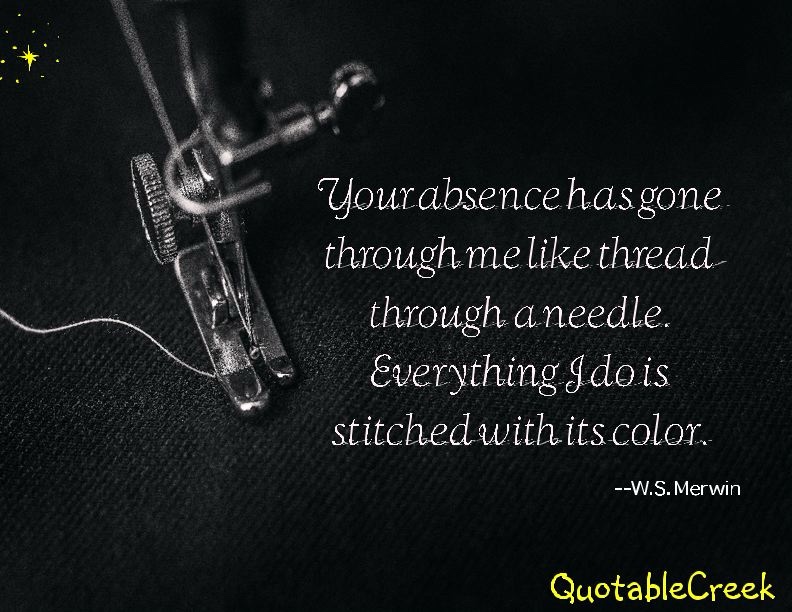
The only thing that makes it bearable is to consider it not loss, but a gift. Moments shared colored your life and made it brighter and more nuanced. The threads of memories you shared become woven together with threads from all the people you’ve loved and become the tapestry that is your life. And that ever-presence becomes not a stab, but a comfort.
e.e. cummings captured it well:
i carry your heart with me(i carry it in
my heart)i am never without it(anywhere
i go you go,my dear;and whatever is done
by only me is your doing,my darling)
i fear
no fate(for you are my fate,my sweet)i want
no world(for beautiful you are my world,my true)
and it’s you are whatever a moon has always meant
and whatever a sun will always sing is you
here is the deepest secret nobody knows
(here is the root of the root and the bud of the bud
and the sky of the sky of a tree called life;which grows
higher than soul can hope or mind can hide)
and this is the wonder that’s keeping the stars apart
i carry your heart(i carry it in my heart)
To all those we have loved and miss dearly, let us look back fondly, grateful for all the colors they brought into the tapestry of our lives, and repeat together:
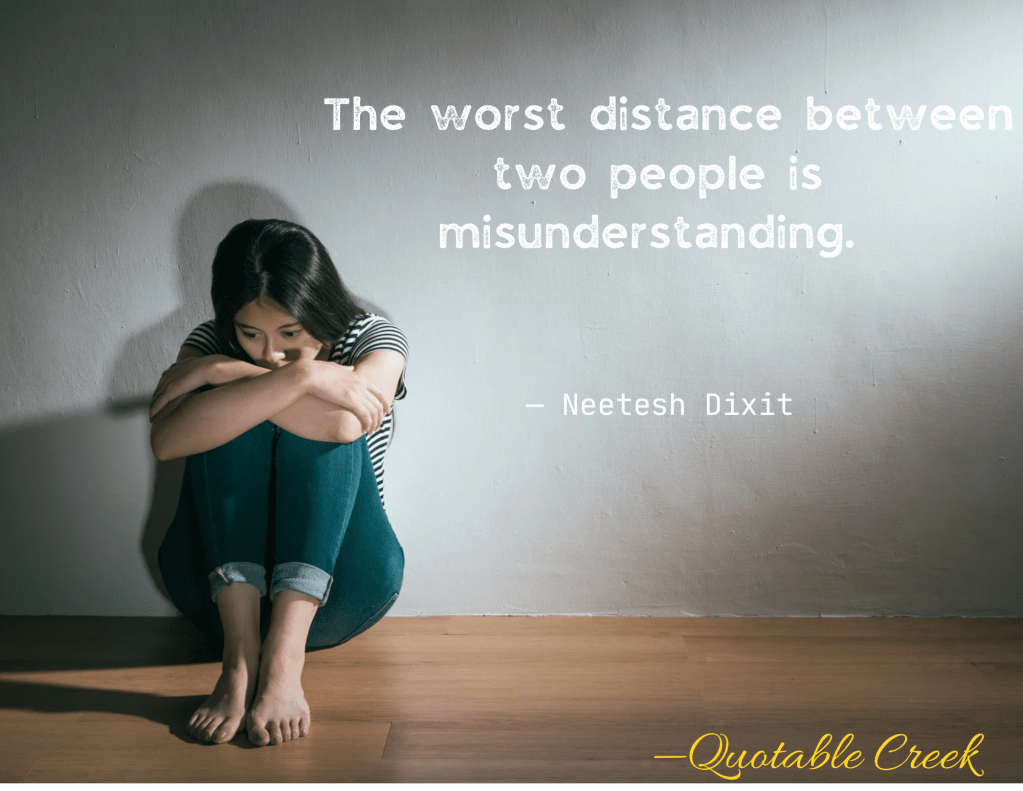
One of the most frustrating things is to be misunderstood. To have your explanations fall on deaf ears or a hardened heart.
Once I lost a friendship because my friend believed I had done something I hadn’t done. My assurances fell flat. Worse, I knew who had actually done the thing I had been accused of but didn’t say because that might jeopardize their friendship. So I became the exiled one. And watched that other friendship prosper. The protected friend knew I had paid the penalty for their own actions but wasn’t about to confess.
Misunderstandings can be so frustrating. Much better to be punished for something you actually did, a choice freely made, even if wrong. There is sense in that. But misunderstandings bring a helpless feeling coupled with an anger at the injustice of it all.
I wonder how many relationships have been lost over misunderstandings, for reasons that weren’t even true. Or how many people, even, wrongfully convicted. What of all that hurt and loss over things that aren’t even true?
What do you do in the face of that kind of senseless tragedy? One thing, of course, is to fess up if someone is bearing a penalty for something you did. But beyond that maybe is the way we open our own ears and soften our hearts to make sure that we’re not the ones cutting people off and ending relationships over things we might be wrong about.
No one captures this angst of being misunderstood better than Nina Simone with her prayer, O Lord, please don’t let me be misunderstood.
One of the most joyful things about teaching is finding the method that leads to a particular child learning where perhaps they struggled before. Finding the right key for the lock. Teaching, in this way, is one of the most creative and challenging jobs because each child is unique. Not every child can simply sit at a desk and listen to their teacher drone on and somehow absorb and master the material. In fact, a student who would prefer this lecture method is rare.
A vibrant classroom is filled with hands-on, group work, mentoring, art, music, activities, and so on. There are so many ways to teach and pair the right method with the right child. This is why a good teacher will always feel they learn as much as they teach. Of course, implicit in this challenge is having as the goal, helping the child learn. When obedience and regiment replaces learning as the goal, and the teaching method is rigid and unyielding, often students will struggle and fall through the gaps.
Teachers need to always keep their eye on the ball. The bottom line, the mission, is helping children learn.
There are so many areas where the same analysis applies. Where perhaps we fail to keep our eye on the right ball.
My pastor posted the following:
The method v. The mission. There are many ‘This is the way we’ve always done it’ or ‘Technology isn’t our thing’ or ‘Let’s just keep to ourselves’ sentiments behind each failing church. And misplaced beliefs that perhaps there’s just no space for church anymore in today’s world.
And yet.
In both teaching and ministry, there remains the mission. To help children learn. To help God’s people. And these needs in the world are growing, not shrinking.
So then the question becomes, and really always has been, how can we adapt our methods to fulfill our mission?
In his letter to the early church at Corinth, Paul sets out how love shows up in the world in his effort to help them get along. It is a frequent text for weddings:
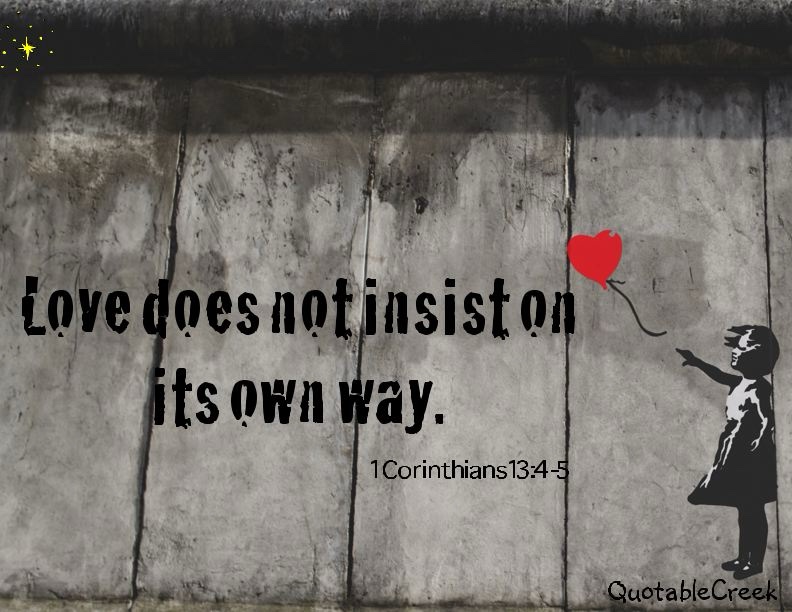
“Love is patient and kind; love does not envy or boast; it is not arrogantor rude. It does not insist on its own way; it is not irritable or resentful…” 1 Corinthians 13:4-5.
To those about to marry, an interesting exercise is to substitute the name of your beloved each time the word ‘Love’ appears. And an even more interesting exercise, for all of us, is to substitute our own names instead of the word ‘love’:
I am patient and kind; I do not envy or boast; I am not arrogant or rude. I do not insist on my own way; I am not irritable or resentful….
How did you do? For many of us, this simple recitation shows us the exact ways and times we are being less than loving and calls us to consider those actions. Must we insist on our own way? How do we know what is right? Isn’t it possible that someone else may be right, too? Are we becoming impatient with others? Can we take a minute to rein ourselves in, breathe deeply, and begin again? Are we holding grudges? Can we let the past go and try to make our present the best possible? And so on.
These checks we can do to measure our progress and monitor our moods against the ideal of love can be very helpful to keep us on track showing up in this world as close to lovingly as we can get.
It’s okay to be heartbroken for more than one group of people at the same time. When it comes to showing compassion, we don’t have to pick sides. Sometimes, often really, maybe even always, there is hurt and anguish everywhere, and we can mourn the lot of it.
Beware people who tell you not to be concerned for this group or that group and the hurt they feel.
Beware those who try to dehumanize others.
Beware those who lump you in as the ‘enemy’ for working to assure people are treated humanely.
Beware people who draw lines between us and them.
Beware those who try to limit you to a label or single identity.
Our hearts are big enough to embrace it all. What we must save is love.




 QuotableCreek.com