On days that seem dark and heavy, mired with concerns about the future, it is nice to remember that babies are being born, people are proposing, family members are coming home, and we are all here today.
Today, where we still have power to work toward better tomorrows.
The might have beens are a killer. We each take so many forks in the road, it’s easy to wonder how our lives might be if we had taken a different turn—gone to a different school, chosen a different career, picked a different partner. Those might have beens can keep us up late with longing and despair about the life we currently have. And, more importantly, they can strip those lives, the actual lives we are living, of joy.
Consider this poem by Carl Dennis:
The God Who Loves You
BY CARL DENNIS
It must be troubling for the god who loves you To ponder how much happier you’d be today Had you been able to glimpse your many futures. It must be painful for him to watch you on Friday evenings Driving home from the office, content with your week— Three fine houses sold to deserving families— Knowing as he does exactly what would have happened Had you gone to your second choice for college, Knowing the roommate you’d have been allotted Whose ardent opinions on painting and music Would have kindled in you a lifelong passion. A life thirty points above the life you’re living On any scale of satisfaction. And every point A thorn in the side of the god who loves you. You don’t want that, a large-souled man like you Who tries to withhold from your wife the day’s disappointments So she can save her empathy for the children. And would you want this god to compare your wife With the woman you were destined to meet on the other campus? It hurts you to think of him ranking the conversation You’d have enjoyed over there higher in insight Than the conversation you’re used to. And think how this loving god would feel Knowing that the man next in line for your wife Would have pleased her more than you ever will Even on your best days, when you really try. Can you sleep at night believing a god like that Is pacing his cloudy bedroom, harassed by alternatives You’re spared by ignorance? The difference between what is And what could have been will remain alive for him Even after you cease existing, after you catch a chill Running out in the snow for the morning paper, Losing eleven years that the god who loves you Will feel compelled to imagine scene by scene Unless you come to the rescue by imagining him No wiser than you are, no god at all, only a friend No closer than the actual friend you made at college, The one you haven’t written in months. Sit down tonight And write him about the life you can talk about With a claim to authority, the life you’ve witnessed, Which for all you know is the life you’ve chosen.
We have choice and agency in the life we have. It is there we find meaning and purpose. It is there, in the now, that we can find joy. Embrace that life.
We are each called to new challenges today. To make a difference, to protect the community, to keep our hope alive. Over the last few weeks, we have seen stories of both tremendous generosity and simple acts of kindness. And of compassion and resolve from leaders such as this from Queen Elizabeth.
As we move forward, Queen Elizabeth’s challenge to act in a way which will make us proud years from now rings true. How we respond to these times defines us. Consider the acts of this little boy working to secure PPE for his local hospital.
There is no one right way to get through a pandemic. Perhaps you’ve seen social posts suggesting you write a book, paint your house, or finish some other huge project. And some people do respond to stress by throwing themselves into activity. (And, apparently, love to post about it.) But others don’t. And that’s ok. We are each unique and need to listen to our own hearts and bodies to figure out what self-care looks like right now. Perhaps it’s enjoying tea, watching the sunset, reading a good book, or cleaning out a closet. Perhaps it is being still. Perhaps it is taking a break from social media to enjoy some introspective time. There are as many answers as there are people asking the question, ‘How can I best care for myself right now?’ Listen to yourself, and be gentle with yourself. This is tough.
Patience is tough. But even in the most aggravating times of waiting, nature keeps going and sends us messages of hope. Dead looking trees budding, flowers blossoming, birds singing and looking for places to build their nests. Warmth seeping back into the frigid ground.
Every bit of good news is a celebration. Every success, a party. Every joy, a parade. Enjoy this summary of the good news of the week by John Krasinsky. It is a delight.
In an interview with Oprah, Elizabeth Gilbert talks about her Inner Crone — a version of herself old, happy, and well past the point of fear — that she pictures when she needs a shot of courage. She considers her Inner Crone to be “a badass old lady who already dwells somewhere deep within [her] and whom [she] hope[s] to fully become someday.” Picturing her Inner Crone gives Gilbert gumption.
But she also remembers her Inner Child, and pictures that child particularly when she is feeling depressed or hard on herself:
Many years ago when I was going through a dark season of depression and self-loathing, I taped a sweet photograph of myself at the tender age of 2 on my bathroom mirror. Looking at that photo every day reminded me that I once was this blameless little person, deserving of all tenderness–and that part of me would always be this blameless little person deserving of all tenderness. Meditating upon a smaller and more innocent version of my face helped me to learn to be more compassionate to myself. I was finally able to recognize that any harm I inflicted on me, I was also inflicting on her. And that little kid clearly didn’t deserve to be harmed.
We could all benefit from picturing our Inner Child when we are being hard on ourselves. Would you criticize that little child the way you are criticizing yourself now, or would you be more patient and encouraging? Would you demand perfection from that child, or would you celebrate progress? If you were wounded by adults when you were a child, you now are an adult who can support that little child in a healing way.
Think back. Can you remember that Inner Child who is still a part of you? The joy and exuberance, enthusiasm and trust, innocence and promise? No matter how far you’ve come from that start, treat yourself with kindness, patience, and compassion. That Inner Child is alive and well…and trusts you.
There are so many ways to be brave. Doing something that needs to be done even though you’re scared. And not doing something everyone else is doing when it feels wrong. Standing up for yourself or others. Speaking out against injustice when it would be so much easier to stay quiet. Facing a tough diagnosis with hope and patience. Being there for someone when they are hurting. Each of these experiences is the right thing to do in a less than wonderful situation.
What is your idea of being brave?
Sending love and encouragement to anyone going through a less than wonderful time right now.
We can grow in strength, courage, and confidence, but, like anything, we have to work for it. In this article, author Rick Hanson explores steps to cultivating resilience and rewiring our brains. Hanson concludes:
“Going on a dangerous hike, we know that we need to bring food and other supplies. The same is true when traveling the road of life. We need psychological supplies, such as courage and generosity, in our neural “backpack.”
“To fill up your backpack, be mindful of which particular need—safety, satisfaction, or connection—is at stake in the challenges of your life. Deliberately call upon your inner strengths related to meeting that need. Then, as you experience mental resources, you can reinforce them in your nervous system.
“As you grow these strengths and become more resilient, you will feel less anxiety and irritation, less disappointment and frustration, and less loneliness, hurt, and resentment. And when the waves of life come at you, you’ll meet them with more peace, contentment, and love in the core of your being.”
The article linked above is well-worth a read. He outlines strategies we can employ right now, today, to help us recognize and develop our inner strength as we meet today’s challenges.
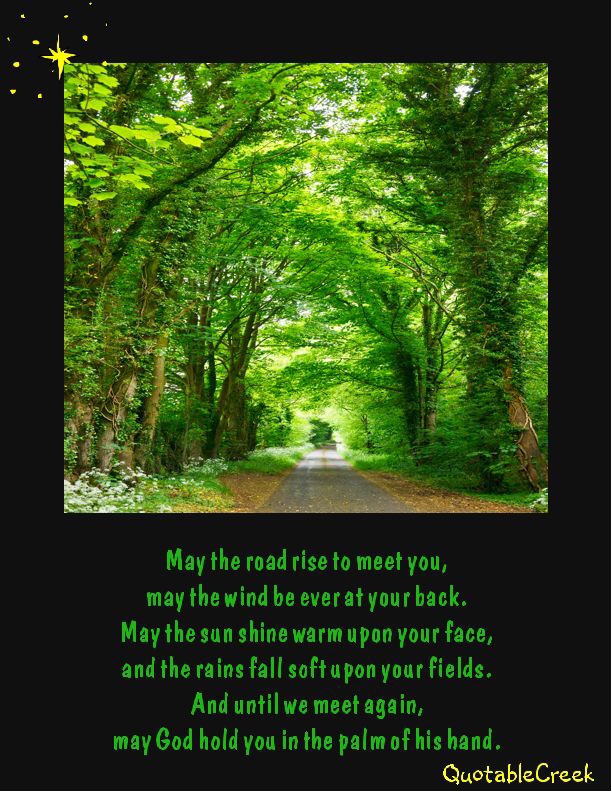
May there always be work for your hands to do May your purse always hold a coin or two; May the sun always shine on your windowpane; May a rainbow be certain to follow each rain; May the hand of a friend always be near you; May God fill your heart with gladness to cheer you.
And one more for the road:
May the blessing of light be upon you, Light on the outside, Light on the inside.
With God’s sunlight shining on you, May your heart glow with warmth, Like a turf fire that welcomes friends and strangers alike.
May the light of the Lord shine from your eyes, Like a candle in the window, Welcoming the weary traveller.




 QuotableCreek.com