Bless the comforters, those who reach out and see others hurting and grief stricken, and offer them solace. Who sit with those going through difficult times, and give of their presence. Who offer kind, comforting words.
We sometimes think those who are good at comforting don’t know loss of their own, but the opposite is probably true.
As said by Rainer Maria Rilke:
Do not assume that he who seeks to comfort you now lives untroubled among the simple and quiet words that sometimes do you good. His life may also have much sadness and difficulty, that remains far beyond yours. Were it otherwise, he would never have been able to find such words.
Perhaps the only good to come of great loss is the ability to recognize it in others and offer them comfort and companionship.
Life is full of hard choices. Particularly when you aren’t the one in danger. Making those tough choices, entering the fray, speaking truth to power, defending the defenseless are vital actions for our collective survival.
As Brené Brown says,
Integrity is choosing courage over comfort; it’s choosing what’s right over what’s fun, fast, or easy; and it’s practicing your values, not just professing them.
Practicing our values, not just professing them. What are your values? How can you bring that to bear in the choices confronting you today?
Many of us have opinions and desire to help in difficult situations but are afraid to raise our voices. We worry about alienating others or of seeming strident. But if not now, when?
Maybe we can start in small ways and exercise our courage muscles.
Consider these words from Maya Angelou:
“I would encourage us to try our best to develop courage. It’s the most important of all the virtues, because without courage, you can’t practice any other virtue consistently. You can be anything erratically — kind, fair, true, generous, all that. But to be that thing time after time, you need courage.
We need to develop courage, and we need to develop it in small ways first. Because we wouldn’t go and say, ‘I’ll pick up this 100-pound weight’ without knowing our capacity. So we need to say, ‘Oh, I’ll start by picking up a five-pound weight, then a 10-pound weight, then a 25-pound, and sooner or later I’ll be able to pick up a 100-pound weight.’ And I think that’s true with courage.
You develop a little courage, so that if you decide, ‘I will not stay in rooms where women are belittled; I will not stay in company where races, no matter who they are, are belittled; I will not take it; I will not sit around and accept dehumanizing other human beings’ — if you decide to do that in small ways, and you continue to do it — finally you realize you’ve got so much courage. Imagine it — you’ve got so much courage that people want to be around you. They get a feeling that they will be protected in your company.” — Maya Angelou
Look for ways to test your voice and develop your courage muscles today. Perhaps it’s in saying you disagree, perhaps it’s posting something to show solidarity with those going through difficulty, perhaps it’s speaking truth to power. Today, a five pound weight of courage flexing. Soon, you will develop the courage you need for the big battles ahead.
Sometimes things hum along nicely, and you can feel a deep sense of progress in yourself, your relationships, and the world.
Sometimes the opposite is true.
You feel yourself retreating and losing hope. Your relationships fray. Progress in the world is wiped away.
At times like these, we need to hunker down and draw on a well of hope inside in each of us that springs up with the knowledge that we can do better, we deserve better, and we will fight for ourselves and each other to make the world better.
We may not know yet the battleground we will be called to or the terms of engagement.
We do, though, know the weaponry we will fight with.
Love, honesty, integrity, justice, compassion. These tools of the light will vanquish darkness. We can’t forget what is good and right.
Finally, brethren, whatsoever things are true, whatsoever things are honest, whatsoever things are just, whatsoever things are pure, whatsoever things are lovely, whatsoever things are of good report; if there be any virtue, and if there be any praise, think on these things. Philippians 4:8
Is your life all ups, no downs? Do you ever feel a need to make it look like it is? Maybe to pretend the rough stuff doesn’t exist or put on a big smile to cover a broken heart? Do you ever feel like there must be something wrong with your faith if your life is going badly?
Truth is, bad things happen. To the best, most faithful of people. Life’s struggles can feel overwhelming. You can get to the point where you simply cannot see how someone could think and feel the way they do. You can lose hope.
At times like these you need to breathe deep and get yourself to a quiet place. And it sure would do no harm, and maybe a whole lot of good, to read a poem like this:
The Peace of Wild Things
by Wendell Barry
When despair for the world grows in me
and I wake in the night at the least sound
in fear of what my life and my children’s lives may be,
I go and lie down where the wood drake
rests in his beauty on the water, and the great heron feeds.
I come into the peace of wild things who do not tax their lives with forethought of grief.
I come into the presence of still water.
And I feel above me the day-blind stars waiting with their light.
For a time I rest in the grace of the world, and am free.
And the good news is, you can read this poem, and your soul will calm without even being in that place where the wood drake rests in his beauty on the water. The words of a good poem are like magic. They can heal you and still the churning waters of your soul. And they can help you remember the ‘day-blind stars waiting with their light’, because, yes, we cannot see the stars in the daytime, but they are there. Shining.
May you rest in the grace of the world and find peace.
Fear keeps us from trying, from stepping out, from baring our hearts. It makes us smaller than we are. When we fear heartbreak, we flee from love or offer only a superficial version of ourselves, practically guaranteeing the relationship will lack depth. When we fear failure, we don’t try, or try only halfheartedly, practically assuring a lack of success. When we fear others, we keep to those we perceive to be like ourselves, thereby ensuring that we will not enrich our relationships with diversity.
Fear tells us to cower, to not show up, to be less than we know we are.
We build our fears and then act in ways that reinforce them until they become self-fulfilling prophecies. Our fears become so much a part of our reality that we begin to accept them as ‘truth’. But when we analyze our fears critically, we can harness our inner strength and step through our limitations. So the antidote to fear may well be truth, cultivating it relentlessly, forcing ourselves to examine our fear with a microscope, and dissect it into harmless pieces.
In this powerful TED talk, Issac Lidsky explores how his fears that blindness would rob him of joy and meaning in his life fell aside when he critically examined them and chose to push through those fears to a full and rich life– lacking in sight, but abundant in vision. He urges us to push through our own fears, challenge our assumptions, and correct our misconceptions:
Hold yourself accountable for every moment, every thought, every detail. See beyond your fears.Recognize your assumptions. Harness your internal strength. Silence your internal critic. Correct your misconceptions about luck and about success. Accept your strengths and your weaknesses, and understand the difference. Open your hearts to your bountiful blessings.
Your fears, your critics, your heroes, your villains — they are your excuses, rationalizations, shortcuts,justifications, your surrender. They are fictions you perceive as reality. Choose to see through them.Choose to let them go. You are the creator of your reality. With that empowerment comes complete responsibility.
Today, consider what’s holding you back and challenge your assumptions.
Nothing is more important than empathy for another human being’s suffering. Not a career. Not wealth. Not intelligence. Certainly not status. We have to feel for one another if we’re going to survive with dignity.
~Audrey Hepburn
Studies show empathy, the ability to put yourself in another person’s shoes and consider their point of view, might be on the decline in the United States. With a lack of empathy comes the possibility of othering, cruelty, and self-absorption.
What can we do to increase our empathy for others?
Consider this novel idea: empathy walks. Literally mirroring someone’s walk, not in a stalkery or critical way, but as a silent practice in visualizing what it must be like to be that person. Consider this example:
It all started on one of my regular walks into town. I was head-down, in a hurry, when I noticed an older woman ahead of me. She was walking slowly—agonizingly slowly, if I’m being honest—and my first instinct was annoyance. But then I thought about the old acting school exercise. What if, instead of speeding up to dodge her, I matched her pace? So, I slowed down, mimicking her small, deliberate steps, the way she slightly leaned to one side, her arms swaying as if carrying invisible weights.
And then it hit me: empathy. Not the mushy, Hallmark-card kind, but a physical understanding of what it might feel like to be her. As I moved like her, my irritation evaporated. I didn’t just see her; I felt her. I thought about the phrase “walk a mile in someone else’s shoes,” and realized it’s not the shoes that matter; it’s the walk….
So, the next time you’re out walking, try it. Pick someone ahead of you and mimic their stride. Notice where they’re tight, where they’re loose, how they carry themselves. Let their tension teach you about your own. Let their walk reshape yours. And maybe, just maybe, you’ll feel a little less separate and a little more connected—to them, to yourself, and to this messy, beautiful, shared experience we call being human.
We are all different, with different joys and burdens, challenges and delights. We each bring a different package of strengths and weaknesses to any situation. As we begin to appreciate the different points of views and perspectives of those around us, our empathy grows, and with that, our own world expands.
Apparently, chaos is on the agenda. With breakneck speed, legal norms are being tossed aside, and guardrails appear missing. It’s hard not to be overwhelmed with concerns about our future.
What to do?
When we lose our way or feel overwhelmed, we can return to nature and be renewed. Hear the birds singing. Feel the cool breeze. See the long grass ripple in a gentle wind like ocean waves. Breathe in the sweet earthy fragrance of the morning. Feel small and surrounded by an amazing, complicated system that has been pulsating with life for millions of years. That awe is good for us:
It has long been established that a healthy diet and lots of sleep and exercise bolster the body’s defenses against physical and mental illnesses. But the new study, whose findings were recently published in the journal Emotion, is one of the first to look at the role of positive emotions in that arsenal.
That awe, wonder, and beauty promote healthier levels of cytokines suggests that the things we do to experience these emotions—a walk in nature, losing oneself in music, beholding art—has a direct influence upon health and life expectancy,” says UC Berkeley psychologist Dacher Keltner, a coauthor of the study.
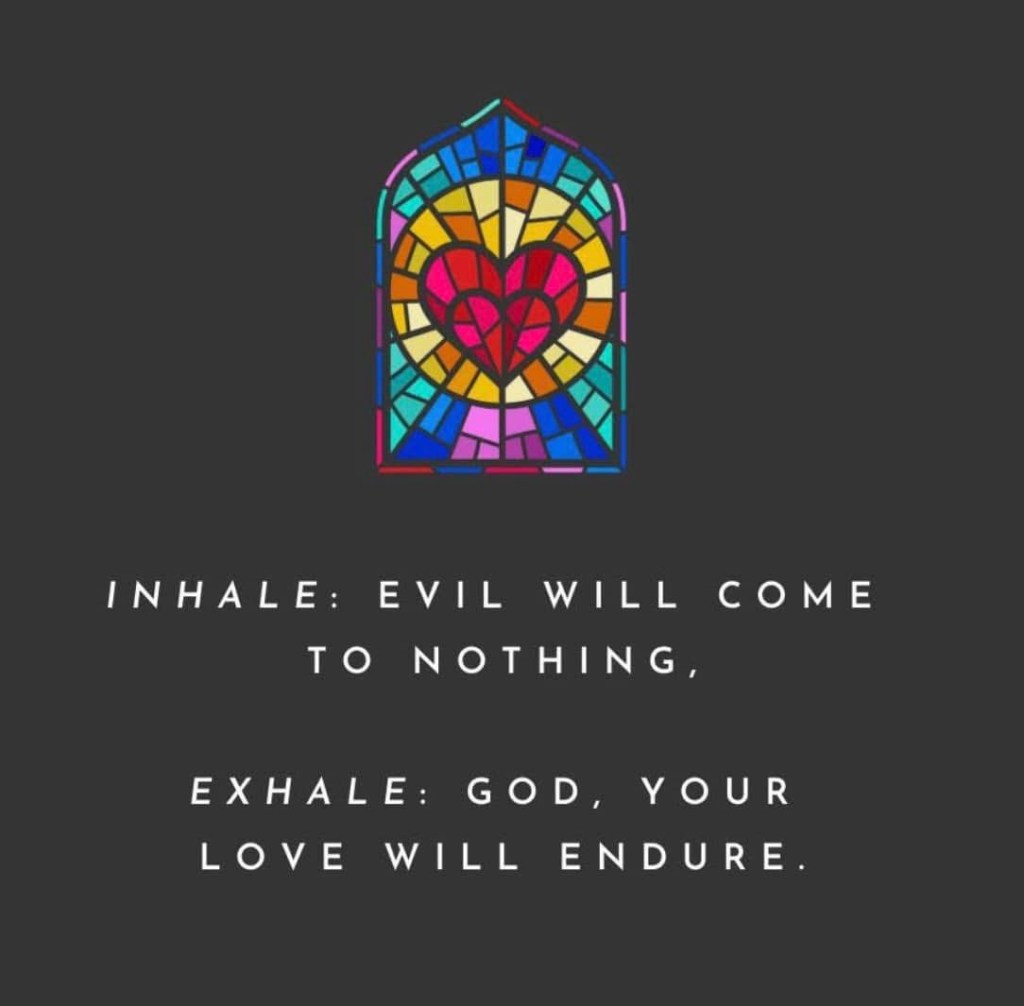
Breathe in the day, full of life and possibility. Breathe out the stress, the worry, the defeat.
In.
Out.
In.
Out.
In.
And for a more guided practice consider adding these words to your breath, suggested by my former pastor John Foster:
Do not lose heart. The challenges you see today are the ones you must face. You are strong enough to do your part, and you will find allies everywhere you look.
Do not be afraid.
You may feel you are riding on stormy seas, but look around you. In the words of Dr. Clarissa Pinkola Estes:
Look out over the prow; there are millions of boats of righteous souls on the waters with you. Even though your veneers may shiver from every wave in this stormy roil, I assure you that the long timbers composing your prow and rudder come from a greater forest. That long-grained lumber is known to withstand storms, to hold together, to hold its own, and to advance, regardless.
In any dark time, there is a tendency to veer toward fainting over how much is wrong or unmended in the world. Do not focus on that. There is a tendency, too, to fall into being weakened by dwelling on what is outside your reach, by what cannot yet be. Do not focus there. That is spending the wind without raising the sails.
We are needed, that is all we can know. And though we meet resistance, we more so will meet great souls who will hail us, love us and guide us, and we will know them when they appear. Didn’t you say you were a believer? Didn’t you say you pledged to listen to a voice greater? Didn’t you ask for grace? Don’t you remember that to be in grace means to submit to the voice greater?
Ours is not the task of fixing the entire world all at once, but of stretching out to mend the part of the world that is within our reach. Any small, calm thing that one soul can do to help another soul, to assist some portion of this poor suffering world, will help immensely. It is not given to us to know which acts or by whom, will cause the critical mass to tip toward an enduring good.
You do not need to do everything. Do what you can, where you can, with what you can. Your actions combined with actions from millions of like-minded individuals will make a difference for good.
No one knows what tomorrow will bring, and that can be frightening. We are in a volatile time. It helps to keep our attention on the present and what we can do here and now.
The great poets help calm our souls. Take comfort today from these tender words from Mary Oliver:
Be still, my soul, and steadfast. Earth and heaven both are still watching though time is draining from the clock and your walk, that was confident and quick, has become slow.
So, be slow if you must, but let the heart still play its true part. Love still as once you loved, deeply and without patience. Let God and the world know you are grateful. That the gift has been given.
+ Mary Oliver
We do not know what tomorrow brings, but we will approach it with full souls, grateful and loving, ready to meet the day with a steadfast heart.
Are these the times that try people’s souls? What does it mean to have your soul tried anyway?
I’ve been thinking about this picture:
Those faces, contorted in rage, caught for history. This picture, reflecting a military presence during school desegregation, anticipating, presumably, a violent reaction from the mob, freezes a moment in history. I wonder how those women feel looking back on it. Would they be ashamed to have been part of a mob hurling epithets at this young woman? Would they feel contrition?
That period in history was certainly turbulent. Fraught with animosity directed at those seeking an education, because of the color of their skins, the women in the crowd wear their anger and hate openly in their faces.
We too are in turbulent times. Whole industries are churning out content intended to divide us, to make us hate others like the women in this picture? We are fed misinformation and disinformation designed to further these divides. Presumably the motive for this hate industry is profit, but at what expense? Will this hate-filled rhetoric cost souls?
It will certainly try them, and it is our job to protect our souls. To listen deep to the wisdom that seeks love and peace, harmony and cooperation. To deplug from the constant rhetoric of othering and hate.
It’s a loud angry world. Hush and listen to the harmony of your soul.