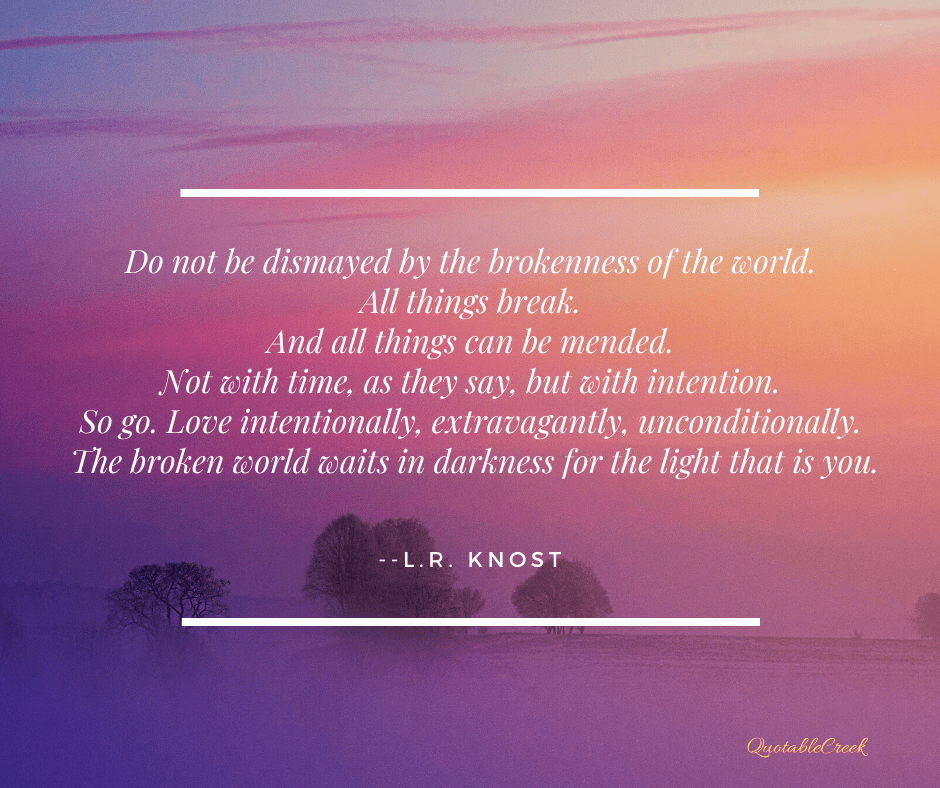
The light that is you.

All things break.

Including us.

Nothing lasts.

Including us.

And yet most of us internalize myths that we are meant to live pain-free lives and that there is always more time. How much more could we accomplish if we embrace the reality instead?

We’re breakable. But our vulnerability is our strength. And when we mend from something painful, we are likely to have tools and skills and sensitivities that may help us and make us more empathic going forward. Breaking and mending is part of growth. Part of change. Part of evolving. To be scared of breaking is to be scared of living.

Time’s short. Now is the time to reach out, apologize, help…whatever it is you’re waiting for a different day to do. There is no promised day. Things don’t just happen. Time doesn’t heal all wounds. We help heal the broken world, and our own broken selves, by continuing to love even in the darkness.

Binding up wounds.

So much of our suffering is invisible. Loneliness, sorrow, depression, not fitting in. We can bind up our own cuts and scrapes, but how do we bind up those kind of wounds?

There is an old parable about heaven and hell. In both, people are forced to eat with spoons that are too long to feed themselves. In hell, they are starving. In heaven, they feed each other.

When it comes to these invisible hurts, we are healed by kindness, one to another. We don’t know when we are being kind that it may help someone, but it certainly can’t hurt. And it may be just the long-spooned nourishment that someone else needs.

To inspire acts of kindness today, watch this video of a poor baby elephant stuck in a muddy hole. The gratitude its mother shows its rescuers will melt your heart.

Embracing life.

Reading history is one of the best ways ironically to really enter the present. As James Baldwin says:

One must say Yes to life and embrace it whenever it is found — and it is found in terrible places; nevertheless, there it is.
For nothing is fixed, forever and forever and forever, it is not fixed; the earth is always shifting, the light is always changing, the sea does not cease to grind down rock. Generations do not cease to be born, and we are responsible to them because we are the only witnesses they have.
The sea rises, the light fails, lovers cling to each other, and children cling to us. The moment we cease to hold each other, the moment we break faith with one another, the sea engulfs us and the light goes out. ~James Baldwin

We look at our past and see people making their ways, making mistakes, celebrating triumphs, struggling but then getting back up. And this is true during objectively awful times of war or suffering as well as in more relatively peaceful times. People go on. They find a way to come together, to survive, to do better.

I wonder what historians will say fifty years from now about the times we are in right now. Will they point to the divisions between us or the attempts to heal and grow. Will they see in us the grit and forbearance we can recognize in our ancestors?

Little band of heroes.

All we face now can feel overwhelming. It’s as if everywhere you turn, there is another challenge and another threat. And yet, even if the midst of all that is wrong, there are opportunities to shine the light, to be a voice for good, and to support others. Yes, it looks bleak now, but we are still here to do some good:

“Yes, it looks bleak. But you are still alive now. You are alive with all the others, in this present moment. And because the truth is speaking in the work, it unlocks the heart. And there’s such a feeling and experience of adventure. It’s like a trumpet call to a great adventure. In all great adventures there comes a time when the little band of heroes feels totally outnumbered and bleak, like Frodo in Lord of the Rings or Pilgrim in Pilgrim’s Progress. You learn to say ‘It looks bleak. Big deal, it looks bleak.’”
— Joanna Macy

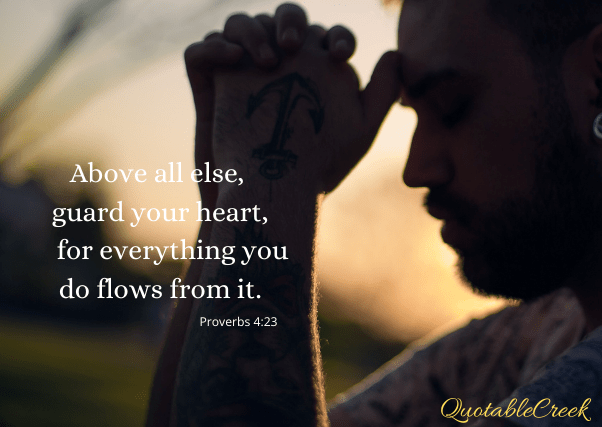
Guarding your heart.

In this world of instant ‘news’ and polarized camps, it is difficult to siphon off the untrue, inflammatory, and malicious from the true, helpful, and conciliatory. 

This is particularly true when we learn that one of the goals of social media is to monetize our attention. In the stunning must-see documentary, The Social Dilemma on Netflix, creators of popular social media sites like Facebook and Pinterest discuss how they have monetized their apps to drive profit. The apps are free to use. What is for sale is…you. Your attention. Your time. Your behavior. 

What you click on, how long you look at it, and how you react is all measured. Complex algorithms calculate what data to show you based on what you are most likely to click. If you click on articles on empathy, you’ll be shown more stories on empathy. And if you click on dark or divisive articles, you will get more of same. Meanwhile, each of those clicks is a pay out from those seeking to put their messages into your head. The algorithms aren’t based on whether the content is good for you to view; they are based on what you are most likely to click. It is not hard to see how someone can become radicalized if they follow one of the darker holes further and further down.

So what to do? First, maybe affirm a universal truth. We want to make our decisions based on reality, not lies. We want to conform our understanding to facts, not alter the facts to fit our understanding. It’s as if there is a map to our destination. When we realize we are off course to a place we want to be, we change course, we don’t rewrite the map.

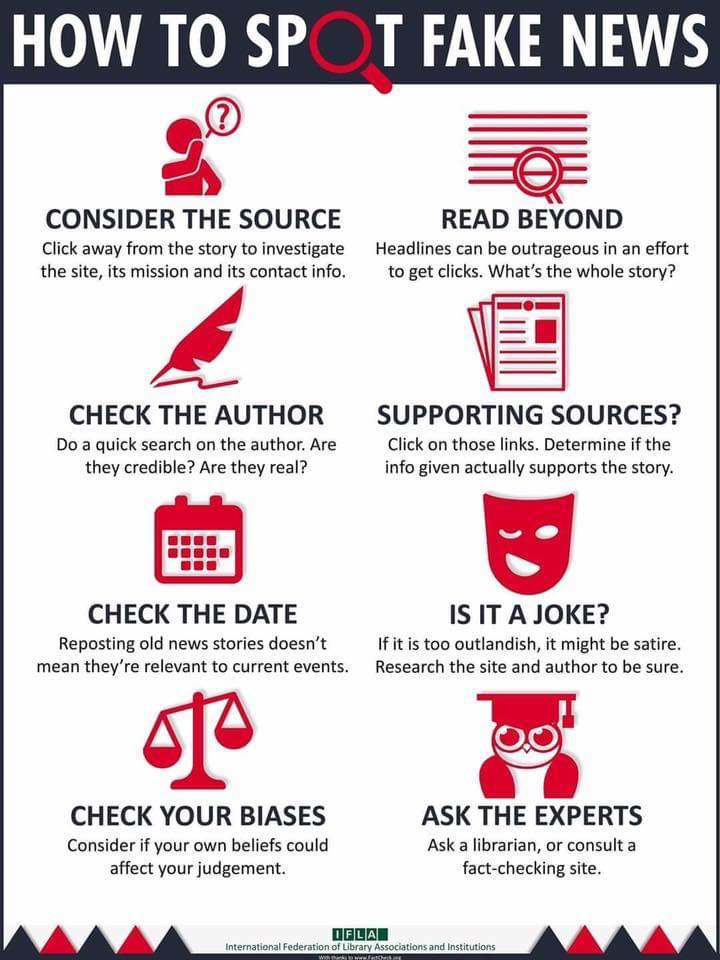
Second, consider your sources. Are they reputable? Rather than feeding the narrative you may want to hear, do they present the issues fairly and with minimal bias? If you are constantly being fed information that doesn’t square with what you see and hear happening around you, change up your sources.

Finally, read broadly. Don’t rely on a single person or news source. With respect to social media, seek out reliable sources directly and go to their sites to read the articles rather than clicking on a tempting link. We can be better informed than ever before, but we need to be intentional about it rather than passively wait for ‘news’ articles to pop up on your Facebook feed.

Social media is a powerful tool, but, like any tool, it can be a force for both good and bad. We need to be wary consumers and protect ourselves from being manipulated solely by advertisers trying to make a dime without regard to whether what they are showing us is true or decent. We need to guard our hearts, not to shelter ourselves from bad news or hurt in the world, but to keep ourselves from falling victim to fraud and deceit and unwittingly perpetuating false narratives ourselves.

Have you fallen for fake news lately? What steps have you taken to make sure you are reading and passing on reliable information? 

I recently clicked on an article purporting to be a response from someone who had been silent on a current political issue. I fell for the ‘Check the Date’ problem above. The article was from about four years ago. That person was still being silent on the current issue, so I didn’t get any new information, but that duplicitous advertiser made some money off my click. 

How about you?

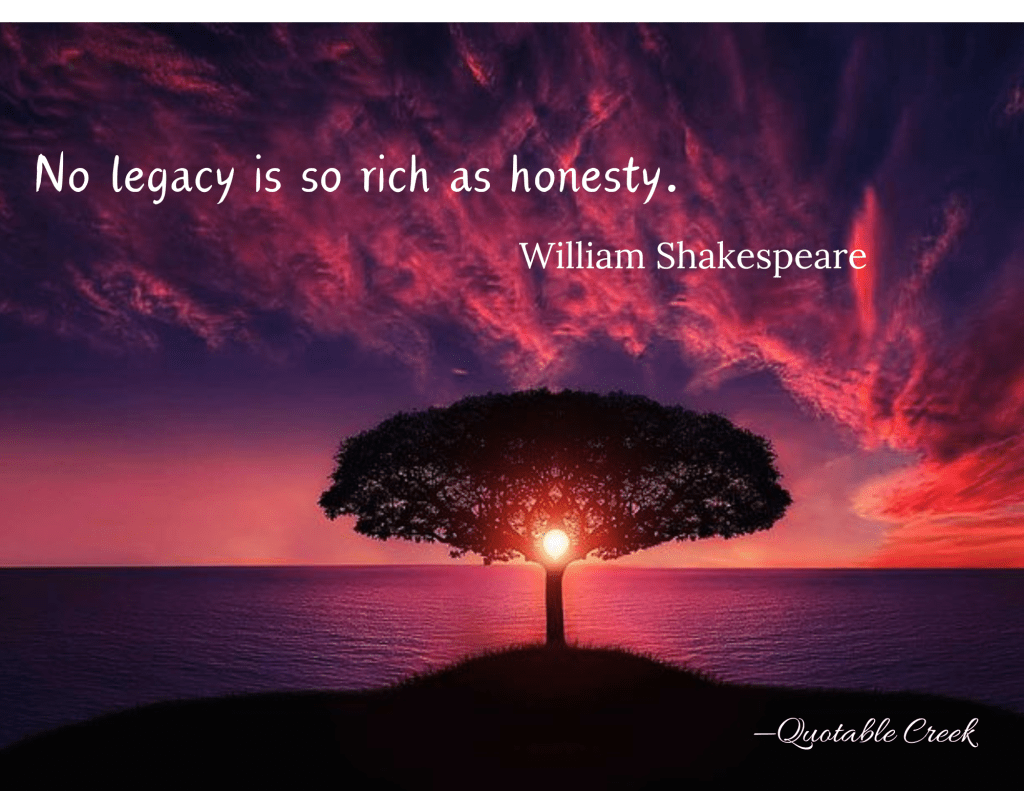
Honesty legacy

In order to make good decisions, you need the foundation of the truth. Double check, triple check, go directly to the sources. And if your understanding of what is true changes, so must your behavior.

As M. Scott Peck said:

Truth or reality is avoided when it is painful. We can revise our maps only when we have the discipline to overcome that pain. To have such discipline, we must be totally dedicated to truth.

‘Revising our maps’ is his way of saying adjust our world view, our sense of what is right or wrong, our conclusions about happened. Bottom line: We will simply not get anywhere near where we want to go if we are operating with faulty maps.

Too many people these days are trying to adjust the ‘facts’ to conform to their world view (with misinformation or disinformation) rather than the other way around.

Misery won’t touch you gentle.

Oh, child. How I wish for you to have a life without misery and heartache, a world without disillusionment and betrayal, a childhood unmarred by neglect or abuse, a journey without conflict. But, alas, that will not be. We do not live in a utopian world, but here in this world, and you will  know sorrow and pain and, as much as I would love to shield and protect you from it, I cannot. There will be dark days, my love.

But you are brighter than the darkness, and, even in your misery, you will find a way to shine. And when you are at your lowest point, I will be there beside you knowing that you will rise again and that this pain will make you more compassionate and humble, more honest and fierce, more determined to make this world a more perfect place, because you, my beautiful child, are not meant to be kept down in the darkness, but to shine.

Stand where the light is shining.

Sometimes, when we feel down, we need to evaluate the input coming into our lives. Are we steeped in negativity? Maybe not just news, but the vitriol that follows it in the comments? The political back and forth can get ugly and pull us down. And then we can think about the friends we surround ourselves with. Are they upbeat, trying to make things better, or always complaining? 

And, while we don’t want to retreat from fighting the good fight or the friends who are going through a rough patch, it’s so easy for people to tear things down, to find the flaws, to make a conflict, and, when we are around that kind of energy constantly, we can feel beaten down. 

But, there is good news to be had, and there are positive people and opportunities to be found. Sometimes we need to focus our attention there, if only for a break from the storm.

Expect the unexpected.

The world is changing and unpredictable. It’s hard to know how to plan for our futures.

What will tomorrow bring?

One thing is sure, ten years from now, things will not be like they are today. Rather than consternate over it, maybe it’s easier to learn how to be adaptable.

Crocodile tears.

Crocodile tears. Derived from an ancient anecdote that crocodiles shed tears for the creature they are eating; the phrase has come to refer to a hypocritical display of false emotion. Insincerity. Sometimes worse– a show of emotion to lull someone in to sharing their story or revealing their vulnerabilities only to use that information against them. Dante reserved his 8th circle of Hell (out of 9, with 9 being worst) for the fraudulent–the hucksters, the corrupt politicians, the panderers and seducers, the false teachers, the perjurers and liars.

Why are they so bad? Perhaps it is because trust is so sacred, a bridge to community, a link between people that keeps us all from chucking it and living like recluses behind a bush. But also, perhaps it is because we do not come with built in BS meters. We are born trusting; we have to learn cynicism. And the way we learn that is to be let down, over and over, by the insincere. And when that harm makes us close off and guard, we become less than what we really are.

So the solution, it seems, is to fight back, not with insincerity of our own, but with authenticity and vulnerability come what may, to keep putting it out there every day, in every circumstance with truth and love and a whole heart. To be sincere. Authenticity and sincerity will help heal those damaged by crocodile tears, and they definitely won’t land us in one of Dante’s circles.