Giving up control.

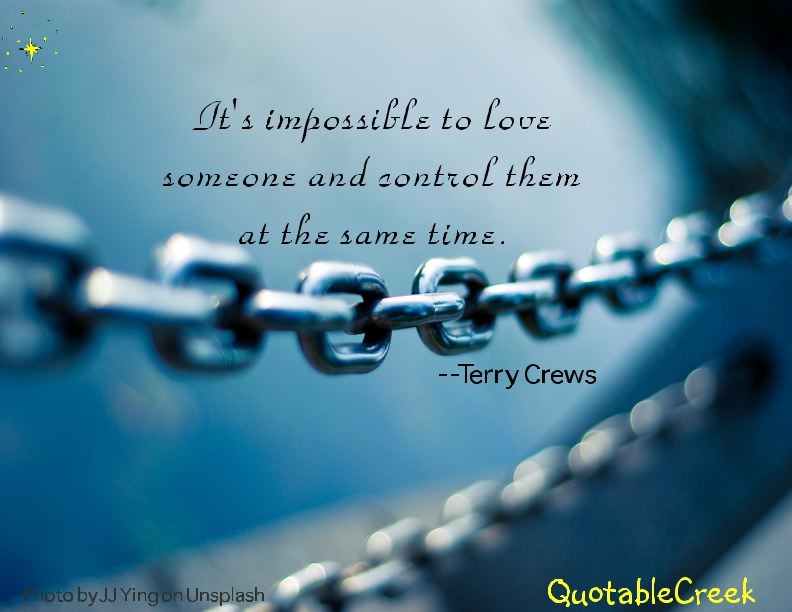
We want to support the people we love as they go through difficult times, but how often does that support turn into telling them what to do or criticizing them for what they’ve done? How often does it make our loved one feel smaller or shamed or detached? What message does our trying to control them or the situation send them about our confidence in their abilities to handle the curve balls that life throws at us all?

In this powerful column on the concept of holding space, Heather Plett explains how we can show up for the people we care about without controlling them or the outcome, how our presence can be constructive rather than destructive, how we can offer support in a healthy way. She learned these lessons from Ann, a palliative care nurse who helped her deal with the challenges of her aging mother’s impending death. Here are Heather’s eight take-aways:

  1. Give people permission to trust their own intuition and wisdom. When we were supporting Mom in her final days, we had no experience to rely on, and yet, intuitively, we knew what was needed. We knew how to carry her shrinking body to the washroom, we knew how to sit and sing hymns to her, and we knew how to love her. We even knew when it was time to inject the medication that would help ease her pain. In a very gentle way, Ann let us know that we didn’t need to do things according to some arbitrary health care protocol – we simply needed to trust our intuition and accumulated wisdom from the many years we’d loved Mom.
  2. Give people only as much information as they can handle. Ann gave us some simple instructions and left us with a few handouts, but did not overwhelm us with far more than we could process in our tender time of grief. Too much information would have left us feeling incompetent and unworthy.
  3. Don’t take their power away. When we take decision-making power out of people’s hands, we leave them feeling useless and incompetent. There may be some times when we need to step in and make hard decisions for other people (ie. when they’re dealing with an addiction and an intervention feels like the only thing that will save them), but in almost every other case, people need the autonomy to make their own choices (even our children). Ann knew that we needed to feel empowered in making decisions on our Mom’s behalf, and so she offered support but never tried to direct or control us.
  4. Keep your own ego out of it. This is a big one. We all get caught in that trap now and then – when we begin to believe that someone else’s success is dependent on our intervention, or when we think that their failure reflects poorly on us, or when we’re convinced that whatever emotions they choose to unload on us are about us instead of them. It’s a trap I’ve occasionally found myself slipping into when I teach. I can become more concerned about my own success (Do the students like me? Do their marks reflect on my ability to teach? Etc.) than about the success of my students. But that doesn’t serve anyone – not even me. To truly support their growth, I need to keep my ego out of it and create the space where they have the opportunity to grow and learn.
  5. Make them feel safe enough to fail. When people are learning, growing, or going through grief or transition, they are bound to make some mistakes along the way. When we, as their space holders, withhold judgement and shame, we offer them the opportunity to reach inside themselves to find the courage to take risks and the resilience to keep going even when they fail. When we let them know that failure is simply a part of the journey and not the end of the world, they’ll spend less time beating themselves up for it and more time learning from their mistakes.
  6. Give guidance and help with humility and thoughtfulness. A wise space holder knows when to withhold guidance (ie. when it makes a person feel foolish and inadequate) and when to offer it gently (ie. when a person asks for it or is too lost to know what to ask for). Though Ann did not take our power or autonomy away, she did offer to come and give Mom baths and do some of the more challenging parts of caregiving. This was a relief to us, as we had no practice at it and didn’t want to place Mom in a position that might make her feel shame (ie. having her children see her naked). This is a careful dance that we all must do when we hold space for other people. Recognizing the areas in which they feel most vulnerable and incapable and offering the right kind of help without shaming them takes practice and humility.
  7. Create a container for complex emotions, fear, trauma, etc. When people feel that they are held in a deeper way than they are used to, they feel safe enough to allow complex emotions to surface that might normally remain hidden. Someone who is practiced at holding space knows that this can happen and will be prepared to hold it in a gentle, supportive, and nonjudgmental way. In The Circle Way, we talk about “holding the rim” for people. The circle becomes the space where people feel safe enough to fall apart without fearing that this will leave them permanently broken or that they will be shamed by others in the room. Someone is always there to offer strength and courage. This is not easy work, and it is work that I continue to learn about as I host increasingly more challenging conversations. We cannot do it if we are overly emotional ourselves, if we haven’t done the hard work of looking into our own shadow, or if we don’t trust the people we are holding space for. In Ann’s case, she did this by showing up with tenderness, compassion, and confidence. If she had shown up in a way that didn’t offer us assurance that she could handle difficult situations or that she was afraid of death, we wouldn’t have been able to trust her as we did.
  8. Allow them to make different decisions and to have different experiences than you would. Holding space is about respecting each person’s differences and recognizing that those differences may lead to them making choices that we would not make. Sometimes, for example, they make choices based on cultural norms that we can’t understand from within our own experience. When we hold space, we release control and we honour differences. This showed up, for example, in the way that Ann supported us in making decisions about what to do with Mom’s body after her spirit was no longer housed there. If there had been some ritual that we felt we needed to conduct before releasing her body, we were free to do that in the privacy of Mom’s home.

That #4 is a tough one, yes? We want to be important; we want to save the day; we think we know best. But giving others a safe place to find their own path forward empowers them to meet future challenges with resilience and courage. If they are dependent on us and our ‘wisdom’, they may not trust their own abilities. And, let’s be honest, do we really have all the answers anyway; isn’t life surprising and full of struggles that we don’t anticipate fully? Don’t we all need to develop the resilience and courage to respond to these challenges?

For more on Terry Crews and the background of the powerful quote above, including his conclusion that we can evolve and change and do things better, go here.

What we must save is love.

It’s okay to be heartbroken for more than one group of people at the same time. When it comes to showing compassion, we don’t have to pick sides. Sometimes, often really, maybe even always, there is hurt and anguish everywhere, and we can mourn the lot of it.

Beware people who tell you not to be concerned for this group or that group and the hurt they feel.

Beware those who try to dehumanize others.

Beware those who lump you in as the ‘enemy’ for working to assure people are treated humanely.

Beware people who draw lines between us and them.

Beware those who try to limit you to a label or single identity.

Our hearts are big enough to embrace it all. What we must save is love.

Aging, well, gracefully?

There is a certain tipping point where life becomes weighted with loss. Things shift from everything out ahead to having a full past. In many ways, it is challenging, sad, and frustrating. But in some, it can be liberating.

Consider these words from Anne Lamott:

“So many indignities are involved in aging, and yet so many graces, too. The perfectionism that had run me ragged and has kept me scared and wired my whole life has abated. The idea of perfectionism at 60 is comical when, like me, you’ve worn non-matching black flats out on stage. In my experience, most of us age away from brain and ambition toward heart and soul, and we bathe in relief that things are not worse. When I was younger, I was fixated on looking good and impressing people and being so big in the world. By 60, I didn’t care nearly as much what people thought of me, mostly.”

“I do live in my heart more, which is hard in its own ways, but the blessing is that the yammer in my head is quieter, the endless questioning: What am I supposed to be doing? Is this the right thing? What do you think of that? What does he think of that?”

“A lot of us thought when we were younger that we might want to stretch ourselves into other areas, master new realms. Now, I know better. I’m happy with the little nesty areas that are mine. For some reason, I love my softer, welcoming tummy. I laugh gently more often at darling confused me’s spaced-outed ness, although I’m often glad no one was around to witness my lapses.”

It’s Good to Remember: We Are All on Borrowed Time,” by Anne Lamott.

I do ‘feel I live in my heart more’ as she notes. And that grief is keen and biting. Almost as if my mind is at war with itself, one half realizing that death is a natural part of life, inevitable. While the other half refuses to accept the new reality. And yet, ultimately, it is our impermanence that gives our lives luster and meaning. And acceptance, if it should come, may not bring comfort, but peace.

Tortoise and the hare

I’ve been watching Lessons in Chemistry, based on a wonderful book. One part stood out for me last night. A dog character, Six Thirty, remembers why his person, Calvin, said he loves running. Calvin said even when it is hard or you don’t think you can go on anymore, you just keep putting one foot in front of the other.

“One foot. One foot. And then sure enough, you’ll be home.”.

Isn’t that profound? In this life, we keep putting one foot in front of the other, until we’re home.

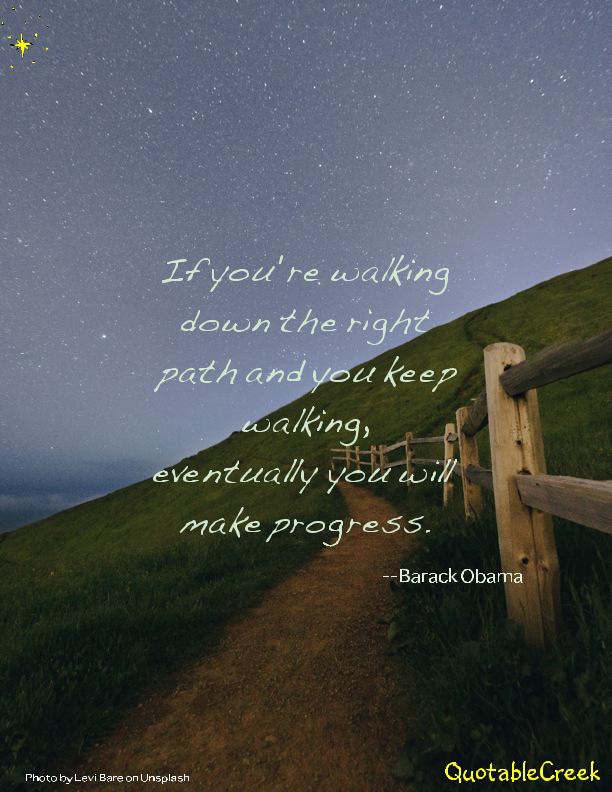
Slow and steady wins the race. We get discouraged and stop, or chase after another enticing goal, or turn back. But, if we stay true, we will make progress. One foot, one foot.

Remember the tortoise and the hare? They had a rematch recently:

This is my yopp.

Sometimes turning off the news is the best form of mental health protection.

But then we remember. In times of darkness, there are always those working to light a path, helping, fighting for the common good, making progress.

And maybe we, too, can help.

Maybe not in large, brokering peace kind of ways. But in small ways that, combined together with the small ways of many, many others, may help to right a wrong or turn a tide.

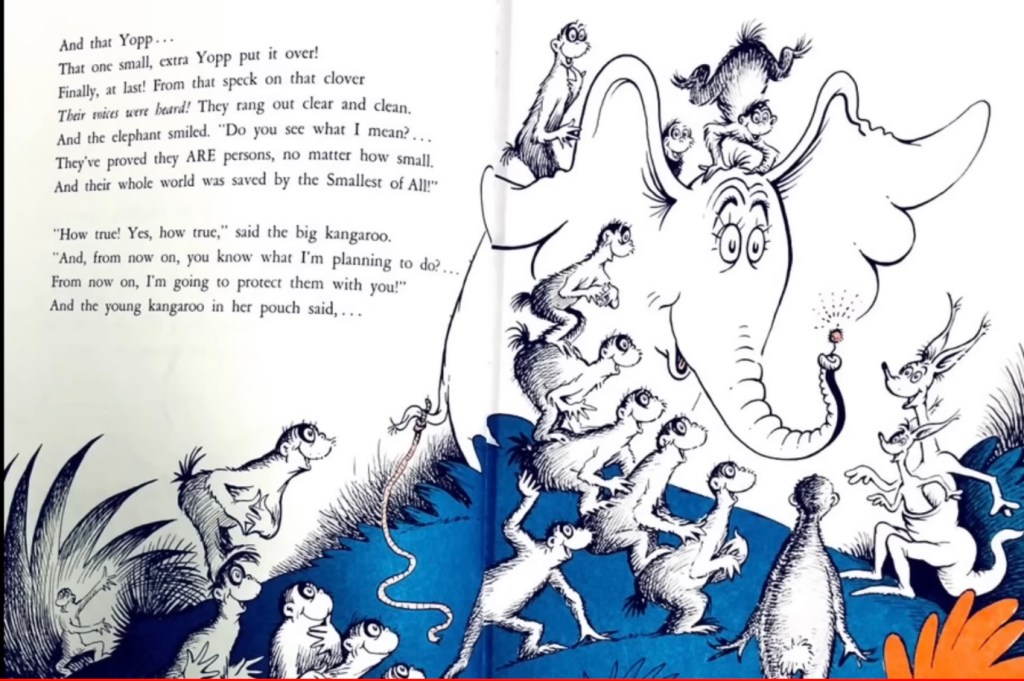
I think of Horton Hears a Who by Dr. Seuss, everyone shouting and banging on pots to be heard, but it is the final Yopp of a child that turns the tide, saving their world.

What is your ‘Yopp’?

Only the lonely

Hindsight often can give context and meaning to our struggles, perhaps no more than when we realize that our lowest times have helped someone else hold on. Some comfort, that.

And maybe, even when we don’t have the benefit of that hindsight, we can believe there is purpose and meaning in our difficulties even if we never do know it. Isn’t that the foundation of faith, that things will work together for good in a big picture way if not perhaps in the personal way? And isn’t that what can give us courage and strength to do our best, to hold on, and to persevere?

As Rainer Maria Rilke said:

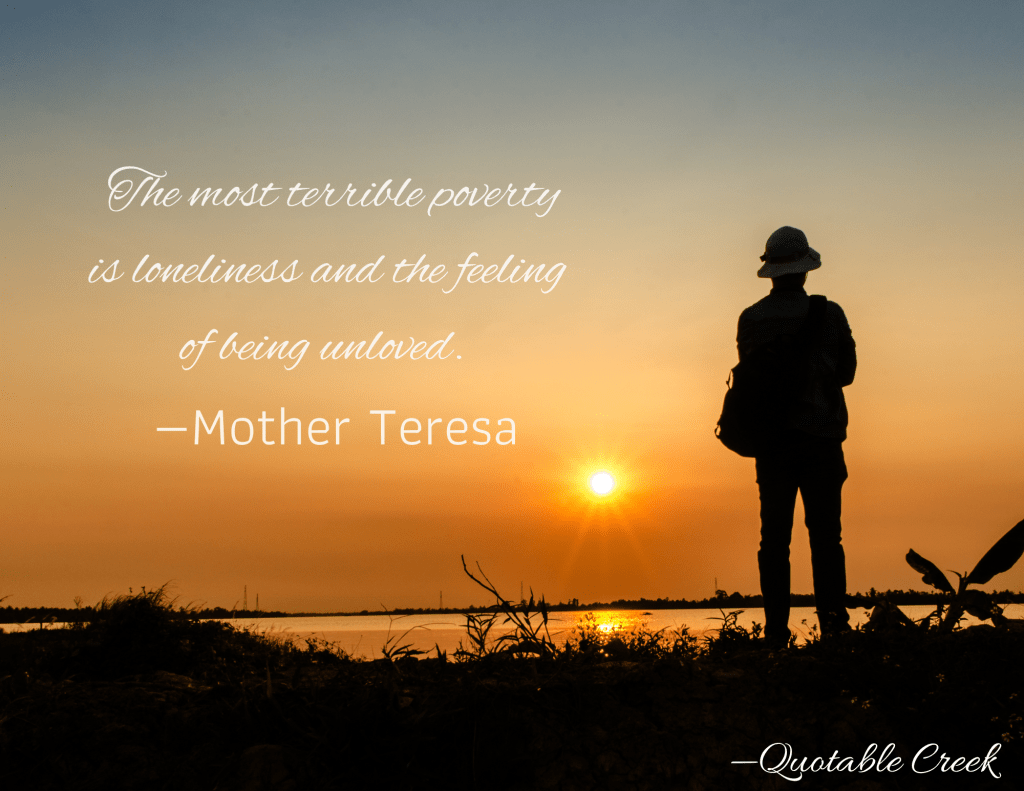
Among lonely people there is not a single one who can be sure that in his suffering he might not yet console someone else and that the gestures of his most personal helplessness, like so many cues and signals, might not serve as signs guiding the way in the realm of the unfathomable.

The Poet’s Guide to Life: The Wisdom of Rilke by Rainer Maria Rilke.

The world is a complicated, interconnected place, and we are all in it together.

Happy 4th

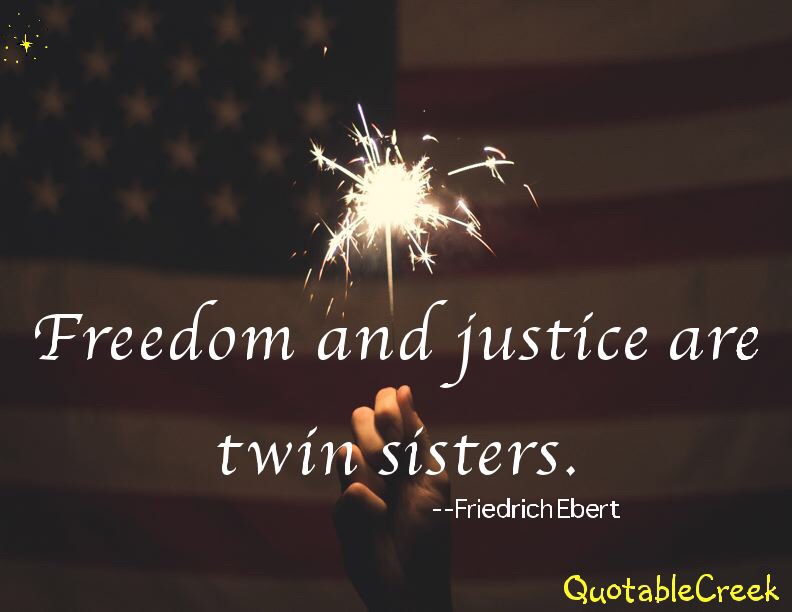
Today, in the United States, we celebrate a country that allows its citizens input into this remarkable experiment of a government of the people, by the people, and for the people. A government rejecting the reign of kings and queens born into their roles in favor of ordinary individuals working for the common good together.

We honor this country and its principles of equality, freedom, and justice for all. Our understanding of those concepts has evolved over time, and taken some steps back, but today let us be grateful for how far we’ve come and consider the steps that we each might take today and every day to make this country move closer to the ideals for which it stands. It is a privilege coupled with responsibility to be an American.

An apology that heals the hurt

“I’m sorry, but…” Some apologies make things better, and some just don’t. In fact, they might make things worse by blaming the person you hurt or showing that there is just no true awareness of what went wrong.

Generally, the apologies that have an excuse fall in the latter category. A good apology makes you feel seen and heard, that someone has looked at things from your point of view and understood the negative impact they have made. A good apology requires us to stand in the shoes of the person we’ve wronged and feel what they are feeling. Not what we would feel if we were in their shoes, but what they’re feeling.

Then, when we feel the harm we’ve caused, it should change us, make us not want to cause that harm again to that person or others, and make us want to make amends. It shouldn’t leave us where we were. If it does, if we repeat the same hurtful words or behavior, perhaps we haven’t yet done the work that goes into reconciliation.

Back into the other person’s shoes we go until we understand and grow. This is how progress is made, how relationships heal and grow stronger, how trust is restored. And, because we humans are very fallible creatures, it’s not a one and done thing, but a continuing process. Evaluating the effect we are having on people, making sure we are treading softly, taking responsibility and making amends when we don’t. Perhaps two steps forward, one step back, but staying in relationship, rebuilding trust, and moving forward together.

Mistake police

In this world of constant scrutiny and omnipresent recordings, mistakes seem to have moved from a necessary part of learning to an instant cause for condemnation.

We can all think back to learning to walk and talk or play a sport where the mistakes were a part of learning. Fear of falling down would keep everyone from walking. In order to learn how to make a basket, lots of shots will bounce off the rim and backboard.

When we moved on to raising children, focusing on the mistakes could cripple a child emotionally. Instead, we celebrated the steps forward, the successes. Noted the progress. We don’t expect a toddler to write a dissertation. We celebrate the milestones as they come.

I wonder if that approach would help move our troubled world forward. Celebrating the progress. Looking for the successes. Embracing the common ground. Letting everyone feel that they can continue to learn from their mistakes, that that is part of being human. A world with a little bit of breathing room. We all will mess up. We can show each other grace when we do.

Being the Hero of Your Own Life

When we think about our own personal heroes, can we see a pattern? How did they rise to the challenges presented in their day?

How are we rising to the occasions and the challenges presented in our time? Right now. Are there injustices we can speak up against? Are there places where our voices will make a difference? What are the rights and wrongs happening right now today?

I am about one-fourth of the way through Charles Dickens’s, David Copperfield. It’s astonishingly good, as are most of his books. And, like others, it calls out some of the injustices of his day—child labor, poorhouses, domestic violence, emotional cruelty, sexism, bullying and so on. With his wide audience and engaging stories, he had tremendous power and is credited for being the impetus for many social justice reforms.

However, he had his own blind spots.

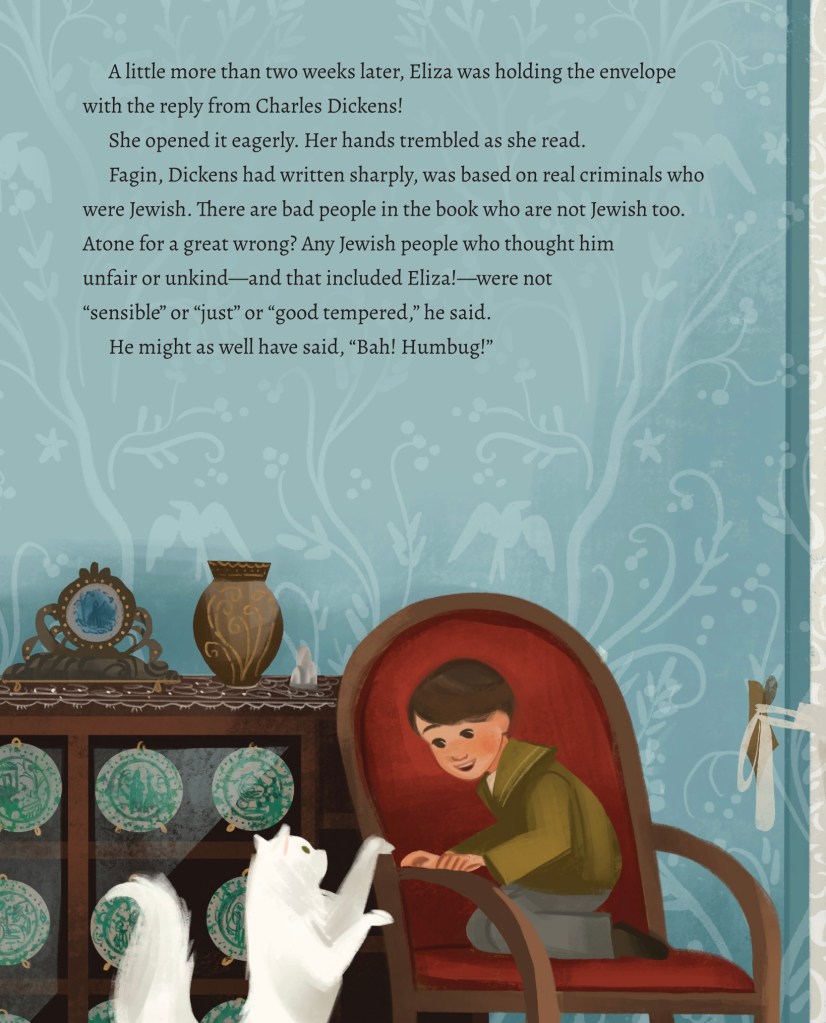
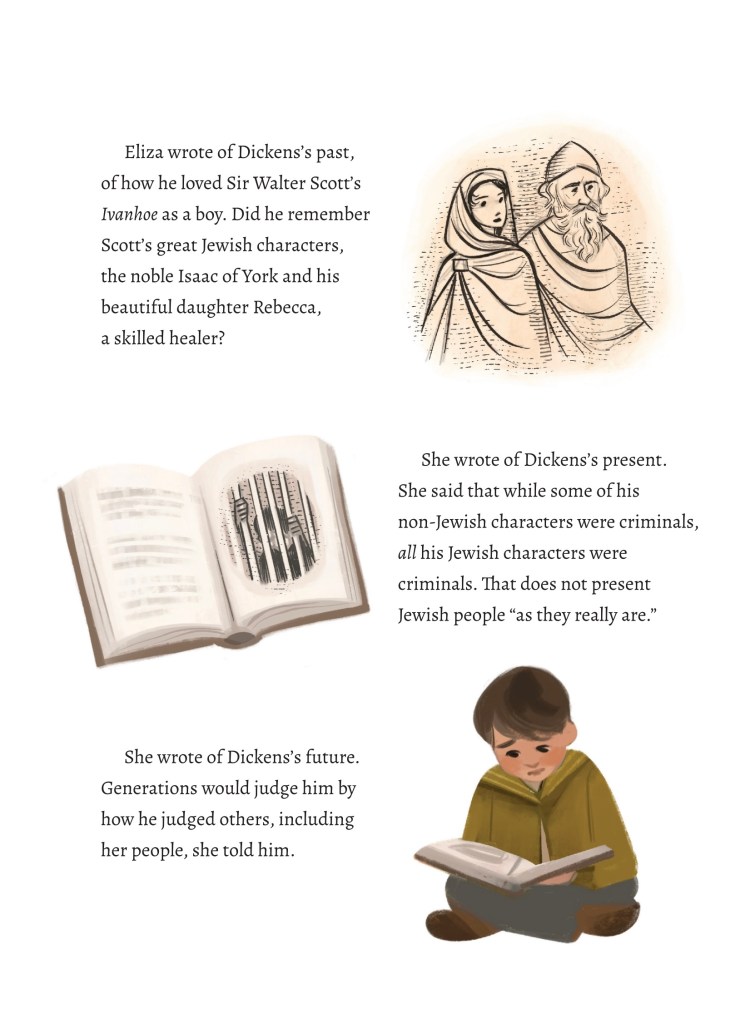
One reader, Eliza Davis, wrote to him, accusing him of portraying her people, those of Jewish ancestry, in stereotypical and negative ways. She cited Fagin, from Oliver Twist, a cruel and selfish man teaching young street urchins to steal. Eliza begged him to show more complexity in his Jewish characters.

Dickens was unimpressed.

Dear Mr. Dickens, By Nancy Churnin

However, taking a page from Dickens’ own, Christmas Carol and the transformation of Ebenezer Scrooge, Eliza wrote him again:

Dear Mr. Dickens, by Nancy Churnin

And this time, Dickens was moved. And changed. From then on, his Jewish characters were complex and kind, and the exchange between Eliza and Dickens is credited for having a part in reducing anti-Semitic views and laws of the day.

Eliza had the same tools at hand as Dickens himself: pen, paper, and a keen sense of justice. While she lacked his fame, she made up for it by essentially teaming with him to bring about change.

What are the injustices of our day? It can be challenging to see them, sometimes, because we’ve been so steeped in things the way they are, that they seem normal. But if we pretend we are explaining our world to an alien, for instance, we might be hard-pressed to answer some of their questions. It is in those places, those places we know to be wrong, that we can strive to be the heroes of our own lives.