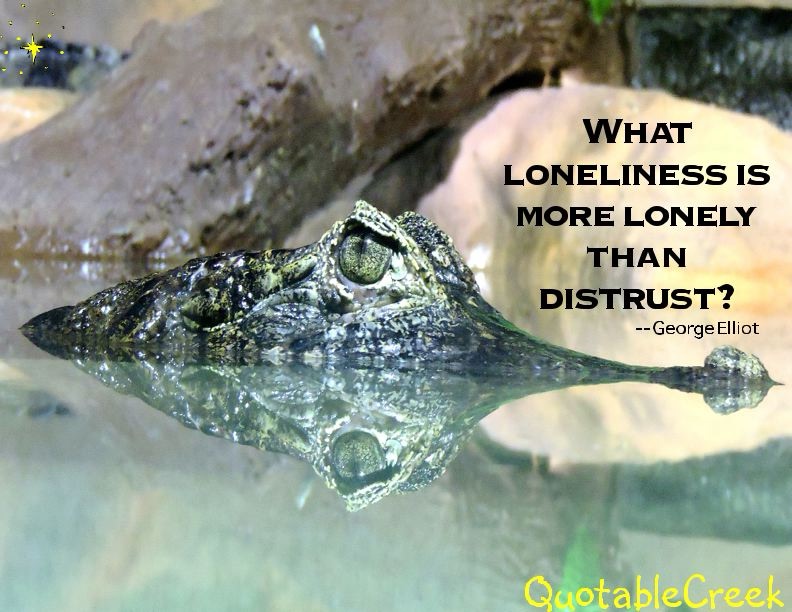
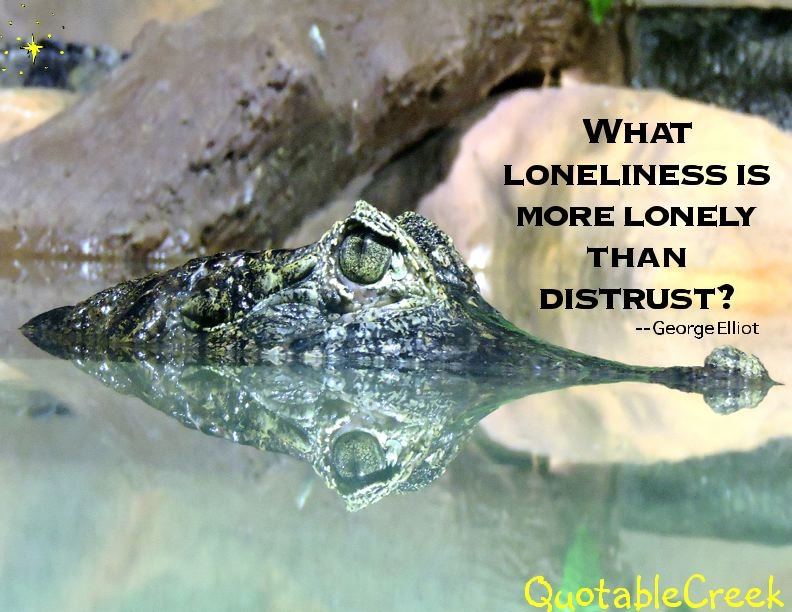
Crocodile tears. Derived from an ancient anecdote that crocodiles shed tears for the creature they are eating; the phrase has come to refer to a hypocritical display of false emotion. Insincerity. Sometimes worse– a show of emotion to lull someone in to sharing their story or revealing their vulnerabilities only to use that information against them. Dante reserved his 8th circle of Hell (out of 9, with 9 being worst) for the fraudulent–the hucksters, the corrupt politicians, the panderers and seducers, the false teachers, the perjurers and liars.
Why are they so bad? Perhaps it is because trust is so sacred, a bridge to community, a link between people that keeps us all from chucking it and living like recluses behind a bush. But also, perhaps it is because we do not come with built in BS meters. We are born trusting; we have to learn cynicism. And the way we learn that is to be let down, over and over, by the insincere. And when that harm makes us close off and guard, we become less than what we really are.
So the solution, it seems, is to fight back, not with insincerity of our own, but with authenticity and vulnerability come what may, to keep putting it out there every day, in every circumstance with truth and love and a whole heart. To be sincere. Authenticity and sincerity will help heal those damaged by crocodile tears, and they definitely won’t land us in one of Dante’s circles.
We don’t let just anyone see us vulnerable, hear our secret stories, watch us struggle. To most of the world, we carry a bit of a shield between them and our tender parts. But there are some few we trust to see the real person behind the mask. We must love those people very much to be so naked and exposed.
Because we need to lay those masks down sometimes, don’t we? We can’t live a life of posture. And so we seek out places where and people with whom we can relax and let down our hair, unafraid of judgment, unconcerned with being deemed eccentric. Perhaps to be part of nature, to rest among creation until we lose sight of where we stop and others begin.
In this poem, Mary Oliver takes us into her sacred space–the woods.
She must love us very much.
How I Go To the Woods
by Mary Oliver
Ordinarily, I go to the woods alone, with not a single friend, for they are all smilers and talkers and therefore unsuitable.
I don’t really want to be witnessed talking to the catbirds or hugging the old black oak tree. I have my way or praying, as you no doubt have yours.
Besides, when I am alone I can become invisible. I can sit on the top of a dune as motionless as an uprise of weeds, until the foxes run by unconcerned. I can hear the almost unhearable sound of the roses singing.
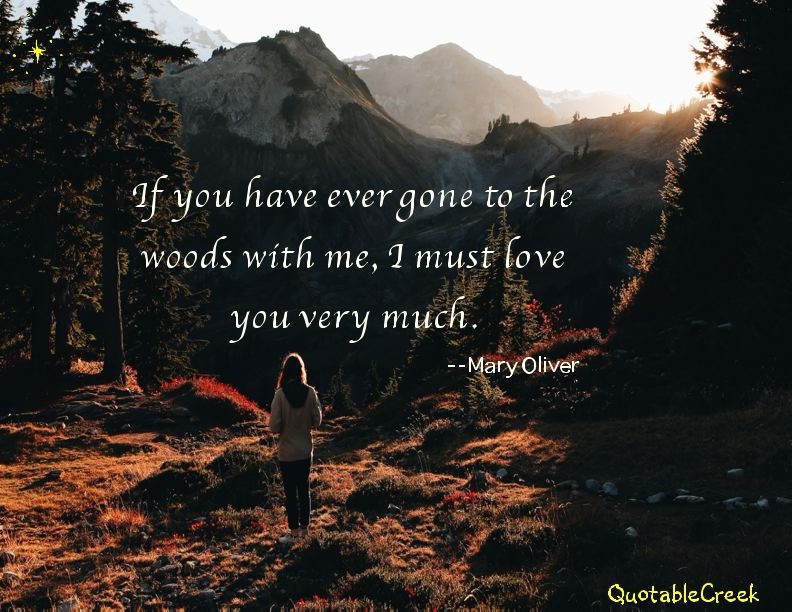
If you have ever gone to the woods with me, I must love you very much.
Crocodile tears. Derived from an ancient anecdote that crocodiles shed tears for the creature they are eating; the phrase has come to refer to a hypocritical display of false emotion. Insincerity. Sometimes worse– a show of emotion to lull someone in to sharing their story or revealing their vulnerabilities only to use that information against them. Dante reserved his 8th circle of Hell (out of 9, with 9 being worst) for the fraudulent–the hucksters, the corrupt politicians, the panderers and seducers, the false teachers, the perjurers and liars.
Why are they so bad? Perhaps it is because trust is so sacred, a bridge to community, a link between people that keeps us all from chucking it and living like recluses behind a bush. But also, perhaps it is because we do not come with built in BS meters. We are born trusting; we have to learn cynicism. And the way we learn that is to be let down, over and over, by the insincere. And when that harm makes us close off and guard, we become less than what we really are.
So the solution, it seems, is to fight back, not with insincerity of our own, but with authenticity and vulnerability come what may, to keep putting it out there every day, in every circumstance with truth and love and a whole heart. To be sincere. Authenticity and sincerity will help heal those damaged by crocodile tears, and they definitely won’t land us in one of Dante’s circles.
We have many words for lies: white lies, fudging, fibs, whoppers, but what is at the heart of each is knowingly substituting a different version of the facts for what we know is the truth. Sometimes, like with Wells Fargo and Bernie Madoff, the lies result in substantial financial gain for the liar and substantial loss for the victim.
What propels someone to lie so extravagantly or, even, at all?
Studies show that the big whoppers evolve from the littlest of lies: our brain changes as we lie, making us more and more willing to tell bigger and bigger lies:
A new study claims to provide the first empirical evidence showing that dishonesty gradually increases over time. By using scans that measured the brain’s response to lying, researchers saw that each new lie resulted in smaller and smaller neurological reactions ― especially in the amygdala, which is the brain’s emotional core.
In effect, each new fib appeared to desensitize the brain, making it easier and easier to tell more lies.
This is alarming, not just because it can lead to widespread fraud but also because a liar begins to live in an alternate reality. Over time, people can begin to believe the lies they tell themselves and others, putting them in a position where their beliefs just don’t square with the world they’re living in. They are constantly confronted with the disconnect between their altered reality and reality itself, leading to greater and greater anger and frustration. Sometimes those lies are self-delusional, leading people to never adequately address and progress beyond their own problems. In short, lies lead to fragmentation, discord, breach of trust, chaos.
Now, truth doesn’t always lead to harmony. Some truths lead to a road of very hard work, reconciliation, and compromise. But at the heart of telling the truth is an increase in trust which is the glue that binds a couple, a family, a community, a country, and is necessary for any true progress.
This moment we are in is but one in the collection of moments that make a life, a story, a history. Each moment building on the last, forward toward a powerful culmination. To stay hopeful and earnest in each moment, no matter how dire, is a testament to what we hold dear, to hope, to a belief that all things will ultimately work together for good.
As Howard Zinn says,
TO BE HOPEFUL in bad times is not just foolishly romantic. It is based on the fact that human history is a history not only of cruelty, but also of compassion, sacrifice, courage, kindness. What we choose to emphasize in this complex history will determine our lives. If we see only the worst, it destroys our capacity to do something. If we remember those times and places—and there are so many—where people have behaved magnificently, this gives us the energy to act, and at least the possibility of sending this spinning top of a world in a different direction. And if we do act, in however small a way, we don’t have to wait for some grand utopian future. The future is an infinite succession of presents, and to live now as we think human beings should live, in defiance of all that is bad around us, is itself a marvelous victory.
Do not give up on the beliefs you have. To be decent, kind, not returning hate for hate, to speak truth to power, to retain hope for a brighter future, a future willing to work for. That is a marvelous victory.
We are bombarded daily with stories of fraud, cheating, self-interest, and dishonesty. People talking over each other, shoving, hostile. Everything is so charged and hot. Sometimes it feels like the people who stoop to these tactics might win the race and that we should do it, too. Otherwise, the ‘bad’ side will triumph. And yet.
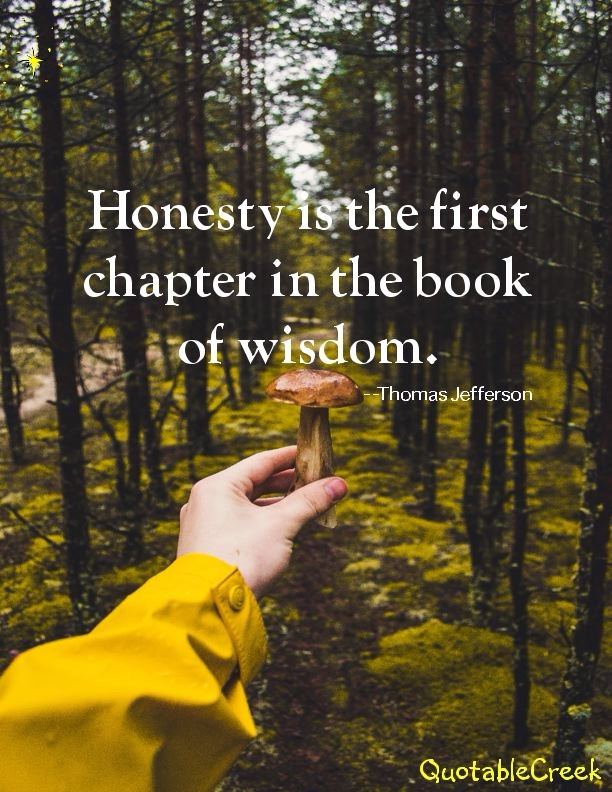
Honesty matters. Integrity matters. Truth matters. Fairness and justice matter. On the foundations of these qualities, trust is built.
Explaining her ‘go high’ comment, Michelle Obama says,
My answer is yes. We need to keep trying to go high. Operating with integrity matters. It will matter forever. It is a tool.
At the same time, though, I want to be clear: Going high is something you do rather than merely feel. It’s not some call to be complacent and wait around for change, or to sit on the sidelines as others struggle. It is not about accepting the conditions of oppression or letting cruelty and power go unchallenged. The notion of going high shouldn’t raise any questions about whether we are obligated to fight for more fairness, decency, and justice in this world; rather, it’s about how we fight, how we go about trying to solve the problems we encounter, and how we sustain ourselves long enough to be effective rather than burn out. There are some who see this as an unfair and ineffective compromise, an extension of respectability politics, in which we conform to rather than challenge the rules in order to get by. Why, people rightly wonder, do we need to try to be so reasonable all the time?
I can see how some think that reason leaves no room for rage. I understand the perception that going high means that you somehow remove yourself and remain unbothered by all that might otherwise gall and provoke you.
But it’s not that at all.
When I first said those words…, I was neither removed nor unbothered. In fact, I was pretty agitated….
But where was my actual power? I knew it didn’t reside in my hurt and rage, at least as they existed in raw forms. My power lay in whatever I could manage to do with that hurt and rage, where I could take it. It hinged on whether or not I could elevate those feelings into something that would become harder for others to write off, which was a clear message, a call to action, and a result I was willing to work for.
That’s what going high is for me. It’s about taking an abstract and usually upsetting feeling and working to convert it into some sort of actionable plan, to move through the raw stuff and in the direction of a larger solution.
I want to be clear that this is a process, and not always a quick one. It can take time and patience. It’s okay to sit and stew for a while, to live inside the agitation caused by injustice or fear or grief, or to express your pain. It’s okay to grant yourself the space you need to recover or heal. For me, going high usually involves taking a pause before I react. It is a form of self-control, a line laid between our best and worst impulses. Going high is about resisting the temptation to participate in shallow fury and corrosive contempt and instead figuring out how to respond with a clear voice to whatever is shallow and corrosive around you. It’s what happens when you take a reaction and mature it into a response.
Because here’s the thing: Emotions are not plans. They don’t solve problems or right any wrongs. You can feel them—you will feel them, inevitably—but be careful about letting them guide you. Rage can be a dirty windshield. Hurt is like a broken steering wheel. Disappointment will only ride, sulking and unhelpful, in the back seat. If you don’t do something constructive with them, they’ll take you straight into a ditch.
My power has always hinged on my ability to keep myself out of the ditch.
How often do we give others the benefit of the doubt? Do we assume the innocent explanation or conclude the worst? Are we patient, or do we pounce at the very first mistake someone makes in trying to get their thoughts out? Do we search for the best in others, or do we protect ourselves in advance about the damage we fear may be inevitable by opening our hearts to trusting someone again?
Wouldn’t it be lovely to live in a world where everyone gave everyone else the benefit of the doubt? Where perceived offenses weren’t allowed to fester and grow? Where there was trust?
Consider this beautiful poem on friendship by Dinah Maria Craik. Isn’t this how we would like to make each other feel?
Friendship
by Dinah Maria Craik
Oh, the comfort —
the inexpressible comfort of feeling safe with a person —
having neither to weigh thoughts nor measure words,
but pouring them all right out,
just as they are,
chaff and grain together;
certain that a faithful hand will take and sift them,
keep what is worth keeping,
and then with the breath of kindness blow the rest away.
We don’t let just anyone see us vulnerable, hear our secret stories, watch us struggle. To most of the world, we carry a bit of a shield between them and our tender parts. But there are some few we trust to see the real person behind the mask. We must love those people very much to be so naked and exposed.
Because we need to lay those masks down sometimes, don’t we? We can’t live a life of posture. And so we seek out places where and people with whom we can relax and let down our hair, unafraid of judgment, unconcerned with being deemed eccentric. Perhaps to be part of nature, to rest among creation until we lose sight of where we stop and others begin.
In this poem, Mary Oliver takes us into her sacred space–the woods.
She must love us very much.
How I Go To the Woods
by Mary Oliver
Ordinarily, I go to the woods alone, with not a single friend, for they are all smilers and talkers and therefore unsuitable.
I don’t really want to be witnessed talking to the catbirds or hugging the old black oak tree. I have my way or praying, as you no doubt have yours.
Besides, when I am alone I can become invisible. I can sit on the top of a dune as motionless as an uprise of weeds, until the foxes run by unconcerned. I can hear the almost unhearable sound of the roses singing.
If you have ever gone to the woods with me, I must love you very much.


 QuotableCreek.com