Guarding your heart.
In this world of instant ‘news’ and polarized camps, it is difficult to siphon off the untrue, inflammatory, and malicious from the true, helpful, and conciliatory. 

This is particularly true when we learn that one of the goals of social media is to monetize our attention. In the stunning must-see documentary, The Social Dilemma on Netflix, creators of popular social media sites like Facebook and Pinterest discuss how they have monetized their apps to drive profit. The apps are free to use. What is for sale is…you. Your attention. Your time. Your behavior. 

What you click on, how long you look at it, and how you react is all measured. Complex algorithms calculate what data to show you based on what you are most likely to click. If you click on articles on empathy, you’ll be shown more stories on empathy. And if you click on dark or divisive articles, you will get more of same. Meanwhile, each of those clicks is a pay out from those seeking to put their messages into your head. The algorithms aren’t based on whether the content is good for you to view; they are based on what you are most likely to click. It is not hard to see how someone can become radicalized if they follow one of the darker holes further and further down.

So what to do? First, maybe affirm a universal truth. We want to make our decisions based on reality, not lies. We want to conform our understanding to facts, not alter the facts to fit our understanding. It’s as if there is a map to our destination. When we realize we are off course to a place we want to be, we change course, we don’t rewrite the map.

Second, consider your sources. Are they reputable? Rather than feeding the narrative you may want to hear, do they present the issues fairly and with minimal bias? If you are constantly being fed information that doesn’t square with what you see and hear happening around you, change up your sources.

Finally, read broadly. Don’t rely on a single person or news source. With respect to social media, seek out reliable sources directly and go to their sites to read the articles rather than clicking on a tempting link. We can be better informed than ever before, but we need to be intentional about it rather than passively wait for ‘news’ articles to pop up on your Facebook feed.

Social media is a powerful tool, but, like any tool, it can be a force for both good and bad. We need to be wary consumers and protect ourselves from being manipulated solely by advertisers trying to make a dime without regard to whether what they are showing us is true or decent. We need to guard our hearts, not to shelter ourselves from bad news or hurt in the world, but to keep ourselves from falling victim to fraud and deceit and unwittingly perpetuating false narratives ourselves.
Have you fallen for fake news lately? What steps have you taken to make sure you are reading and passing on reliable information? 

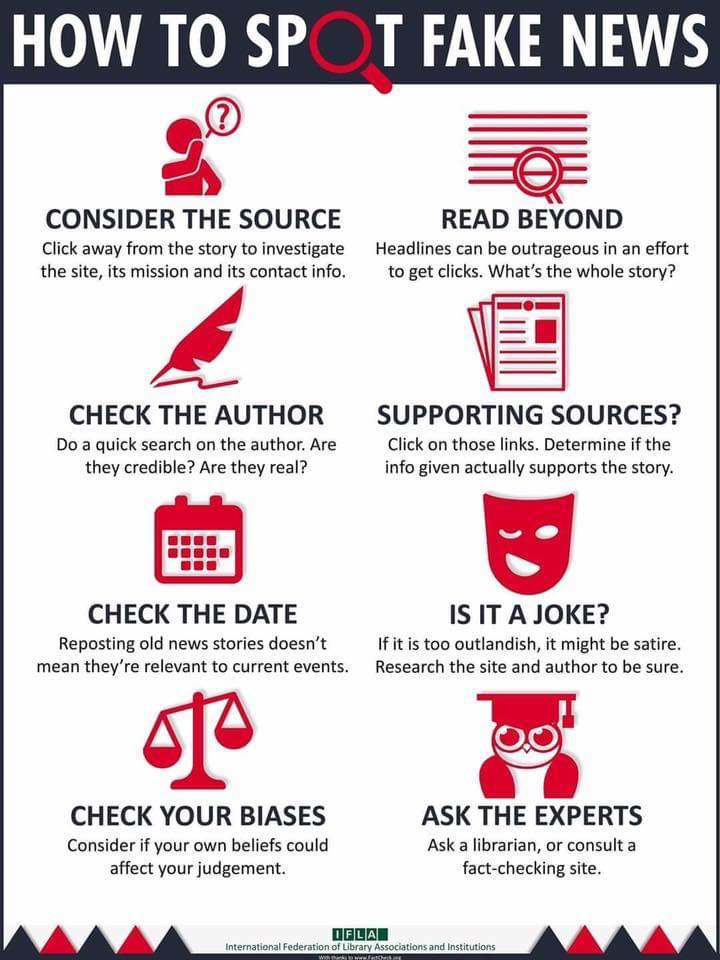
I recently clicked on an article purporting to be a response from someone who had been silent on a current political issue. I fell for the ‘Check the Date’ problem above. The article was from about four years ago. That person was still being silent on the current issue, so I didn’t get any new information, but that duplicitous advertiser made some money off my click. 

How about you?
Are we tending?

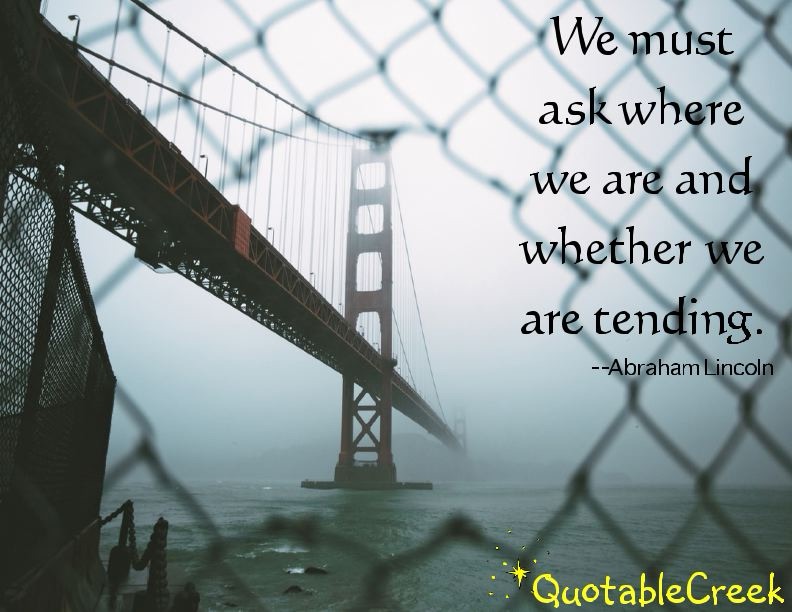
Tending is such a dear word, not much used these days. To tend: ‘to care or look after, to give one’s attention to’. Lincoln reminds us to ask where we are and whether we are tending. Where we are. Are we where we want to be? Are our relationships as tender and loving as we would like? Are we tending? Do we feel someone is tending to that relationship with us? Do we feel tended to?

What are the kind, gentle ways we can tend to our relationships?

When someone tells us they are sad their relationship with us isn’t better, is our first instinct to deflect, blame, ignore, change the subject, shrug, laugh? Or is to pause, breathe deep, and say, ‘Yes, I wish our relationship was closer, too. Where are we? Are we tending? What can we do to better tend our relationship and draw closer rather than shrug and pull away?’

The world is certainly full of shruggers who turn away even from their closest relationships in favor of new friends or less vulnerability. The shruggers, the cynics, the distancers, the superficial. So be it.

But God bless the tenders. That is where the heart is.

All the concentric circles of who we are.

We are complicated and carry with us all the ages we have been and life experiences we have had. As Sandra Cisneros put it:

What they don’t understand about birthdays and what they never tell you is that when you’re eleven, you’re also ten, and nine, and eight, and seven, and six, and five, and four, and three, and two, and one. And when you wake up on your eleventh birthday you expect to feel eleven, but you don’t.

So at 63, we can still long for a parent’s unconditional love rather than constant harsh judgment or expectation, or quiver in excitement over an upcoming holiday, or find ourselves sleepless over a stupid thing we said yet again. There is no ta-da moment where we wake up and suddenly make only good decisions and wise pronouncements.

It is all a becoming.

And hopefully those experiences we have had at all those prior ages help increase our empathy and understanding of others bumbling along, also becoming. Because what it really is, this thing called life, is putting one foot in front of the other and keeping on, striving.

Listening to our souls.

Are these the times that try people’s souls? What does it mean to have your soul tried anyway?

I’ve been thinking about this picture:

Those faces, contorted in rage, caught for history. This picture, reflecting a military presence during school desegregation, anticipating, presumably, a violent reaction from the mob, freezes a moment in history. I wonder how those women feel looking back on it. Would they be ashamed to have been part of a mob hurling epithets at this young woman? Would they feel contrition?

That period in history was certainly turbulent. Fraught with animosity directed at those seeking an education, because of the color of their skins, the women in the crowd wear their anger and hate openly in their faces.

We too are in turbulent times. Whole industries are churning out content intended to divide us, to make us hate others like the women in this picture? We are fed misinformation and disinformation designed to further these divides. Presumably the motive for this hate industry is profit, but at what expense? Will this hate-filled rhetoric cost souls?

It will certainly try them, and it is our job to protect our souls. To listen deep to the wisdom that seeks love and peace, harmony and cooperation. To deplug from the constant rhetoric of othering and hate.

It’s a loud angry world. Hush and listen to the harmony of your soul.

Guarding your heart.

In this world of instant ‘news’ and polarized camps, it is difficult to siphon off the untrue, inflammatory, and malicious from the true, helpful, and conciliatory. 

This is particularly true when we learn that one of the goals of social media is to monetize our attention. In the stunning must-see documentary, The Social Dilemma on Netflix, creators of popular social media sites like Facebook and Pinterest discuss how they have monetized their apps to drive profit. The apps are free to use. What is for sale is…you. Your attention. Your time. Your behavior. 

What you click on, how long you look at it, and how you react is all measured. Complex algorithms calculate what data to show you based on what you are most likely to click. If you click on articles on empathy, you’ll be shown more stories on empathy. And if you click on dark or divisive articles, you will get more of same. Meanwhile, each of those clicks is a pay out from those seeking to put their messages into your head. The algorithms aren’t based on whether the content is good for you to view; they are based on what you are most likely to click. It is not hard to see how someone can become radicalized if they follow one of the darker holes further and further down.

So what to do? First, maybe affirm a universal truth. We want to make our decisions based on reality, not lies. We want to conform our understanding to facts, not alter the facts to fit our understanding. It’s as if there is a map to our destination. When we realize we are off course to a place we want to be, we change course, we don’t rewrite the map.

Second, consider your sources. Are they reputable? Rather than feeding the narrative you may want to hear, do they present the issues fairly and with minimal bias? If you are constantly being fed information that doesn’t square with what you see and hear happening around you, change up your sources.

Finally, read broadly. Don’t rely on a single person or news source. With respect to social media, seek out reliable sources directly and go to their sites to read the articles rather than clicking on a tempting link. We can be better informed than ever before, but we need to be intentional about it rather than passively wait for ‘news’ articles to pop up on your Facebook feed.

Social media is a powerful tool, but, like any tool, it can be a force for both good and bad. We need to be wary consumers and protect ourselves from being manipulated solely by advertisers trying to make a dime without regard to whether what they are showing us is true or decent. We need to guard our hearts, not to shelter ourselves from bad news or hurt in the world, but to keep ourselves from falling victim to fraud and deceit and unwittingly perpetuating false narratives ourselves.

Have you fallen for fake news lately? What steps have you taken to make sure you are reading and passing on reliable information? 

I recently clicked on an article purporting to be a response from someone who had been silent on a current political issue. I fell for the ‘Check the Date’ problem above. The article was from about four years ago. That person was still being silent on the current issue, so I didn’t get any new information, but that duplicitous advertiser made some money off my click. 

How about you?
Choose truth.

We are in the midst of a slander epidemic. In today’s world, someone can publish fake news, and it can go viral, spreading around the world in an instant. People eagerly like and share derogatory information about people they don’t care for or political candidates they oppose. Companies can crumble based on the public’s wrath over a false bit of news. People’s lives can be ruined.

And what of the effect on all of us? It is to the point where we can’t trust much of anything we read unless we do our own diligence with fact checking and research.

What happened to the truth? What happened to accountability?

As with most things, the buck stops with each of us. We can’t control the world, but we can choose whether we want to further lies. Take your time before you believe what you hear. Do your research. And let your words and actions shine with the light of truth.

Honesty legacy

In order to make good decisions, you need the foundation of the truth. Double check, triple check, go directly to the sources. And if your understanding of what is true changes, so must your behavior.

As M. Scott Peck said:

Truth or reality is avoided when it is painful. We can revise our maps only when we have the discipline to overcome that pain. To have such discipline, we must be totally dedicated to truth.

‘Revising our maps’ is his way of saying adjust our world view, our sense of what is right or wrong, our conclusions about happened. Bottom line: We will simply not get anywhere near where we want to go if we are operating with faulty maps.

Too many people these days are trying to adjust the ‘facts’ to conform to their world view (with misinformation or disinformation) rather than the other way around.

The real things.

In this world of rapidly expanding AI capabilities and widespread misinformation, where are we to find our footing? What is real?

Let’s remember the true things, the unchanging things, and find our foothold there. As Laura Ingalls Wilder said:

The real things haven’t changed. It is still best to be honest and truthful; to make the most of what we have; to be happy with simple pleasures; and have courage when things go wrong.

And for more grounding, consider this passage from Philippians 4:8:

Finally, brethren, whatsoever things are true, whatsoever things are honest, whatsoever things are just, whatsoever things are pure, whatsoever things are lovely, whatsoever things are of good report; if there be any virtue, and if there be any praise, think on these things.

It may be harder to discern these things, but only the truth will provide a firm foundation for our thoughts, our opinions, our relationships, and our lives.

Edges called Perhaps.

How many angels can dance on the head of a pin? Is there any way we could ever truly know?

There are so many issues for which we may never have answers, true answers, like who’s ‘right’ and who’s ‘wrong’, and yet we cling to our answers as if our lives depend on it. And we cling to our questions, from our points of view, without realizing there are so many other questions that have equal or even more merit.

Consider Mary Oliver’s poem, Angels:

Is it possible that we aren’t even asking the right questions? Is there room for Perhaps in our edges?

Lying liars who lie.

Lie? Why not? Everyone does it, don’t they?

We have many words for lies: white lies, fudging, fibs, whoppers, but what is at the heart of each is knowingly substituting a different version of the facts for what we know is the truth. Sometimes, like with Wells Fargo and Bernie Madoff, the lies result in substantial financial gain for the liar and substantial loss for the victim.

What propels someone to lie so extravagantly or, even, at all?

Studies show that the big whoppers evolve from the littlest of lies: our brain changes as we lie, making us more and more willing to tell bigger and bigger lies:

A new study claims to provide the first empirical evidence showing that dishonesty gradually increases over time. By using scans that measured the brain’s response to lying, researchers saw that each new lie resulted in smaller and smaller neurological reactions ― especially in the amygdala, which is the brain’s emotional core.

In effect, each new fib appeared to desensitize the brain, making it easier and easier to tell more lies.

This is alarming, not just because it can lead to widespread fraud but also because a liar begins to live in an alternate reality. Over time, people can begin to believe the lies they tell themselves and others, putting them in a position where their beliefs just don’t square with the world they’re living in. They are constantly confronted with the disconnect between their altered reality and reality itself, leading to greater and greater anger and frustration. Sometimes those lies are self-delusional, leading people to never adequately address and progress beyond their own problems. In short, lies lead to fragmentation, discord, breach of trust, chaos.

Now, truth doesn’t always lead to harmony. Some truths lead to a road of very hard work, reconciliation, and compromise. But at the heart of telling the truth is an increase in trust which is the glue that binds a couple, a family, a community, a country, and is necessary for any true progress.