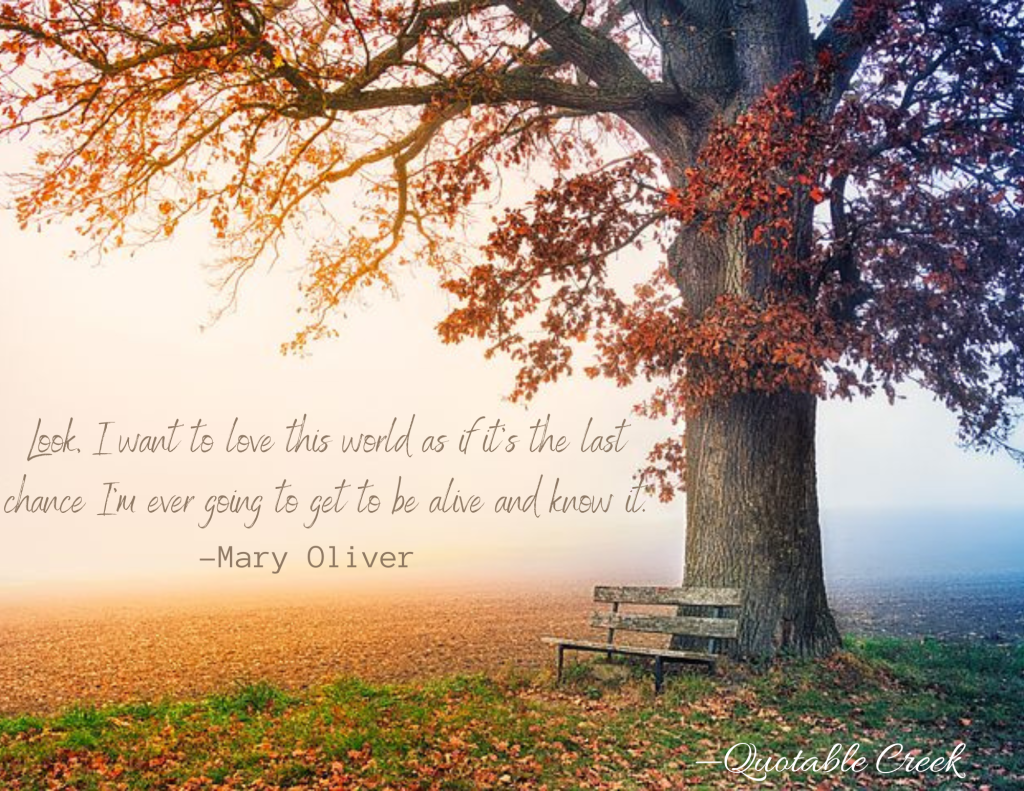
Now is our time to be alive. It will not come again. This is our last chance to savor nature and all of its wonder, to spend time with loved ones, to do good, to spread joy. This is it. This is our opportunity.
In the movie, Michael, an angel comes to Earth to influence the course of events. He, apparently, smells of cookies. But there is a scene, after ‘battle’ (he’s that kind of angel), when he is savoring the day. He is soaking it in, just enjoying being corporeal, waltzing with the breeze.
If only we could hold on to that wonder, awe, and appreciation, live in the moment, truly appreciate all we’ve been given here. What a fine world that would be.
Before his crucifixion, Jesus told his disciples: “Peace I leave with you; my peace I give you. I do not give to you as the world gives. Do not let your hearts be troubled and do not be afraid.” (John 14:27.)
Today, as we celebrate Easter, remember his words and his sacrifice. For a lovely story and song in the Easter spirit, go here:
Grace is upon us Open your heart It is done
Grace is upon us Open your heart This is love,
The Lord is here This is love
Come to the highest point of the mountain At the earliest possible moment
With appreciation to MovedByLove.com, consider this beautiful parable of a saint:
The story of the Holy Shadow Osho
There once lived a saint so good that the angels came from heaven to see how a man could be so godly. This saint went about his daily life diffusing virtue as the stars diffuse light and the flowers scent, without being aware of it. His day could be summed up by two words — he gave, he forgave — yet these words never passed his lips. They were expressed in his ready smile, his kindness, forbearance, and charity.
The angels said to God, “Lord, grant him the gift of miracles.”
God replied, “Ask what it is that he wishes.”
They said to the saint, “Would you like the touch of your hands to heal the sick?”
“No,” answered the saint. “I would rather God do that.”
“Would you like to convert guilty souls and bring back wandering hearts to the right path?”
“No, that is the angels’ mission. It is not for me to convert.”
“Would you like to become a model of patience, attracting men by the luster of your virtues, and thus glorifying God?”
“No,” replied the saint. “If men should be attracted to me, they would become estranged from God.” “What is it that you desire, then?” asked the angels.
“What can I wish for?” asked the saint smiling. “That God gives me his grace; with that would I not have everything?”
The angels said, “You must ask for a miracle, or one will be forced upon you.”
“Very well,” said the saint. “That I may do a great deal of good without ever knowing it.”
The angels were perplexed. They took counsel and resolved upon the following plan: every time the saint’s shadow fell behind him or to either side, so that he could not see it, it would have the power to cure disease, soothe pain, and comfort sorrow.
When the saint walked along, his shadow, thrown on the ground on either side or behind him, made arid paths green, caused withered plants to bloom, gave clear water to dried-up brooks, fresh color to pale children, and joy to unhappy men and women.
The saint simply went about his daily life diffusing virtue as the stars diffuse light and the flowers scent, without being aware of it. The people, respecting his humility, followed him silently, never speaking to him about his miracles. Soon they even forgot his name, and called him “The Holy Shadow.”
This is the ultimate: one has to become the holy shadow, just a shadow of God. This is the greatest revolution that can happen to a human being: the transfer of the center. You are no longer your own center; God becomes your center. You live like his shadow. You are not powerful, because you don’t have any center to be powerful. You are not virtuous; you don’t have any center to be virtuous. You are not even religious; you don’t have any center to be religious. You are simply not, a tremendous emptiness, with no barriers and blocks, so the divine can flow through you unhindered, uninterpreted, untouched — so the divine can flow through you as he is, not as you would like him to be. He does not pass through your center — there is none. The center is lost.
This is the meaning of this sutra: that finally you have to sacrifice your center so you cannot think in terms of the ego again, you cannot utter “I,” to annihilate yourself utterly, to erase yourself utterly. Nothing belongs to you; on the contrary, you belong to God. You become a holy shadow.
I’m a huge Ted Lasso fan. When an episode ends, I actually groan. This week was a powerful demonstration of how important words are, how the things we say can impact a person for years (for good or bad), and how important genuine, heart-felt communication is to heal old wounds.
Tough guy Roy Kent was hurt by the blunt criticism of his skills written in an article by reporter Trent Crimm from Roy’s first game when Roy was just 17. Roy still carries the article around in his wallet decades later.
Do you have any words like that that you’re still metaphorically carrying around years later? Perhaps we remember a mentor’s encouragement that sparked our interest or passion in a chosen career. Perhaps, sadly, we still struggle under the weight of words by someone who condemned us at our worst, saw as as inadequate or a failure. someone who felt we would never measure up.
Words have heft to weigh us down or sustain us. We need to remember that when we choose ours.
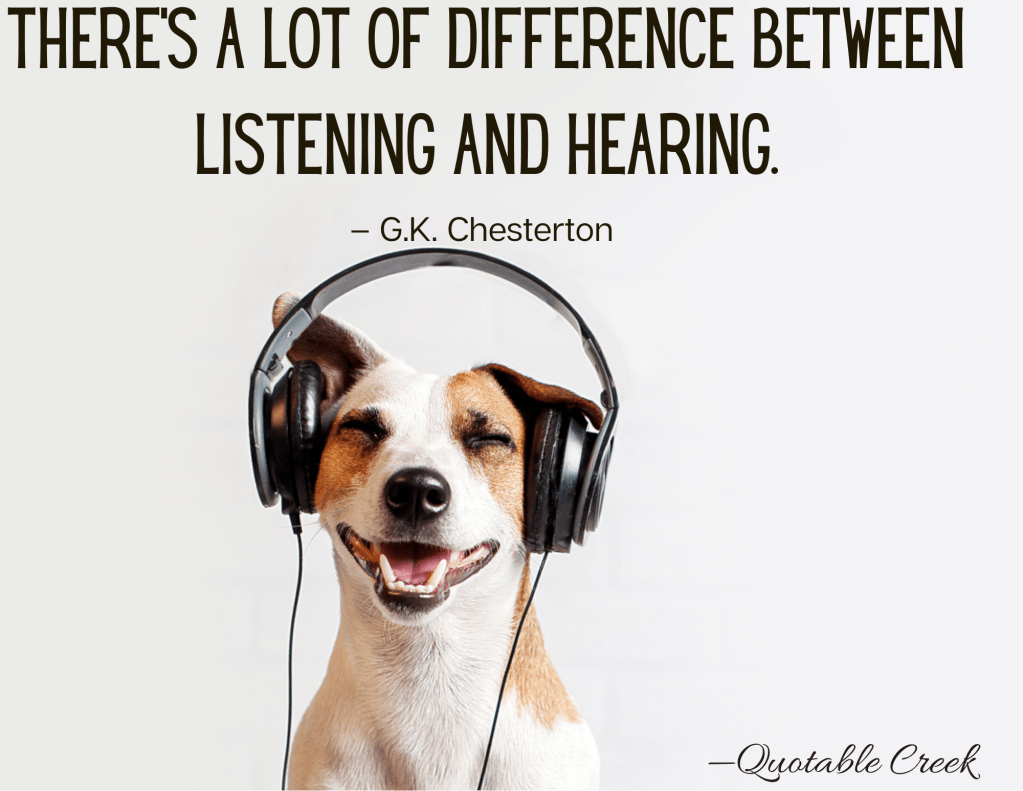
These days there is a lot of noise—everyone has a soapbox—but I wonder how much is really heard. This article explores the problem of autobiographical listening, listening with the hope of injecting a story about yourself into the mix. There are levels to this. The matcher, who always has a similar vacation or achievement to switch the conversation to. The topper who has an even better vacation or achievement to turn the conversation to. And the outright conversation narcissist where really all parts of the conversation somehow turn on him.
But if our goal is connection, we really need to learn how to better listen:
“Listen with curiosity. Speak with honesty. Act with integrity. The greatest problem with communication is we don’t listen to understand. We listen to reply. When we listen with curiosity, we don’t listen with the intent to reply. We listen for what’s behind the words.”
Roy T. Bennett, The Light in the Heart
Practice listening to understand. Avoid autobiographical listening:
“When we fail to listen from the other person’s perspective, we are listening through our own lens and tend to pass more judgments compared to simply listening,” Reigstad added. “There are four types of autobiographical listening ― evaluate, probe, advise and interpret. These responses tend to have us asking questions based on our experiences, offering advice to fix the problem and so on. It’s important to resist the urge and allow the other person to speak.”
We can’t choose everything in life, but we can choose what kind of person we want to be.
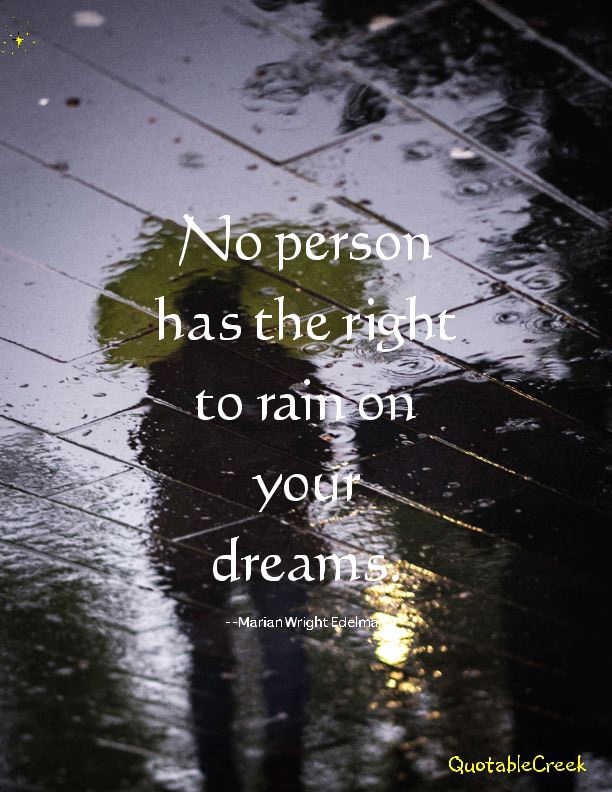
As we deal with storms across the country and unprecedented blizzard watches here in Southern California, consider the importance of rain. Rain can be like encouragement, bringing nourishment and rebirth to dry parched land. It can promote an abundance of life and energy.
But, in excess, rain can cause flooding and landslides. It can sweep people away into rushing water and leave the landscape devastated.
Our words have the same power. We can be supportive and encouraging, fostering life and vitality in those we engage with. Or we can be harsh and critical, pessimistic and judgmental. Our words can both heal and wound. Our choice.
We can choose to be encouraging and supportive, rather than bleak and pessimistic.
We can avoid being the person who rains on someone else’s parade.
There are as many ways to pray as there are people praying. But what is it, exactly? Maybe it’s easier to answer what it isn’t: a flamboyant show, a chance to pose and preen publicly, a subterfuge, a droning recitation of memorized but not considered words.
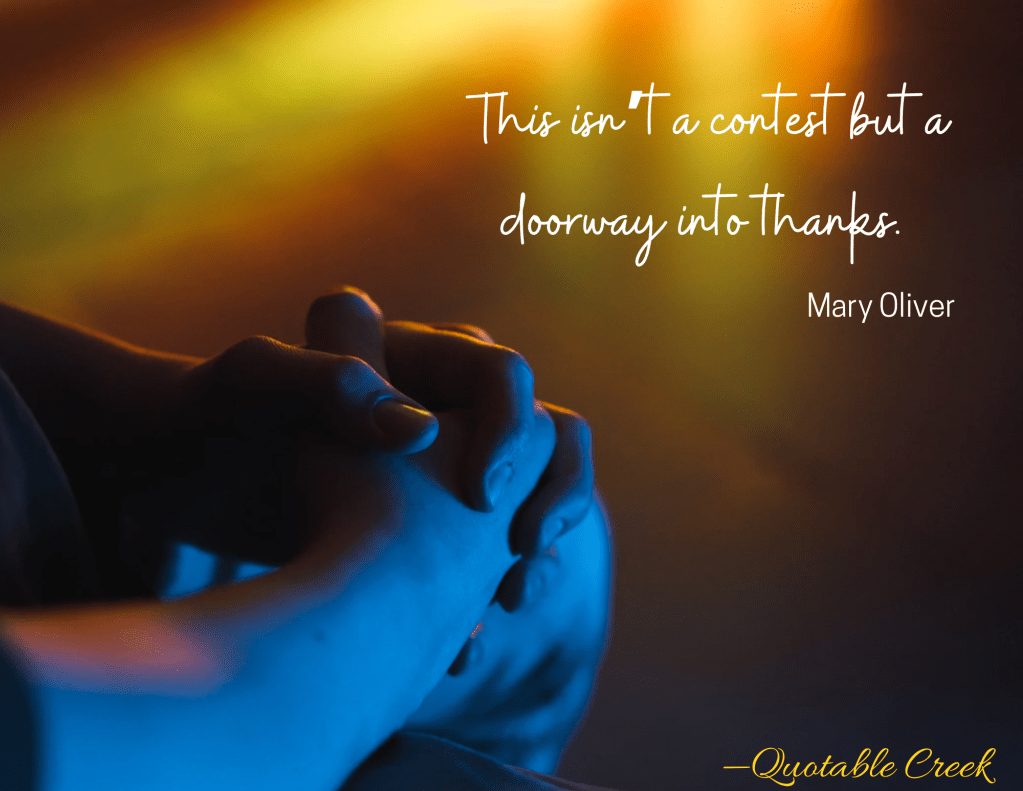
What prayer actually is, though, is more complicated: a bridge between ourselves and the mysterious, a chance to become small, and yet fully individual, in a vastness, an experience of awe. Mary Oliver’s definition above in her poem Praying is lovely: a doorway into thanks. Consider the whole poem:
Praying
It doesn’t have to be
The blue iris, it could be
Weeds in a vacant lot, or a few
Small stones; just
Pay attention, then patch
A few words together and don’t try
To make them elaborate,
This isn’t a contest but the doorway
Into thanks, and a silence in
Which another voice may speak.
Pay attention; see the beauty around you; give thanks. Rinse and repeat.
The Rose Parade is always a joyous start to the new year, the pageantry, the vivid colors, the community. The floats are huge, once nearly 100 feet tall. (Disney 2004). Every inch must be covered with something organic—mostly flowers, of course, but also oatmeal, potatoes, beans, seeds, and so on. The illusions created are remarkable. Look at the bicycles in the photo above (Kaiser 2023). Every detail created out of flowers and organic material. You think you’re looking at bicycles, but really you’re looking at a masterful combination of organic material:
The pink and yellow bikes are made from cut straw flowers confetti, while the blue bike is made from blue statice. The black bike tires are made from onion seeds and the handlebars are comprised of dark lettuce seeds. Other flowers and materials used include pampas grass, banana leaf, red and pink anthurium, commadore fern, Italian ruscus, lemon leaf, and green dianthus.
In many ways, a Rose Parade float is a metaphor for life: you think you see things one way, but really everything is a combination of multitudes of factors—point of view, back story, nuance, history. Very little is as objective as we first think. This is particularly true when it comes to looking at each other. We are all a combination of life experience, history, bias, personality, filters and so on. We each bring that myriad of factors to our encounters.
Our job in everything is to look closely and pay attention, to move past assumption and bias. Jumping to hasty conclusions will get you trying to ride bicycles made of pampas grass.
None of us knows what the future holds. But we do know the values we hold dear—honesty, integrity, love, compassion, empathy, respect, tolerance. As we raise our children, we instill these values. As adults, we model these values whether we win or lose, succeed or fail, sink or swim. Watching us, they learn, and, as they go forward into their futures, they will bring these values to their own decisions. If each of us does this, we will leave the world a better brighter place for our having been here.
In this interview, Brené Brown discusses the complexity of emotions we are experiencing as a result of the pandemic and social isolation. Her words bring comfort and solace to all of us, but particularly those of us raised to believe that only positive emotions should be felt or expressed.
These are tough times. And it’s particularly difficult because this is not an emergency you have to gear up for and get through; it’s a slow burn. As she says:
“Normally, in order to get through a crisis, you know, our bodies are built to respond with a lot of adrenaline, a lot of energy, a lot of super coping surge. And then the waters recede or the fires are out or, you know, the crisis ends and we slog our way through kind of cleanup and trying to find our new normal. But we are not going to be able to depend on the adrenaline surge for this, because it’s going to out- it’s going to outpace us. And I think we are hitting that moment where we are weary in our bones. We are physically tired. We, you know, anxiety, uncertainty take a lot out of us physically. I think, you know, we’re on Zoom calls. I don’t know what happened. Like, I work a lot to begin with, but I feel like I’m on Zoom calls from 6:00 in the morning until midnight. You know, and then we’ve got toddlers crawling up our backs and partners trying to, you know, tell us to be quiet. They’re also are being called. And we’re tired. And I’ll tell you, the other thing that’s exhausting; that we are not acknowledging – again as a collective – is grief.”
And the grief is perhaps more extensive than any we’ve felt before. It’s grieving a loss of everything that was normal to us. Brown explains, “Well, I think it’s a very difficult position we’re in right now because I think we are both grieving the loss of normal and grieving the ordinary moments that make the touchstones for our lives. We’re grieving the loss of those at the very same time we’re having to find and settle into a new normal. And those two things are very difficult to do. At the same time, not mutually exclusive, but as close as it gets without being mutually exclusive. So there’s grief, I think. Grief is the loss of normal.”
And it is ok to experience that grief and mourn those losses. We are vulnerable, and there is no shame in acknowledging that:
“To be alive is to be vulnerable, to be in this pandemic, is to be vulnerable every second of every minute of every day. And the thing about vulnerability is it is difficult, but it’s not weakness. It’s the foundation and the birthplace of courage. There is no courage without risk, uncertainty and exposure. And so, you know, I’ve asked 10000 people that this question, starting with special forces military: give me an example of courage in your life that did not require uncertainty, risk and emotional exposure. And in probably 15 thousand people at this point, not one person has been able to give me an example of courage that did not require vulnerability. So we need to dispel that mess and we need to acknowledge we are in a lot of vulnerability right now. That means we can be our best, bravest selves or we can be our worst selves, and I think the thing about choosing to be our most courageous selves is having to understand this is another method to style that most of us know we’re taught growing up that we’re either brave or afraid, that the truth is we can be brave and afraid at the exact same time. Most of us are in these moments today.”
We can be brave and afraid at the exact same time. We can be strong in our vulnerability. And, even though we are living a new normal, we can choose how we show up there.
How lovely it is to stand still in the enormity of your questions. To realize that what you know is minuscule in relation to all there is to know. To let your curious mind take you on a journey of discovery. How liberating it is to lay down the facade of expertise and acknowledge that, in this world, we are all students.



 QuotableCreek.com