We start so little and helpless, not knowing much of anything, but responding to love, comfort, care, concern. As we grow, there have been people who have brought joy to our lives, people who have helped us step out and grow.
For these people, we offer thanks.
As Mr. Rogers explained:
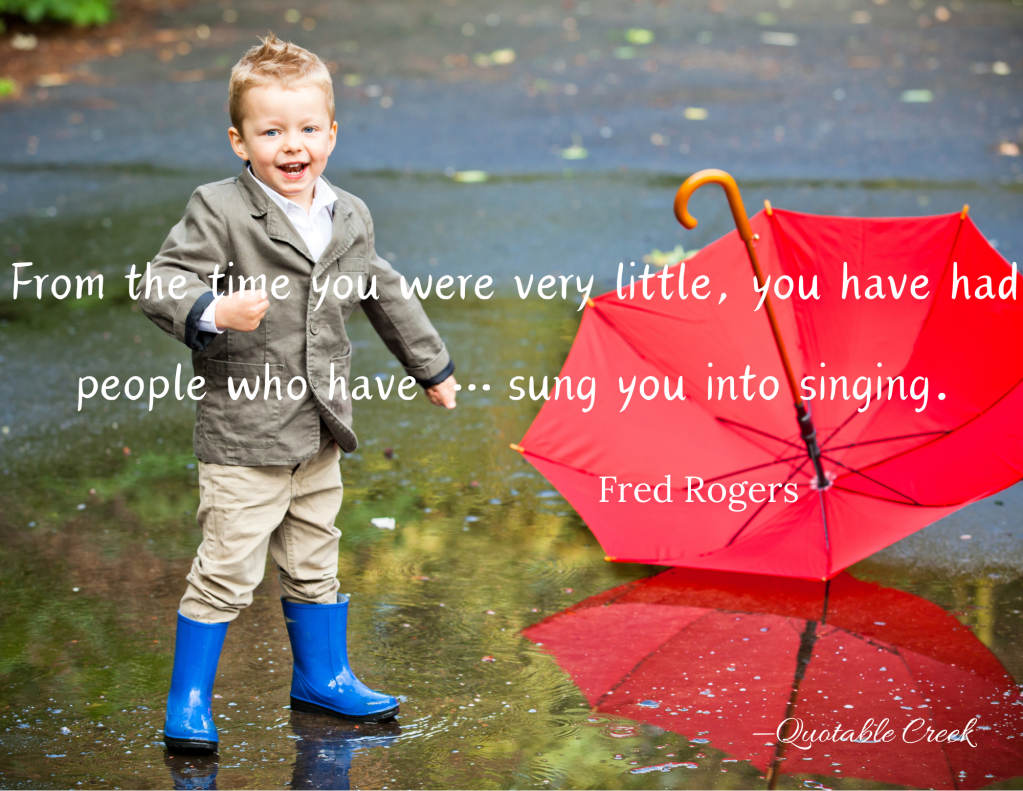
From the time you were very little, you’ve had people who have smiled you into smiling, people who have talked you into talking, sung you into singing, loved you into loving. So, on this extra special day, let’s take some time to think of those extra special people.
And we have them now, don’t we? Those people who smile us into smiling and love us into loving?
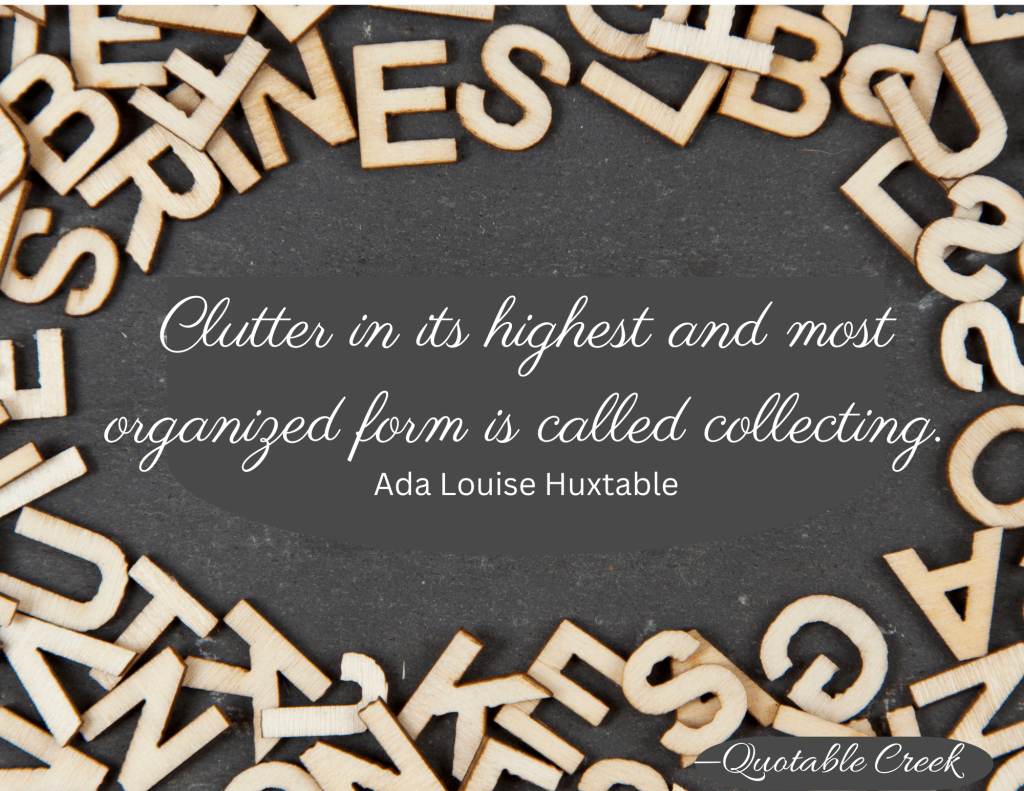
I’m not a fan of clutter. I’m also quite challenged to part with stuff. It’s a problem. Like some people avoid carbs or sugar, I avoid ‘collecting’ because I know, given my propensities, it will lead to clutter. But there are many things that are clutter-free that I love to collect. Among these are words. Words are just so delightful— the sound and smack of them, their history, their aptness for a particular purpose.
One of my favorite bits of writing advice is to collect words that might fit for the time and place of your story.
In The Writer’s Portable Mentor, Priscilla Long writes:
The writers of deep and beautiful works spend real time gathering words. They learn the names of weeds, and tools, and types of roof. They make lists of color words (ruby, scarlet, cranberry, brick). They savor not only the meanings, but also the musicality of words. They are hunting neither big words nor pompous words nor Latinate words but mainly words they like. They are not “improving their vocabulary” or studying for the SAT or the GRE. They are not trying to be fancy or decorative. This is a different kind of thing.
She suggests keeping a journal of these words and going on quests to capture more:
HANDS ON: MAKE YOUR OWN LEXICON Buy a small bound and sewn blank book, with fine paper. This is your Lexicon. Put in words you like, words that strike your fancy, words you want to own. I suggest giving each word half a page. Put in the word _ lickspittle – and draw a horizontal line dividing the page in half. This way you can put in a word and look it up later. (Under lickspittle write: a contemptible, fawning person; a flatterer or toady.) You will end up with two words per page. This is not a typical vocabulary list full of horrible Latinate words you don’t know and don’t want to know. The rule is, put in only the good words, the juicy words, the hot words. From time to time, savor this book. Look up words you’ve put in (something from your reading) and haven’t looked up yet. Be sure to investigate the root. Put in familiar words along with new words. Play with sounds right in your Lexicon: kitchen matches; cord/weird/word/ fired/turd. From time to time read a big dictionary hunting for a new good word, any word that strikes your fancy: galoot. On some pages make word lists. Fiddle parts – peg box, button, side rib, bridge. Words for blue – cobalt, woad, sapphire, smalt. Words from an art exhibition you especially loved – bone, tin plate; cotton, cord, silk ribbon, silver, galloon; coconuts, shells, ostrich eggs (from Moscow Treasures). Put down things you don’t know the names of. Do you know the parts of a window? (Muntin? Sash?) Do you know the parts of a rocking chair? Draw or describe the thing in your Lexicon and then set about looking (in a book on house repairs or on furniture) for splat or spindle or stile. Do not order your list in any way.
She goes on to discuss making a word trap to fit the piece you are working on, the musicality and derivation of words, the vowel scale, and all sorts of other intriguing ways to add nuance, accuracy, and lilt to your piece. Hers is one of my favorite craft books, of which I have dozens. (See above about my hoarding propensities.)
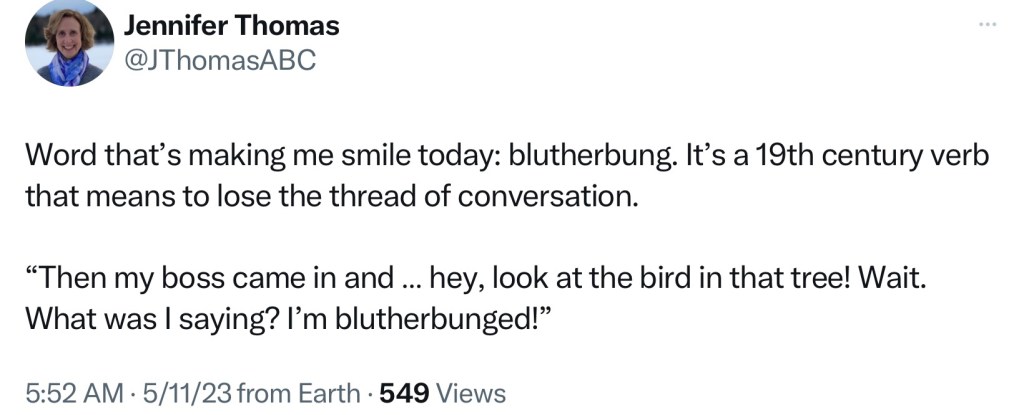
But this intro brings me to my joy for the day. I discovered someone on Twitter who shares this love of words, who posted a word for the day. It’s blutherbung, an appropriate word for me these days as it turns out.
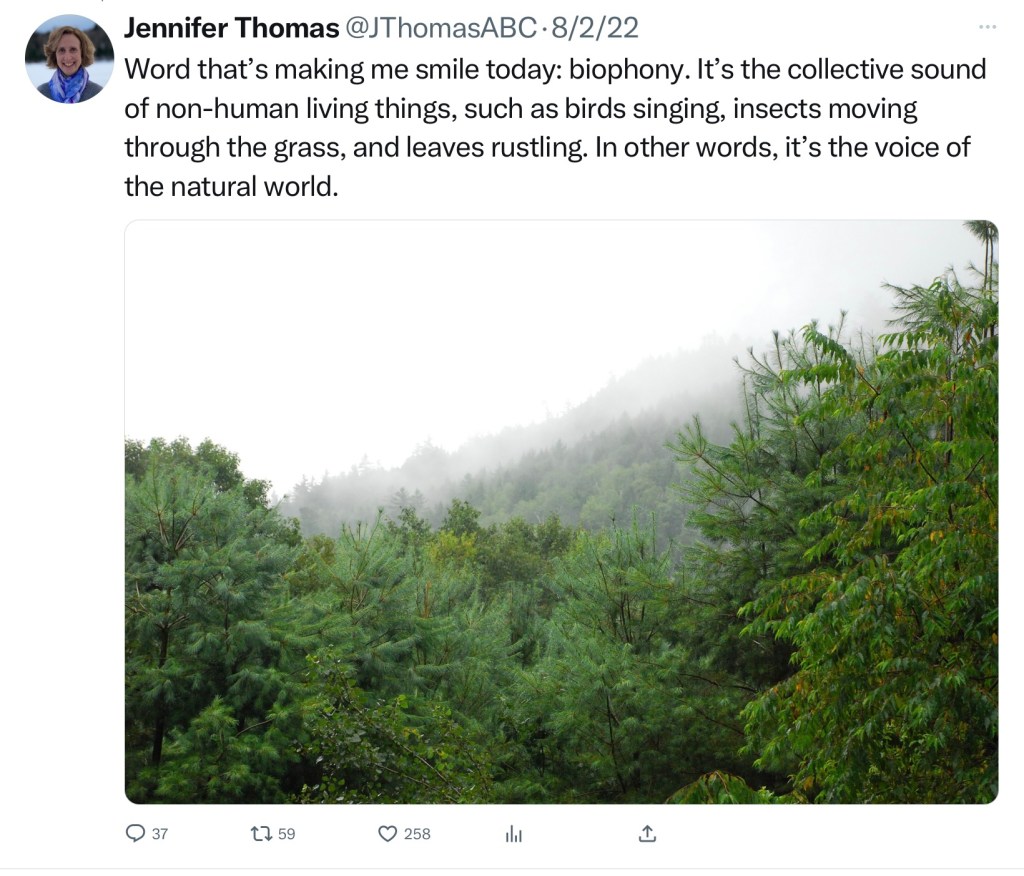
And then I looked at her feed and found another
Lickspittle, blutherbung, biophony. Aren’t these just wonderful? who do you suppose thought these up, studying human nature or the natural world and coming up with just the word to describe that particular confluence of traits? And now I’ve subscribed to her feed to get these delightful tidbits each day.
As you can probably guess, another thing I collect is quotations. I have a little book to jot them as I’m reading an article or book. I periodically look through this little book and write my thoughts about them. Which is what brought me here to writing Quotable Creek.
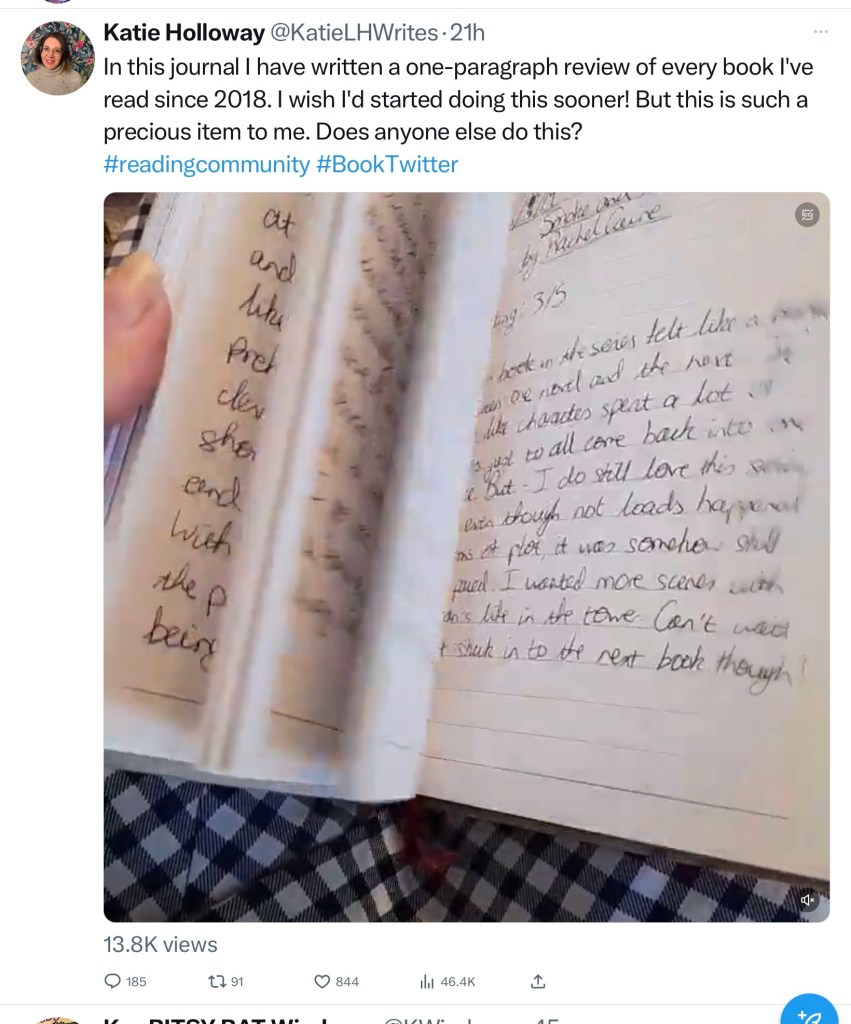
Another thing I ‘collect’ is gratitudes. I write the things I’m thankful for in a gratitude journal, to keep them and remember those moments. My next thing I’m thinking of to collect is book impressions. I read quite a bit, but get blutherbunged and forget about them. Perhaps keeping a little thought about each will bring them back to me. It’s another thing I found on Twitter. Probably when I was reading from the word lady’s thread.
I’m a huge Ted Lasso fan. When an episode ends, I actually groan. This week was a powerful demonstration of how important words are, how the things we say can impact a person for years (for good or bad), and how important genuine, heart-felt communication is to heal old wounds.
Tough guy Roy Kent was hurt by the blunt criticism of his skills written in an article by reporter Trent Crimm from Roy’s first game when Roy was just 17. Roy still carries the article around in his wallet decades later.
Do you have any words like that that you’re still metaphorically carrying around years later? Perhaps we remember a mentor’s encouragement that sparked our interest or passion in a chosen career. Perhaps, sadly, we still struggle under the weight of words by someone who condemned us at our worst, saw as as inadequate or a failure. someone who felt we would never measure up.
Words have heft to weigh us down or sustain us. We need to remember that when we choose ours.
Are pleasantries a thing of the past? Asking after someone’s health and family? Really listening to their answer? Showing concern? Waiting your turn to talk? Making sure your words don’t wound?
For most of us, we can identify moments in our past where we were lifted up or shoved down, and often both of those extremes were a result of someone’s words. What we say has power, and we would do well to wield that power wisely.
Have you ever noticed that someone’s words were exactly what you needed to hear at that moment? Perhaps even life-changing. When you are on the receiving end of such words, you have no doubt how important they are. Those words gave you hope, or let you see another side, or soothed your anger, or gave you purpose.
But sometimes, on the giving end of such words, we forget how important they can be. We forget to tell people how much we like them or how grateful we are for them or how we are in their corner. We rationalize–they’re just words. Who cares? It’s not life-changing.
But, in fact, as those of us who have heard such words at just the right time can attest, those words can indeed be life-changing. When they start a ripple of positivity that doesn’t begin or end with you, those words can set in motion other words and those new words just may reach someone at the right time to provide comfort or solace.
Keep shaking the world. Put kindness out there; the ripples will spread endlessly.


 QuotableCreek.com