How broad is your focus? On your own needs and wants, or broader? It seems that a broad focus, on others as much or more than ourselves increases empathy and happiness.
As Daniel Goleman said:
Self-absorption in all its forms kills empathy, let alone compassion. When we focus on ourselves, our world contracts as our problems and preoccupations loom large. But when we focus on others, our world expands. Our own problems drift to the periphery of the mind and so seem smaller, and we increase our capacity for connection – or compassionate action.
Does this seem true as you think about the people in your life?
The other thing that happens when you turn your concern to others is the whole world opens up. There is so much to learn, to do, to care about. So many places to put your time and efforts. So many people to love and help.
Joy is a fascinating emotion. It often springs up in us at surprising times. There is something of a wellspring vibe to it, as if it bubbles up in us with little bearing to our circumstance in life or particular experience. As C. S. Lewis notes,
“I call it Joy. ‘Animal-Land’ was not imaginative. But certain other experiences were… The first is itself the memory of a memory. As I stood beside a flowering currant bush on a summer day there suddenly arose in me without warning, and as if from a depth not of years but of centuries, the memory of that earlier morning at the Old House when my brother had brought his toy garden into the nursery. It is difficult to find words strong enough for the sensation which came over me; Milton’s ‘enormous bliss’ of Eden (giving the full, ancient meaning to ‘enormous’) comes somewhere near it. It was a sensation, of course, of desire; but desire for what?…Before I knew what I desired, the desire itself was gone, the whole glimpse… withdrawn, the world turned commonplace again, or only stirred by a longing for the longing that had just ceased… In a sense the central story of my life is about nothing else… The quality common to the three experiences… is that of an unsatisfied desire which is itself more desirable than any other satisfaction. I call it Joy, which is here a technical term and must be sharply distinguished both from Happiness and Pleasure. Joy (in my sense) has indeed one characteristic, and one only, in common with them; the fact that anyone who has experienced it will want it again… I doubt whether anyone who has tasted it would ever, if both were in his power, exchange it for all the pleasures in the world. But then Joy is never in our power and Pleasure often is.” The Shape of My Early Life
Joy is distinct from pleasure and happiness. It is an abundance, a bliss, an immeasurable gratitude for the privilege of being. It isn’t meant to be ignored, but embraced, relished, cherished. Not as a byproduct of some other experience, but in itself.
As Mary Oliver says,
“If you suddenly and unexpectedly feel joy,
don’t hesitate.
Give in to it.
There are plenty of lives and whole towns destroyed or about to be.
We are not wise, and not very often kind.
And much can never be redeemed.
Still life has some possibility left.
Perhaps this is its way of fighting back,
that sometimes something happened better than all the riches or power in the world.
It could be anything, but very likely you notice it in the instant when love begins.
Anyway, that’s often the case.
Anyway, whatever it is,
don’t be afraid of its plenty. Joy is not made to be a crumb.
Swan, Poems and Prose Poems
If you should be lucky enough to feel joy bubbling up, savor it. Don’t hesitate.
Sometimes life is hard. Really hard. Relationships falter. Obstacles seem insurmountable. And just getting to the next day feels overwhelming. At times like these, we have to remember that it is OK to struggle.
We don’t have to be perfect. We do not need to have all the answers. Sometimes all we have are questions. But that is often a good place to start. And then we begin again, one foot in front of the other, perhaps not seeing the whole path ahead, but just enough to know where to put each foot.
“Just because something is difficult doesn’t mean it’s impossible. Uncomfortable? Yes. Exhausting and overwhelming and painfully hard? Yes. But not impossible. And it won’t necessarily feel this difficult and debilitating forever. You’ve made it through similar hard things before. You’ve survived every single bad day and every obstacle the universe has ever thrown at you. You’ve survived all the things you felt convinced would break you. Every single one. And this is evidence that you can make it through this too.
“You don’t have to figure everything out today. You don’t have to solve your whole life tonight. And you don’t have to tackle everything at once. You just have to show up and try. You just have to focus on the most immediate thing in front of you. And you have to trust that you’ll figure out the rest along the way. It’s okay to struggle. It’s okay to feel overwhelmed. And its okay to make mistakes. You’re still learning how to navigate this new path. It’s going to take time, and you’re allowed to give yourself that time. You don’t have to be perfect. You don’t have to get all A’s or be the best version of yourself or outperform everyone else. All you have to do is show up and try. It’s always been enough before. It will be enough this time too.”
— Daniell Koepke
Here’s to you finding the light to take that next step, and then the next and the next, until your path leads you out of this present darkness. It is OK to struggle.
It is hard to overestimate the importance of hope, even when going through the most dire of circumstances. Retaining our own spark.
As James Baldwin continues:
One discovers the light in the darkness, that is what darkness is for; but everything in our lives depends on how we bear that light. It is necessary, while in darkness, to know that there is a light somewhere, to know that in oneself, waiting to be found, there is a light.
It’s so interesting to think about all the different ways we can show up in this world. On stage, as in this quote. Or behind the scenes.
What motivates you to get out there and shine your light?
What do you think of the phrase ‘The world is your oyster’? Full of possibilities, and maybe a pearl. Treasure! But also something born inside the oyster as a result of grit or sand, an irritant, inside the oyster, around which the oyster builds the pearl.
Life is full of irritants, and pearls, runways and behind the scenes. It’s a big complicated world.
There is a sort of magic in reading a book. Someone, maybe long dead, has perhaps expressed deep feelings or new thoughts or complex theories, writing out of their aloneness, and connecting with someone they have never met and may never meet.
And yet the impact of that shared space over a book can be life-changing. It can help you feel less alone in this big world. It can help you feel empathy for others in a way you may never have experienced without the book. It can open your heart and mind in new and wonderful ways.
Do you find yourself making the same mistakes repeatedly? Maybe even sabotaging relationships or failing to meet your goals? Is it possible you are getting in your own way?
In this insightful article, Tim Hoch identifies 10 ways you may be making your life harder than it needs to be:
1. You ascribe intent.
Another driver cut you off. Your friend never texted you back. Your co-worker went to lunch without you. Everyone can find a reason to be offended on a steady basis. So what caused you to be offended? You assigned bad intent to these otherwise innocuous actions. You took it as a personal affront, a slap in the face.
Happy people do not do this. They don’t take things personally. They don’t ascribe intent to the unintentional actions of others.
2. You’re the star of your own movie.
It is little wonder that you believe the world revolves around you. After all, you have been at the very center of every experience you have ever had.
You are the star of your own movie. You wrote the script. You know how you want it to unfold. You even know how you want it to end.
Unfortunately you forgot to give your script to anyone else. As a result, people are unaware of the role they are supposed to play. Then, when they screw up their lines, or fail to fall in love with you or don’t give you a promotion, your movie is ruined.
Lose your script. Let someone else star once in awhile. Welcome new characters. Embrace plot twists.
3. You fast forward to apocalypse.
I have a bad habit of fast forwarding everything to its worst possible outcome and being pleasantly surprised when the result is marginally better than utter disaster or jail time. My mind unnecessarily wrestles with events that aren’t even remotely likely. My sore throat is cancer. My lost driver’s license fell into the hands of an al-Qaeda operative who will wipe out my savings account.
Negativity only breeds more negativity. It is a happiness riptide. It will carry you away from shore and if you don’t swim away from it, will pull you under.
4. You have unrealistic and/or uncommunicated expectations.
Among their many shortcomings of your family and friends is the harsh reality that they cannot read your mind or anticipate your whims.
Did your boyfriend forget the six and a half month anniversary of your first movie date? Did your girlfriend refuse to call at an appointed hour? Did your friend fail to fawn over your tribal tattoo?
Unmet expectations will be at the root of most of your unhappiness in life. Minimize your expectations, maximize your joy.
5. You are waiting for a sign.
I have a friend who won’t make a decision without receiving a “sign.” I suppose she is waiting on a trumpeted announcement from God. She is constantly paralyzed by a divinity that is either heavily obscured or frustratingly tardy. I’m not disavowing that fate or a higher power plays a role in our lives. I’m just saying that it is better to help shape fate than be governed by it.
6. You don’t take risks.
Two words: Live boldly. Every single time you are offered a choice that involves greater risk, take it. You will lose on many of them but when you add them up at the end of your life you’ll be glad you did.
7. You constantly compare your life to others.
A few years ago I was invited to a nice party at a big warehouse downtown. I was enjoying the smooth jazz, box wine and crustless sandwiches. What more could a guy want? Later in the evening I noticed a steady parade of well-heeled people slide past and disappear into another room. I peeked and saw a large party with beautiful revelers dancing and carrying on like Bacchus. Suddenly my gig wasn’t as fun as it had been all because it didn’t appear to measure up to the party next door- a party I didn’t even know existed until just moments before.
I do this frequently. Those people are having more fun. Mary has a bigger boat. Craig gets all the lucky breaks. Ted has more money. John is better looking.
Stop it.
Always remember what Teddy Roosevelt said: “Comparison is the thief of joy.”
8. You let other people steal from you.
If you had a million dollars in cash under your mattress, you would check it regularly and take precautions to insure it is safe. The one possession you have that is more important than money is time. But you don’t do anything to protect it. In fact you willingly give it to thieves. Selfish people, egotistical people, negative people, people who won’t shut up. Treat your time like Fort Knox. Guard it closely and give it only to those who deserve and respect it.
9. You can’t/won’t let go.
These are getting a little harder aren’t they? That’s because sometimes you have to work at happiness. Some hurdles are too difficult to clear by simply adjusting your point of view or adopting a positive mindset.
Do you need to forgive someone? Do you need to turn your back on a failed relationship? Do you need to come to terms with the death of a loved one?
Life is full of loss. But, in a sense, real happiness would not be possible without it. It helps us appreciate and savor the things that really matter. It helps us grow. It can help us help others grow.
Closure is a word for people who have never really suffered. There’s no such thing. Just try to “manage” your loss. Put it in perspective. You will always have some regret and doubt about your loss. You may always second guess yourself. If only you had said this, or tried that.
You’re not alone. Find someone who understands and talk to that person. Reach out for support. If all else fails, try #10 below.
10. You don’t give back.
One way to deal with loss is to immerse yourself in doing good. Volunteer. Get involved in life.
It doesn’t even have to be a big, structured thing. Say a kind word. Encourage someone. Pay a visit to someone who is alone. Get away from your self-absorption.
When it comes down to it, there are two types of people in this world. There are givers and there are takers. Givers are happy. Takers are miserable. What are you?
Do any of these fit? You may need to get out of your own way.
How much do our expectations get in the way of our gratefulness? If we were expecting nothing, would our eyes open more to all the gifts we receive each day. Brother David Steindhal-Rast explores just this link between surprise and gratitude:
Have you ever noticed how your eyes open a bit wider when you are surprised? It is as if you had been asleep, merely day-dreaming or sleepwalking through some routine activity, and you hear your favorite tune on the radio, or look up from the puddles on the parking lot and see a rainbow, or the telephone rings and it’s the voice of an old friend, and all of a sudden you’re awake. Even an unwelcome surprise shakes us out of complacency and makes us come alive. We may not like it at first, but looking back, we can always recognize it as a gift. Humdrum equals deadness; surprise equals life. In fact, my favorite name for the One I worship in wonder – the only name that does not limit God – is Surprise.
Right this moment, as I remember spiritual giants I have been privileged to meet – Mother Teresa, Thomas Merton, Dorothy Day, His Holiness the Dalai Lama – I can still feel the life energy they radiated. But how did they come by this vitality? There is no lack of surprises in this world, but such radiant aliveness is rare. What I observed was that these people were all profoundly grateful, and then I understood the secret.
Surprise is a seed. Gratefulness sprouts when we rise to the challenge of surprise
A surprise does not make us automatically alive. Aliveness is a matter of give-and-take, of response. If we allow surprise to merely baffle us, it will stun us and stunt our growth. Instead, every surprise is a challenge to trust in life and so to grow. Surprise is a seed. Gratefulness sprouts when we rise to the challenge of surprise. The great ones in the realm of Spirit are so intensely alive because they are so deeply grateful.
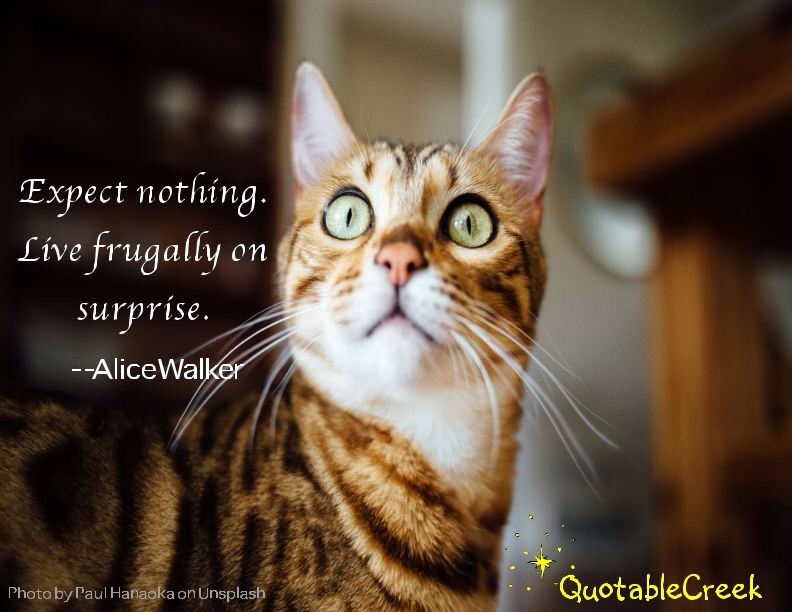
Gratefulness can be improved by practice. But where shall beginners begin? The obvious starting point is surprise. You will find that you can grow the seeds of gratefulness just by making room. If surprise happens when something unexpected shows up, let’s not expect anything at all. Let’s follow Alice Walker’s advice. “Expect nothing. Live frugally on surprise.”
To expect nothing may mean not taking for granted that your car will start when you turn the key. Try this and you will be surprised by a marvel of technology worthy of sincere gratitude. Or you may not be thrilled by your job, but if for a moment you can stop taking it for granted, you will taste the surprise of having a job at all, while millions are unemployed. If this makes you feel a flicker of gratefulness, you’ll be a little more joyful all day, a little more alive.
Once we stop taking things for granted our own bodies become some of the most surprising things of all.
Once we stop taking things for granted our own bodies become some of the most surprising things of all. It never ceases to amaze me that my body both produces and destroys 15 million red blood cells every second. Fifteen million! That’s nearly twice the census figure for New York City. I am told that the blood vessels in my body, if lined up end to end, would reach around the world. Yet my heart needs only one minute to pump my blood through this filigree network and back again. It has been doing so minute by minute, day by day, for the past 75 years and still keeps pumping away at 100,000 heartbeats every 24 hours. Obviously this is a matter of life and death for me, yet I have no idea how it works and it seems to work amazingly well in spite of my ignorance.
I do not know how my eyes adapt, yet when I chant by candlelight they are 100,000 times more sensitive to light than when I read outdoors on the porch at noon. I wouldn’t know how to give instructions to the 35 million digestive glands in my stomach for digesting one single strawberry; fortunately, they know how to do their job without my advice. When I think of this as I sit down to eat, my heart brims with gratefulness.
From the humble starting point of daily surprises, the practice of gratefulness leads to these transcendent heights.
In those moments, I can identify with the Psalmist who cried out in amazement, “I am fearfully and wonderfully made.” (Ps.139:14) From there it is only a small step to seeing the whole universe and every smallest part of it as surprising. From the humble starting point of daily surprises, the practice of gratefulness leads to these transcendent heights. Thomas Carlyle pointed to these peaks of spiritual awareness when he wrote, “Worship is transcendent wonder” – transcendent surprise.
Surprise is a seed; let it sprout and blossom today to color your life with gratitude.
It certainly changes things depending on your perspective. Someone who thinks of life as a contest is always striving, comparing what he has to others. The one who views life as a burden might sigh a lot. And so on.
But what if we thought of life as a gift? Unearned, given out of love, no strings attached. Something to be grateful for. Something to savor and enjoy but also something to treasure. Would that affect what we see when we open our eyes in the morning? Face challenges? Greet people? Pick a career?
Brian Zhand says:
Most of us are scripted to think that life is a game and the purpose of life is to win. But the divine truth is that life is a gift and the purpose of life is to learn to love well.
The truth is being here is a gift, an opportunity, a chance to do some good. Open your gift.
Life is full of hard choices. Particularly when you aren’t the one in danger. Making those tough choices, entering the fray, speaking truth to power, defending the defenseless are vital actions for our collective survival.
As Brené Brown says,
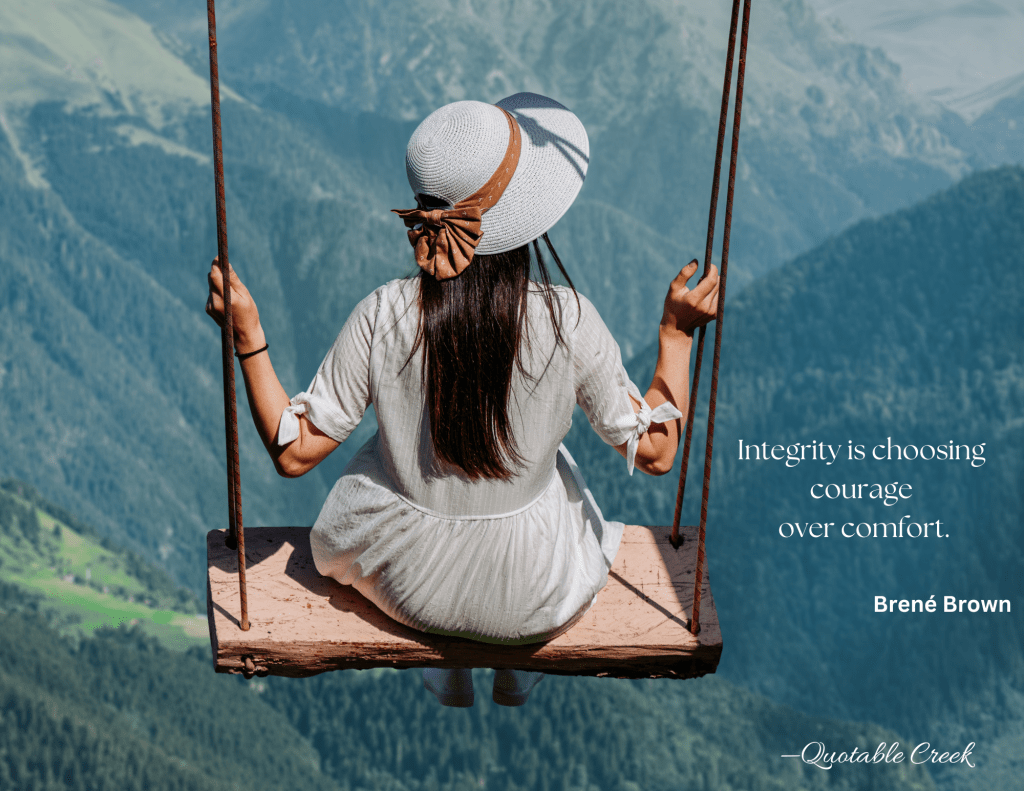
Integrity is choosing courage over comfort; it’s choosing what’s right over what’s fun, fast, or easy; and it’s practicing your values, not just professing them.
Practicing our values, not just professing them. What are your values? How can you bring that to bear in the choices confronting you today?