Awe inspires.

When we lose our way or feel overwhelmed, we can return to nature and be renewed. Hear the birds singing their spring song. Watch them collect twigs and bits for their nests. See the long grass ripple in a gentle wind like ocean waves. Breathe in the sweet earthy fragrance of the morning. Feel small and surrounded by an amazing, complicated system that has been pulsating with life for millions of years. That awe is good for us:

“It has long been established that a healthy diet and lots of sleep and exercise bolster the body’s defenses against physical and mental illnesses. But the new study, whose findings were just published in the journal Emotion, is one of the first to look at the role of positive emotions in that arsenal.

“That awe, wonder, and beauty promote healthier levels of cytokines suggests that the things we do to experience these emotions—a walk in nature, losing oneself in music, beholding art—has a direct influence upon health and life expectancy,” says UC Berkeley psychologist Dacher Keltner, a coauthor of the study.”

Breathe in the day, full of life and possibility. Breathe out the stress, the worry, the defeat. In. Out. In. Out. In.
The heart of a child

Do you remember what it is like to look at the world through a child’s eyes? When magic, wishes, and hope are as real as the miracle of the sun coming up each day? When trust is the default response? When everything is filled with wonder? How lucky we are to have children to bring us back to that time we better understood the world because now we’ve gotten too serious to appreciate or even see the mystery.

Cultivating gratitude

In this beautiful film set to the words of Brother David Steindhl-Rast, you can’t help but see much of what makes life good and affirming. What if we learn to appreciate each day as if it is our first day…and our last? What if we appreciate each miracle as it presents itself to us throughout the day…the miracle of sight, of running water, of food, of laughter? What then?

The incredible power of community.

Blue Blueberries Food Fact Facebook Post

In 1943, President Roosevelt had several competing problems to solve; his answer: Victory Gardens. Author Elisa Carbone (Diana’s White House Garden) describes the amazing bit of history this way:

The World War II Victory Garden plan grew out of necessity. There was not enough steel and tin to make both fighter planes and tin cans for vegetables. There were not enough train cars to carry soldiers to the ports and to send food around the country. And with Japan controlling the islands where most of the world’s rubber plants grew, there was not enough rubber for tires for trucks to carry food from the farms to the cities.

The Roosevelts’ plan was a resounding success. In every city and town, vacant land was turned to food production. City parks, suburban and urban yards, vacant lots, and even apartment rooftops were used to grow fruits and vegetables. An estimated 20 million gardens were planted in the  U.S., producing between 9 and 10 million tons of food, over 40 percent of all the produce eaten in the United Sates. Community centers offered classes in canning, and the harvest was put away to feed the country during the winter as well.

This bit of history is remarkable in so many ways. Success depended on wide-spread buy-in from the total population based on their shared concern for and desire to support the troops and win the war. The solution wasn’t based on borrowing or over-spending but directly resulted from an honest appraisal of scarcity. People stepped up, across all divides. The solution stemmed from a deep recognition of the interrelatedness of things. People welcomed the opportunity to help. Each of those facts is powerful alone, but together, it marks a remarkable time in history.

What could we do today with buy-in like that among an entire populace? Can we even imagine anymore what it would feel like to be part of a country where everyone was looking for a way to help a global problem by making changes and contributions at a local level? In 1943, the impetus for the action was a desire to feed the troops and help win the war. What will we care enough about to pull together now?

Home is a place we all must find.

ache

Something there is in each of us that longs for home, that place where we are welcome and accepted and known. Yet in this world of constant mobility and displacement (often involuntary), that feeling of home remains elusive. What if that feeling of home is something we can activate ourselves and bring to ourselves and others? What if we could make everyone feel a bit more at home?

‘Home’ is more than just a place. But what is it really?


In Willie Baronet’s TEDx talk last year, he quoted Glinda from the Wiz: ”Home is a place we all must find, child. It’s not just a place where you eat or sleep. Home is knowing. Knowing your mind, knowing your heart, knowing your courage. If we know ourselves, we’re always home, anywhere.”

What can we do today to bring that feeling of home to everyone we meet?


Walk around

May your choices reflect your hopes, not your fears.

In her delightful book, Maybe You Should Talk to Someone, Lori Gotlieb relays this encounter with her therapist:

“I’m reminded,” he begins, “of a famous cartoon. It’s of a prisoner, shaking the bars, desperately trying to get out–but to his right and left, it’s open, no bars.”

He pauses, allowing the image to sink in.

“All the prisoner has to do is walk around. But still, he frantically shakes the bars. That’s most of us. We feel completely stuck, trapped in our emotional cells, but there’s a way out–as long as we’re willing to see it.”

We cling to what we think is an agonizing choice between A and B and don’t even see choices C-Z. Sometimes we have the choice not to make a choice at all, to not be part of the conflict. Sometimes choices are knee-jerk reactions that maybe, if we had just paused, we will regret. Sometimes we need to step back and consider.

If only all of our choices could be made from a place of hope, seeing the best in ourselves and our neighbors, looking to build up rather than tear down, reaching for healing rather than harm.

What a wonderful world that would be.

The Courage to Stand Alone

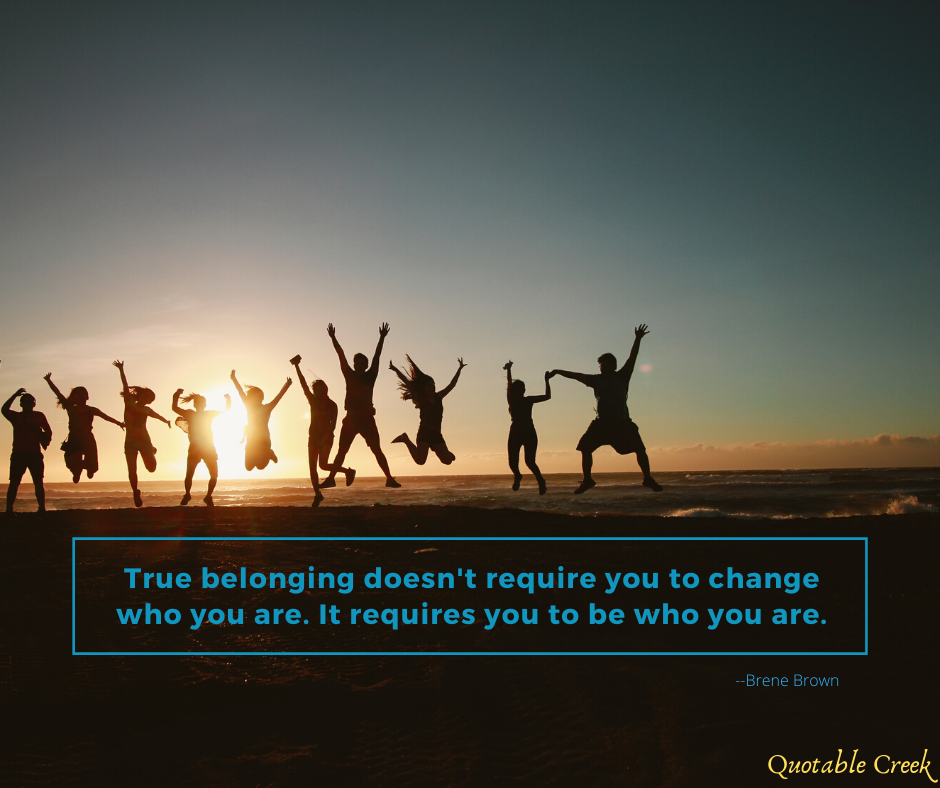
True belonging doesn't require you to change who you are. It requires you to be who you are.

We are more separated into camps than perhaps we’ve ever been. It is now possible to watch news that confirms your world view, to go to schools or socialize only with people who share your perspective, and to alienate yourself from the rest, the ‘others’. But, even though we may think that being only with birds of our feather, might make us feel more included, it is really making us more lonely. Turns out what we have in common in those homogeneous group is mostly just a common set of people to dislike. Anger, distrust, alienation grows rather than wanes, and we become more apart because echo chambers breed loneliness.

In this fascinating interview, Brene Brown shares what her research has uncovered. That rather than stifle ourselves to fit in by conforming, what is ultimately freeing is showing up authentically in diverse groups. We are stronger in our community because of, not despite, our differences because there is a huge difference between fitting in and belonging.


Ripple effect

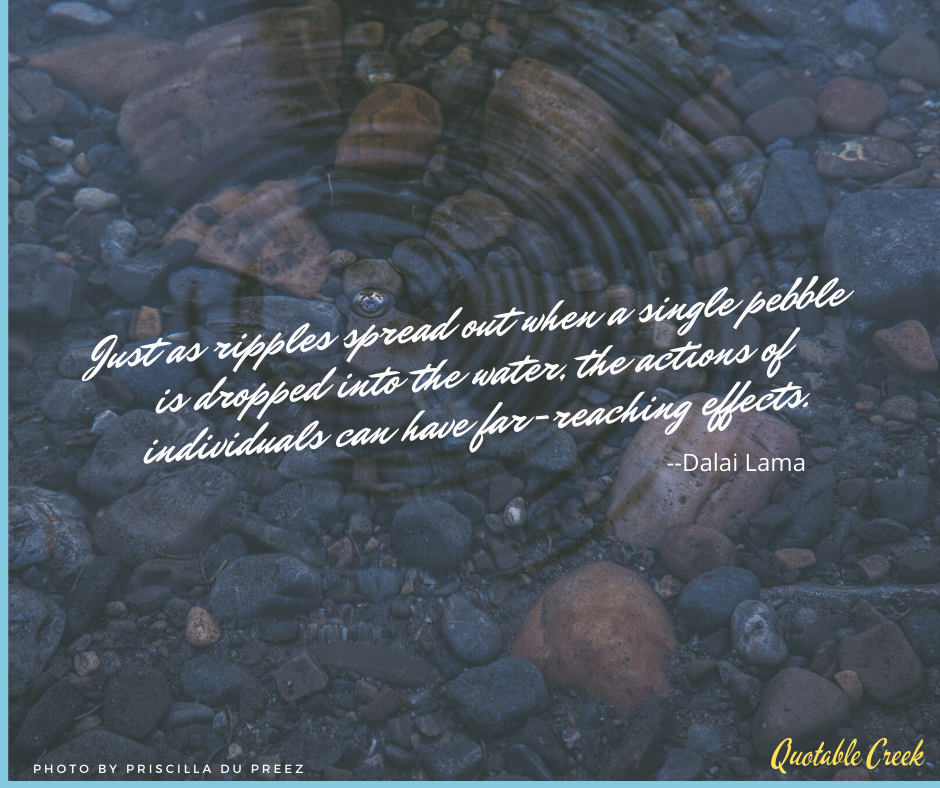
Just as ripples spread out when a single pebble is dropped into the water, the actions of individuals can have far-reaching effects.

We never quite know where the ripples of our behavior start and stop. What did we see or hear about that inspired us to make that kind gesture, or, conversely, what made us lose our temper? If we really analyze it deeply, it’s never just one thing. We are influenced by all the stimuli around us.

Our actions, good and bad, ripple out and touch others, usually in ways we will never see or know. Check out this video below, and think about what ripples you want to put out into the universe today.