Things in proportion
Have you ever felt that things were too big, too scary, too overwhelming?
Maybe we just need to step back and get a sense of proportion. Check out this amusing collection of pictures to help us get a grip.
Have you ever felt that things were too big, too scary, too overwhelming?
Maybe we just need to step back and get a sense of proportion. Check out this amusing collection of pictures to help us get a grip.
In her delightful book, Maybe You Should Talk to Someone, Lori Gotlieb relays this encounter with her therapist:
“I’m reminded,” he begins, “of a famous cartoon. It’s of a prisoner, shaking the bars, desperately trying to get out–but to his right and left, it’s open, no bars.”
He pauses, allowing the image to sink in.
“All the prisoner has to do is walk around. But still, he frantically shakes the bars. That’s most of us. We feel completely stuck, trapped in our emotional cells, but there’s a way out–as long as we’re willing to see it.”
We cling to what we think is an agonizing choice between A and B and don’t even see choices C-Z. Sometimes we have the choice not to make a choice at all, to not be part of the conflict. Sometimes choices are knee-jerk reactions that maybe, if we had just paused, we will regret. Sometimes we need to step back and consider.
If only all of our choices could be made from a place of hope, seeing the best in ourselves and our neighbors, looking to build up rather than tear down, reaching for healing rather than harm.
What a wonderful world that would be.
We are more separated into camps than perhaps we’ve ever been. It is now possible to watch news that confirms your world view, to go to schools or socialize only with people who share your perspective, and to alienate yourself from the rest, the ‘others’. But, even though we may think that being only with birds of our feather, might make us feel more included, it is really making us more lonely. Turns out what we have in common in those homogeneous group is mostly just a common set of people to dislike. Anger, distrust, alienation grows rather than wanes, and we become more apart because echo chambers breed loneliness.
In this fascinating interview, Brene Brown shares what her research has uncovered. That rather than stifle ourselves to fit in by conforming, what is ultimately freeing is showing up authentically in diverse groups. We are stronger in our community because of, not despite, our differences because there is a huge difference between fitting in and belonging.
We never quite know where the ripples of our behavior start and stop. What did we see or hear about that inspired us to make that kind gesture, or, conversely, what made us lose our temper? If we really analyze it deeply, it’s never just one thing. We are influenced by all the stimuli around us.
Our actions, good and bad, ripple out and touch others, usually in ways we will never see or know. Check out this video below, and think about what ripples you want to put out into the universe today.

Where do you stop?
Is it at your skin, that organ holding all your pieces all together? If it’s there, at your skin, how do your words fly out into the air and touch, maybe even wound, someone else? Does your you stop when your physical self passes away? If so, how do memories of you inspire your grandchildren to smile long after your death?
When did you start? Was is at your birth? If so, how do you carry the genetic material of all your ancestors that have come before? How are you influenced by events that occurred long before you were born?
Is your you sufficient and complete in itself? Or does your you depend on many others, both human and not human? The plants and trees for oxygen? Other people for companionship? The air, the moon, the stars, the sun, plants, animals, gravity……a giant web of life, really?
It is hard to isolate our actions. Instead they ripple out into the world around us, resulting in things sometimes seen but more often unseen. In this delightful video, we see an orangutan preschool, a learning community. But, at the heart of the delight in these darling animals is a cold truth: they were orphaned, probably by people that walked and talked like we do. Instead of spending the first seven or eight years of life with their mothers, they are spending it with people trying to teach them how to be orangutans.
When we put out our ripples into this world, let our words be gentle and kind and our touch soft. Let us keep in mind that we are not separate from each other and nature, but that we all share this place we call home. We are all hitched.
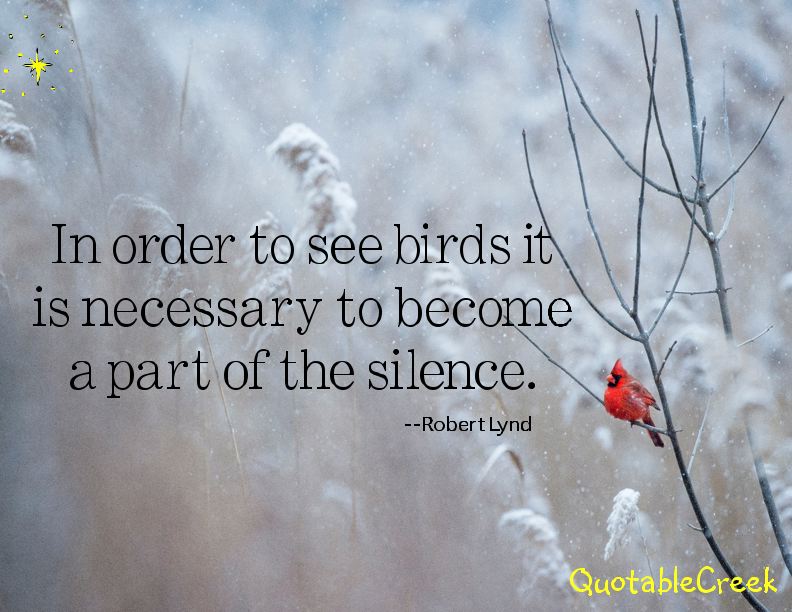
Consider the birds. They have so much to teach us. They sing; they fly; they soar. When the storm is over, they come out and sing, fly, and soar again. They vary dramatically from the tiny hummingbird to the great bald eagle, but they have so much in common. And, when we are quiet, they remind us to look up, to look to the future and the possibility that lies there. It turns out considering the birds is good for our well-being, keeping depression at bay.
Be still and notice the birds. Do you see the vulture with its huge wings soaring above you? Do you hear the hawk shriek? Do you see the crows tuck in their wings and dive to open them again and rise only after you gasp, worried?
Watch the little sparrows bathe in a puddle, delighting in the way the water splashes around them. Listen to them sing.
They sing for you.
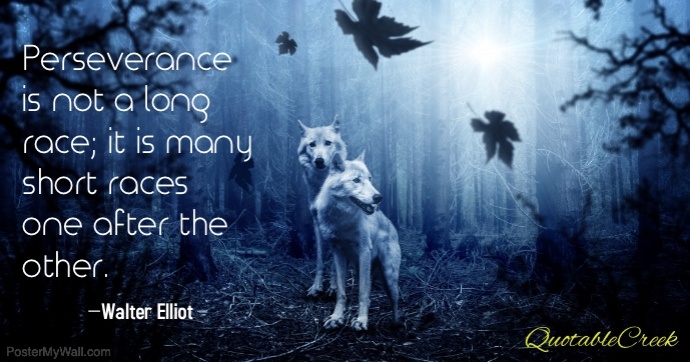
Some tasks are daunting. So much to do, so little time. And yet every accomplishment begins with a first step. When we can break down the large projects into little, more manageable steps, we can move forward toward our goal.
In her book, Bird by Bird, Annie Lamott describes just this:
“Thirty years ago my older brother, who was ten years old at the time, was trying to get a report written on birds that he’d had three months to write, which was due the next day. We were out at our family cabin in Bolinas, and he was at the kitchen table close to tears, surrounded by binder paper and pencils and unopened books about birds, immobilized by the hugeness of the task ahead. Then my father sat down beside him put his arm around my brother’s shoulder, and said, “Bird by bird, buddy. Just take it bird by bird.”
Perhaps you are facing a huge decision or task. One step, one decision at a time. You will get there. Bird by bird.
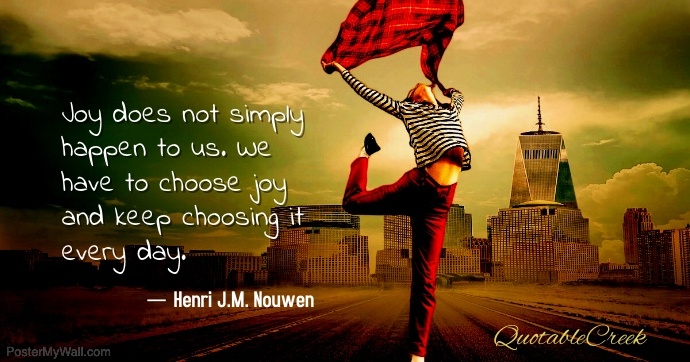
Sometimes joy is a matter of perspective. It’s reaching down and being grateful for it all, the mess, the euphoria, the triumphs, and the tragedies. Grateful to be here, to have a voice, to have people to care about, to have a chance to make a difference. Joy in it all is a choice.
In Bread for the Journey, Henri Nouwen unpacks this further:
Joy is what makes life worth living, but for many joy seems hard to find. They complain that their lives are sorrowful and depressing. What then brings the joy we so much desire? Are some people just lucky, while others have run out of luck? Strange as it may sound, we can choose joy. Two people can be part of the same event, but one may choose to live it quite differently from the other. One may choose to trust that what happened, painful as it may be, holds a promise. The other may choose despair and be destroyed by it. What makes us human is precisely this freedom of choice.
What is the promise behind the circumstances that threaten to steal your joy? Is there something hopeful there? Seeing that promise may just be the key you are looking for.
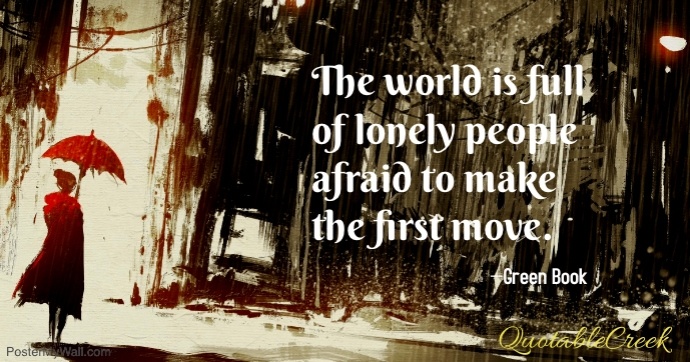
Who do you know who could use a phone call or a card in the mail? Who would you love to see? Are you waiting for that person to reach out? Maybe they are waiting for you, like two people sitting on opposite sides of a closed door. Someone needs to turn the knob and open the door. It might as well be you.
 Sy Montgomery’s delightful book, How To Be a Good Creature, is a ‘Memoir in Thirteen Animals‘. What an interesting way to organize a memoir, focusing on the impact various animals have made on her life and what they have taught her about co-existing as fellow creatures on this planet! It is a profound, yet simple, book.
If you were to write a memoir of your life through that lens, who would the animals be that impacted your life in meaningful and enriching ways? What life lessons did you learn? How were your limits expanded from sharing space with that fellow creature?
For inspiration, consider Montgomery’s words:
All the animals I’ve known–from the first bug I must have spied as an infant, to the moon bears I met in Southeast Asia, to the spotted hens I got to know in Kenya–have been good creatures. Each individual is a marvel and perfect in his or her own way. Just being with any animal is edifying, for each has a knowing that surpasses human understanding. A spider can taste the world with her feet. Birds can see colors we can’t begin to describe. A cricket can sing with his legs and listen with his knees. A dog can hear sounds above the level of human hearing, and can tell if you’re upset even before you’re aware of it yourself. Knowing someone who belongs to another species can enlarge your soul in surprising ways.
I often wish I could go back in time and tell my young, anxious self that my dreams weren’t in vain and my sorrows weren’t permanent. I can’t do that, but I can do something better. I can tell you that teachers are all around to help you: with four legs or two or eight or even none, some with internal skeletons, some without. All you have to do is recognize them as teachers and be ready to hear their truths.
Today, consider the wonder of creation around you and thank your teachers of the non-human persuasion.
 QuotableCreek.com