Pay attention.

waterfallattn

What do we miss simply by failing to pay attention? By rushing?

In 2007, in the arcade area of a subway in D.C., over a thousand people missed something spectacular. Joshua Bell, one of today’s foremost classical musicians, played a few pieces by Bach and Mendelssohn, among others, on his multi-million dollar violin. Three days before this, Bell had performed to a filled Symphony Hall in Boston where tickets for average seats went for over $100.

Over a thousand people rushed by on their way to work and failed to notice the free gift. Why?

Was it because of the context? Bell wasn’t in a tuxedo; he had an open violin case in front of him sprinkled with change and a couple bucks; the forum was mundane; Bell looked just like any other street musician.

Why didn’t Bell’s expertise and the difficulty and complexity of the pieces he played transcend the day to day and encourage people to stop and listen?

Perhaps it is because we have become a bit numb to beauty. We don’t look for it in the ordinary places. Maybe we even look away from the ordinary places.

We miss so much when we rush.

Slow down. What amazing thing is right there if only you stop to see?

What is your lens?

perception

What is your lens?

Do you see the world as friendly or hostile? How many of these biases do we bring to our relationships with each other and strangers?

So much of perception is bias. We see what we expect to see–based on what we think we know.

In this fascinating study, photographers were told different life stories about the man they were about to photograph– a millionaire, a hero, a former inmate, a psychic, a former alcoholic, a fisherman.

The photographers’ feelings about him based on those stories dramatically influenced the resulting portraits. It looked like they had photographed six different people.

How do your biases influence the way you see people? Can you set aside that perception to look a bit deeper?

Do your bit.

handsbutterfly

So much to do. Where to start? It is easy to get overwhelmed with the world’s problems and think there is nothing you can do to solve them. And that may well be true— if you had to work alone. But problems tend to be solved by many people, each doing their own little bit. Small actions multiplied by large numbers of people yield results.

And what about the smaller problems? Can you solve them? The answer is that you are far more powerful than you realize, and that by putting your love out there into the world you are making a difference. Maybe in profound ways.

For one guy, his little difference, his bit, saved an entire species:

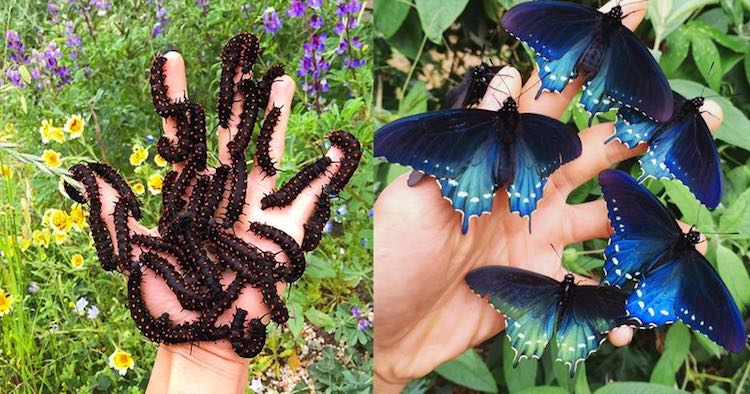
When [Tim Wong]  first learned of the predicament of the pipevine swallowtail, the 28-year-old swooped in to help by creating a screened backyard enclosure with ideal environmental conditions for the insect.

He filled it with specific plants that the insects like to feed on. Then, he gathered a group of 20 different pipevine swallowtail caterpillars from nearby areas. As he carefully nursed the small tribe of precious insects, their numbers began to quickly multiply.

Now years later, the DIY butterfly breeder brings dozens of caterpillars to the San Francisco Botanical Garden’s “California Native” exhibit every week—and thanks to Wong’s efforts, the pipevine swallowtail has been successfully repopulated in the city for the first time in decades.

Imagine that.

Pipevine-Swallotail-Butterflies-Tim-Wong

What is your little bit? What are the ways you can put love out there in the world?

Don’t for a minute think it doesn’t make a difference.

What’s your question?

soulchildren

Children have a way of cutting through the fake and getting to the real. They look around themselves and wonder why things are the way they are. Sometimes the questions they ask are tamped down, leading those kids to spend their adult lives trying to answer them:

Why can’t boys cry?

Why do we have to always pretend to be happy? (Or, to put it another way, What’s wrong with having lots of different emotions?)

Why can’t I play with those children?

Why are you lying?

Why must I accept things that seem wrong?

In this brilliant essay by Courtney E. Martin, she asks ‘What was your first question?’and taps into the power that comes from looking at the world with innocent eyes, OUR own innocent eyes. Dorothy Day, for instance, witnessed an outpouring of love and charity after the San Francisco earthquake in 1906 and wondered, why don’t people care for each other like that all the time. She went on to make that her life’s work in the Catholic Worker Movement. Susan Cain showed up at camp with books and wondered what’s wrong with wanting to be quiet. She went on to write the book Quiet about society’s preference for the extroverted. Oprah Winfrey, sexually abused as a child, went on to constantly unveil the light and dark of human existence asking, “What’s the cathartic story here?”

That child question is powerful. Things we may have gotten used to over time or now just accept as the way things are weren’t so simple to the little child in you who wondered why.

Martin says,

In some ways, these questions are so powerful because they are asked from such a pure place. Children are famously intuitive about underlying dynamics that adults assume they couldn’t possibly understand. They focus in on unspoken truths like homing pigeons and then have the audacity to speak them; the world hasn’t yet acculturated them to fearing the sound of a silence breaking. They are not, in the best of all possible ways, team players. They are inexhaustible witnesses and truth seekers.

Which is what we all are, underneath the home training and the wear and tear of decades of living on this brutal planet. Peel back the layers and we are still the little people we once were, looking around at the adults and wondering what the heck is going on. We are curious and outraged and perhaps sometimes naively sure that there is a better way.

So what was your first question? What is the question you weren’t allowed to ask as a kid? Are you still asking that question? Is there some way, now that you are an adult, that you can answer it, or at least expose it to the light of day?

Sorry. Not sorry?

goodapology

Some apologies make things worse. They don’t feel like apologies at all. They feel, instead, like just more hurt. Other apologies acknowledge the wound and help it heal. What makes the difference?

In When Sorry Isn’t Enough: Making Things Right with Those You Love, Gary Chapman (of Five Love Languages fame) and Jennifer Thomas suggest that a true apology must have six characteristics:

Expressing regret–It’s important for an apology to be for something you did or said.  The more specific, the more it acknowledges the harm caused, the better. “I’m sorry you’re so sensitive,” doesn’t really feel like an apology because it is just restating some perceived flaw in the victim and isn’t focussing on anything you did wrong. Even if the harm was wholly unintended, when your actions cause another person pain, an apology is warranted. It goes to the very essence of the apology: I did not mean to hurt you.

Accepting responsibility— Yes, the pressures of the world can sometimes lead us to get wound up and stressed and to hurt other people, but that does not make it the world’s fault. We control ourselves. We are responsible if we act badly. Blaming the boss, the dog, the economy, the other drivers is deflecting. Apologies for the state of the world or all its ills will not feel like a real apology to the person you lashed out at. Apologizing for losing your temper or not considering the effects of your actions will.

Making restitution–“How can I make it right?” are powerful words. It shows an acknowledgement that what you did caused someone else harm. Maybe you can’t make it right. Maybe you can never make it right. But listening to the victim explain the damage is a powerful step forward in the process. Listening here is key–no justifying your actions, no quarreling with the facts, no defenses, just listening to the other person share their perspective. If there is something you can do to make things better, do that thing.

Genuinely repenting–If you are truly sorry, and have listened deeply to the pain you’ve caused, you will not want to cause that person pain again. You will stop causing the damage. You will want to change. Maybe you will need to write down the steps you want to take to prevent causing further harm. Maybe you will slip up and need to start again. But the most important thing is that you will try to not do this again. Otherwise, are you really sorry?

Requesting Forgiveness–“Can you forgive me?” are powerful words. They show you care about the relationship. They show you understand you did things wrong. They show you are not in control of the relationship.

Everyone messes up. Not everyone takes responsibility for messing up. When we do take responsibility for the harm we’ve caused, it may strengthen our relationships and help them grow stronger. Trust can reenter, fostering healing.

Randy Pausch, the author of the quote above, gave a powerful Last Lecture before he died young of pancreatic cancer. His timeless words can teach us all a lesson about life and living.
Read.

read1

Nowhere can you experience life from someone else’s point of view better than in a book. You can feel what it is like to be another gender, race, lifeform. Time is no limitation–you might experience life now, in the past, in the future. Opening those pages allows you to step inside someone else’s shoes. And that can’t help but change you, stretch your empathy, and expand your experience.

What would it be like if you could talk over things with those characters? Ask them about life in their shoes?

In a very cool project, doing exactly that, library patrons have the chance to check out a human book. Hopefully the human book they check out will be someone with a different life experience and perspective.

So check out a book, or maybe talk with someone as unlike from you as you can find. You’ll be surprised at all the things you have in common.


Thank you.

exquisite

How do we thank someone for the big things? The REALLY big things? Like saving your life? Or seeing promise in you when no one else did? Or for lifting you up when you had nothing left to offer?

Whatever the big thing is that makes your breath catch in your throat and your eyes well up with tears when you think about what your life would be like without that person in it?

Thank yous like that call for something bigger than a note or flowers. They call for your whole self. A thank you from your heart in whatever way most clearly can show the enormity of your gratitude.

In these two heartwarming videos, a man thanks his dog for being his beloved companion, and a mother dog thanks the woman who rescued her pregnant self. These over-the-top gestures cross language and even species barriers.

Thank you!

Welcome home.

ache

Something there is in each of us that yearns for home.  Sometimes we confuse that yearning with a physical place. We travel back to that place and wonder why it feels different. What has changed? Why doesn’t it still feel like home? Sometimes we confuse that yearning with a particular time, a past perhaps that wasn’t complicated with today’s troubles, and lose ourselves in nostalgia. Sometimes we confuse that yearning with a particular person and, if we lose that person, wonder if we will ever feel at home again.

But what if home is not a particular place in time but a feeling we can take steps to cultivate?

What is it, really, that ache for home? Perhaps it is a longing for a time and place when you felt welcome and that someone cared if you were there and was happy to see you. A longing for community, for fitting in. Life is difficult and we are all vulnerable, but that feeling of home makes the burden lighter somehow. Someone cares.

And, while we can’t travel backwards to any particular place or time when we felt at home, we can take steps right now today and every day from now on to be welcoming to others. The people shouting ‘Norm’ felt just as much a part of the community as Norm did when he walked into the bar in the old sitcom Cheers. 

To welcome others and to be welcomed both feel like home. There is as much community in reaching out to others as there is in someone reaching out to you. So consider who may be feeling adrift, in need of a community or a welcoming hand. And then reach out because, when your hands meet, you will both feel a bit more comfortable in this wild unpredictable and often inhospitable world.

Welcome home!

Take a nature bath.

deepnature

When was the last time you hiked? Or paused to admire the intricacy of a flower? Or listened to birds sing? Or felt the breeze tousle your hair?

When times are tough, the tough immerse themselves in nature. It soothes us, comforts us, leads us back to our bearings. While many benefits of nature are unsurprising–relaxation, bliss, awe–some are downright startling. Studies show spending time in nature makes us more altruistic and helps us be more social creatures.

Now, a large body of research is documenting the positive impacts of nature on human flourishing—our social, psychological, and emotional life. Over 100 studies have shown that being in nature, living near nature, or even viewing nature in paintings and videos can have positive impacts on our brains, bodies, feelings, thought processes, and social interactions. In particular, viewing nature seems to be inherently rewarding, producing a cascade of position emotions and calming our nervous systems. These in turn help us to cultivate greater openness, creativity, connection, generosity, and resilience.

Take time today to dip your toe in nature. It’s good for whatever ails you.

Listen.

listenduty

When was the last time you felt heard?

Listening, truly listening–without an agenda, without interrupting, without offering solutions or fixes, without criticism or judgment–is a rare thing. But it is vital to relationships. And it is a gift to be in a position to listen. Someone is trusting you with their story, their feelings, their hurts and hopes. That is precious. How can we best listen to each other?

In this thoughtful article, Martha Caldwell offers advise for listening compassionately in the classroom that really applies well to any situation. As a compassionate environment transforms a classroom, it too transforms any relationship. Consider her suggestions:

1. Be fully present. We bear witness to someone’s felt experience by giving them our complete and undivided attention. Paying full attention when someone is speaking creates safety and focus in the classroom. Compassionate listeners maintain complete silence and pay attention not only to words they hear, but also to facial expressions, body language, and tone of voice, noticing even the silences between words.

2. Know listening is enough. Listening with deep attention involves a calm, relaxed state of mind, free of the desire to “fix” someone or solve their problems for them. It does not involve giving advice or intervening in any way. If our minds are busy coming up with solutions for the speaker, we fail to truly listen.

3. Respond with acceptance. Deep listeners are motivated by the desire to understand how others feel and how their experiences have affected them. Their genuine interest and heartfelt concern make it safe for others to share their vulnerabilities because they sense that what they say will be received without judgement.

4. Understand conflict as part of real-life learning. A learning community in which people are encouraged to be honest and express how they feel involves a degree of risk. Conflict may arise. Sometimes this happens, and working through difficult feelings may take time. However, when we stay connected and stick with the process, conflict can be a catalyst for positive change. When conflict can be resolved, relationships often become stronger.

5. Ask authentic questions to learn more. By asking open-ended questions like “What was that like for you?,” “Can you tell me more about that?,” or “What were you experiencing?,” compassionate listeners guide speakers to share more deeply. These questions are motivated by the desire to honestly learn more (as opposed to reinforcing preconceived notions). If they think they may not have understood something, listeners can repeat back what they think they heard and ask for clarification. “Did I hear that right?”

6. Be gentle with yourself. Deep listening involves compassion for yourself as well as for others. Accept yourself and your internal feeling responses without judgement. Allow yourself time to process and learn.

7. Treat the candidness of others as a gift. Honor the trust others have placed in you and keep what you hear confidential.

Today, listen deeply and be grateful that someone is trusting you with their story.