You can.

We tend to think of peace as the absence of violence as quiet is the absence of noise, but is it more? Perhaps peace is active. It exists in the kind word offered, the refusal to meet hate with hate, the comfort of following higher principles, the strength of the outstretched hand. It is so easy to lose, to slip into mirroring the hate and violence we see around us, to sit silent in front of a bully, to trade barbs, to slide down. Peace is active. We maintain it in our hearts and mind. We breathe deeply to draw us back to that peaceful place. We remember truth, honor, decency, compassion. We breathe in the world; we breathe out heaven.
Pessimists and optimists are both right. Technically. The glass is half full and also half empty. But the optimistic way of looking at the world, of looking for the blessings in each situation, can be much better for your health and spirit. Cultivating gratitude for each day, each experience, each person you know will give you new eyes and help you appreciate the life you are actually living.
It doesn’t really matter what your New Year’s resolution is, it’s all about the how, not the what. Adverbs are important when it comes down to it.
If your resolution is to lose a few pounds, does it make a difference whether you lose it sensibly or too fast or maybe, even, because you’re ill?
If your resolution is to make more money, does it make a difference if it is done at someone else’s expense or illegally?
No matter what we pick as the what of the resolution, the focus really must be on the how as well. Consider the adverb. The how of things makes a difference.
Generously or greedily. Selfishly or selflessly. Safely or recklessly. Kindly or maliciously. Honestly or dishonestly.
For every action that you can resolve to do, there is a spectrum of hows to reach that goal. Maybe, even, there is a line that can be crossed on that spectrum where the what isn’t important anymore because it involves a how that will make us someone who we don’t want to be.
So, when you’re going about planning your new year, consider what adverbs you want to be a part of it.
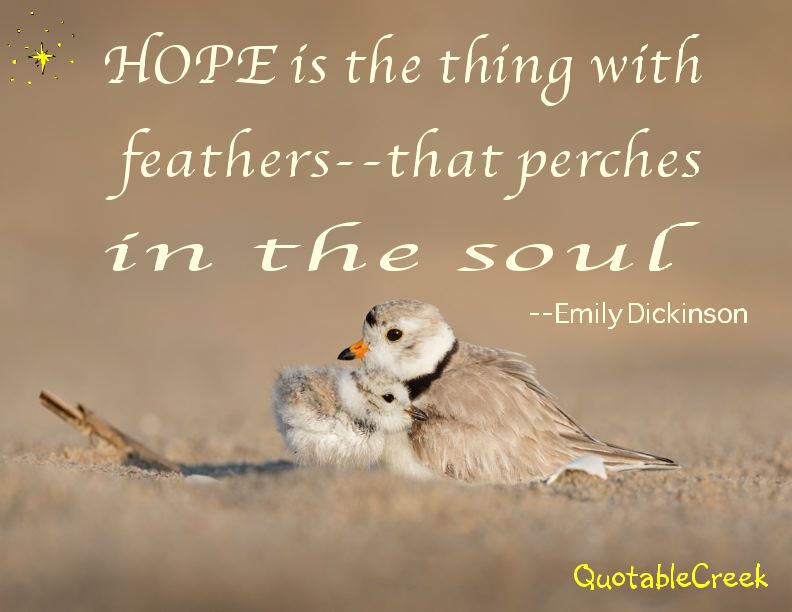
We begin the year with hope. Hope for peace; hope for good health; hope for reconciliation and redemption; hope for progress on our journeys and throughout the world. Emily Dickinson’s poem is a lovely metaphor to return to when drawing on this hope to get us through rough days:
“Hope” is the thing with feathers –That perches in the soul –And sings the tune without the words –And never stops – at all –And sweetest – in the Gale – is heard –And sore must be the storm –That could abash the little BirdThat kept so many warm –I’ve heard it in the chillest land –And on the strangest Sea –Yet – never – in Extremity,It asked a crumb – of me.
In the winter I am writing about, there was much darkness. Darkness of nature, darkness of event, darkness of the spirit. The sprawling darkness of not knowing. We speak of the light of reason. I would speak here of the darkness of the world, and the light of _______. But I don’t know what to call it. Maybe hope. Maybe faith, but not a shaped faith–only, say a gesture, or a continuum of gestures. But probably it is closer to hope, that is more active, and far messier than faith must be. Faith, as I imagine it, is tensile, and cool, and has no need of words. Hope, I know is a fighter and a screamer.

As 2016 heads to a close, we look forward to a new year and turn our attention to how to make it our best year yet. In this powerful TED talk, Steve Jobs reflects on his life and offers insights into how to make these decisions so that, when you die, you will truly have lived. Chief among these is his insistence on following what you love, regardless of whether that makes sense, and even when that path goes in unpredictable or unestablished ways. He urges us not to waste time by leading someone else’s life by following their dogma or sense of what should be done, but instead to pursue our own hearts and intuition because “they somehow already know what you truly want to become.” Death, he claims, is a powerful motivator because confronting it squarely strips away the inessential and makes the vital more plain. We “are already naked,” he points out. There is nothing to lose by following your heart.
Jobs reminds us not to lose faith. Sometimes “life is going to hit you in the head with a brick,” but that is not the end of your story. Instead, failure opens up new opportunities and possibilities. Keep doing what you love. Keep following your own heart and intuition.
Keep the faith.


The days before Christmas can be frantic. We sometimes find our tempers short, our tongues loose, and our wits frayed. We think of Christmas as something in the future, speeding toward us, that we need to hurry around and prepare for so that we can enjoy His coming. But a birthday, like Christmas, is a celebration of something that has already happened. And, in the case of Christmas, it is a celebration of a whole new world order that is here. We are His now, not just at Christmas. We need to shine with His love now and everyday. Particularly when the world is harried. We need to reflect the joy and peace that comes with knowing that love conquers all.
Pause. Breathe. And remember whose you are.
Are there people in your life who encourage you and make you feel stronger and lifted up? Are there some who drag you down or take the wind out of your sails? In her book, Balcony People, Joyce Landor Heatherley argues there are two types of people: the evaluators and the affirmers. She suggests:
I am sure, if there were a way to view a movie and see instant replays of all the strategic change points in our lives, that we’d instantly spot the people who either broke our spirits by their critical or judgmental evaluations, or who healed us by their loving, perceptive affirmations.
To be honest, I seem to be able to remember the negative comments of evaluators faster and more clearly than the positive remarks of the affirmers. I’m not alone in this ability to recall the negative….I suspect that not far from anyone’s conscious level of thinking lies the memory of an evaluator who pulled on his or her spiked boots and stomped deliberately over our bare soul and personhood.
Do you have any of these evaluators in your life? Maybe you can recognize the voice in your head that tells you that you can’t do something. In her book The Artist’s Way: A Spiritual Path to Higher Creativity, Julia Cameron calls these the censors. Maybe you have many censors, a rogue’s gallery of them.
So what do we do with these evaluators and censors to keep them from stifling our blossoming with their negative talk or opinions? Heatherley suggests leaving them in the past, even if that past was five minutes ago:
We all have the choice to replay the harmful remarks from evaluators, or we can choose to let them pass on. We can even choose to make allowances for their discouraging, destructive words. But best of all is the choice to willingly focus our minds and hearts on today’s person who is affirming us.
So who are these affirmers in our lives? Think back…
Who by one small sentence or more, has changed and lifted your opinion of yourself? Who was the person early in your life who recognized the first sparks of originality in the labyrinths of your mind and soul and saw what no one else saw? And who is the special affirmer who catches quick glimpses of the flames from the fires of your potential and tells you so? Who, by his or her words, helps you to respect and believe in your own value as a person? And who is the affirmer who encourages you to stretch and dream beyond your self-imposed limits and capabilities?
These affirmers are your Balcony People, cheering you on to blossom and stretch. These are the people whose words you must cling to when working toward your goal. These affirmers see you “by a clearer, truer light. They [are] able to peel back the layers of pretense [you] wear like like costumes for a bad play. Most of the time they [see] through and past the masks [you] hide behind. Then, once having broken through to [you] they’d get on with the business of motivating [you] to be all [you] can be.”
Affirmation is vital to our health and progress:
When others discern the good, the noble, the honorable, and the just tenets of our character (no matter how minuscule they may be) and proceed to tell us how they admire those traits, we feel visible. We begin to ‘see’ ourselves and our worth. We feel nurtured and nourished, but mostly we feel loved.
The Basement People do just the opposite. With their words they cause you to doubt and shrink. They focus on your flaws or failings. They encourage you to not try, to stay where you are, to wallow in the “murky waters of failure and discouragement.” We don’t need to linger on their words.
Who is in your Balcony? Who cheers you on and sees your unique worth? Who do you admire in history for their accomplishments or moral victories?
When you struggle, picture these people, your Balcony People. Remember their words. Let their affirmations encourage and comfort you in defeat and to keep pressing onward in your goals.
You are meant to blossom not wither. You are meant to shine not lurk in the shadows.
You are meant to soar.

