Jane Goodall was an inspiration. She will be missed. Consider her words above today.
Think of all the people you’ve brushed up against as you went about your day today. Were their lives made better by the encounter? Even something as simple as a greeting or smile can brighten someone else’s day, and they in turn will be more encouraged to brighten someone else’s day and so on and so on and so on. Good cheer ripples out into the world endlessly. So, of course, does a dour grumpy mood. But who needs more of that?
Consider your actions today. You’re making ripples of one kind or another.
Jaqueline Kennedy once said that, “If you bungle raising your children, I don’t think whatever else you do matters very much.”
Our children are our highest priority. Through our love and attention, they can grow up believing in themselves and their ability to make a difference. For a fascinating discussion on how simple changes in the ways we speak to them and affirm their efforts can make profound differences in their future lives, go here.
It’s not about an A; it’s about engagement. It’s not about learning one skill; it’s about curiosity. It’s not about talent; it’s about effort. Simple shifts, profound results!
There is a Museum of Medieval Torture in Hollywood. Imagine that. All the creative and horrendous ways people came up with to hurt other people. And even in this ‘modern’ era, some people spend time thinking of creative ways to hurt others, including in our penal system where solitary confinement is perhaps one of the harshest. Or in our churches, where shunning, cutting someone off from the community with no further interaction, is still practiced in many faiths.
This cruelty can extend into our most intimate relationships and friendships when one person practices the silent treatment, shutting down communication completely over some perceived transgression. Or even when they ‘ghost’ someone, disappearing completely from another’s life and leaving no trace, with no warning or explanation. And these acts like the bed of nails or drawing and quartering or yore are torture, too, because they are intended to inflict pain and misery.
The silent treatment goes by many names: shunning, social isolation, stonewalling, ghosting. Although psychologists have nuanced definitions for each term, they are all essentially forms of ostracism. And the tactic is nothing new. Ancient Greeks expelled for 10 years citizens who were thought to be a threat to democracy, and early American settlers banished people accused of practicing witchcraft. Religions have frozen out individuals for centuries: Catholics call it excommunication, herem is the highest form of punishment in Judaism, and the Amish practice Meidung. The Church of Scientology recommends total “disconnection” from anyone deemed antagonistic toward the religion.
“My research suggests that two in three individuals have used the silent treatment against someone else; even more have had it done to them,” Williams said. Experts told me that although they need more data to know for certain, instances of the silent treatment have likely increased over the years as new forms of communication have been invented. “Every new method of connection can be used as a form of disconnection,” Williams said.
Ostracism can also manifest in lesser ways: someone walking out of the room in the middle of a conversation, a friend at school looking the other way when you wave at them, or a person addressing comments from everyone in a message thread except you. “Partial ostracism,” Williams told me, might mean monosyllabic replies—a terse period at the end of a one-word text message. But in serious cases, ostracism can take a heavy toll whereby victims become anxious, withdrawn, depressed, or even suicidal.
“Because we humans require social contact for our mental health, the ramifications of isolation can be severe,” Joel Cooper, a psychology professor at Princeton, told me. “In the short term, the silent treatment causes stress. In the long term, the stress can be considered abuse.”
And silent treatment hurts, not just the victim, but the perpetrator as well.
But the silent treatment ultimately harms the person causing it, too. Humans are predisposed to reciprocate social cues, so ignoring someone goes against our nature, Williams said. The perpetrator is therefore forced to justify the behavior in order to keep doing it; they keep in mind all the reasons they’re choosing to ignore someone. “You end up living in a constant state of anger and negativity,” Williams said.
One study found that social rejection provoked a response in its victims similar to that of victims of physical abuse; the anterior cingulate cortex area of the brain—the area thought to interpret emotion and pain—was active in both instances. “Exclusion and rejection literally hurt,” John Bargh, a psychology professor at Yale, told me.
So, in this modern era, what should we do when tempted to give someone the silent treatment? What can we do when we’re on the receiving end?
Perhaps the beginning of an answer is realizing just how damaging that type of behavior can be to ourselves, each other, and the relationship. Realizing that communication, no matter how fraught, is the way back into community. Appreciating that we were put here on this earth to do good, not harm.
“In one of John Muir Laws’s books, I read something profound that changed the way my brain thinks. “As you draw the bird,” he writes, “try to feel the life within it.” So now I look at the bird before me and imagine how it senses the world, how it feels breathing cold air, how it feels to have its feathers ruffling in the wind, how it feels to always have an eye out for possible food and possible predators. The bird sees me and is a nanosecond from flying off, but it stays. Why? By imagining the life within, the bird I am drawing is alive, no longer a shape and its parts, but a thinking, sentient being, always on the brink of doing something. By feeling the life within, I am always conscious that all creatures have personalities, and so do trees and clouds and streams. To feel the life within, I now imagine myself as the bird that is looking at me. I imagine its wariness, the many ways it has almost died in its short life. I worry over its comfort and safety, and whether I will see my little companion the next day, the next year. To feel the life within is to also feel grief in the goneness of a single creature or an entire species. Imagination is where compassion grows. Let us join with children to imagine and wonder, to use curiosity as the guide to miracles in plain sight. Let us enter with them into wild wonder so that we become guardians together of all that is living and all that must be saved.”From Orion Magazine, “The Life Within”.
I wonder if we can look at each other that way, as something vaster, as thinking sentient beings with worlds of experience, some harsh. Would that help us to treat each other better? In her book, Dead Man Walking, Sister Helen Prejean describes just this sort of thing as she works with a death row inmate, a man who admittedly committed a heinous act, seeing not just the man but also, though covered with tattoos and bathed in bravado, the little wounded child within. That empathy allowed her to see past the crimes to the human and to feel compassion for him.
Perhaps today we can look with new eyes to see each other as a composite of good and bad, but each fully human and fully deserving of respect and compassion. To paraphrase Amy Tan above, when we consider the person, can we try to picture the life within, the challenges and struggles, hopes and triumphs? Can we become, together, ‘guardians of all that is living and must be saved’ in a place where ‘compassion grows’?
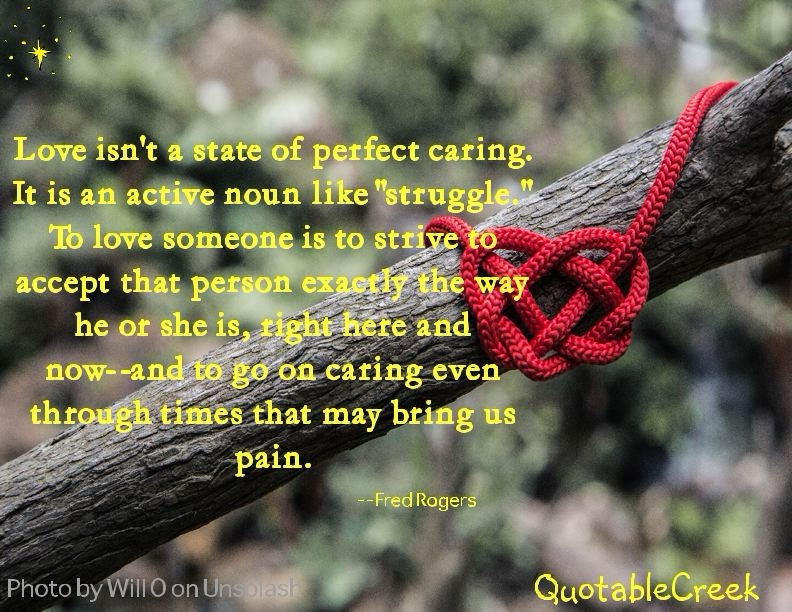
Love isn’t a feeling we fall in and out of. It’s an action we choose to take even when it may be challenging. Sometimes it brings pain. When we think of love as an active verb, like, as Mr. Rogers suggests above, ‘struggle’, rather than as an emotion, it opens our eyes to the fact that we must work at it. It’s a struggle, a constant readjustment and tinkering, constantly expanding our own understanding and empathy.
Love is not molding someone to our vision of what they should be, but accepting who they are and supporting them as they blossom. Thinking of love as something more akin to struggle encourages us to keep looking for new and better ways to show up for the people in our lives, to view the relationships as evolving rather than static, and to appreciate all the little successes and breakthroughs in those relationships along the way.
Fear of failure can keep us from trying something we really, really want to try. And it can keep us from admitting that we have taken a wrong turn and need to reevaluate things. But, at some point, we have to ask ourselves, why? What is so bad about failure?
Thomas Edison famously said, “I have not failed. I’ve just found 10,000 ways that won’t work.” Each experiment that did not succeed helped him move forward on the one path that would ultimately succeed by ruling out the other paths. That attitude helped spur him on because each failed experiment was itself a discovery and taught him something he didn’t know before.
In this remarkable TED talk, Kathryn Schulz, a self-proclaimed wrong-ologist, talks about failure and our responses to it and suggests that it is in these moments of failure, or, as she sees it, moments when reality does not align with our expectations, that the moments of growth, creativity, expansion happen:
So effectively, we all kind of wind up traveling through life, trapped in this little bubble of feeling very right about everything.
I think this is a problem. I think it’s a problem for each of us as individuals, in our personal and professional lives, and I think it’s a problem for all of us collectively as a culture. So what I want to do today is, first of all, talk about why we get stuck inside this feeling of being right. And second, why it’s such a problem. And finally, I want to convince you that it is possible to step outside of that feeling and that if you can do so, it is the single greatest moral, intellectual and creative leap you can make.
So why do we get stuck in this feeling of being right? One reason, actually, has to do with a feeling of being wrong. So let me ask you guys something — or actually, let me ask you guys something, because you’re right here: How does it feel — emotionally — how does it feel to be wrong? Dreadful. Thumbs down. Embarrassing. Okay, wonderful, great. Dreadful, thumbs down, embarrassing — thank you, these are great answers, but they’re answers to a different question. You guys are answering the question: How does it feel to realize you’re wrong? (Laughter) Realizing you’re wrong can feel like all of that and a lot of other things, right? I mean it can be devastating, it can be revelatory, it can actually be quite funny, like my stupid Chinese character mistake. But just being wrong doesn’t feel like anything.
I’ll give you an analogy. Do you remember that Loony Tunes cartoon where there’s this pathetic coyote who’s always chasing and never catching a roadrunner? In pretty much every episode of this cartoon,there’s a moment where the coyote is chasing the roadrunner and the roadrunner runs off a cliff, which is fine — he’s a bird, he can fly. But the thing is, the coyote runs off the cliff right after him. And what’s funny — at least if you’re six years old — is that the coyote’s totally fine too. He just keeps running — right up until the moment that he looks down and realizes that he’s in mid-air. That’s when he falls. When we’re wrong about something — not when we realize it, but before that — we’re like that coyote after he’s gone off the cliff and before he looks down. You know, we’re already wrong, we’re already in trouble, but we feel like we’re on solid ground. So I should actually correct something I said a moment ago. It does feel like something to be wrong; it feels like being right.
We have all been raised to get the right answers on the test, to score a winning shot, to achieve. But reality is more complex than a true-false quiz. No one of us has all the answers. And yet it feels like we do.
Schulz thinks this can be dangerous:
Think for a moment about what it means to feel right. It means that you think that your beliefs just perfectly reflect reality. And when you feel that way, you’ve got a problem to solve, which is, how are you going to explain all of those people who disagree with you? It turns out, most of us explain those people the same way, by resorting to a series of unfortunate assumptions. The first thing we usually do when someone disagrees with us is we just assume they’re ignorant. They don’t have access to the same information that we do, and when we generously share that information with them, they’re going to see the light and come on over to our team. When that doesn’t work, when it turns out those people have all the same facts that we do and they still disagree with us, then we move on to a second assumption,which is that they’re idiots. (Laughter) They have all the right pieces of the puzzle, and they are too moronic to put them together correctly. And when that doesn’t work, when it turns out that people who disagree with us have all the same facts we do and are actually pretty smart, then we move on to a third assumption: they know the truth, and they are deliberately distorting it for their own malevolent purposes. So this is a catastrophe.
This attachment to our own rightness keeps us from preventing mistakes when we absolutely need to and causes us to treat each other terribly. But to me, what’s most baffling and most tragic about this is that it misses the whole point of being human. It’s like we want to imagine that our minds are just these perfectly translucent windows and we just gaze out of them and describe the world as it unfolds. And we want everybody else to gaze out of the same window and see the exact same thing. That is not true, and if it were, life would be incredibly boring. The miracle of your mind isn’t that you can see the world as it is.It’s that you can see the world as it isn’t. We can remember the past, and we can think about the future,and we can imagine what it’s like to be some other person in some other place. And we all do this a little differently, which is why we can all look up at the same night sky and see this and also this and also this.And yeah, it is also why we get things wrong.
We are fallible. We make mistakes, constantly even, and no amount of convincing ourselves otherwise changes this particular reality. Once we accept this, we can soften our edges in the ways we treat each other and ourselves. We can jump into an uncertain future, not knowing what can happen because we realize we ACTUALLY DO NOT KNOW what will happen. That lack of knowledge isn’t something to be ashamed of or to pretend isn’t there like Wile E. Coyote who has just run off a cliff: it’s part of the human condition. We simply do not have all the answers.
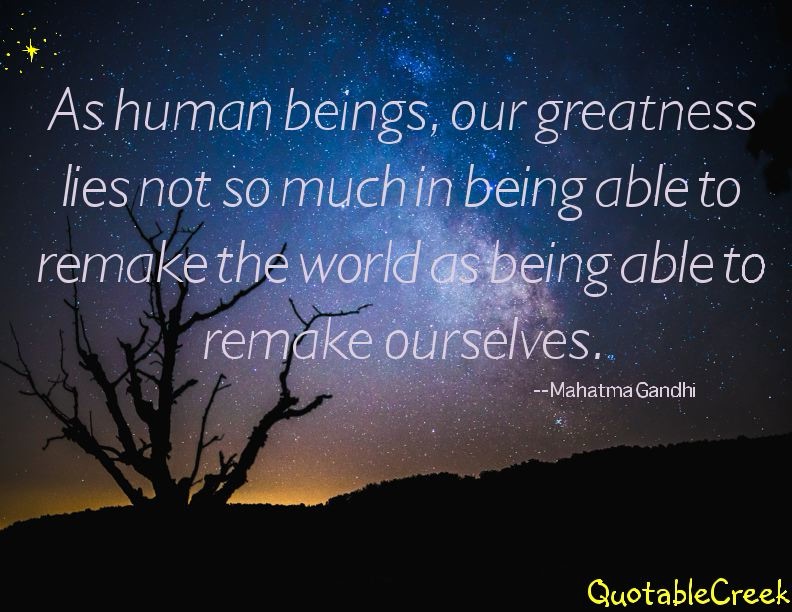
Today, embrace the moment and consider each experience a learning opportunity to grow and stretch and learn. To maybe, even, discover you’ve been wrong and to incorporate that new knowledge into your choices going forward.
When we find ourselves in challenging times and are unsure which way to turn, let these words help guide you.
Do justice. Peace, justice, love are things we do and bring about, not things we wait for. With our best discernment, we offer ourselves to the world, hoping to make a difference. Kind words, loving hearts, calm demeanors, patience, forbearance, and forgiveness. The way of the One we follow. A servant’s heart but a leader’s strength.
Love mercy. Oh, how the world loves vengeance, cancelling, grudges, getting even, punishment. To love mercy is a kinder, gentler path, one that believes in the redeem-ability of every last one of us. One that doesn’t insist on being avenged or having the last word. One that delights in forgiveness and healing.
Walk humbly. No matter how hard we try to do or be right, we may be wrong. The other guy might be right. And, get this, God loves the other guy as much as God love you.
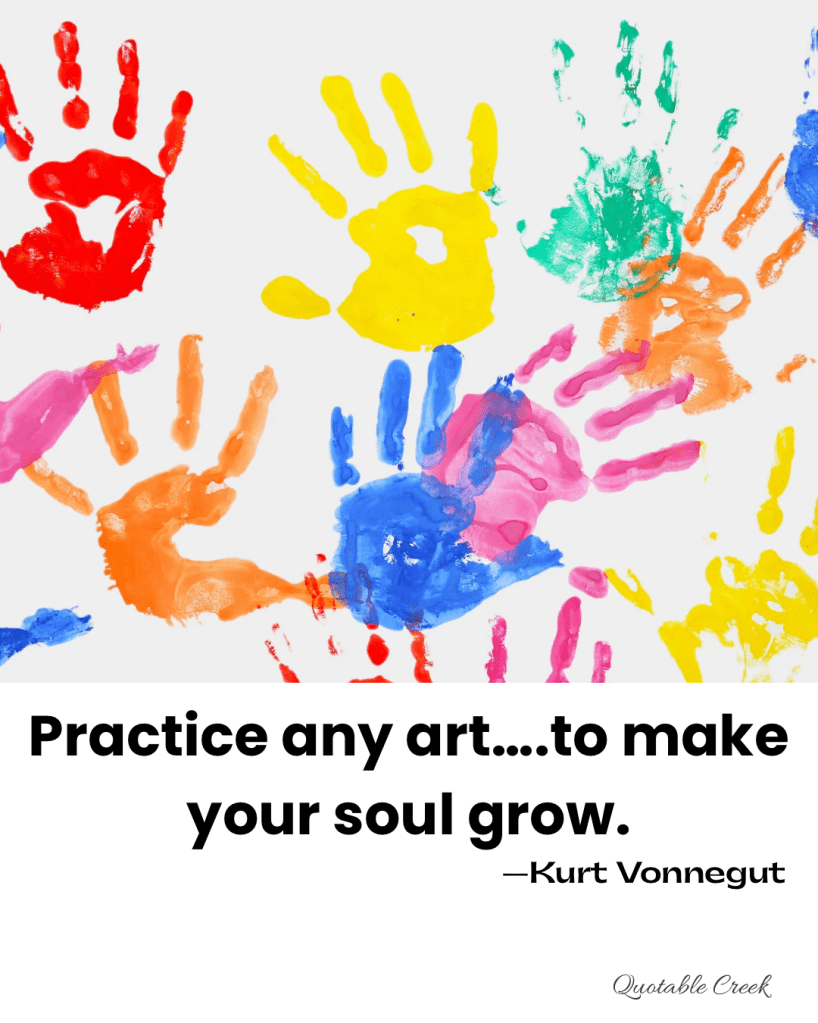
In 2006 a high school English teacher asked students to write to a famous author and ask for advice. Kurt Vonnegut was the only one to respond – and his response is magnificent:
“Dear Xavier High School, and Ms. Lockwood, and Messrs Perin, McFeely, Batten, Maurer and Congiusta:
I thank you for your friendly letters. You sure know how to cheer up a really old geezer (84) in his sunset years. I don’t make public appearances any more because I now resemble nothing so much as an iguana.
What I had to say to you, moreover, would not take long, to wit: Practice any art, music, singing, dancing, acting, drawing, painting, sculpting, poetry, fiction, essays, reportage, no matter how well or badly, not to get money and fame, but to experience becoming, to find out what’s inside you, to make your soul grow.
Seriously! I mean starting right now, do art and do it for the rest of your lives. Draw a funny or nice picture of Ms. Lockwood, and give it to her. Dance home after school, and sing in the shower and on and on. Make a face in your mashed potatoes. Pretend you’re Count Dracula.
Here’s an assignment for tonight, and I hope Ms. Lockwood will flunk you if you don’t do it: Write a six line poem, about anything, but rhymed. No fair tennis without a net. Make it as good as you possibly can. But don’t tell anybody what you’re doing. Don’t show it or recite it to anybody, not even your girlfriend or parents or whatever, or Ms. Lockwood. OK?
Tear it up into teeny-weeny pieces, and discard them into widely separated trash receptacals. You will find that you have already been gloriously rewarded for your poem. You have experienced becoming, learned a lot more about what’s inside you, and you have made your soul grow. God bless you all!” ~Kurt Vonnegut
There is something soul-stretching about entering the zone, that timelessness we find in creating art. Writing, drawing, dancing, singing. All of it. Lose yourself in creating and find yourself a bit different on the other end.
Communication can be tough, particularly after a long silence. Finding inroads, healing thaws, rediscovering common ground takes effort.
Sometimes it’s nice to have a game plan before going into what might be an emotionally-charged conversation.
Consider this one:
So often we get lost in who’s right, who’s wrong. But is that really the point? Harsh words are often spoken in just such a competition to be right. Often the words cause more harm than the original conflict. Is right/wrong really the best way? Especially when the objective is to try to get a friendship back on track.
Being gentle, vulnerable, attentive is true strength. Moving through the world with a genuine sense of curiosity rather than an avowed sense of your own rightness can open the door to a better appreciation of someone else’s point of view and a greater chance of improving, rather than destroying, the remnants of a relationship you hope to save.
In a difficult and challenging place and time, we are called to continue the fight for what is right and good, true and just, honorable and compassionate. We push forward– listening more, caring more, giving more. We can drown out the din and listen to our hearts which strive for peace and harmony, communion, reconciliation. We must hold fast to our principles and to hope as our anchor, especially now.