I was recently reminded about a story from 2017 where two little boys were caught in a rip tide and swept out to sea. Their entire family and four woud-be rescuers tried to swim out to save them but ended up similarly stranded. Officials on shore stood, helpless, waiting for a rescue boat while the family and would-be rescuers floundered.
But then the people on the beach did a remarkable thing. People from all walks of life, across every possible difference or division, linked arms together and formed a human chain stretching out into the ocean until they reached those stuck and and then passed them person to person, beginning with the little boys, Noah (11) and Stephen (8), and ending with their grandmother who had tried to save them, back to safety.
Stories like this don’t get a lot of press. But it’s why we’re here.
Have you ever been to a ghost town? You see the saloon and can picture it with card games going on and drinks being slid down the bar to thirsty patrons. The hoofbeats of horses maybe bringing strangers into town, the scurry to safety if a gunfight breaks out, breaking glass, swishing skirts, laughter and tears. Lives lived and lost all as rich and complicated, full of joy and strife, as your own. And those people who once lived there, chugging their whiskey and loading their pistols—they’re gone. Their time came…..and went.
In Dead Poet’s Society, John Keating (played by Robin Williams) encourages his young students to remember that life is short and that they need to live fully now:
We don’t read and write poetry because it’s cute. We read and write poetry because we are members of the human race. And the human race is filled with passion. And medicine, law, business, engineering, these are noble pursuits and necessary to sustain life. But poetry, beauty, romance, love, these are what we stay alive for. To quote from Whitman, “O me! O life!… of the questions of these recurring; of the endless trains of the faithless, of cities fill’d with the foolish…what good amid these, O me, O life? Answer. That you are here—that life exists, and identity, that the powerful play goes on, and you may contribute a verse.”
That the powerful play goes on, and you may contribute a verse. What will your verse be?
We dance because, for now, we inhabit these bodies and it is joyful to get lost in the beauty of music and move to its rhythms. We sing because we have a song. We love because that’s what life is all about.
One of the frustrations of life is you gain perspective as you mature which may have come really in handy back when you were young. So many mistakes then could have been avoided if you had then the perspective you have now.
Movies like Back to the Future and The Kid have fun with this premise allowing a character to return to their younger selves with their current perspective or vice versa. In Back to the Future, Marty McFly changes the whole course of his family history. In Disney’s The Kid, Russ Duritz, played by Bruce Willis, is confronted by an 8 year old version of himself who wants to know where their dog is since he assumed he would have one as an adult.
What would you ask your older self? What would your child self have wanted you to remember? Would your younger self recognize who you have become?
Each year as I grew up, my mother would have me fill out a school years book of memories. One of the checklists asked you what you wanted to be when you grew up. For girls, the choices were pretty stereotyped: mother, teacher, nurse, stewardess…. But there was an Other box with a blank. One year, I checked that and filled in ‘Pet Owner’. My little self hadn’t know a day without pets to love and couldn’t imagine my older self wouldn’t have pets, too.
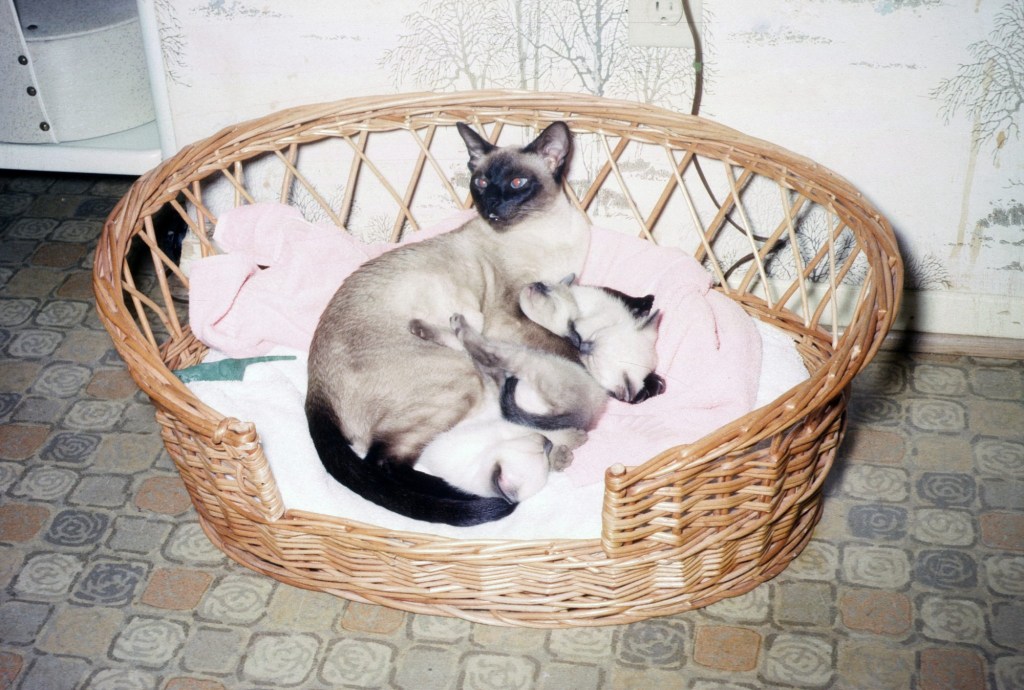
My cats then
My cats now
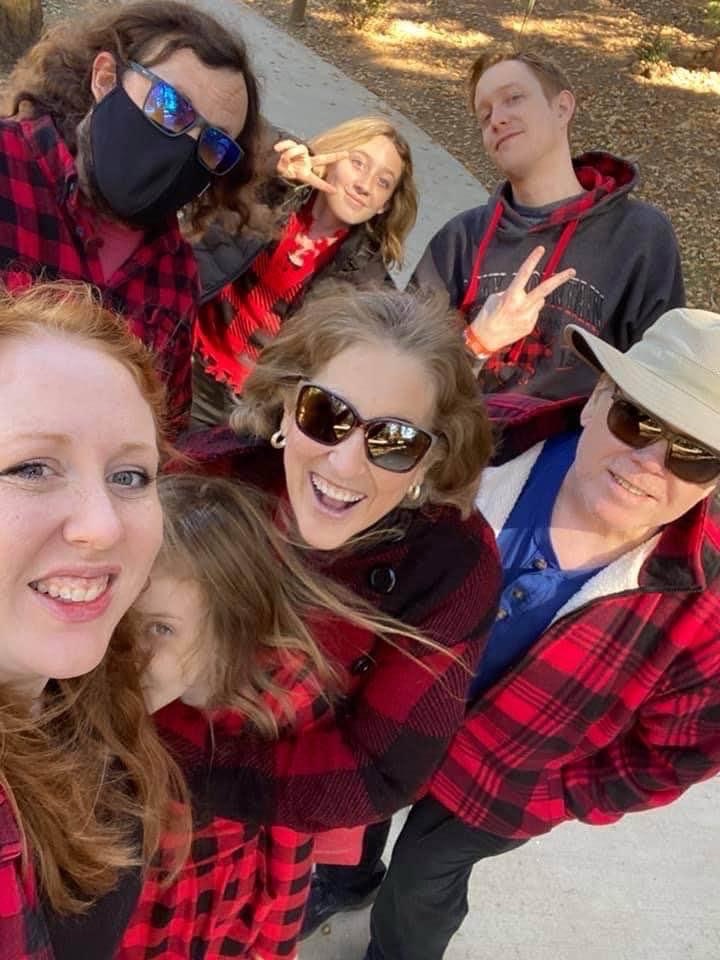
And, each year, I checked, among other things, ‘Mother’. Now, I’m lucky to be a mother and a nana to this lot.
So in some ways, I have been true to little Shari. But I wonder what else she might have wondered about me. What questions would I have had?
In Pride Month, I’m reminded of the videos of people telling younger people, ‘It Gets Better’, that the loneliness and questioning they may feel now won’t define them later. That impulse to tell their younger selves to hold on has been a powerful statement for youth coming to age later. Www.itgetsbetter.org has become the world’s largest story telling effort to help LGBTQIA youth.
The perspective we’ve gained now, lessons we’ve learned, can be lifeblood to others going through struggles like what we have overcome. One of the gifts of age is to be able to use our experiences to help others. Indeed, many therapy models embrace the idea of nurturing your own younger self now in ways you might not have received when you were young, to listen to your own inner young self, and treat yourself now with the kindness you wish you had had then.
It’s an interesting exercise to sit and imagine what the conversation between your current self and your child self would look like? What questions does your younger self have? What comfort and reassurance can your older self provide?
Consider this video, years in the making, where 6th grade children recorded the questions and their older 12th grade selves recorded the answers.
Most of us will not be inventing a vaccine to end a pandemic or donating millions to the research. Most of us will not be heroes in the saving the day sense.
And yet each of us has incredible power to choose how we want to meet each day when life is so stressful. Whether we want to retreat into a cocoon focused only on our own wants and needs or use this as an opportunity to reach out to others. Whether we want to add to someone’s anxiety or be their shelter in the storm. Whether we want to be comforted or to comfort.
And the impetus for any acts of kindness comes from the deep recognition of how important those acts of kindness have been to you when you have despaired. The kind gesture, the comfort of a friend simply abiding with you as you travel a dark path, the reminder that you are precious when you’ve forgotten and can see only your mistakes. These have been your lifeblood. And you can offer that gift to others, particularly now.
Take a moment to enjoy this profound poem by Naomi Shihab Nye.
Before you know what kindness really is you must lose things, feel the future dissolve in a moment like salt in a weakened broth. What you held in your hand, what you counted and carefully saved, all this must go so you know how desolate the landscape can be between the regions of kindness. How you ride and ride thinking the bus will never stop, the passengers eating maize and chicken will stare out the window forever.
Before you learn the tender gravity of kindness you must travel where the Indian in a white poncho lies dead by the side of the road. You must see how this could be you, how he too was someone who journeyed through the night with plans and the simple breath that kept him alive.
Before you know kindness as the deepest thing inside, you must know sorrow as the other deepest thing. You must wake up with sorrow. You must speak to it till your voice catches the thread of all sorrows and you see the size of the cloth. Then it is only kindness that makes sense anymore, only kindness that ties your shoes and sends you out into the day to gaze at bread, only kindness that raises its head from the crowd of the world to say It is I you have been looking for, and then goes with you everywhere like a shadow or a friend.
Children have a way of shaking things up. Don’t they? They see things we’ve stopped noticing. They question things we’ve started to take for granted. They cause us to stop and notice. They hold up a giant mirror to us and cause us to do some soul-searching.
That is, if we take the time to listen.
Why is that person asking for money? Why are people starving? Why do some people get treated better? Why do you say one thing in public but do another in private? Is this fair? Does everyone cheat? Does everyone lie? Is there a better way?
They force us to confront the gap between what we say they should do and what we do, or what society does, or what their friends do. Most adults suffer from some degree of cognitive dissonance: the mental discomfort from holding two or more differing beliefs, ideas or values at the same time. We value honesty but cheat on our taxes. We tell them not to bully others but then bully them or laugh as others are bullied. We tell them never to hit someone else while spanking them. We tell them all children are precious but then harbor racial or gender biases.
They notice.
And they point it out.
For those of us listening, this is a time to ask ourselves what we do, in fact, stand for and then work to align our lives with those values, to be internally and externally consistent.
For an unbelievably uplifting video of a diverse group of kids singing their hearts out, please watch this video. It will start your day off with hope and promise and excitement for the future of our nation and world.
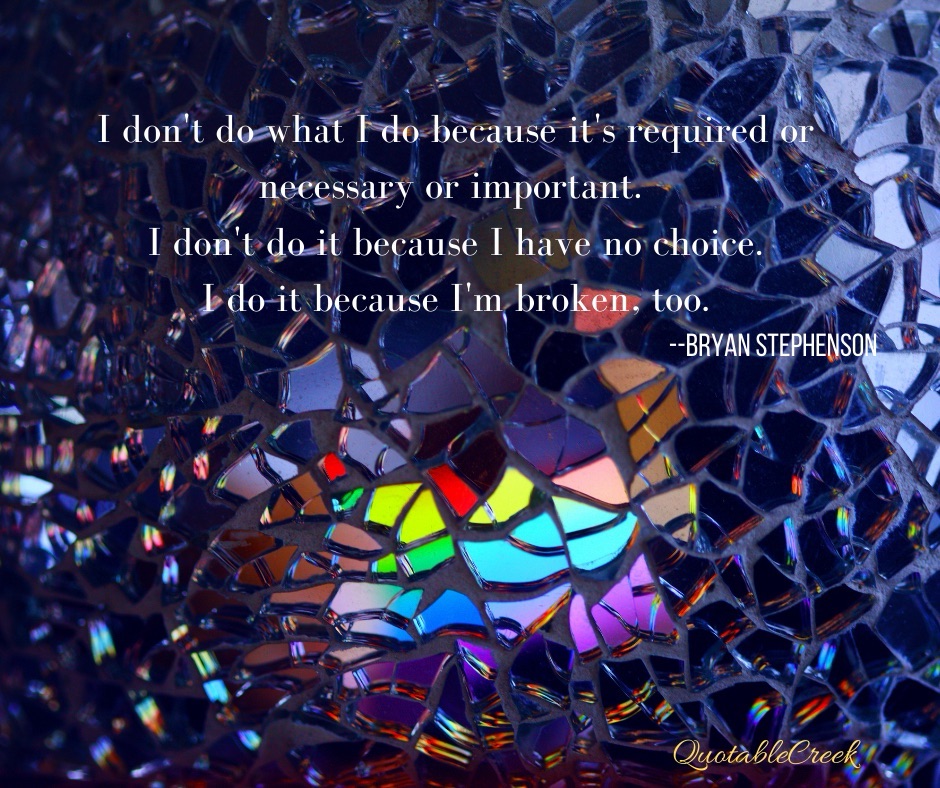
What makes some people able to empathize more than others, able to help in dire circumstances, able to put the greater good above the personal good? Bryan Stephenson, founder of the Equal Justice Institute, fierce advocate against systemic racism, and criminal defense attorney for those on death row explains: “I do it because I’m broken, too.” That recognition of a common humanity and brokenness by a system that needs changing propels him to fight.
Who among us isn’t broken? Because we all are bound together, we all suffer in an unjust world. Because we all have known pain, we all have the capacity to put ourselves into the shoes of those hurting.
In his book, Just Mercy, Stephenson explains:
My years of struggling against inequality, abusive power, poverty, oppression, and injustice had finally revealed something to me about myself. Being close to suffering, death, executions and cruel punishments didn’t just illuminate the brokenness of others; in a moment of anguish and heartbreak, it also exposed my own brokenness. You can’t effectively fight abusive power, poverty, inequality, illness, oppression, or injustice and not be broken by it.
We are all broken by something. We have all hurt someone and have been hurt. We all share the condition of brokenness even if our brokenness is not equivalent. I desperately wanted mercy for Jimmy Dill and would have done anything to create justice for him, but I couldn’t pretend that his struggle was disconnected from my own. The ways in which I have been hurt–and have hurt others–are different from the ways Jimmy Dill suffered and caused suffering. But our shared brokenness connected us.
Paul Farmer, the renowned physician who has spent his life trying to cure the world’s sickest and poorest people, once quoted me something that the writer Thomas Merton said: ‘We are bodies of broken bones.’ I guess I’d always known but never fully considered that being broken is what makes us human. We all have our reasons. Sometimes we’re fractured by the choices we make; sometimes we’re shattered by things we would never have chosen. But our brokenness is also the source of our common humanity, the basis for our shared search for comfort, meaning, and healing. Our shared vulnerability and imperfection nurtures and sustains our capacity for compassion.
We all have a choice. We can embrace our humanness, which means embracing our broken natures and the compassion that remains our best hope for healing. Or we can deny our brokenness, forswear compassion, and, as a result, deny our humanity
…So many of us have become afraid and angry. We’ve become so fearful and vengeful that we’ve thrown away children, discarded the disabled, and sanctioned the imprisonment of the sick and the weak–not because they are a threat to public safety or beyond rehabilitation but because we think it makes us seem tough, less broken. …We’ve submitted to the harsh instinct to crush those among us whose brokenness is most visible. But simply punishing the broken–walking away from them or hiding them from sight–only ensures that they remain broken and we do, too. There is no wholeness outside of our reciprocal humanity.Just Mercy, by Bryan Stephenson
How many of the problems we face today can be mitigated by recognizing our common humanity, by following the Golden Rule of treating others how we would have them treat us, a tenet found in many of the world’s religions? How would we have others treat us if we were the elderly, the sick, the refugee, the hurt, the accused, the other? Each of us would benefit from considering things from this perspective. Bryan Stephenson continues:
Whenever things got really bad, and they were questioning the value of their lives, I would remind them that each of us is more than the worst thing we’ve ever done. I told them that if someone tells a lie, that person is not just a liar. If you take something that doesn’t belong to you, you are not just a thief. Even if you kill someone, you’re not just a killer. I told myself that evening what I had been telling my clients for years. I am more than broken. In fact, there is a strength, a power even, in understanding brokenness, because embracing our brokenness creates a need and desire for mercy, and perhaps a corresponding need to show mercy. When you experience mercy, you learn things that are hard to learn otherwise. You see things you can’t otherwise see; you hear things you can’t otherwise hear. You begin to recognize the humanity that resides in each of us.
…I began thinking about what would happen if we all just acknowledged our brokenness, If we owned up to our weaknesses, our deficits, our biases, our fears. Maybe if we did, we wouldn’t want to kill the broken among us who have killed others. Maybe we would look harder for solutions to caring for the disabled, the abused, the neglected, and the traumatized.Just Mercy, by Bryan Stephenson
We are all broken. Some of us don’t acknowledge that. We have all hurt and been hurt. It is that humbling insight that can help us recognize our common humanity across all divides. If we just have the eyes to see and the ears to hear. Stephenson refers to an unnamed pastor who would preface singing: “The minister would stand, spread his arms wide, and say, “Make me to hear joy and gladness, that the bones which thou hast broken may rejoice.”
In a recent Oprah magazine, Elizabeth Gilbert talks about her Inner Crone — a version of herself old, happy, and well past the point of fear — that she pictures when she needs a shot of courage. She considers her Inner Crone to be “a badass old lady who already dwells somewhere deep within [her] and whom [she] hope[s] to fully become someday.” Picturing her Inner Crone gives Gilbert gumption.
But she also remembers her Inner Child, and pictures that child particularly when she is feeling depressed or hard on herself:
Many years ago when I was going through a dark season of depression and self-loathing, I taped a sweet photograph of myself at the tender age of 2 on my bathroom mirror. Looking at that photo every day reminded me that I once was this blameless little person, deserving of all tenderness–and that part of me would always be this blameless little person deserving of all tenderness. Meditating upon a smaller and more innocent version of my face helped me to learn to be more compassionate to myself. I was finally able to recognize that any harm I inflicted on me, I was also inflicting on her. And that little kid clearly didn’t deserve to be harmed.
We could all benefit from picturing our Inner Child when we are being hard on ourselves. Would you criticize that little child the way you are criticizing yourself now, or would you be more patient and encouraging? Would you demand perfection from that child, or would you celebrate progress? If you were wounded by adults when you were a child, you now are an adult who can support that little child in a healing way.
Think back. Can you remember that Inner Child who is still a part of you? The joy and exuberance, enthusiasm and trust, innocence and promise? No matter how far you’ve come from that start, treat yourself with kindness, patience, and compassion. That Inner Child is alive and well…and trusts you.
Picture a fussy baby, afraid to fall asleep, but then comforted in his mother’s arms by her lilting lullaby, her breath soft against his face, her song sweet to his ears.
Who among us can’t, at times, relate to that child? The future seems particularly uncertain. Worry disrupts sleep. Anxiety weakens our resolve.
There is something about a lullaby, though, the soft tones, the repetitive melody, the gentleness of the presentation, that can help soothe and relax, comfort and reassure us. The sweet song can reach into our long past baby consciousness and help us rest.
Take a minute to enjoy this beautiful rendition of Billy Joel’s Goodnight, My Angel, by Social Dissonance with soloist Ryan Nagelmann. May it help you find peace.
Tending is such a dear word, not much used these days. To tend: ‘to care or look after, to give one’s attention to’. Lincoln reminds us to ask where we are and whether we are tending. Where we are. Are we where we want to be? Are our relationships as tender and loving as we would like? Are we tending? Do we feel someone is tending to that relationship with us? Do we feel tended to?
What are the kind, gentle ways we can tend to our relationships?
When someone tells us they are sad their relationship with us isn’t better, is our first instinct to deflect, blame, ignore, change the subject, shrug, laugh? Or is to pause, breathe deep, and say, ‘Yes, I wish our relationship was closer, too. Where are we? Are we tending? What can we do to better tend our relationship and draw closer rather than shrug and pull away?’
The world is certainly full of shruggers who turn away even from their closest relationships in favor of new friends or less vulnerability. The shruggers, the cynics, the distancers, the superficial. So be it.
But God bless the tenders. That is where the heart is.
This week, Pope Francis passed away, and stories are circulating about some of the changes he made in the church and some of his more compelling speeches. Back in 2017, in a surprise TED talk, Pope Francis put in a request for more tenderness in our lives. He stressed that we are all connected:
First and foremost, I would love it if this meeting could help to remind us that we all need each other, none of us is an island, an autonomous and independent “I,” separated from the other, and we can only build the future by standing together, including everyone. We don’t think about it often, but everything is connected, and we need to restore our connections to a healthy state. Even the harsh judgment I hold in my heart against my brother or my sister, the open wound that was never cured, the offense that was never forgiven, the rancor that is only going to hurt me, are all instances of a fight that I carry within me, a flare deep in my heart that needs to be extinguished before it goes up in flames, leaving only ashes behind.
Many of us, nowadays, seem to believe that a happy future is something impossible to achieve. While such concerns must be taken very seriously, they are not invincible. They can be overcome when we don’t lock our door to the outside world. Happiness can only be discovered as a gift of harmony between the whole and each single component. Even science – and you know it better than I do – points to an understanding of reality as a place where every element connects and interacts with everything else.
The Pope suggested tenderness for bridging the divides that separate us:
And what is tenderness? It is the love that comes close and becomes real. It is a movement that starts from our heart and reaches the eyes, the ears and the hands. Tenderness means to use our eyes to see the other, our ears to hear the other, to listen to the children, the poor, those who are afraid of the future.To listen also to the silent cry of our common home, of our sick and polluted earth. Tenderness means to use our hands and our heart to comfort the other, to take care of those in need….
Yes, tenderness is the path of choice for the strongest, most courageous men and women. Tenderness is not weakness; it is fortitude. It is the path of solidarity, the path of humility. Please, allow me to say it loud and clear: the more powerful you are, the more your actions will have an impact on people, the more responsible you are to act humbly. If you don’t, your power will ruin you, and you will ruin the other. …
The future of humankind isn’t exclusively in the hands of politicians, of great leaders, of big companies.Yes, they do hold an enormous responsibility. But the future is, most of all, in the hands of those peoplewho recognize the other as a “you” and themselves as part of an “us.” We all need each other. And so, please, think of me as well with tenderness, so that I can fulfill the task I have been given for the good of the other, of each and every one, of all of you, of all of us. Thank you.
As we grieve, Pope Francis, let us heed his words. The future is in our hands. Can we think of and treat each other with tenderness? Do we recognize that we are all part of an “us”?

 QuotableCreek.com