Like to the lark at break of day.

I am a huge fan of birdsong. It is so joyful. Listening to a little bird, so unassuming, singing with all it has to welcome the day reminds us of what it is like to be alive—vibrant and grateful, blessed with a day ahead to sing our song however that might manifest itself in each individual life. Open. Ready. Eager even.

And yet life can bring us low. Consider Shakespeare’s 29th Sonnet below. He certainly gets what it is like to feel outcast and alone, bemoaning our fate, jealous of others’ future and friends, their talents and possibilities, when we feel we have none.

And yet,

There is, or maybe was, someone who brightened our spirits. Someone who loved us and, like the simple lark singing its joyful song, that love can change an outlook in a blink. And next to that love, all the treasure of kings is paltry.

For a perfect, tear-jerking read of this Sonnet, take a listen to Judi Dench in the clip below. and take a minute, sometime today, to listen to a bird singing its heart out and remember those you love and those who love you.

When, in disgrace with fortune and men’s eyes,

I all alone beweep my outcast state,

And trouble deaf heaven with my bootless cries,

And look upon myself and curse my fate,

Wishing me like to one more rich in hope,

Featured like him, like him with friends possessed,

Desiring this man’s art and that man’s scope,

With what I most enjoy contented least;

Yet in these thoughts myself almost despising,

Haply I think on thee, and then my state,

(Like to the lark at break of day arising

From sullen earth) sings hymns at heaven’s gate;

       For thy sweet love remembered such wealth brings

       That then I scorn to change my state with kings.
Thorns or roses?

If you look for thorns, you’ll see thorns. If you look for love, you’ll see it all around you. And if you look for opportunities to make a difference, to shower people with love, and to take a stand for all that is good and right in the world, those opportunities will be there.

What opportunities do you see in the day ahead?

Advice to your younger self.

What can you tell us? With all of your experiences to date, what have you learned that you can pass on to help others? How would you advise your younger self?

For many of us, that advice would be: don’t be afraid. In this delightful video, elders counsel their juniors with some gems on how to negotiate this crazy world.

Avoiding the drift.

Otters sleep holding hands. In the open water, it would be so easy for them to drift away from each other in the ebb and flow of the tides. They also use kelp to wrap around themselves, but there is something about the image of sleeping otters holding hands to stay connected that is utterly endearing.

Sea_otters_holding_hands.jpg.638x0_q80_crop-smart.jpg

We, too, bounce around in rough seas, and it is easy to drift away from those we love. Distractions, distance, inattentiveness add up until you are apart, in the storm separately, rather than braving it together.

Today, work to avoid the drift away from those you love.

Being shelter.

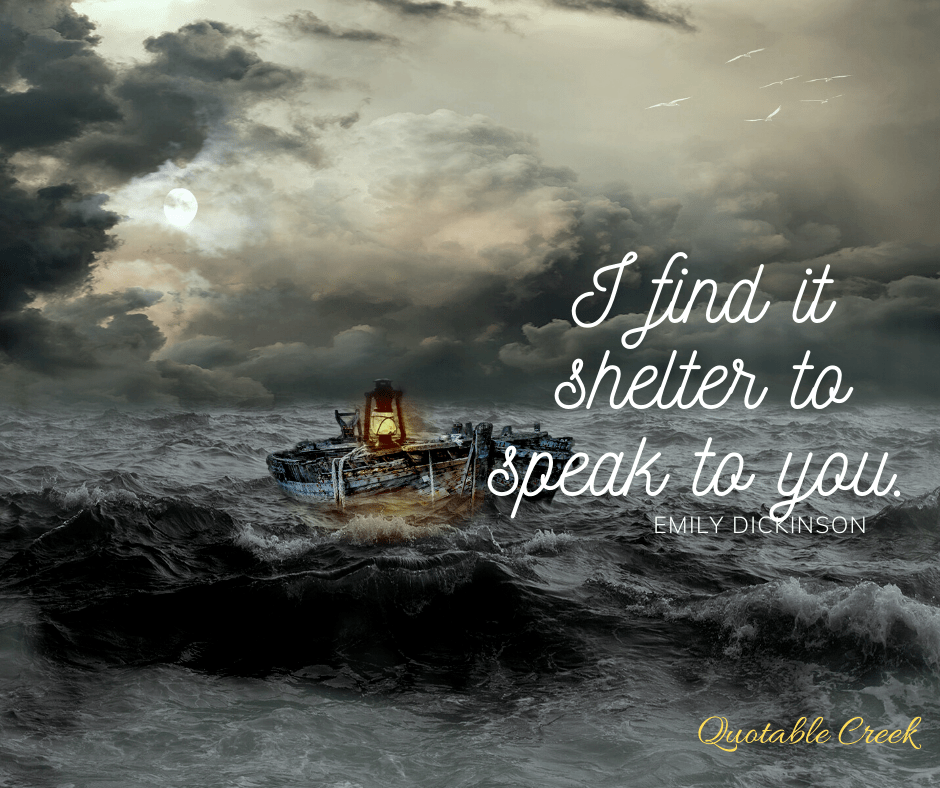
Of all the compliments you could receive, perhaps the best is that you feel like shelter. That, in all the storms and chaos that swirl around us, talking to you feels like safety. Not in the sense of being a yes man or echo chamber, or even in the sense of being able to do anything to stop the storm, but in the sense of home. 

“I find it shelter when I speak to you,” says Emily Dickinson. What might we do and say to make someone feel that way? Shelter implies that the storm is still swirling, the elements are still fierce, but talking to you is a respite from that and an entry into something welcoming and safe. A place where you are known, and heard, and cared for. A place of comfort. 

Certainly there are plenty of people making themselves someone’s storm. Wouldn’t it be wonderful to be someone’s shelter instead?

What can you do in this increasingly chaotic and exhausting world for someone to find it shelter when they talk with you?

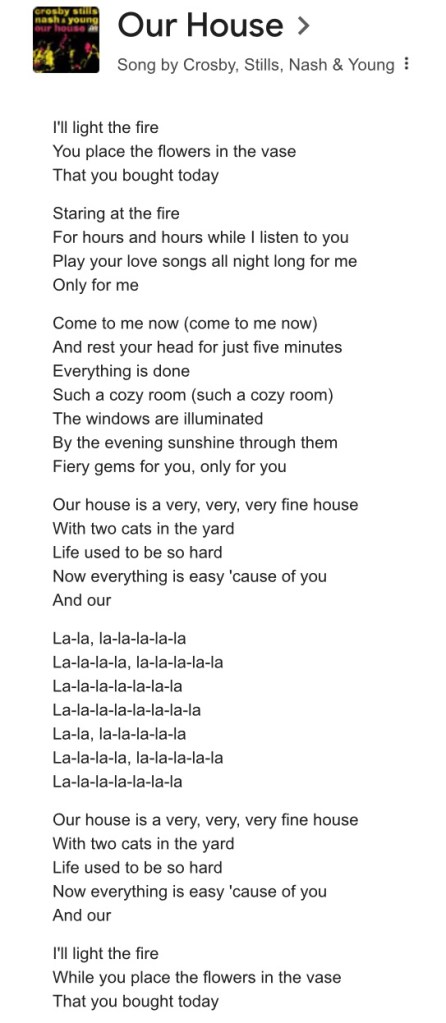
Everything is easy ‘cause of you.

Sometimes you can lift out of a moment and say to yourself, ‘This is a wonderful moment. I am so content.’ Everything has a new luster. And sometimes a song might come to mind.

In my case, I was sitting with my husband, watching our two cats (pictured) and thinking about how homey everything felt. It brought to mind the CSNY song, ‘Our House’.

Here are the lyrics:

And, while we were sitting so inclined, my husband did a Google search about the song and learned that Graham Nash and Joni Mitchell had been shopping after dining at Art’s Deli, bought a vase, came back to her two cats, and lit the fire on a drizzly day. Nash sat at her piano and wrote this song in an hour. He must have been feeling what we felt. Content. Full.

How lovely he memorialized it for all of us to share.

The singing leaf and your busy heart.

Let heaven and nature sing.

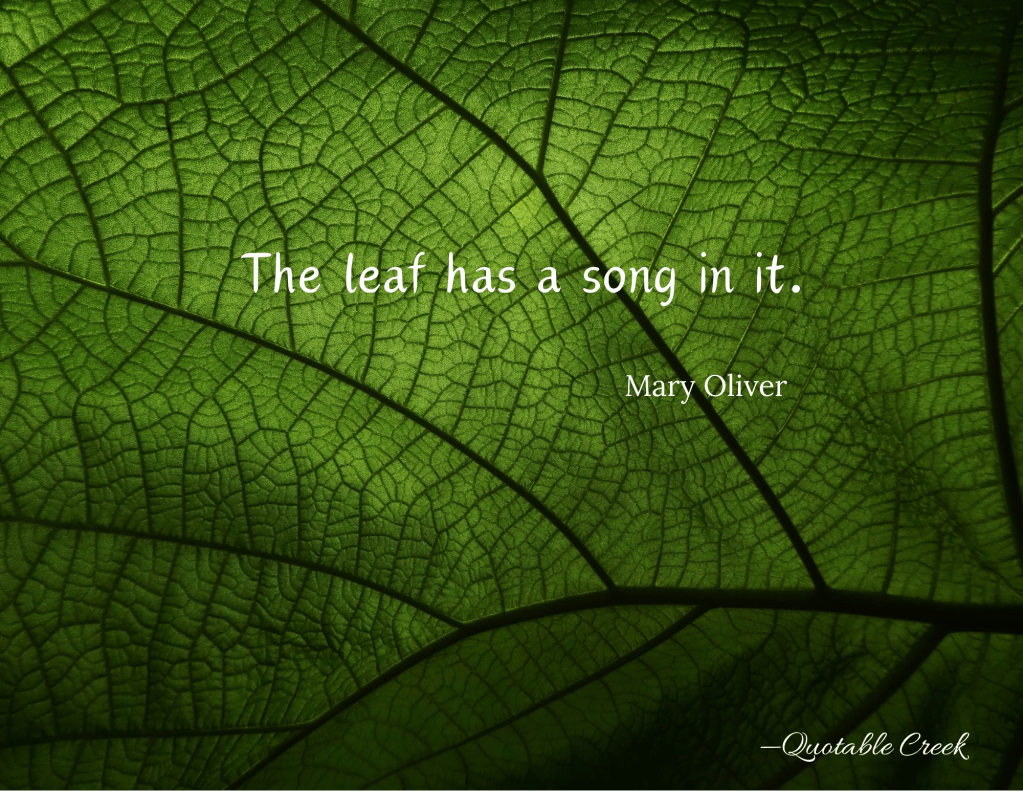
There is a thrum, a life force, a joy at the core of it all, and sometimes we need to tune in to it and listen.

As Mary Oliver wrote:

What can I say that I have not said before?

So I’ll say it again.

The leaf has a song in it.

Stone is the face of patience.

Inside the river there is an unfinishable story and you are somewhere in it

And it will never end until all ends.

Take your busy heart to the art museum and the chamber of commerce

But take it also to the forest.

The song you heard singing in the leaf when you were a child

Is singing still.

I am of years lived, so far, seventy-four,

And the leaf is singing still.

Where will you take your busy heart today? Can you hear the leaf singing?

How to be a good creature.

Sy Montgomery’s delightful book, How To Be a Good Creature, is a ‘Memoir in Thirteen Animals‘. What an interesting way to organize a memoir, focusing on the impact various animals have made on her life and what they have taught her about co-existing as fellow creatures on this planet! It is a profound, yet simple, book.

If you were to write a memoir of your life through that lens, who would the animals be that impacted your life in meaningful and enriching ways? What life lessons did you learn? How were your limits expanded from sharing space with that fellow creature?

For inspiration, consider Montgomery’s words:

All the animals I’ve known–from the first bug I must have spied as an infant, to the moon bears I met in Southeast Asia, to the spotted hens I got to know in Kenya–have been good creatures. Each individual is a marvel and perfect in his or her own way. Just being with any animal is edifying, for each has a knowing that surpasses human understanding. A spider can taste the world with her feet. Birds can see colors we can’t begin to describe. A cricket can sing with his legs and listen with his knees. A dog can hear sounds above the level of human hearing, and can tell if you’re upset even before you’re aware of it yourself. Knowing someone who belongs to another species can enlarge your soul in surprising ways.

I often wish I could go back in time and tell my young, anxious self that my dreams weren’t in vain and my sorrows weren’t permanent. I can’t do that, but I can do something better. I can tell you that teachers are all around to help you: with four legs or two or eight or even none, some with internal skeletons, some without. All you have to do is recognize them as teachers and be ready to hear their truths.

Today, consider the wonder of creation around you and thank your teachers of the non-human persuasion.

I shall not pass this way again.

There is an elephant in the room. We don’t talk about it, we try not to think about it, we pretend it doesn’t exist. That elephant is the fact that we are all on a one way journey through this life. Our time is limited. None of us knows in advance when our end of the journey will come, but that end will come.

When we pull ourselves out of denial and gaze directly at this elephant, we can realize something important: our opportunities should be seized now. That good we can do? Don’t put it off. That kind word? Say it. That gift or remembrance? Give it now.

We will not have this place and time and opportunity to make a difference again.

Love v. Control.

Falling is an appropriate metaphor for love. Exhilaration, yes, but also a loss of control, fear, vulnerability, chance of being hurt. And yet, as a relationship develops, and we become more and more entwined in each other’s lives, often we have expectations of how that should go. We proceed with plans and agendas.

When the love is of a child, often control is a substitute for teaching and patience. Molding them rather than letting them blossom is easier.

But is that still love?

Tenzen Palmo says:

Attachment is the very opposite of love. Love says, ‘I want you to be happy.’ Attachment says, ‘I want you to make me happy.’

In any loving relationship, we need to constantly remind ourselves to put the other first, to want what is best for them, to cheer their successes and mourn their failures, to encourage and support. And, hopefully, our loved one will love us in that same way right back.