Not long ago, the world shut down, and most people were asked to sequester and stay home while essential workers reported, still, for duty. It was a strange time, involving so many swiftly moving facts to assimilate and assess forward progress.
But that question of ‘essential’ is an interesting one. Some of the jobs labeled ‘essential’ or not were surprising choices.
How does one determine what is ‘essential’? What of the artist? With so many schools cutting art and music programs as non-essential, I wonder what the world would look like filled just with grammarians and mathematicians. Surely, art, though it puts no food on the table and sets no broken bones, is essential to the human spirit.
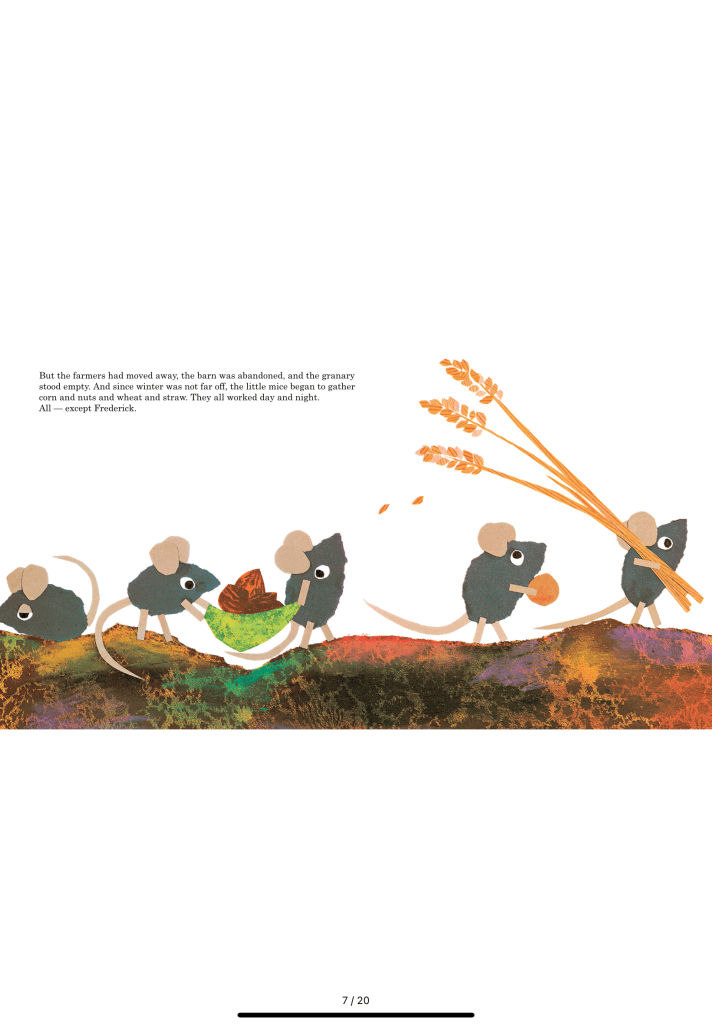
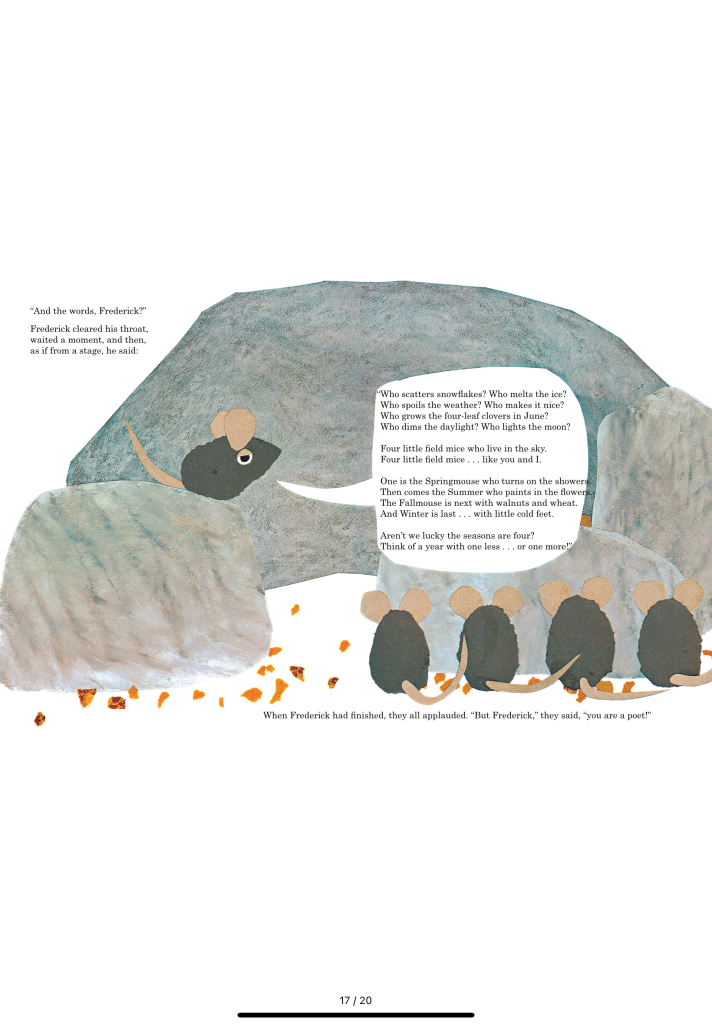
Such is the theme of Frederick by Leo Lionni. While four mice toil to set up stores of grain for winter, one mouse collects color, and sounds, and words.
And when winter came, and the mice were cold and hungry, Frederick’s words sustained them.
So lift a glass in praise to the artists, the writers, the musicians. Those who lift us up and sustain us and offer us beauty for our souls.
Life can be tough. Even the most charmed of lives has loss and heartbreak, disillusionment and despair. Everyone hurts. But buried deep under the hurt and pain is the little waif you used to be, full of hope and promise, enthusiasm and excitement.
Your identity is not equivalent to your biography. There is a place in you where you have never been wounded, where there is still a sureness in you, where there’s a seamlessness in you, and where there is confidence and tranquility in you.
The intention of prayer and spirituality and love is now again to visit that inner kind of sanctuary.
Deep in there, behind the daily worries, aches and pains, hurts and disgruntlements, is your soul. Prayer, staying still and letting your mind clear in meditation, will take you there, again and again, a way to connect with both your own individuality and your place in the awesome collective of it all.
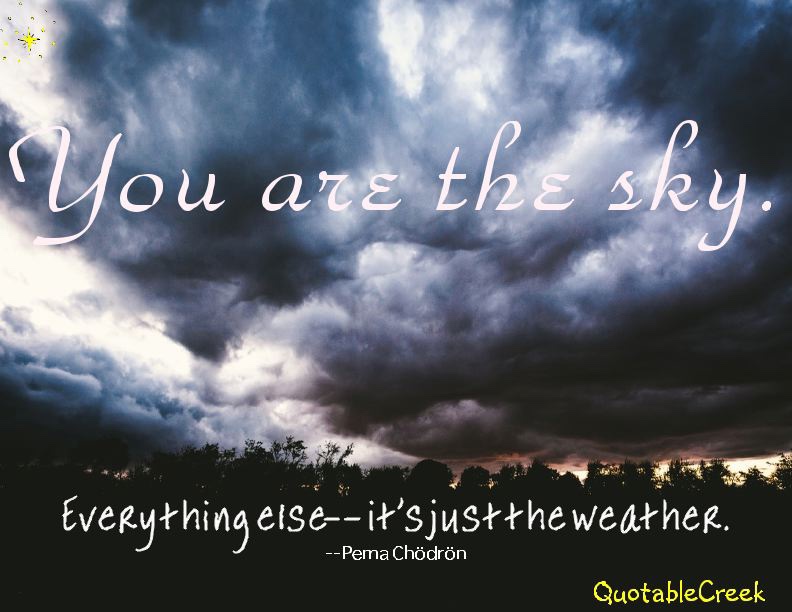
You may be in a storm right now–untethered, free-falling, desperate. But the storm does not control you any more than you control the storm. You are apart from the storm.
Have you ever taken a flight on a stormy day? You board the plane, and it is overcast, stormy, perhaps raining furiously. But after take off, you climb until you are above the clouds. It’s shocking to discover that there, above the clouds, the sky is blue and clear.
Remember the storm will fade. You are not the storm. Your essence is still there above the clouds, blue in the shining sun. Hold on. The sun will come out again. (But, just so we follow this analogy to its logical end, you are not the sun either. You may have a beautiful day, but that, too, does not define you.)
You are the sky, the constant, behind the weather, influenced by the storms and sunshine in your life but not controlled by them.
It feels like we have fought this battle before. Why won’t it go away? Why are we here again?
Perhaps it is as simple and complex as that there are epic forces of good and evil alive in the world. Evil, whether in the form or racism, misogyny, selfishness, and so on, keeps coming back, even when we think progress has been made. That is the nature of the world we live in.
The answer: to keep flooding the world with good, keep fighting the good fight.
As I age, I have a new appreciation for those poets like Dylan Thomas raging against mortality. I do not want to go gentle into that good night. I like it here.
Here is a new variation on that theme I enjoyed:
Sorrow Is Not My Name BY ROSS GAY
—after Gwendolyn Brooks
No matter the pull toward brink. No matter the florid, deep sleep awaits. There is a time for everything. Look, just this morning a vulture nodded his red, grizzled head at me, and I looked at him, admiring the sickle of his beak. Then the wind kicked up, and, after arranging that good suit of feathers he up and took off. Just like that. And to boot, there are, on this planet alone, something like two million naturally occurring sweet things, some with names so generous as to kick the steel from my knees: agave, persimmon, stick ball, the purple okra I bought for two bucks at the market. Think of that. The long night, the skeleton in the mirror, the man behind me on the bus taking notes, yeah, yeah. But look; my niece is running through a field calling my name. My neighbor sings like an angel and at the end of my block is a basketball court. I remember. My color’s green. I’m spring.
As we age, there is loss. That loss is like a presence that follows us relentlessly like a shadow. No avoiding it. No pretending. We are mortal. The people we love are mortal, perhaps imminently so. This is part of the rules of engagement. And while most of us avoid thinking too much about it, poets like Mary Oliver offer life instructions:
To live in this world, you must be able to do three things:
To love what is mortal
To hold it against your bones knowing your own life depends on it;
And, when the time comes, to let it go, to let it go.
I honestly don’t know which of these three rules is the hardest. Right now, they each seem nearly impossible. But having the courage to follow these instructions feels like the answer.
Her full poem is below.
Look, the trees are turning their own bodies into pillars
of light, are giving off the rich fragrance of cinnamon and fulfillment,
the long tapers of cattails are bursting and floating away over the blue shoulders
of the ponds, and every pond, no matter what its name is, is
nameless now. Every year everything I have ever learned
in my lifetime leads back to this: the fires and the black river of loss whose other side
is salvation, whose meaning none of us will ever know. To live in this world
you must be able to do three things: to love what is mortal; to hold it
against your bones knowing your own life depends on it; and, when the time comes to let it go, to let it go.
Mr. Rogers had a gift for seeing each child he encountered as an individual, a neighbor, someone worthy of respect just as they are. No need to impress him, or to put on an act, or to pretend. He accepted children. Period. No strings attached.
How wonderful.
Do you feel you are enough, just as you are? Sometimes our families, friends, or societies give us the message that we aren’t. That we need to be thinner, richer, smarter, younger, more attractive. Something different from what we are. That we must think the same as they do and fall in line. It’s exhausting.
What a gift it is to accept people, including ourselves, just as is. No one is perfect, so why pretend we are? We each have strengths and weaknesses, things we’re working on and things we’ve got sorted. Instead of finding flaws, we can look at ourselves and each other as complicated works in progress, with value just as we are, giving ourselves and each other ‘the best opportunity for growing into the healthiest of people.’
My daughter recently organized her library, not by any of the more common methods of organizing books—genre, audience, age, author last name, — but by color of the cover. I must say, this startled me. It upset my Dewey-decimal apple cart. But look how lovely it is!
I have always focused on organization, both as a lawyer and, now, as an author. It is so vital to figure out your system for how something is to be done. How to organize the information in the most compelling way. Generally, for instance, an appellate brief is organized chronologically, but often that isn’t the most persuasive way. Some testimony needs to be highlighted, some evidence footnoted. And so on. The organization of the brief is a hidden layer adding content. The same is true for stories, sometimes jumbling the timeline or telling things from multiple points of view adds layers and juxtapositions you simply couldn’t get in any other way.
Or, for that matter, consider organizing socks. As a little girl I tried out organizing my socks from white to black with all the colors in the middle in a lovely spectrum (she is my daughter!) but then realized that wasn’t as efficient as organizing them for their intended use—play, school, dress, etc. I’ve had similar questions in my closet. What goes with what? How should things be ordered? Currently my blouses and tops are organized from sleeveless to long-sleeved. But color would certainly be fun, or seasons, or play to formal. The possibilities are endless. But this brings me somewhat round about to my point.
Everything is organized, and we need to pay attention to how.
Consider a grocery store with the popular items at eye level and the tempting items at check out. Or the casino, windowless and clockless to encourage extended gambling. Or a library? What goes in fiction/non-fiction? Is that line ever blurry? Or the church: how would you organize a church? Where should the focus be? How, or do, you make it welcoming? Or a city? Is there a right and wrong side of the tracks? Why?
These kind of questions keep us sharp and open, more able to see when systems aren’t working or when the organization of a thing is manipulating us. And taking things and jumbling up the order, like sorting books by color rather than content, let’s us see with fresh eyes and catch new and interesting juxtapositions, and challenge the very systems we use for categorizing what’s in or out.
Compassion is an active, engaging emotion. It recognizes that another’s pain is as important as your own and seeks to help alleviate it. It is the emotion behind all social justice reform.
Compassion comes from empathy which is very different from sympathy. Dr. Eric Perry describes the two like this:
To better understand empathy, it is important to distinguish it from sympathy. Sympathy is the ability to understand another person’s situation from your point of view. It is a self-centered point of view that helps you understand what the other person is going through based on your own circumstances. You are able to acknowledge how the other person is feeling but, from a distance. You do not become emotionally connected to the person. For example, you are able to sympathize with someone having problems in their relationship because you have had problems in your own relationship. You do not feel what they are feeling but you have an understanding of what they are experiencing.
Empathy is a bit more complicated and abstract. In order to experience empathy, you must have the ability to identify the emotion and to place yourself in the other person’s position. The focus of empathy is self-less. You are experiencing another person’s emotional life by your ability to connect with them. In a sense, you are vicariously feeling the emotion. For example, through empathy, you are able to feel a stranger’s loss of a child, even if you are childless, by seeing the loss through their perspective. Through this connection, you are able to wear the emotional skin of another and essentially feel with them.
The inability to imagine yourself in someone else’s place in order to understand what they are feeling will result in difficulty in connecting with others.
Narcissists and sociopaths can feel sympathy. They use their knowledge of a person’s emotions, not to help them, but to manipulate and control them. But the empathetic person shares the pain of another and works to alleviate it.
The good new is that compassion is like a muscle and can be practiced and strengthened. In this fascinating article by Greater Good, they outline some steps for increasing your empathy.
They identify four goals to the practice:
Bringing attention or awareness to recognizing that there is suffering (cognitive)
Feeling emotionally moved by that suffering (affective)
Wishing there to be relief from that suffering (intentional)
A readiness to take action to relieve that suffering (motivational)
How often do we give others the benefit of the doubt? Do we assume the innocent explanation or conclude the worst? Are we patient, or do we pounce at the very first mistake someone makes in trying to get their thoughts out? Do we search for the best in others, or do we protect ourselves in advance about the damage we fear may be inevitable by opening our hearts to trusting someone again?
Wouldn’t it be lovely to live in a world where everyone gave everyone else the benefit of the doubt? Where perceived offenses weren’t allowed to fester and grow? Where there was trust?
Consider this beautiful poem on friendship by Dinah Maria Craik. Isn’t this how we would like to make each other feel?
Friendship
by Dinah Maria Craik
Oh, the comfort —
the inexpressible comfort of feeling safe with a person —
having neither to weigh thoughts nor measure words,
but pouring them all right out,
just as they are,
chaff and grain together;
certain that a faithful hand will take and sift them,
keep what is worth keeping,
and then with the breath of kindness blow the rest away.





 QuotableCreek.com