Stand where the light is shining.
Sometimes, when we feel down, we need to evaluate the input coming into our lives. Are we steeped in negativity? Maybe not just news, but the vitriol that follows it in the comments? The political back and forth can get ugly and pull us down. And then we can think about the friends we surround ourselves with. Are they upbeat, trying to make things better, or always complaining?

And, while we don’t want to retreat from fighting the good fight or the friends who are going through a rough patch, it’s so easy for people to tear things down, to find the flaws, to make a conflict, and, when we are around that kind of energy constantly, we can feel beaten down.

But, there is good news to be had, and there are positive people and opportunities to be found. Sometimes we need to focus our attention there, if only for a break from the storm.

Awe inspires.

When we lose our way or feel overwhelmed, we can return to nature and be renewed. Hear the birds singing their spring song. Watch them collect twigs and bits for their nests. See the long grass ripple in a gentle wind like ocean waves. Breathe in the sweet earthy fragrance of the morning. Feel small and surrounded by an amazing, complicated system that has been pulsating with life for millions of years. That awe is good for us:

“It has long been established that a healthy diet and lots of sleep and exercise bolster the body’s defenses against physical and mental illnesses. But the new study, whose findings were just published in the journal Emotion, is one of the first to look at the role of positive emotions in that arsenal.

“That awe, wonder, and beauty promote healthier levels of cytokines suggests that the things we do to experience these emotions—a walk in nature, losing oneself in music, beholding art—has a direct influence upon health and life expectancy,” says UC Berkeley psychologist Dacher Keltner, a coauthor of the study.”

Breathe in the day, full of life and possibility. Breathe out the stress, the worry, the defeat. In. Out. In. Out. In.

The heart of a child

Do you remember what it is like to look at the world through a child’s eyes? When magic, wishes, and hope are as real as the miracle of the sun coming up each day? When trust is the default response? When everything is filled with wonder? How lucky we are to have children to bring us back to that time we better understood the world because now we’ve gotten too serious to appreciate or even see the mystery.

Cultivating gratitude

In this beautiful film set to the words of Brother David Steindhl-Rast, you can’t help but see much of what makes life good and affirming. What if we learn to appreciate each day as if it is our first day…and our last? What if we appreciate each miracle as it presents itself to us throughout the day…the miracle of sight, of running water, of food, of laughter? What then?

The incredible power of community.

Blue Blueberries Food Fact Facebook Post

In 1943, President Roosevelt had several competing problems to solve; his answer: Victory Gardens. Author Elisa Carbone (Diana’s White House Garden) describes the amazing bit of history this way:

The World War II Victory Garden plan grew out of necessity. There was not enough steel and tin to make both fighter planes and tin cans for vegetables. There were not enough train cars to carry soldiers to the ports and to send food around the country. And with Japan controlling the islands where most of the world’s rubber plants grew, there was not enough rubber for tires for trucks to carry food from the farms to the cities.

The Roosevelts’ plan was a resounding success. In every city and town, vacant land was turned to food production. City parks, suburban and urban yards, vacant lots, and even apartment rooftops were used to grow fruits and vegetables. An estimated 20 million gardens were planted in the  U.S., producing between 9 and 10 million tons of food, over 40 percent of all the produce eaten in the United Sates. Community centers offered classes in canning, and the harvest was put away to feed the country during the winter as well.

This bit of history is remarkable in so many ways. Success depended on wide-spread buy-in from the total population based on their shared concern for and desire to support the troops and win the war. The solution wasn’t based on borrowing or over-spending but directly resulted from an honest appraisal of scarcity. People stepped up, across all divides. The solution stemmed from a deep recognition of the interrelatedness of things. People welcomed the opportunity to help. Each of those facts is powerful alone, but together, it marks a remarkable time in history.

What could we do today with buy-in like that among an entire populace? Can we even imagine anymore what it would feel like to be part of a country where everyone was looking for a way to help a global problem by making changes and contributions at a local level? In 1943, the impetus for the action was a desire to feed the troops and help win the war. What will we care enough about to pull together now?

Walk around

May your choices reflect your hopes, not your fears.

In her delightful book, Maybe You Should Talk to Someone, Lori Gotlieb relays this encounter with her therapist:

“I’m reminded,” he begins, “of a famous cartoon. It’s of a prisoner, shaking the bars, desperately trying to get out–but to his right and left, it’s open, no bars.”

He pauses, allowing the image to sink in.

“All the prisoner has to do is walk around. But still, he frantically shakes the bars. That’s most of us. We feel completely stuck, trapped in our emotional cells, but there’s a way out–as long as we’re willing to see it.”

We cling to what we think is an agonizing choice between A and B and don’t even see choices C-Z. Sometimes we have the choice not to make a choice at all, to not be part of the conflict. Sometimes choices are knee-jerk reactions that maybe, if we had just paused, we will regret. Sometimes we need to step back and consider.

If only all of our choices could be made from a place of hope, seeing the best in ourselves and our neighbors, looking to build up rather than tear down, reaching for healing rather than harm.

What a wonderful world that would be.

Ripple effect

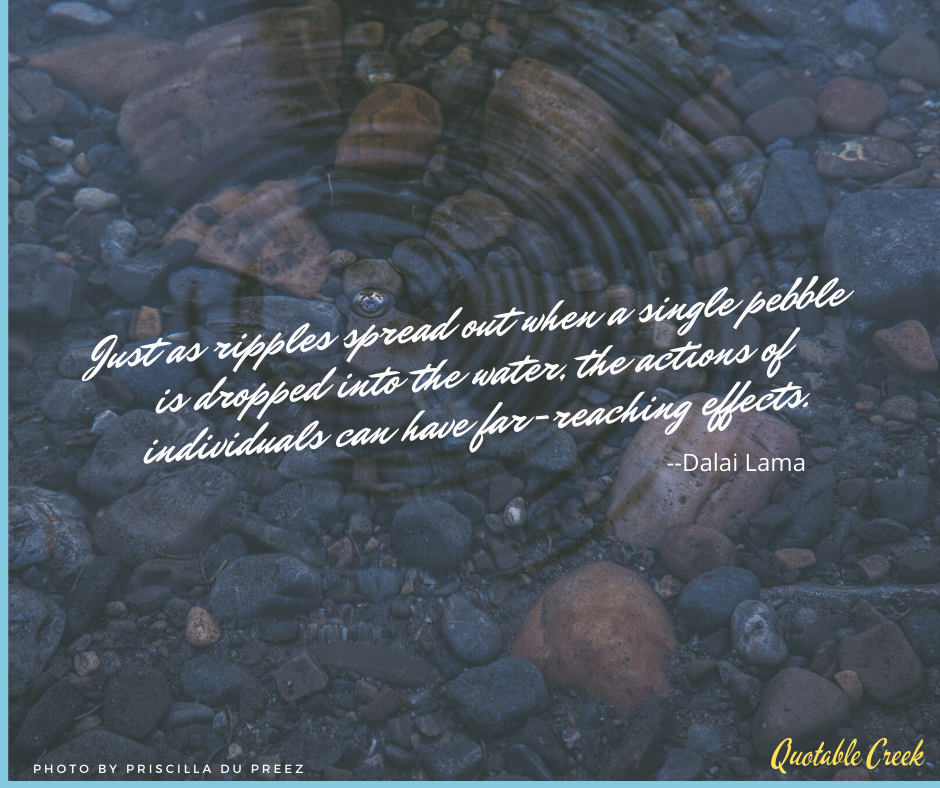
Just as ripples spread out when a single pebble is dropped into the water, the actions of individuals can have far-reaching effects.

We never quite know where the ripples of our behavior start and stop. What did we see or hear about that inspired us to make that kind gesture, or, conversely, what made us lose our temper? If we really analyze it deeply, it’s never just one thing. We are influenced by all the stimuli around us.

Our actions, good and bad, ripple out and touch others, usually in ways we will never see or know. Check out this video below, and think about what ripples you want to put out into the universe today.

We’re hitched.

hitched

Where do you stop?

Is it at your skin, that organ holding all your pieces all together? If it’s there, at your skin, how do your words fly out into the air and touch, maybe even wound, someone else? Does your you stop when your physical self passes away? If so, how do memories of you inspire your grandchildren to smile long after your death?

When did you start? Was is at your birth? If so, how do you carry the genetic material of all your ancestors that have come before? How are you influenced by events that occurred long before you were born?

Is your you sufficient and complete in itself? Or does your you depend on many others, both human and not human? The plants and trees for oxygen? Other people for companionship? The air, the moon, the stars, the sun, plants, animals, gravity……a giant web of life, really?

It is hard to isolate our actions. Instead they ripple out into the world around us, resulting in things sometimes seen but more often unseen.  In this delightful video, we see an orangutan preschool, a learning community. But, at the heart of the delight in these darling animals is a cold truth: they were orphaned, probably by people that walked and talked like we do. Instead of spending the first seven or eight years of life with their mothers, they are spending it with people trying to teach them how to be orangutans.

When we put out our ripples into this world, let our words be gentle and kind and our touch soft. Let us keep in mind that we are not separate from each other and nature, but that we all share this place we call home. We are all hitched.

Consider the birds.

silence

Consider the birds. They have so much to teach us. They sing; they fly; they soar. When the storm is over, they come out and sing, fly, and soar again. They vary dramatically from the tiny hummingbird to the great bald eagle, but they have so much in common. And, when we are quiet, they remind us to look up, to look to the future and the possibility that lies there. It turns out considering the birds is good for our well-being, keeping depression at bay.

Be still and notice the birds. Do you see the vulture with its huge wings soaring above you? Do you hear the hawk shriek?  Do you see the crows tuck in their wings and dive to open them again and rise only after you gasp, worried?

Watch the little sparrows bathe in a puddle, delighting in the way the water splashes around them. Listen to them sing.

They sing for you.