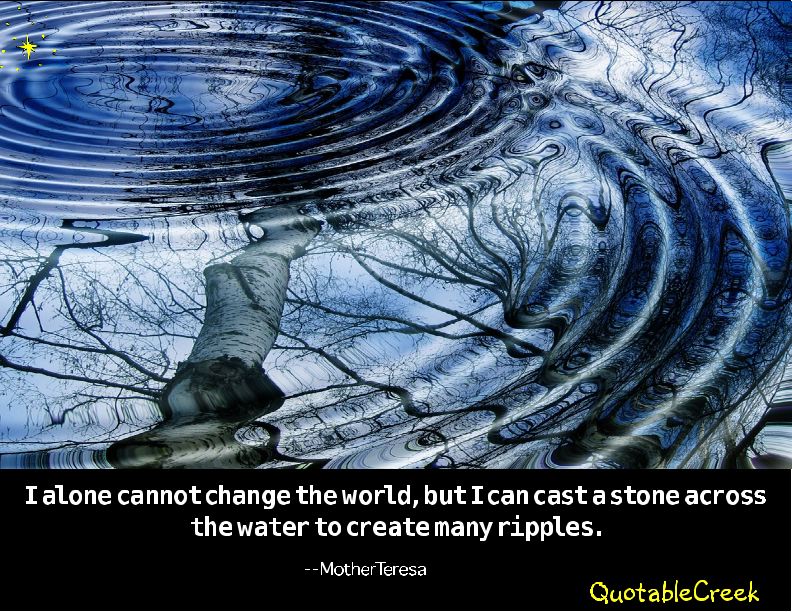
Make a ripple.

mtripples

In “Sound of Thunder“, Ray Bradbury introduced the idea that one tiny butterfly could have a far-reaching ripple effect on later historical events:

In the year 2055, time travel has become a practical reality, and the company Time Safari Inc. offers wealthy adventurers the chance to travel back in time to hunt extinct species such as dinosaurs. A hunter named Eckels pays $10,000 to join a hunting party that will travel back 65 million years to the Late Cretaceous period, on a guided safari to kill a Tyrannosaurus rex. As the party waits to depart, they discuss the recent presidential elections in which an apparently fascist candidate, Deutscher, has been defeated by the more moderate Keith, to the relief of many concerned. When the party arrives in the past, Travis (the hunting guide) and Lesperance (Travis’s assistant) warn Eckels and the two other hunters, Billings and Kramer, about the necessity of minimizing the events they change before they go back, since tiny alterations to the distant past could snowball into catastrophic changes in history. Travis explains that the hunters are obliged to stay on a levitating path to avoid disrupting the environment, that any deviation will be punished with hefty fines, and that prior to the hunt, Time Safari scouts had been sent back to select and tag their prey, which would have died within minutes anyway, and whose death has been calculated to have minimal effect on the future.

Although Eckels is initially excited about the hunt, when the monstrous Tyrannosaur approaches, he loses his nerve. Travis tells him he cannot leave, but Eckels panics, steps off the path and runs into the forest. Eckels hears shots, and on his return he sees that the two guides have killed the dinosaur, and shortly afterward the falling tree that would have killed the T. rex has landed on top of it. Realizing that Eckels has fallen off the path, Travis threatens to leave him in the past unless he removes the bullets from the dinosaur’s body, as they cannot be left behind. Eckels obeys, but Travis remains furious, threatening on the return trip to shoot him.

Upon returning to 2055, Eckels notices subtle changes – English words are now spelled and spoken strangely, people behave differently, and Eckels discovers that Deutscher has won the election instead of Keith. Looking at the mud on his boots, Eckels finds a crushed butterfly, whose death has apparently set in motion a series of subtle changes that have affected the nature of the alternative present to which the safari has returned. He frantically pleads with Travis to take him back into the past to undo the damage, but Travis had previously explained that the time machine cannot return to any point in time that it has already visited (so as to prevent any paradoxes). Travis raises his gun, and there is “a sound of thunder”.

Bradbury’s genius in considering how small seemingly insignificant changes can alter the future has, of course, become a standard sci-fi plot device. But how about applying the principle to the present. What can we do now to ensure a better future for us all? We can’t possibly know the effect of the small acts of kindness we do each day. But we do know that one kind act leads to another, ever onward, each person touched by kindness more likely to pass it on, creating an entire chain, then web, outward, expanding farther and farther as it goes. That ever-expanding ripple of kindness can perhaps circle the world if we could only track it.

In this heart-warming, and tear-jerking (in a good way) video, one man discovers just how powerful a little gesture of kindness can be.

What can you do today to start ripples everywhere you go?

SaveSave

Create light.

weisellight

Hurricane Harvey has been devastating, and the images showing those hardest hit have been heart-wrenching and dark. But sometimes, in those images, we glimpse the light. Consider this video of a man stopping to play his piano even as the water has nearly reached his piano bench. He brings a bit of beauty, peace, and light to a ravaged reality.

This video calls to mind the orchestra members on the Titanic who, forced with the certainty of imminent death, chose to play until the end so the music would bring comfort and peace to those also remaining on the ship as well as those struggling to reach the life boats:

Many brave things were done that night, but none were more brave than those done by men playing minute after minute as the ship settled quietly lower and lower in the sea. The music they played served alike as their own immortal requiem and their right to be recalled on the scrolls of undying fame.

Or perhaps it recalls the story of Vedran Smailovic who played his cello, in full dress attire, even as Sarajevo was being bombed around him:

As the 155-millimeter howitzer shells whistled down on this crumbling city today, exploding thunderously into buildings all around, a disheveled, stubble-bearded man in formal evening attire unfolded a plastic chair in the middle of Vase Miskina Street. He lifted his cello from its case and began playing Albinoni’s Adagio.

Smailovic did not consider himself a hero: “I am nothing special, I am a musician, I am part of the town. Like everyone else, I do what I can.”

But a hero he was. Adding light and beauty into a dark and dire situation is heroic. It’s counter-culture. It’s inspiring. And it makes the world a brighter place.

How can you create light in your circumstances today?


SaveSaveSaveSaveSaveSave

SaveSaveSaveSave

Give yourself a break.

yourself

If one of your friends were struggling with the problems you are facing right now, what words would you offer in support? Would you call them names, berate them, remind them of all the other times they messed up just like this and how, honestly, can they ever expect to get anything right, ever?

Probably not. Right? But often this is the way we talk to ourselves. We replay all our other mistakes in our minds, call ourselves stupid, sink into our shells scared to face the world.

But why do we do this? If the words we would offer our friend are what we think would help, why are we so reticent to speak kind encouraging words to ourselves? Maybe today is a good day to try a different approach.

Be a kind friend to yourself. Offer yourself words of support and encouragement. Focus on all the many times you got things right. Tell yourself the truth: you are precious and beloved.


SaveSave

SaveSave

And yet it remains.


hiddenClouds, night, and eclipses can hide the sun, and yet it remains. Lies, denial, and ignorance can obscure the truth, and yet it remains. We are foolish to believe that things change because we lie about them.

The truth will out.

It always does.

August high.

August

August marks the end of summer and the beginning of another school year. It is as good a time as any to ask yourself–

Where are you going?

Are you progressing?

What vision do you have for the months to come?

Months turn into years turn into decades turn into a lifetime. Pausing periodically to make sure you’re on the right path is always a good idea.

Opening to gratitude.

joyroot

What can take us out of our gloom and melancholy? Sometimes the veil is pulled back and we can glimpse a larger picture, a connection between all things, an appreciation for the here and now, and we are grateful.

Brother David Steindl-Rast explains how these jolts into a different reality can change a day, and, perhaps, even a world:

My vision of the world? My hope for the future? This topic sounds a bit big. Allow me to start small—say, with crows. They are my special friends. Just as I am writing these lines, one of them, the shy one among my three regular guests, is gobbling up the Kitty Fritters I put out for them. This brings to mind a short poem by Robert Frost that might provide a stepping-stone for our deliberations about world-vision and hope for the future—if any.

The way a crow
Shook down on me
The dust of snow
From a hemlock tree
Has given my heart
A change of mood
And saved some part
Of a day I had rued.

Surely you will remember a similar experience of your own: some quirky little incident made you smile, changed your mood, and suddenly the world looked brighter. If this ever happened to you, the key for understanding a causal chain of great consequence is in your hand:  any change in attitude changes the way one sees the world, and this in turn changes the way one acts. When Robert Frost claims that the crow’s little trick “saved” part of a day he had rued, or of which he repented, he means this in the full sense of a redeeming change of heart. When he got home, I’m sure he greeted Mrs. Frost in a better mood than he would have been able to do without the crow’s nudge. And there is no telling what this did to her—and to the way she treated the dog afterwards, or talked more kindly to her neighbor.

He continues to suggest five small, easily adopted ways to bring this gratitude into your life and, consequently, into the world:

1.  Say one word today that will give a fearful person courage.

All gratitude expresses trust. Suspicion will not even recognize a gift as gift: who can prove that it isn’t a lure, a bribe, a trap? Gratefulness has the courage to trust and so overcomes fear. The very air has been electrified by fearfulness these days, a fearfulness fostered and manipulated by politicians and the media. There lies our greatest danger: fear perpetuates violence. Mobilize the courage of your heart. Say one word today that will give a fearful person courage.

2. Make a firm resolution never to repeat stories and rumors that spread fear.

Because gratitude expresses courage, it spreads calm. Calm of this kind is quite compatible with deep emotions. In fact, mass hysteria fostered by the media betrays a morbid curiosity rather than deep feeling—superficial agitation rather than a deep current of compassion. The truly compassionate ones are calm and strong. Make a firm resolution never to repeat stories and rumors that spread fear. From the stillness of your heart’s core reach out. Be calm and spread calm.

3. Make contact with people whom you normally ignore

When you are grateful, your heart is open—open towards others, open for surprise. When disasters hit we often see remarkable examples of this openness: strangers helping strangers sometimes in heroic ways. Others turn away, isolate themselves, dare even less than at other times to look at each other. Violence begins with isolation. Break this pattern. Make contact with people whom you normally ignore—eye-contact at least—with the cashier at the supermarket, someone on the elevator, a beggar. Look a stranger in the eyes today and realize that there are no strangers.

4. Give someone an unexpected smile today

You can feel either grateful or alienated, but never both at the same time. Gratefulness drives out alienation; there is not room for both in the same heart. When you are grateful you know that you belong to a network of give-and-take and you say “yes” to that belonging. This “yes” is the essence of love. You need no words to express it; a smile will do to put your “yes” into action. Don’t let it matter to you whether or not the other one smiles back. Give someone an unexpected smile today and so contribute your share to peace on earth.

5.  Listen to the news today and put at least one item to the test of Common Sense.

What your gratefulness does for yourself is as important as what it does for others. Gratefulness boosts your sense of belonging; your sense of belonging in turn boosts your Common Sense—not the conventional mind set which we often confuse with it. The common sense that springs from gratefulness is incompatible with a set mind. It is just another name for thinking wedded to cosmic intelligence. Your “yes” to belonging attunes you to the common concerns shared by all human beings—all beings for that matter. In a world we hold in common, nothing else makes sense but Common Sense. We have only one enemy: Our common enemy is violence. Common Sense tells us: we can stop violence only by stopping to act violently; war is no way to peace. Listen to the news today and put at least one item to the test of Common Sense.

The five steps I am suggesting here are small, but they work. It helps that they are small: anyone can take them. Imagine a country whose citizens—maybe even its leaders—are brave, calm, and open towards each other; a country whose people realize that all human beings belong together as one family and must act accordingly; a country guided by Common Sense. To the extent to which we show ourselves not hateful but grateful this becomes reality.

Who would have thought that a prankish crow shaking down snow from a hemlock tree could inspire this vision of a sane world? Well, if we leave it to the crows, there is still hope.

Small steps; big pay-off. And, to remember, keep your eyes open for the birds. They are there, singing songs of hope.
 

What do you have to lose?

entitlement

What do you feel entitled to? Your life, job, spouse, happiness, health, good weather? It’s remarkable how we can feel that we have earned our stations in life and are entitled to all the good things.

Until something happens to take it away.

A diagnosis, job loss, natural disaster, and then we realize we weren’t entitled to any of it after all. It was a gift, and we hadn’t been grateful.

Think of all you have been blessed with and be grateful.

Finding home.

lights

Are you broken? Lost?

Lights will guide you home.

Consider the story of The Tenth Goose told by Richard R. Powell in his book Wabi Sabi for Writers:

Nine Canada geese lift off a clear mountain lake; droplets from their wings cast lines of rings behind them on the glassy surface as they rise. Light gray feathers reflect amber light from the early morning sun, a clean glow off each curved body. You watch their broad wings grip air, watch nine bodies rise and fall in rhythm against the dark forest behind them. Each bird’s neck kinks in counter-time to its wing beats so that all nine heads remain level and each set of eyes gazes steadily out at the cool dawn, bright mystery of sight amid the shiny black head feathers. Closer now, you make out the expressionless curve of their beaks, see one goose’s thin moist tongue as she honks; hear the whistle of air across wing feathers as they pass over your head. Then you notice that there is a tenth goose far back, low to the water, working hard to catch up, honking softly, as if each wing beat hurts. This goose loses a feather as she passes close over you and you watch the feather spiral and glide to the ground. You pick it up and it looks perfect, each barbule lying neatly against its neighbor, the tiny whorl of fluff near the calamus soft to the touch. Then you see that the shaft is not perfect; it is cracked open from the middle to the tip.

You keep that feather, tuck it under the strap around your car’s sun visor, look at it every day you drive to work and remember the tenth goose. Remember your own efforts to keep up. And somehow, that tenth goose gives you courage. You wonder if she will find enough food or if winter will separate her from the rest, separate her from life. She speaks to you in a dream one night. In the distracted moments of the day she speaks to you, in the elevator or while you wait in traffic. Then one night she is there in your dream again, as silent as her feather in your car. She tips her head at you and that beak, with its lumpy prominence like a Roman nose, bobs up and down and you realize she is giving you permission to speak. In the dream you speak and she turns her head to hear you and you tell her your fear of dying and your hopes while living and she comes and rattles her beak between your fingers.

There is beauty and strength in the broken places, a beauty that continues on even when everything is a struggle, that faces setbacks with determination. Sometimes we are one of the nine geese, sure and strong, in sync, but sometimes we are the tenth goose struggling to keep up. And there is beauty in that, too:

It is a kind of beauty on the edge of defeat, a beauty tenacious and brave, and it is the beauty left behind when the warm, honking goose is gone. And not just flown away–but dead and gone. That feather remains as a testament to the beauty in living; and even when the feather dries and cracks and is eventually eaten by insects or the drab extension of time, it will live on in the imaginations of those who hear the story of the tenth goose.

Remember the Story of the Tenth Goose and take heart.

And, for a treat, here is Coldplay.


Why hold back?

afternoon

Does anything keep you from plunging into life? Whether you savor it, delight in it, enjoy it, or not, time will keep moving. You will get older; opportunities will pass. Perhaps it is time to say: I will savor this day; I will delight in these people; I will enjoy my time here while I can.

Embrace each other and fly.

onewing

We need each other–our friends, our families, our communities. We would be lost alone. Consider this remarkable video of a seal who turned to a group of boaters for help when it was in dire need. (Be prepared–it’s intense!)

Sometimes we’re the seal; sometimes we’re the people in the boat providing safe harbor. With each other, we are capable of so much more than any of us is alone.